
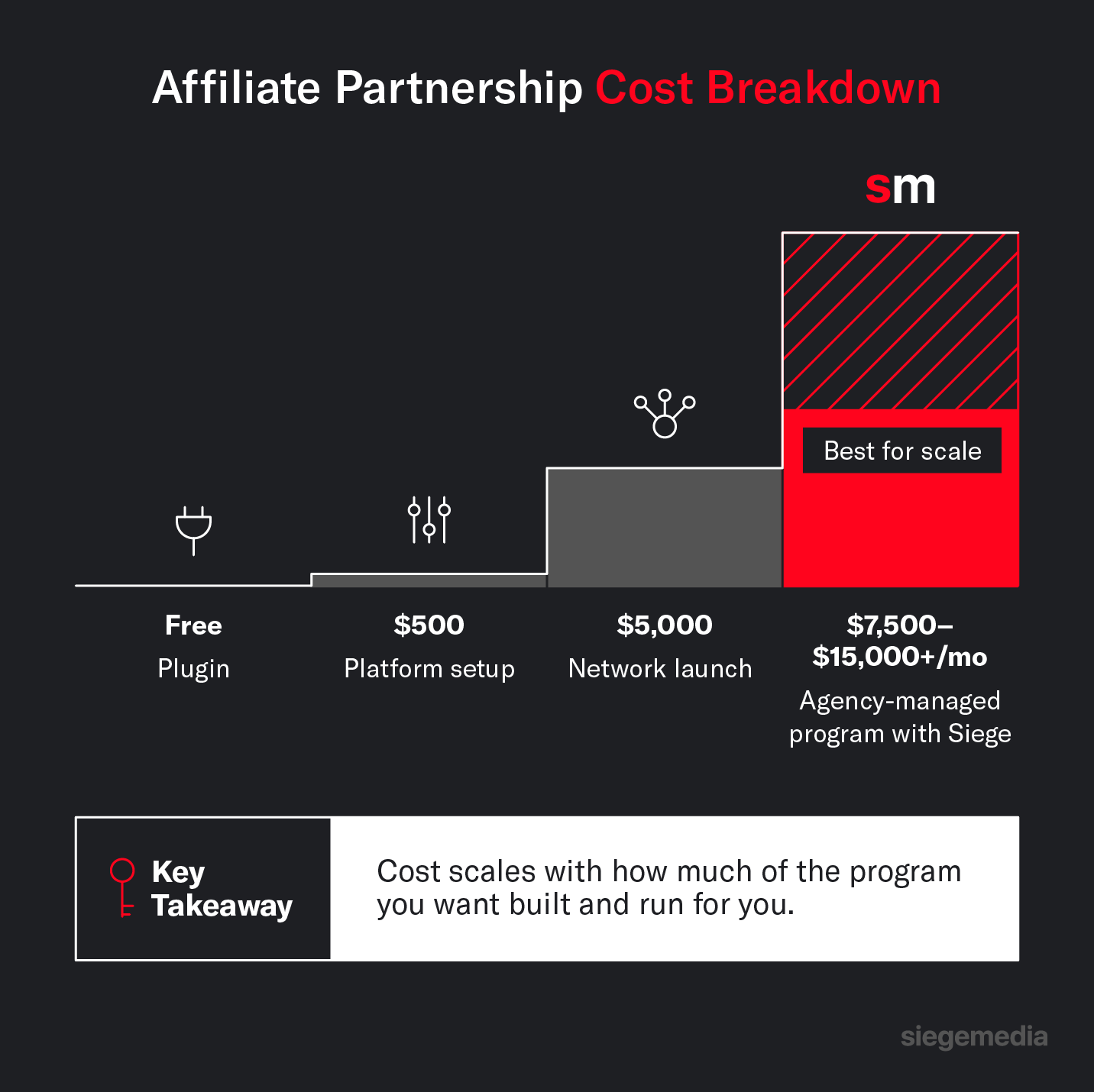
Affiliate marketing costs start free with a plugin and commissions only. A full network launch runs about $5,000. Add management, seeding, and placement, and the investment scales with it.
A do-it-yourself affiliate program can start on a shopping cart plugin with no software fee, just commission payouts. Build it on a dedicated platform like Everflow, or launch on a network like impact.com, and set up alone runs $500 to $5,000. That’s before a single dollar goes toward management or the seeding and placement work that follows.
Recruiting partners and negotiating placements is where a DIY program earns its keep. You can run this in-house, or bring in a freelancer or contractor to handle outreach on your behalf. Either way, you’re paying for the work itself, hours spent finding the right partners and getting them onboard.
What you’re not getting is a strategy built around your specific goals, or a team that’s already run this playbook for other brands.
That’s the difference an agency brings. According to Nicholas Podrasky, Siege Media’s Director of Affiliate Partnerships, clients typically come to Siege once they’ve outgrown ad hoc outreach and want a program built around the right partners and tied back to revenue, not just more outreach volume.
Siege’s affiliate and partnership engagements, including publisher budgets, typically start around $7,500 to $15,000 per month, depending on program scope, existing infrastructure, vertical competitiveness, and creative requirements. Most programs pay for themselves within 90 to 120 days on direct attributable revenue alone.
Below, we’ll break down the variables that drive affiliate partnership costs to help you determine how you want to approach your own program.
- Affiliate Platform Costs
- Management Costs
- Commission and Payout Costs
- Seeding Costs
- Placement and Creative Fees
- What To Invest in Your Affiliate Program
- Cost Comes Down to Fit
- Frequently Asked Questions
Affiliate Platform Costs
Technology cost is the widest range in the whole budget. It spans a free plugin on one end and a fully managed network on the other.
Free and Low-Cost Plugin Options
A native shopping cart plugin costs nothing beyond the commissions or discounts you pay affiliates. Options built into platforms like Shopify handle the basics: tracking a link, crediting a sale, and paying out a commission. This tier works fine for a small program with a handful of partners you can manage yourself.
Brands that need automation and fraud protection may want to explore the next tier up, once the program grows past a handful of active affiliates.
Mid-Tier Platforms
With a dedicated platform, like PartnerStack or Everflow, you get access to more infrastructure in exchange for a licensing fee. Everflow can start around $500.
That fee typically covers tracking, automated payouts, and an affiliate portal, the pieces a plugin can’t handle once you outgrow manual tracking. Brands land here once they need real automation but aren’t ready for full network reach.
Affiliate Networks
Affiliate networks like CJ, Impact, and Awin work differently. Expect a setup fee, a monthly fee, and a network override on top of whatever you pay affiliates in commissions. Impact can also start at around $500, but most clients are ready for a full network launch and should budget closer to $5,000 to go live.
Management Costs
Someone has to run the program day-to-day, and who that person is shapes your budget. Managing the affiliate partnership program yourself costs time, not cash, at least early on. An outsourced program manager shifts that cost onto a monthly retainer, typically $1,500 to $5,000 for freelance or outsourced management.
Agency management brings strategy and execution together under one team. Siege’s affiliate partnership marketing pairs program strategy with the content and design resources already built for client work, so recruiting, creative, and reporting run through the people who do this daily rather than as add-on tasks.
Depending on the program’s scope, these services typically start at $7,500 to $15,000 per month.
Commission and Payout Costs
You can pay affiliates in a few different ways. Some programs pay per registration, some pay per lead, and some only pay when a sale actually happens. Which one you choose changes how much you pay and when.
The type of product you sell also changes the math.
- Digital products, like online courses or software, usually land in the 20% to 50% commission range because there’s nothing to manufacture or ship.
- Physical products tend to run lower, typically 5% to 15%, since production and shipping costs eat into profit first.
- Subscriptions work differently again. Sometimes you pay a bigger commission once, when the customer first signs up. Sometimes you pay a smaller commission every month, for as long as that customer keeps paying you.
The commission percentage isn’t actually what affiliates care about most, though. They focus on earnings per click (EPC), which is how much money they actually make every time someone clicks their link. A big percentage of a cheap product can still pay an affiliate very little. A smaller percentage on an expensive product often pays them more.
When you’re setting your commission rates, think about the real dollar amount an affiliate walks away with, not just the percentage you’re advertising.
Seeding Costs
Getting your product into the hands of influencers and experts costs money. Free samples for reviews and hands-on testing add up fast once you’re seeding to more than a handful of partners, and it’s a cost that’s easy to underbudget because it doesn’t show up in a platform fee or a commission line item.
This cost applies almost entirely to product-based brands. If you sell a SaaS product or a service, there’s nothing physical to seed, so this line item drops out of your budget, and your spend shifts toward the placement and creative costs covered next.
Placement and Creative Fees
Influencers rarely work for commissions alone anymore. Most require an upfront creative fee to develop the content itself, on top of a performance bonus tied to tracked conversions.
Trade publications are increasingly following the same model. Referral traffic from traditional search engines has dropped 60% for small publishers, 47% for medium-sized publishers, and 22% for large publishers over the past two years, and AI Overviews are adding to that decline.
Some publishers are compensating by requesting fixed placement fees to offset the traffic they’re losing to AI-generated answers.
This is where Siege’s model differs. Siege’s flat monthly retainer, including publisher budgets, covers creative and placement costs as part of the engagement, rather than charging per placement or taking a cut of your commissions.
What To Invest in Your Affiliate Program
Spend what generates a positive return against your expected affiliate-driven revenue. That’s the right amount, not a flat dollar figure.
Overall Investment
Benchmark your investment against that revenue before committing to a network fee or a management retainer. A $5,000 network launch is easy to justify against $50,000 a year in affiliate-driven sales. Against $8,000 a year, the math doesn’t work yet, and a lighter setup makes more sense until the program proves itself.
Ongoing Management
The same logic applies to management. Self-managing costs time, not cash, and that’s the right trade while you’re still learning what moves your program.
Once affiliate-driven revenue reaches a level where a dedicated manager’s time pays for itself in new placements and partnerships, that’s the signal to bring in help, whether that’s a freelancer, an OPM, or an agency.
Cost Comes Down to Fit
The cost of an affiliate partnership depends on five decisions: platform, management, commissions, seeding, and placement. A brand testing the waters can start for free, while a brand ready to compete needs real budget behind it.
Every program looks different once you factor in your own revenue goals. Siege’s affiliate partnership marketing team builds plans around what your business can realistically return, not a generic estimate.
Frequently Asked Questions
What’s the Difference Between Affiliate Marketing and an Affiliate Partnership Program?
Affiliate marketing typically describes a transactional setup. An affiliate places a link, drives a click, and earns a commission with little relationship beyond the payout. An affiliate partnership program goes further. It includes recruiting the right partners, briefing them on your product, and often paying creative fees in addition to commissions.
Do I Need an Affiliate Network to Start a Program?
You don’t need an affiliate network to start a program. A native shopping cart plugin lets you launch with no software fee beyond the commissions you pay out.
Networks like CJ, Impact, and Awin become worth the added cost once you want access to an established pool of affiliates and are ready to budget closer to $5,000 for a full launch. Most brands start smaller and move to a network once the program outgrows manual tracking.
When Should I Hire Someone to Manage My Affiliate Program?
Managing the program yourself works well early on, since the cost is your time rather than cash. Bring in dedicated help, a freelancer, an outsourced program manager, or an agency, once affiliate-driven revenue reaches a level where that person’s time pays for itself in new placements and partnerships.
Below that point, self-management is still the better use of your budget.