52.5% of the domains LLMs cite most on transactional queries are affiliate or sponsorship sites. If your commission strategy is not built for that reality, you are leaving visibility on the table.
Most affiliate managers don’t realize their programs directly impact brand sentiment in LLM models.
Affiliates and creators are the dominant voices in “best X” content across nearly every commercial category. That content is what LLMs learn from and cite, and brands with weak or underpaying affiliate programs get deprioritized or counter-positioned in it.
Affiliate marketing GEO is already happening. This post covers how it works, the math behind it, and a four-step framework for auditing your affiliate program LLM visibility.
- Where Affiliate Sites Fit in LLM Results
- Commission Rate Affects Placement
- The LLM Value of an Affiliate Listing
- Your Affiliates Define You to LLMs
- Choose the Platform That Fits Your Program
- The Affiliate GEO Audit
- Make Your Affiliate Program Work for AI
1. Affiliate Are Where LLMs Go to School
When someone asks a large langauge model (LLM) like ChatGPT for the best CRM or the top travel credit cards, the answer is synthesized directly from the web’s highest-authority sources.
In an analysis of 1,000 transactional prompts, 52.5% of the top 40 most-sourced domains were affiliate or sponsorship-focused sites.
These are the pages with the most links, traffic, and topical authority in competitive commercial categories.
LLMs reflect the web’s consensus, and that consensus is largely affiliate-driven. How well your affiliate program performs directly determines how prominently your brand appears in AI results, especially in regard to buying decisions across the funnel.
“The sites that dominate affiliate results are the same ones LLMs pull from today. If you are not investing in those publisher relationships, you are losing the citations that shape what AI says about your brand to every future buyer.”
— Nicholas Podrasky, Director, Affiliate Partnerships
2. Commission Rate Affects Placement
Every publisher in your affiliate program asks the same question: how much revenue will this brand generate for me? Their formula probably looks like this:
Price Paid Per Lead x Conversion Rate = Total Revenue
Four variables drive that equation. Most brands only compete on one.
- Commission rate: When two comparable products diverge significantly on commission, the math wins. A higher rate tips the equation in your favor, but it is not the only lever.
- Conversion rate: Amazon pays relatively low commissions but converts so well that publishers prioritize it anyway. A weak conversion rate will undermine even a generous program.
- Landing page quality: Higher commissions cannot fully compensate for a weak page. If a competitor converts twice as many customers at half the cost, you cannot outspend that gap.
- Cookie window: A 24-hour cookie versus a 30-day cookie changes how aggressively a creator promotes a brand in longer-form content, which is exactly the content LLMs are most likely to cite.
Brands with low or complicated programs do not just lose direct referral traffic. They lose placement in the exact content LLMs learn from and cite. That is a different and larger problem.
“Most brands treat commission rate as a margin lever without realizing it is also a visibility lever. When you cut commissions, you lose placement in the roundups and review sites LLMs pull from on every transactional query. That cost does not show up in your affiliate dashboard. It shows up six months later when your brand is not in the AI answer.”
— Nicholas Podrasky, Director, Affiliate Partnerships
3. The LLM Value of an Affiliate Listing
Most affiliate teams model the direct value of a listing. Factoring in LLM’ indirect value gives a fuller picture of what it is actually worth, and that number often changes decisions.
The full equation looks like:
(Sponsorship Direct Value + LLM Indirect Value) – Sponsorship Cost = Net Monthly Value
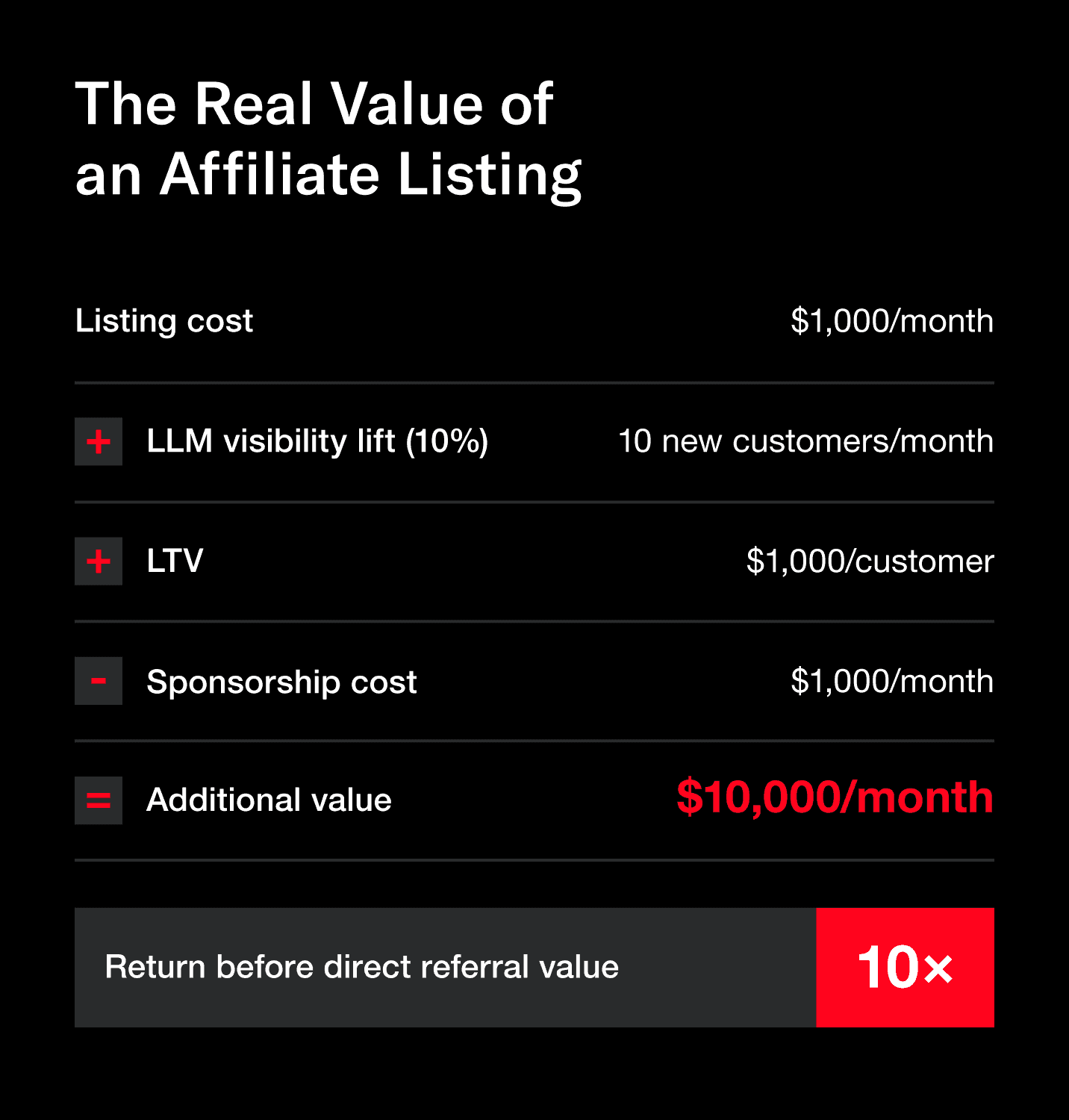
Listings that look break-even on direct traffic often flip to strongly positive when LLM attribution is included. If the LLM influence of a given URL is high, paying more per lead to rank higher, or to be listed at all, is a rational investment.
Affiliate teams need this framing to make that case internally. And the math only works if the page the traffic lands on is optimized for conversion. That is where product page mapping comes in. It aligns each page to a specific audience and use case, so affiliate traffic converts.
“When you run source URL analysis on a client’s top transactional prompts, the affiliate gaps become obvious fast. The conversation with the affiliate team changes when you can show them exactly which publisher URLs are driving LLM citations in their category and where they are missing. It stops being a marketing discussion and starts being a revenue one.”
— Nicholas Podrasky, Director, Affiliate Partnerships
4. Your Affiliates Define You to LLMs
Every affiliate listing describes your brand. The aggregation of those descriptions is how LLMs understand what you are, what you are best for, and who you compete with. In the same way Reddit sentiment shapes brand perception in AI results, so does what your affiliate partners say about you.
Third-party sources account for 80-95% of AI citations at the bottom of the funnel, and affiliate content drives a significant share of that.
Two things determine whether that description is working for you or against you.
Outdated Descriptions Create Positioning Drift
Brands that have not audited their affiliate descriptions in 12 to 24 months may be teaching LLMs an outdated version of themselves. A brand can rank first in a roundup and still not reach the right audience if its description misaligns with what users are actually looking for.
Audit what your top affiliate partners are actually saying. Look for:
- Features they highlight
- Use cases they lead with
- Competitors they place you next to
- Whether their description matches your current positioning
Where descriptions are outdated or inconsistent, work with publishers to update them. Shrinking engagement rates from affiliate partners are often an early signal that this gap exists.
“Best For” Framing Compounds in LLM Outputs
“Best for X” language in affiliate roundups carries more weight than most brands realize. LLMs use it to build co-citations, meaning the more consistently your partners describe you as “best for” a specific use case, the stronger that signal becomes in model outputs.
The inverse is equally true. Inconsistent descriptions across partners means your brand may rank for nothing specifically in LLM brand visibility results.
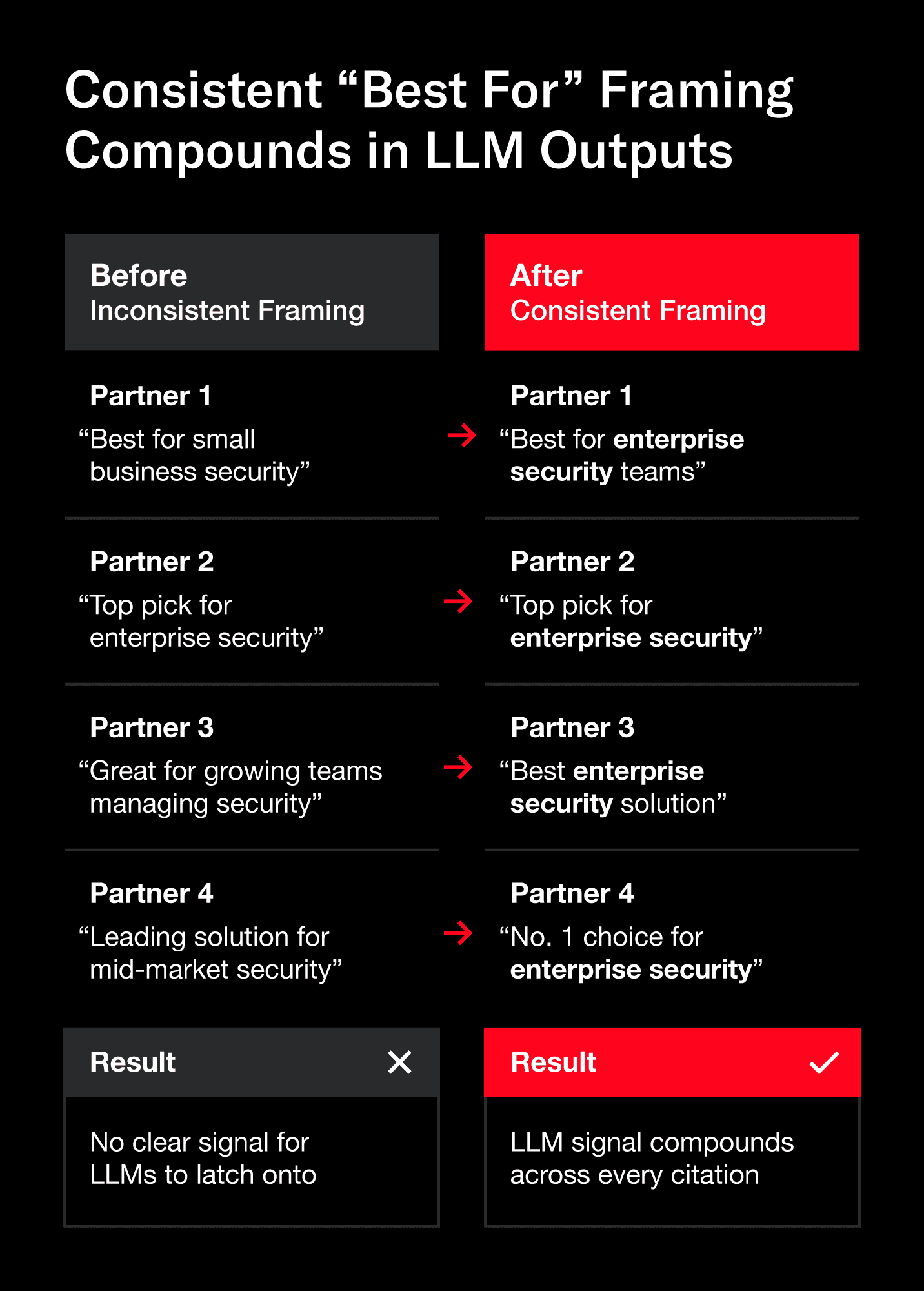
Decide what you want to be known for and make sure every affiliate partner is saying the same thing.
“When deciding how to position your brand across affiliate partners, consistency matters more than creativity. Pick the use case you want to own, make sure your top publishers are using the same language, and audit it at least once a year. LLMs are forming opinions about your brand from those descriptions whether you are managing them or not.”
— Nicholas Podrasky, Director, Affiliate Partnerships
5. Choose the Platform That Fits Your Program
The affiliate platform you are on determines how easily you can recruit, manage, and track the publishers that drive LLM citations. Large authoritative publishers show up across nearly every vertical, whether fintech, B2B SaaS, or DTC e-commerce. The platform that gives you the best access to those relationships is the right one for your program.
Before choosing or switching platforms, identify which affiliate domains are showing up as LLM sources in your category and whether your current platform makes it easy to work with them.
| Platform | Publisher Type | Attribution Window | GEO Audit Capability | Recommended For | Industry Fit |
|---|---|---|---|---|---|
| Impact | Creators, niche publishers | 7–180 days (flexible) | High | Brands that want granular publisher-level LLM source data | Healthcare, wellness, DTC |
| CJ Affiliate | Major media, editorial publishers | 7–30 days | High | Brands in categories where editorial affiliates dominate LLM citations | Fintech, insurance, travel |
| PartnerStack | Software review sites | 90 days | Medium | B2B SaaS brands in dense LLM comparison categories | B2B SaaS, tech |
| ShareASale | Niche bloggers | 30 days | Low | Emerging or DTC brands building their first affiliate ecosystem | DTC, e-commerce |
Not every brand needs to switch platforms. But every brand should know whether their current platform gives them the tools to manage the publisher relationships that matter for LLM visibility.
6. The Affiliate GEO Audit
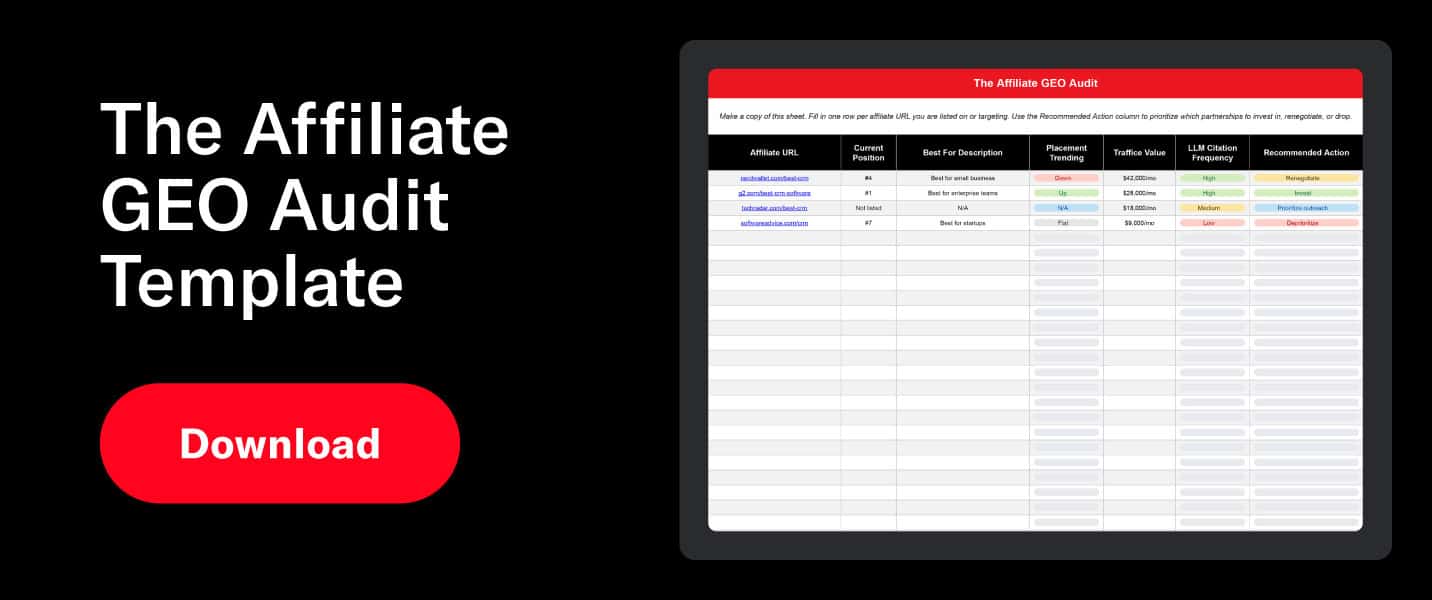
Most affiliate programs are optimized for last-click conversions. These four steps are designed for affiliate program optimization for AI, diagnosing and improving your affiliate program’s LLM visibility impact, something most affiliate teams are not yet measuring.
Step 1: Map Your Affiliate Source URLs
Run your top 20-30 transactional prompts in ChatGPT, Gemini, and Perplexity. The goal is to identify which affiliate domains LLMs are already pulling from in your category.
These are the URLs that have the most influence over your brand’s AI visibility, whether you are listed on them or not.
Cross-reference those domains against your current partner list and ask:
- Which high-influence URLs are you already on?
- Where are you listed but ranking poorly?
- Which URLs are you missing entirely?
Improve with AI: Use the Ahrefs MCP to pull the top-ranking pages for your highest-priority transactional queries and build your source URL list faster than running prompts manually.
Step 2: Audit Your Placement Quality
For each source URL you are listed on, identify:
- Your current position in the roundup
- Your “best for” description and whether it matches your current positioning
- Whether your placement has been trending up or down over the past 12 months
Then pull your top three competitors’ affiliate pages and compare them against your own. Look for:
- Offer clarity
- Social proof
- Whether program details are easy to find
A weak landing page costs you publisher prioritization regardless of how competitive your commission rate is.
Improve with AI: Use a Claude skill to open each affiliate URL and log your placement position and “best for” description automatically across your top partner sites.
Step 3: Model the Full Value of Each Listing
For each affiliate URL you are listed on or targeting, pull two numbers:
- Traffic value of the listing page using Ahrefs
- LLM citation frequency for your top transactional prompts
Together, they tell you how much pipeline a listing could realistically drive. A listing that looks break-even on direct traffic alone may be strongly positive when LLM attribution is included.
Use this to prioritize which partnerships to invest in, pay up for, or renegotiate.
Improve with AI: Use the Ahrefs MCP to automate traffic value pulls across your full affiliate partner list, so you can prioritize at scale rather than one URL at a time.
Step 4: Brief Your Affiliate Team
Most affiliate teams are not thinking about LLM visibility yet. The opportunity is to bring them in early with data they can act on and a story they can take to stakeholders.
Bring them:
- Prompt data showing which affiliate URLs are driving LLM citations in your category
- A gap analysis of where you are missing or underplaced
- A dollar figure showing what closing those gaps means in attributable revenue
Pro tip: The traffic value and pipeline numbers from Step 3 are your strongest asset here. They translate the LLM visibility opportunity into a language that finance and leadership already understand.
Make Your Affiliate Program Work for AI
Your affiliate program is already shaping what LLMs say about your brand. The publishers you work with, the commissions you pay, and how consistently they describe you all feed into that signal. Maintaining that voice across your affiliate ecosystem is one of the most direct levers you have on AI search visibility.
Siege Media is a full-service GEO agency that maps which affiliate publishers matter for your category, audits how they describe you, and optimizes your site so the traffic converts. The brands treating affiliate marketing GEO as a strategic input now will be the ones LLMs recommend later. Take the first step today.