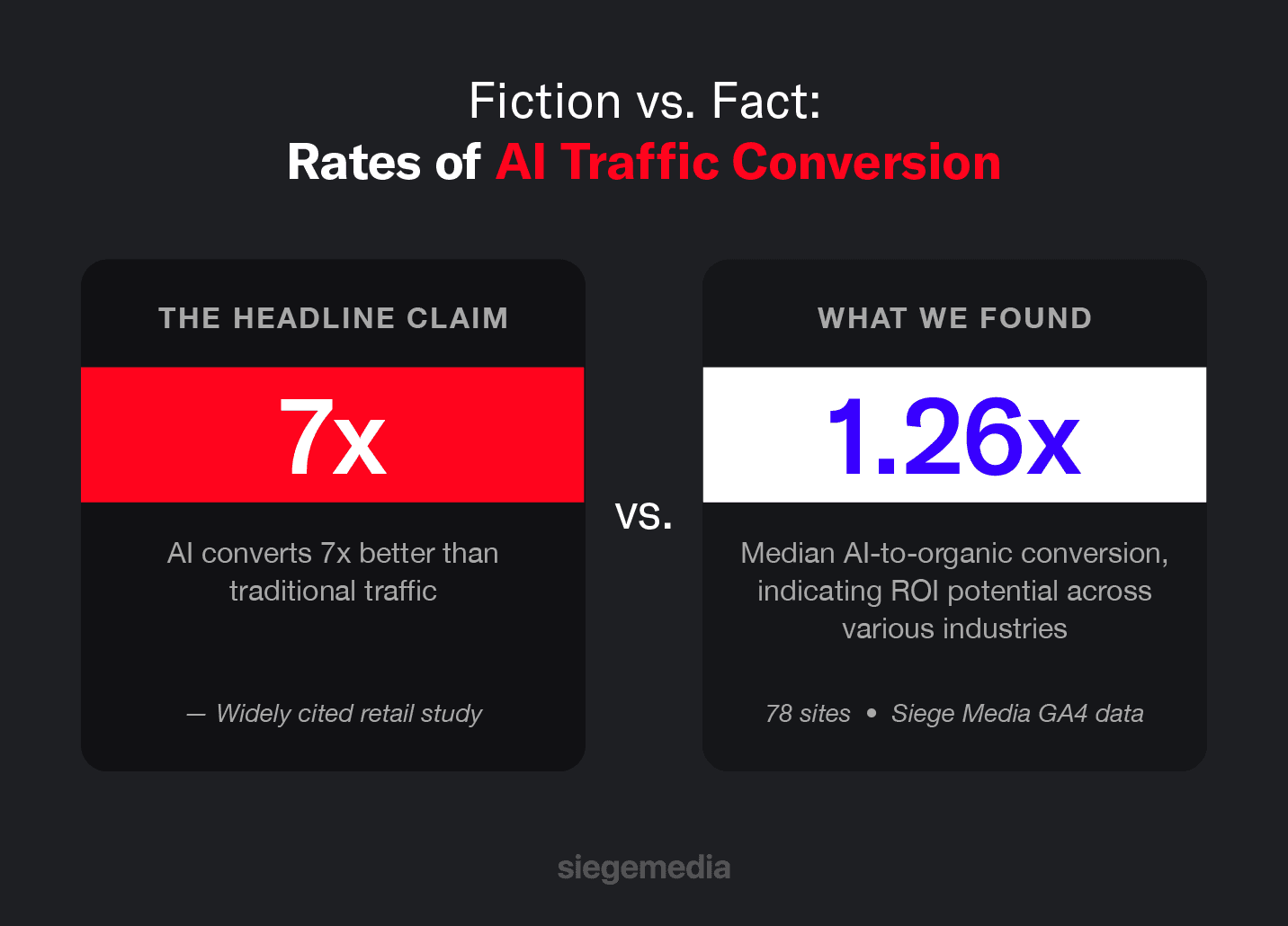
Across 78 sites, we found that AI-referred visitors convert at 1.26x the rate of traditional traffic. And even though the 7x headlines are a myth, the case for GEO is very real, especially in the financial and consumer services industries.
You may have seen Similarweb’s claim that AI traffic converts at 7.1% (second only to paid search), or data from other sites stating that AI improves conversions by some large amount. This is a compelling headline, no matter the name behind the numbers, and it’s showing up in board decks and budget proposals across industries.
However, there’s one problem: Much of this data comes from a narrow slice of high-intent retail sites, inaccurately reflecting what other industries are seeing.
In response, we tested the claims against our first-party AI referral traffic data split across 5 industries. Instead of the 3x-7x rates reported by other studies, we found that AI converts at a median of 1.26x the traditional rate.
Despite this difference, AI traffic is already converting above organic on nearly three-quarters of sites, and that gap will only widen as LLM engagement and AI search grow.
- Key Takeaways
- Top 5 Findings
- Rates by Industry
- The Truth for Your Strategy
- Improve Rates With Siege Media
- Methodology
Key Takeaways
- The median AI-to-organic conversion rate is 1.26x.
- AI matches or beats traditional conversions across 72% of sites.
- AI beats direct traffic across 71% of sites.
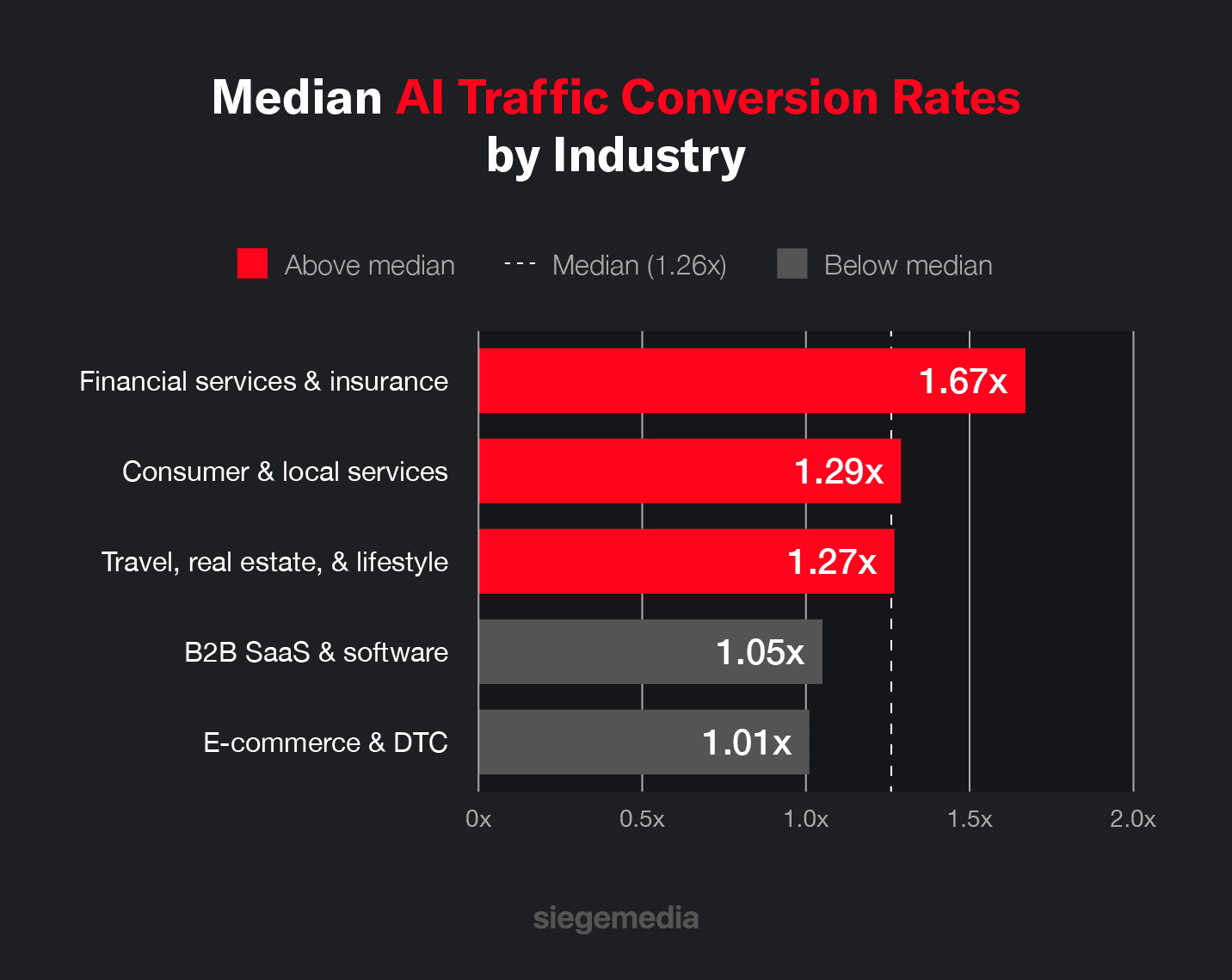
- Rates vary significantly across verticals, with financial services leading at 1.67x and e-commerce closest to parity at 1.01x.
The Top 5 AI Traffic Conversion Rate Findings
We screened 78 websites with AI-referral traffic and usable conversion tracking. Here’s what the data showed.
1. AI Converts Like Organic, Not 7x Better
High-converting headlines spread because they’re compelling, but a broader cross-section of the web shows a lower median AI-to-organic conversion ratio of 1.26x. Despite this lower rate, outperforming organic (often the most proven acquisition channel) is a meaningful signal that AI traffic is worth investing in.
2. AI Matched or Beat Organic on 72% of Sites
AI-referred visitors converted at or above the traditional rate across 72% of tracked sites. Although the strongest results were in financial services and consumer/local services, this isn’t a niche pattern confined to a single industry.
The only vertical where AI meaningfully lagged was e-commerce, where conversion parity was closer to a coin flip. Based on these findings, the question isn’t whether AI traffic or LLM brand visibility matters but whether you’re positioned to earn more of it.
3. AI Reliably Beats Direct Traffic
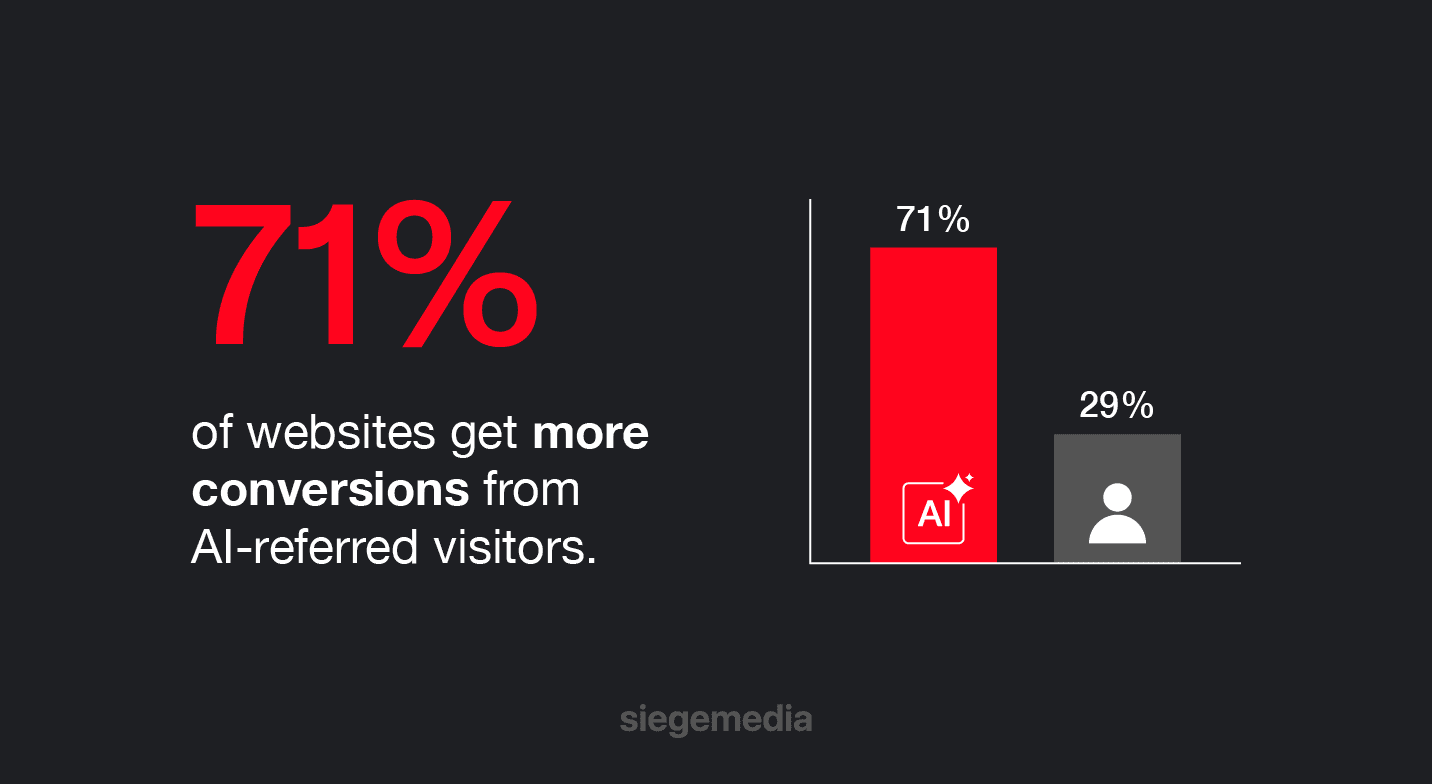
Across 71% of tracked sites, AI-referred visitors outperformed direct traffic on conversions. Since direct traffic skews toward existing customers, re-engaged users, and people who already know your brand, AI traffic often comes from higher-intent users who reach your site after asking a targeted query.
4. Revenue Per Session Is Genuinely Mixed
AI’s conversion advantage doesn’t always translate to revenue. Among our sites with reliable revenue tracking, AI out-earned traditional traffic on fewer than half. Some sites saw strong revenue per session from AI referrals, while others trailed with no clear vertical pattern.
But here’s the point: Revenue per session is the wrong lens for evaluating a channel that’s still building volume. AI traffic today looks a lot like traditional search did in its early days, with high intent and inconsistent monetization across sites.
The brands that invested in search early didn’t do it because the numbers were proven, but because they knew that owning a discovery channel before it scales is worth more in the long run. AI answers work the same way. When your brand gets cited, you’re earning compounding value, rather than focusing on the value of a single session.
Key thought: The question isn’t whether AI traffic pays off per session today. It’s whether you want to be cited when AI search volume is substantially higher than it is now.
5. AI Users Are Engaged but Still Small in Volume
Our data also shows that AI-referred visitors aren’t bouncing:
- AI-referred traffic: Median session depth is 2.0 pages/session.
- Traditional traffic: Median session depth is 1.9 pages/session.
However, AI traffic only accounts for roughly 0.2% to 3% of total sessions on most sites. While these visitors are high-intent users and session depth signals content quality, AI is not a high-volume channel — yet.
This distinction matters for prioritization and tracking. By combining traditional and AI-specific strategies, the sites that earn citations now will own a disproportionate share of that traffic as AI use compounds.
The Real Variation: Rates by Industry
The 1.26x headline ratio is strong, but it hides real variation across industries.
Here’s how each category breaks down:
| Industry | Median Rate | AI > Traditional | AI > Direct |
|---|---|---|---|
| Finance | 1.67x | 80% | 83% |
| Consumer/Local Services | 1.29x | 83% | 67% |
| Travel/Real Estate | 1.27x | 89% | 67% |
| B2B SaaS | 1.05x | 60% | 73% |
| E-commerce | 1.01x | 56% | 67% |
| All Sites | 1.26x | 72% | 71% |
- Finance: As the strongest conversion category, products like banking, payments, and rate comparison drive more action from high-intent users than other pages.
- Consumer/local services: AI traffic to local service sites sees conversion rates well above those of traditional and direct traffic, which is consistent with the pattern of someone asking an AI engine for a nearby provider and arriving ready to act.
- Travel/real estate: Rates are highly query-dependent, and AI performs well for clear transactional needs but underperforms on considered comparison products with longer research cycles.
- B2B SaaS: AI behaves like research-stage demand (prioritizing versus pages, category explainers, and how-to content), with conversion rates at or above traditional and direct traffic, but below paid search.
- E-commerce: Conversion rates are nearly even in this vertical, with revenue per session also split.
The Truth for Your Strategy
The best strategic choice isn’t to chase a 7x channel. It’s to treat AI as the organic-class acquisition channel it’s becoming. Brands that invest in generative engine optimization (GEO) and appear in AI answers will own the traffic as it scales.
If AI traffic is worth 1.26x traditional traffic today (and is rapidly growing its total share of sessions), the cost of not being cited by AI will compound. So, the truth for you is: You need to be showing up where your high-intent audience is, and a traditional-, paid-, or direct-only strategy won’t cut it.
Improve AI and Traditional Traffic Conversion Rates With Siege Media
Across every vertical we studied, AI traffic behaved like a stronger version of traditional traffic. It’s not a replacement for it, nor the conversion anomaly that plenty of headlines suggest. However, the underlying story that AI is becoming a meaningful acquisition channel holds up under scrutiny.
The brands that will own AI traffic are building citation-worthy content now, including the comparison pages and category explainers that AI engines surface when someone asks a question your product answers.
At Siege Media, a full-service GEO agency, we combine content strategy, digital PR, and AI search optimization to help brands earn visibility across traditional search and generative engines — and convert that traffic once it arrives.
Reach out today if you’re ready to build a strategy that surfaces your brand where your buyers are actually searching.
Methodology
Our data is from first-party GA4 accounts from January 1 to May 31, 2026. We screened more than 120 properties and found 78 with AI-referral traffic and usable channel data. Results are reported at the category level only.
Given the distribution, conversion ratios above 3x were rare enough that we grouped them to prevent a single outlier from skewing the category results.
AI traffic is defined as sessions originating from generative chat engines, such as ChatGPT, Perplexity, Gemini, Copilot, Claude, and related services.
Conversion rate uses GA4’s session KeyEventRate. The ratio includes only sites with at least 250 AI sessions, 1,000 organic sessions, non-zero conversion on both channels, and standard key-event tracking.