Great thought leadership is built on insight, not authorship.
In SaaS, trust is everything.
Your prospects need months to evaluate your solution, involve multiple stakeholders, and justify significant budget allocation. Thought leadership content builds trust before your sales team ever hops on a call by positioning your brand as an authority in the industry.
If you’re delivering an exceptional product, your thought leadership content can lead conversations, helping to draw in leads and close deals.
But here’s the catch: The people who know your product best shouldn’t be the ones writing content about it.
Your internal subject matter experts (SMEs) are your most valuable internal minds — think heads of product and engineers — and they’re swamped with product roadmapping, sales calls, and strategic planning. Plus, the person with the deepest technical knowledge isn’t always the best storyteller.
The good news is you don’t have to be an SME to write great thought leadership content. At Siege, we’ve scaled thought leadership programs that generate measurable ROI without leaning on SMEs to write a single word.
In a time when nearly two-thirds of content marketers don’t know where to put their marketing resources, a scalable thought leadership strategy offers clarity and compounding returns. Rather than chasing quick wins, this approach builds long-term authority through repeatable systems that turn expert insights into multi-use content.
In this post, we’ll show you a scalable system for leveraging internal expertise to create high-impact, SME-driven thought leadership without sacrificing quality, trust, or anyone’s calendar.
- Thought Leaders vs. Subject Matter Experts
- The Myth: Only SMEs Can Author Thought Leadership
- A Scalable Thought Leadership Strategy That Actually Works
- Reframing Thought Leadership for SaaS Growth
- Let Your Experts Lead — We’ll Handle the Content
Thought Leaders vs. Subject Matter Experts
Before we dive into strategy and process, let’s define what it means to be a thought leader vs. a subject matter expert. In B2B SaaS marketing, thought leaders and SMEs both play crucial roles but serve very different purposes.
- A thought leader shapes narratives, provokes new ways of thinking, and speaks to industry-level trends.
- A subject matter expert goes deep into product knowledge. They know the product inside and out, the tech stack, and real customer pain points.
Both are valuable, but confusing one for the other can lead to mismatched content strategies that either lack credibility or vision (and probably never see the light of day).
| Thought leader | Subject matter expert (SME) | |
|---|---|---|
| Primary goal | Shape industry conversations | Share deep technical/product knowledge |
| Focus | Big-picture trends, opinions, positioning | Executional expertise, process, features |
| Best for | Top-of-funnel content, awareness | Mid-to-bottom-funnel content, enablement |
| Audience | Industry peers, media, analysts | Customers, power users, implementation teams |
| Tone | Visionary, provocative | Detailed, precise, factual |
| Content formats | Op-eds, reports, LinkedIn posts, keynote topics | How-to guides, technical guides, product demos, FAQs |
| Writing involvement | Producing, often partnered with an editor | Typically interviewed or consulted |
When it comes to creating content, this difference becomes even more important.
Thought leadership content is big-picture, perspective-driven, and ideal for building brand trust and driving awareness. SME content is technical, tactical, and often most useful in bottom-funnel conversations where specific product knowledge is crucial.
That said, SME knowledge can be a powerful input for both types of content, especially when captured and refined by a strategic content team.
Subject matter acquaintance (SMA) vs. SME: An SME holds deep, specialized knowledge and extensive experience in a particular field. An SMA may know more than the average person on a topic but lacks the profound depth, current practice, or extensive experience of that of an SME.
The Myth: Only SMEs Can Author Thought Leadership
Time and time again, we hear a consistent misconception in B2B content marketing: Subject matter experts must personally write thought leadership content to maintain authenticity.
It’s an understandable assumption. After all, they’re the ones closest to the product, the customers, and the industry.
But confusing the roles of subject matter experts with those of a content strategist or writer leads to a lose-lose scenario where neither expertise nor content quality reaches its full potential.
Thought leadership requires speed, consistency, and strategic packaging. And the truth is, most SMEs don’t have the time — or the training — to deliver that.
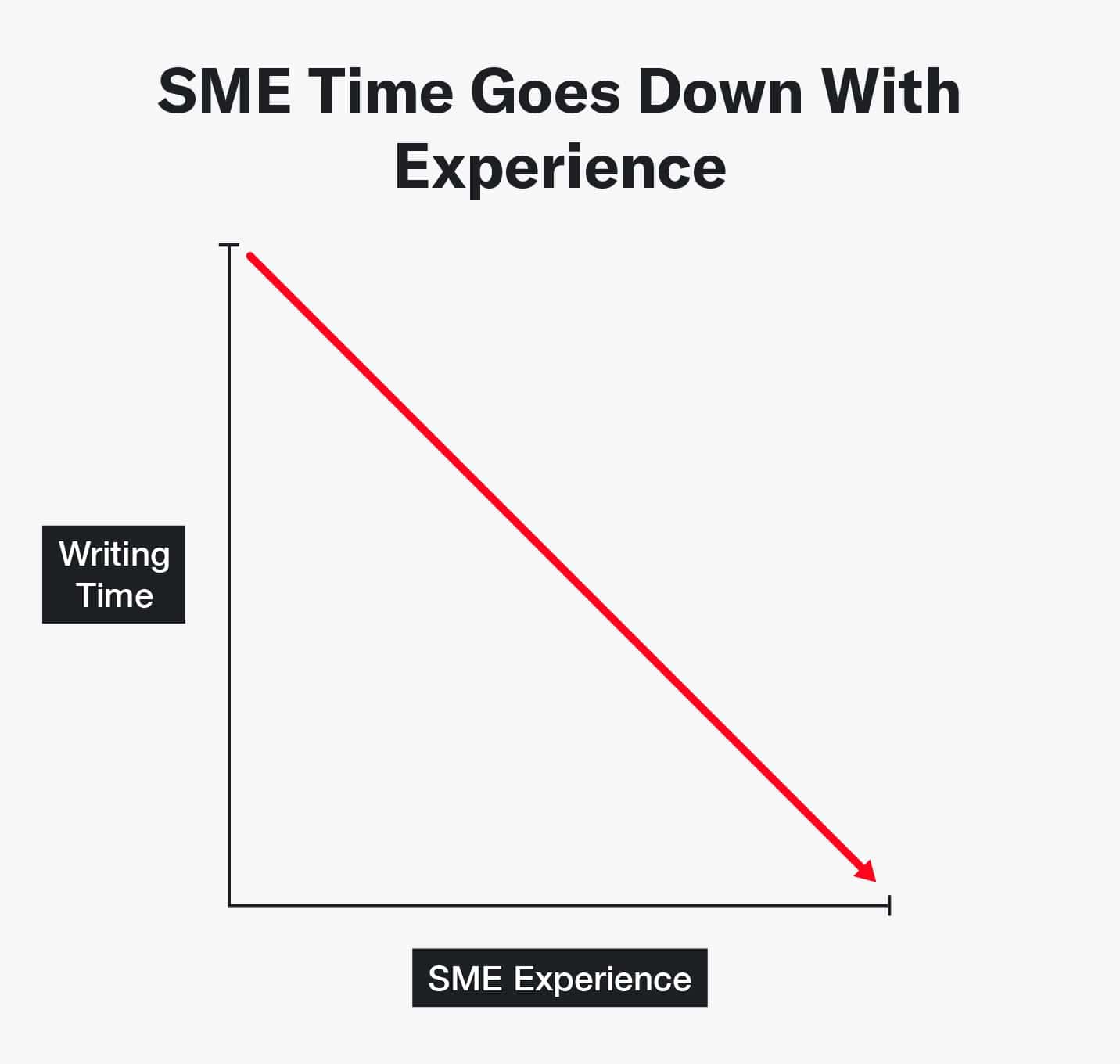
Relying solely on SMEs to write thought leadership creates a bottleneck that chokes content velocity across enterprise SaaS companies. Here’s why:
- Time constraints: Once you’re an SME, your bandwidth for additional tasks depletes quickly, and writing is rarely a priority.
- Inefficiency: Pulling SMEs away from product development or customer insights is counterproductive and can slow down your entire operation.
- Too close to the material: Experts often assume a high baseline of knowledge. They can struggle to “zoom out” and explain big-picture insights in a way that’s digestible for a broader audience.
- Lack of writing expertise: SMEs are experts in their field and hold institutional knowledge, but are not necessarily skilled writers. Writing takes time, structure, and a strategic lens for content and brand positioning — skills most SMEs aren’t trained for and don’t have time to master.
- Misaligned incentives: Writing for brand awareness might not feel urgent to a technical lead. If there’s no clear ROI for their department, they’re unlikely to prioritize it, leaving the content to suffer.
- Low output: Even if they do write something, it’s often sporadic, over-polished, or misaligned with marketing goals.
- Burnout risk: Asking SMEs to carve out hours to write a 2,000-word blog post while juggling their core work is a fast track to burnout.
While these experts are essential for informing your brand’s POV, it’s clear that sitting behind a keyboard writing isn’t the best use of their time (or talents). Their value lies in their institutional knowledge and not in drafting thought leadership posts line by line.
Instead of turning content into their side hustle, position them as expert sources who can feed valuable insights into a content system designed to scale. This shift not only respects their role but also ensures your content reflects both authority and credibility, building your content’s E-E-A-T value.
SME sourcing tip: If you don’t have internal SMEs available, consider sourcing experts through curated platforms like HARO and its alternatives to inform your content without slowing down production.
A Scalable Thought Leadership Strategy That Actually Works
Thought leadership as a strategy works well for brands with:
- Small, niche audiences without search volume
- A B2B focus
- Long sales cycles
- A strong distribution platform
If that sounds like your company and you want to take the next step in thought leadership content development, it’s crucial to create a scalable strategy. The key is building a system that captures SME insights efficiently and turns them into strategic, well-crafted content.
This approach respects the value of your SMEs’ time while ensuring your brand consistently publishes high-quality, trust-building thought leadership.
Let’s dive into how you can build a repeatable workflow that keeps your content engine running and your experts focused on what they do best.
1. Batch Expert Input (Not One-Offs)
One of the biggest inefficiencies when working with subject matter experts is chasing them down post by post. This reactive approach leads to delays, inconsistent output, and frustrated teams. Instead, build a repeatable system that batches expert input on a regular cadence.
By proactively gathering insights upfront, you can turn one SME interview into multiple content pieces without constantly pulling them away from their core work. This is the foundation of a scalable thought leadership workflow that works for both marketers and SMEs.
SME interview tip: Send your questions in advance for the SME to ponder. On the call, ask to record and ask follow-up questions — even “Tell me more!” or asking for specific examples — to give you more context for building the piece.
When working with SMEs, your goal should be to minimize interruptions while maximizing the value of their input.
An SME’s time is valuable, so even when they aren’t authoring content, you still need to respect the time they give you. This is just another reason why we recommend batching your requests.
Here’s what this workflow could look like:
- Monthly structured interviews: Schedule a 30-minute call guided by pre-prepared questions tied to your upcoming editorial calendar.
- Quick video walkthroughs: Ask SMEs to record short videos of themselves explaining a process, trend, or point of view in their own words. In a pinch, a voice memo could work, too.
- Short response forms: Send lightweight forms with three to five questions to collect specific insights asynchronously.
- Optional SME draft review: Give SMEs the opportunity to fact-check or lightly comment on content, without asking them to write it. This way, you can ethically give them a reviewer byline in publication.
This method not only ensures a steady pipeline of insights but also gives your editorial team the time and structure needed to craft high-impact thought leadership content.
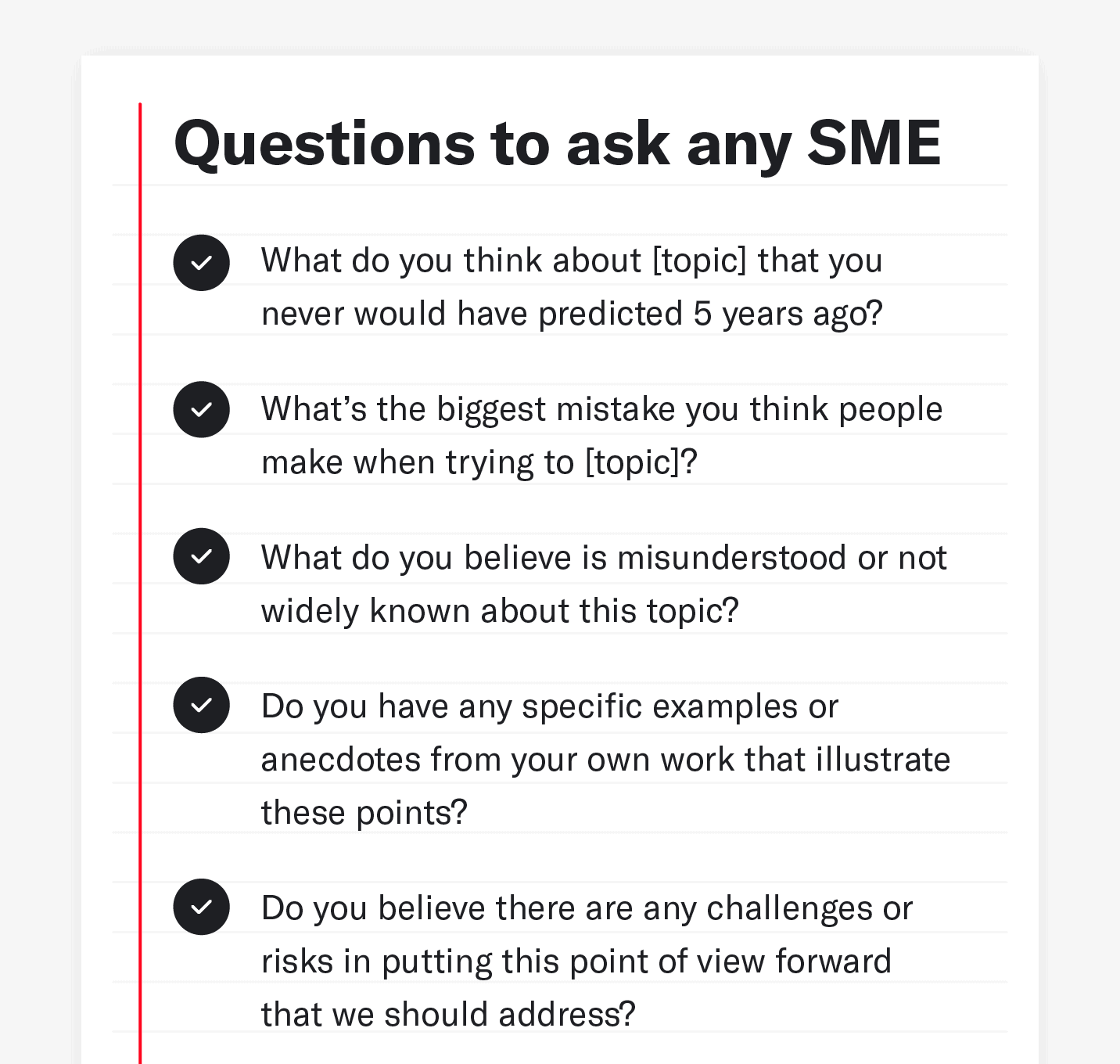
SME interview tip: Bring your meeting or video recording transcript to an AI tool like ChatGPT to help you create a content brief to ensure you’re incorporating all of your SME’s golden nuggets.
2. Use Data as Fuel
No SMEs available to share their expertise when you need it? There’s a good chance you can get by just fine by leaning into internal data and resources to demonstrate thought leadership.
Your company is sitting on a goldmine of unique insights that can drive authority, credibility, and engagement without requiring direct SME authorship.
Product-led, data-backed content is inherently more trustworthy and easier to differentiate from your typical blog content. It reflects your understanding of customer needs, real-world trends, and product value. Even better, it offers scalable, repeatable fuel for your content engine.
Here are some powerful sources you can tap:
- Product and customer usage data: Spot behavior patterns, top-performing features, or usage trends over time.
- Sales call transcripts: Identify recurring objections, feature misunderstandings, or competitive comparisons.
- Customer pain points: Use support tickets, reviews, or social listening to surface real user challenges.
- Feature request logs and complaints: Show how your product is evolving and why.
Content built around first-party data not only earns links and attention — it reinforces your authority in the market. It’s a powerful way to showcase thought leadership through what you know, rather than who wrote it.
Data scrubbing tip: Use an AI tool like Gemini to identify patterns and themes across datasets and contextualize your data with broader market shifts.
3. Build in Multi-Channel Distribution
Creating strong thought leadership content is only half the battle — getting the right eyes on it is the other half. Successful thought leadership requires a strategic content distribution plan.
Too often, SaaS brands treat thought leadership as a one-and-done blog post when it should be treated like a product launch. That means building a multi-channel distribution strategy from the start.
If your content reflects the strategic insight of your internal experts, it deserves more than a single slot in your blog feed. It should live where your audience already spends time: on LinkedIn, in sales conversations, in their inboxes, and across your website.
To get the most out of every piece of content, plan for repurposing and distribution upfront. Here are some key channels to integrate into your workflow:
- LinkedIn posts: Break the core insight into two or three punchy, standalone posts to increase visibility and reach. Include direct quotes or POVs from SMEs when possible and graphics from the post.
- Sales enablement assets: Repurpose content into internal one-pagers or snippets sales teams can drop into email threads or pitch decks.
- Email newsletters: Feature thought leadership pieces in your monthly or quarterly sends with a brief editorial takeaway or excerpt.
- Homepage or resource hub highlights: Surface top-performing thought leadership in high-visibility areas like homepage banners, hero carousels, or navigation drop-downs.
Thought leadership is only effective if it reaches and resonates with your target audience. By building in distribution across channels, you maximize the ROI of each piece and create a consistent, authoritative presence that reinforces your brand’s voice across the entire funnel.
Repurposing content tip: Treat content repurposing like part of the original scope, not an afterthought. For each blog post, list three to five potential distribution formats (e.g., a LinkedIn carousel, sales one-pager, newsletter blurb), assign them to relevant team members, and add deadlines to your editorial calendar.
4. Measure Your Success
You can’t scale what you don’t measure. While thought leadership isn’t always built for direct conversion, it should still show clear signs of impact across your marketing funnel.
Go beyond basic traffic and start tracking a blend of reach, engagement, and business relevance to understand whether your content is resonating with the right audience. A few high-value shares from industry influencers or sales enablement wins can be just as meaningful as a spike in organic visits.
Start by monitoring social media distribution. Use tools like LinkedIn post analytics or BuzzSumo to track amplification. Then, look at how the content performs in your “All Pages” view in Google Analytics — this gives a more accurate picture than organic traffic alone.
Was the content viewed during high-value sessions? Did users visit additional high-intent pages afterward? Those are signals of downstream impact.
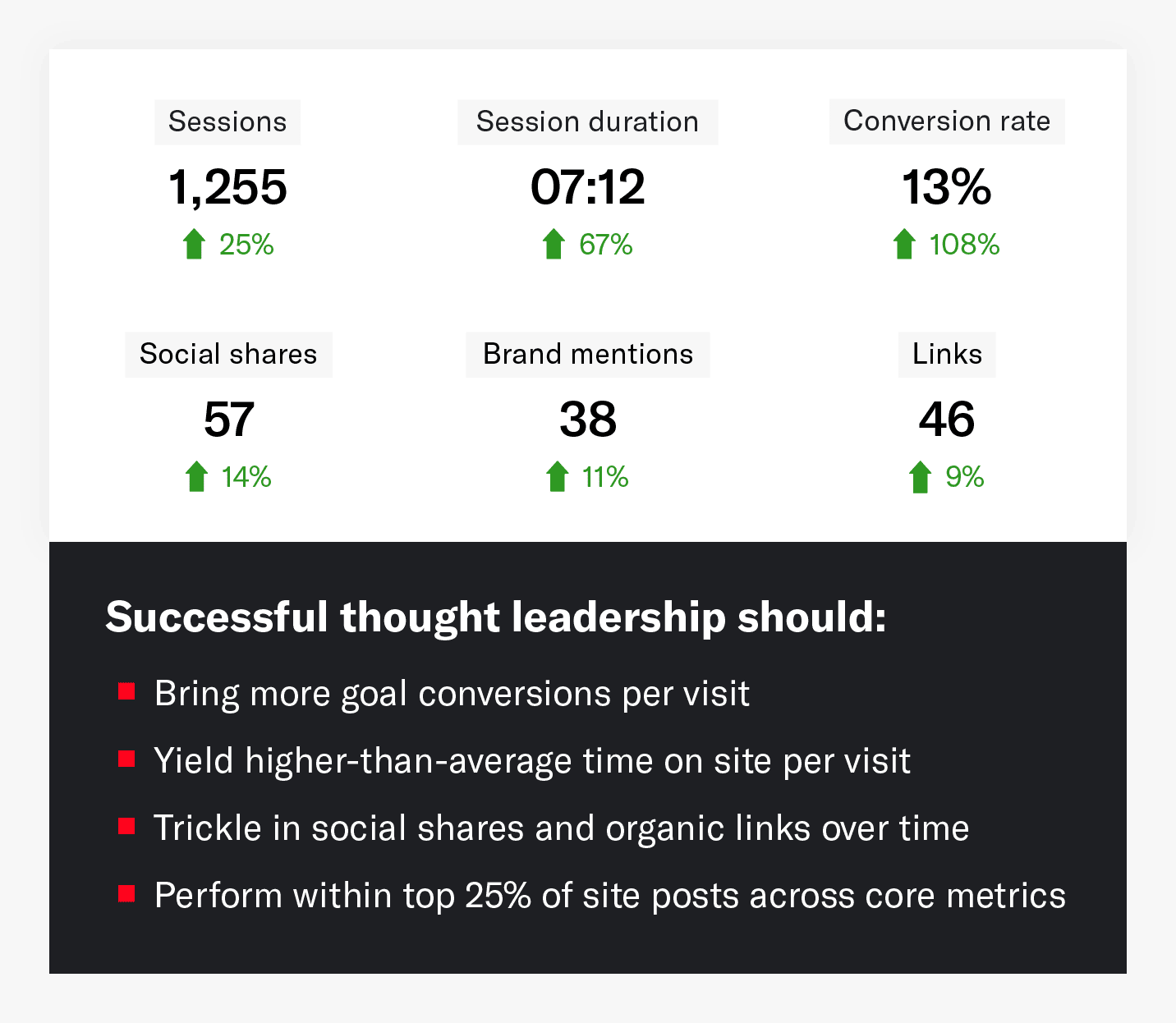
Finally, report on success in context. Not every thought leadership piece will go viral. But if it’s sparking conversation, being cited, or getting picked up by sales reps and newsletters, it’s working. Set benchmarks, test formats, and use those insights to refine your approach with every new post.
Reframing Thought Leadership for SaaS Growth
According to Siege data, only 32% of marketers feel confident in their B2B content marketing strategy in 2025, down nearly 9% YoY. This dip signals a growing need to evolve past outdated strategies.
In SaaS content marketing, traditional thought leadership looked like one brilliant SME publishing one long-form blog post that maybe got shared once or twice.
But in today’s content landscape, that model doesn’t scale. To drive real growth, SaaS brands need to adjust their understanding of thought leadership from person-led to positioning insightful company-led content.
This means shifting from SME-authored blog posts to SME-enabled content that’s systematized, strategic, and rooted in cross-functional insights, from product, sales, customer success, and beyond.
You don’t have to be a thought leader to produce thought leadership content. When SaaS companies build a repeatable system for capturing expert input and turning it into credible, high-impact content, they unlock a content engine that drives trust, awareness, and sales enablement.
The magic isn’t in the byline — it’s in the process.
By focusing on the company’s POVs and distributing SME-enabled content across channels like LinkedIn, email, and your resource hub, your brand (not just your people) becomes the trusted voice in the market.
Let Your Experts Lead — We’ll Handle the Content
Your SMEs shouldn’t be stuck in Google Docs. They should be focused on building, innovating, and solving customer problems. High-impact SME thought leadership doesn’t mean putting the burden of content creation on your busiest experts.
Instead, it’s a team sport: Your SMEs provide the raw insight, writers turn it into sharp, structured content, and marketers amplify it across channels. With the right system, you’ll produce more consistent, high-performing thought leadership without burning out your top talent.
SaaS teams grow faster when their experts stay focused on what they do best. A structured, scalable approach to thought leadership ensures your brand builds trust, generates leads, and stays top of mind in competitive markets.
Want to see what that looks like in action? Explore how our content marketing services help SaaS companies turn internal knowledge into measurable impact.
Your SMEs have the insights. Let us help turn those ideas into influence. Whether you’re ready to level up your SaaS content strategy or just want to see what a smarter approach could look like, we’re here to help.