
Read our Pangram review for hands-on accuracy results, pricing, features, pros, and cons to decide if it’s the right AI detector for your content team.
AI-assisted production is now one of the most significant content marketing trends shaping editorial workflows. As more brands use AI to create and refine copy, content teams need a consistent way to identify drafts that warrant closer review.
Knowing how to spot AI-generated text still requires human judgment, while detection tools can surface likely AI involvement at scale and help editors apply internal AI-use policies.
Pangram has become a popular option due to its accuracy claims and detailed results. To see if it lives up to the hype, we evaluated it alongside other leading AI content detection tools, examining its accuracy, usability, features, and value.
Our Pangram review found that it correctly classified all six human-written and AI-generated samples, making it a strong quality-control option for publishers, agencies, and in-house content teams.
- Pangram Review at a Glance
- How Accurate Is Pangram?
- Pangram’s Key Features
- How Easy Is Pangram To Use?
- How Much Does Pangram Cost?
- Pangram Performance and Limitations
- Is Pangram Worth It?
- Frequently Asked Questions
Pangram Review at a Glance
Pangram is one of the strongest AI detectors we tested, particularly for professional and institutional teams that need to minimize false positives and identify partial AI assistance. The detailed results, clean interface, and workflow integrations make it especially useful for publishers, content agencies, and educators.
No AI detector is perfectly accurate, and Pangram’s limited free plan may not support frequent casual use. Its greatest value lies in higher-stakes reviews, where users need enough context to investigate a flag before taking action.
| Category | Rating | What we found |
|---|---|---|
| Accuracy | 5/5 | Correctly classified all six human and AI-generated samples in Siege’s existing test |
| Result detail | 5/5 | Provides document-level scores, segment analysis, and sentence-level signals |
| Ease of use | 5/5 | Clean interface with paste, upload, and in-workflow scanning options |
| Features | 4.5/5 | Includes AI-assistance detection, plagiarism checking, integrations, and multilingual support |
| Value | 4/5 | Free access is limited, but paid plans support more frequent professional use |
| Overall | 4.7/5 | Best suited to publishers, educators, and teams making higher-stakes content decisions |
Pangram AI Detector Review: Quick Verdict
- Best for: Publishers, content agencies, educators, and organizations where false flags carry meaningful consequences
- Not best for: Casual users who need frequent free scans
- Standout feature: Detection of AI-assisted and mixed-authorship content
- Starting price: Free for four scans per day; individual plans start at $20 per month
- Siege accuracy score: 5/5 for fully human and fully AI-generated samples
Our Methodology
We scored each category on a five-point scale, with 5 representing exceptional performance, 4 indicating strong performance with minor limitations, and 3 reflecting satisfactory performance with notable trade-offs. Half points were used when Pangram fell between two levels.
Accuracy was assessed using six samples with known origins and was supported by independent research. We evaluated the results in detail based on the clarity and usefulness of Pangram’s analysis, while ease of use was assessed using setup, scan speed, and navigation.
The features score considered the breadth of detection capabilities and integrations, and value accounted for pricing, usage limits, and functionality compared with similar tools. The overall rating is the unweighted average of all five categories, rounded to the nearest tenth.
We also reviewed three AI-assisted samples to assess mixed-authorship detection. Because these samples span a spectrum rather than yielding a binary human-or-AI answer, they informed our feature assessment but did not factor into the six-sample accuracy score.
How Accurate Is Pangram?
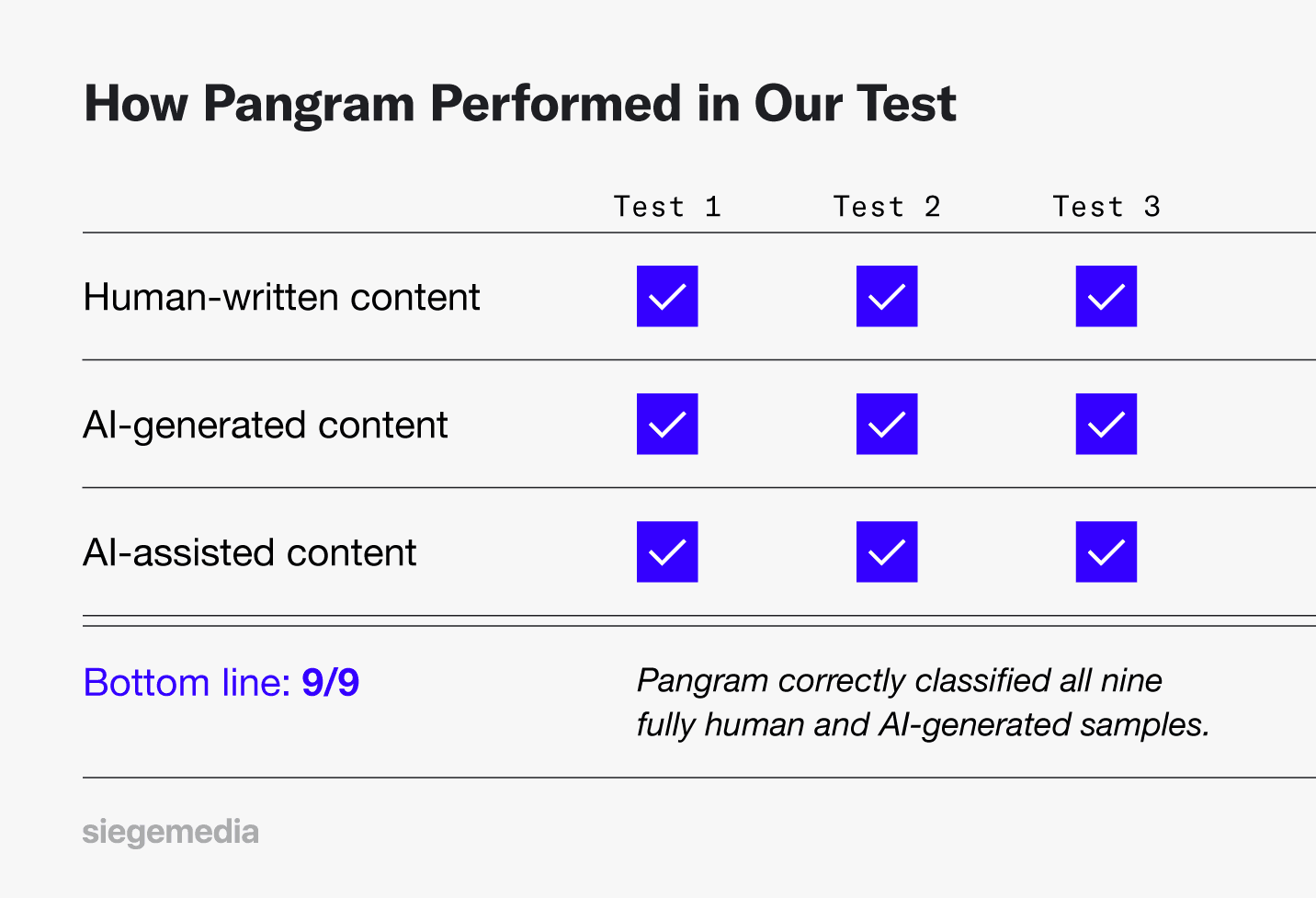
The pangram AI detector review earned a 5/5 accuracy score in Siege Media’s testing, correctly classifying three AI-generated and three human-written samples. While this was a small test, Pangram was among the strongest detectors we evaluated.
An AI detector’s accuracy depends partly on how often it produces false positives and false negatives. A false positive incorrectly labels human writing as AI-generated, which can lead to unfair accusations. A false negative clears AI-generated writing as human, allowing it to pass through the review process undetected.
A Chicago Booth study found that Pangram achieved 100% accuracy across most models and content types, never falling below 99.8%. False positives remained near zero across most thresholds, while false negatives reached 2%–4% under some conditions. Accuracy also varied by passage length, source model, and decision threshold.
For agencies offering content creation services, Pangram’s low false-positive rate is especially valuable because incorrect flags can erode trust between writers, editors, and clients. Its results should still support human review rather than serve as definitive proof of AI use.
Pangram’s Key Features
Pangram’s core value comes from two flagship features: AI-assistance detection and segment analysis. Together, they move beyond a document-level percentage to show how AI may have influenced a piece of writing and where that influence appears. The remaining features expand that detection into broader editorial and institutional workflows.
AI-Assistance Detection
AI-assistance detection is one of Pangram’s biggest differentiators. It distinguishes fully AI-generated content from human writing that AI has helped edit or rewrite. This gives teams more context when reviewing documents that combine human work with limited AI input.
Segment Analysis and AI Phrase Detection
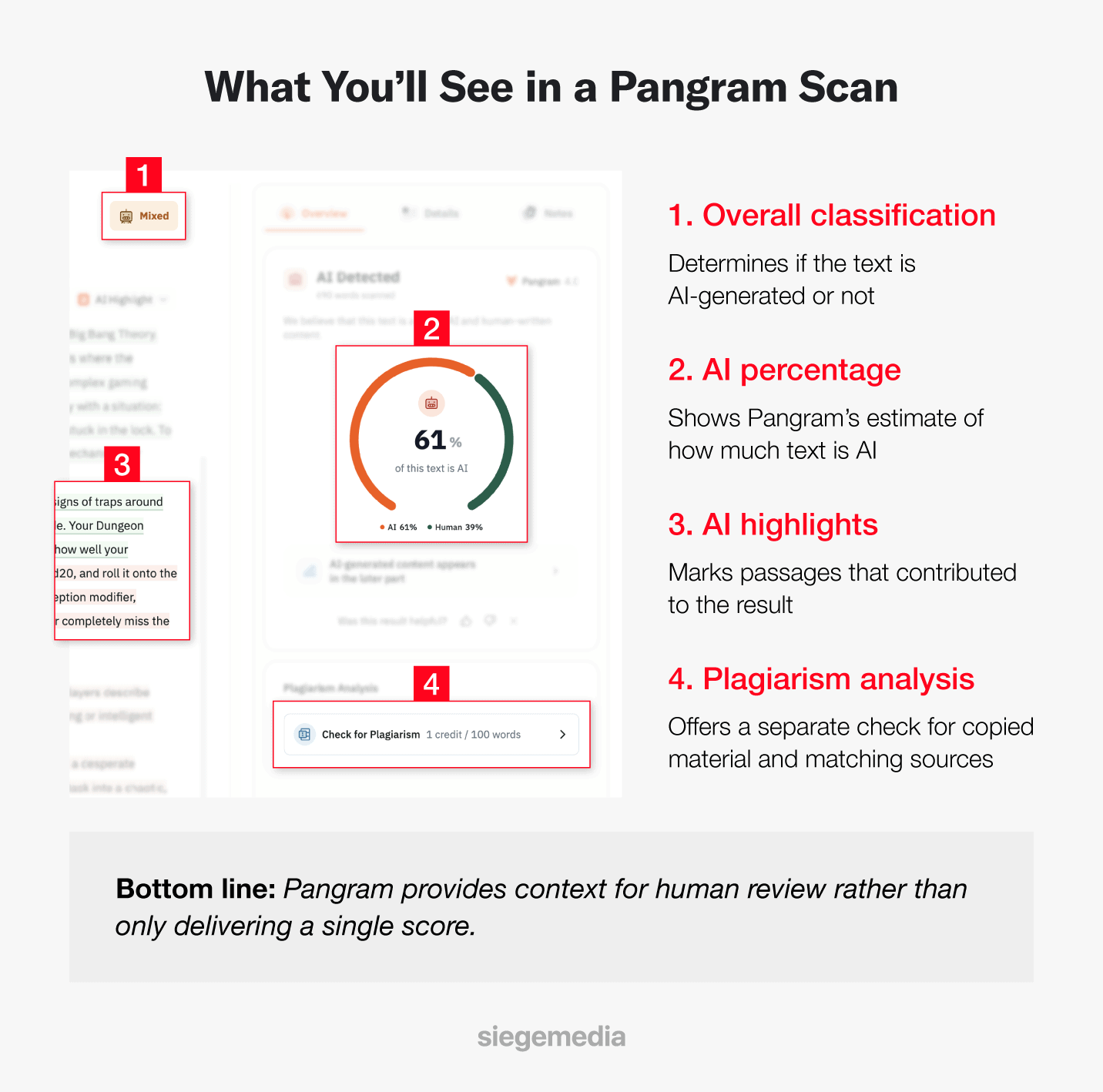
Pangram’s other flagship feature adds passage-level context to the overall result. Segment analysis highlights the sections most likely to contain AI-generated writing, while phrase detection surfaces language patterns associated with AI. For reviewers learning how to spot AI-generated text, these details provide a clearer starting point for further investigation.
Plagiarism Detection
Pangram combines AI and plagiarism detection in one scan, allowing paid users to review matching text and source links without switching platforms. This is a practical advantage for editorial and academic teams that need to check both authorship and originality, though occasional users may not need both capabilities.
File Uploads and Bulk Scanning
Pangram accepts pasted text, PDFs, DOCX files, and RTF files, and supports uploading up to 100 documents at once. Bulk scanning is one of its more valuable professional features because it reduces repetitive work for publishers and educators, while offering less benefit to users checking one document at a time.
Multilingual Detection
Pangram supports AI detection in more than 20 languages, making it suitable for organizations reviewing content across multiple markets. That coverage is strong, but it trails competitors such as Copyleaks, which supports a wider range of languages. Because Siege tested Pangram only in English, we cannot independently assess its accuracy in other languages.
Integrations and API
Pangram’s integrations are strongest for education and structured organizational workflows. It connects with Google Docs, Google Classroom, Canvas, Moodle, Brightspace, Schoology, and Ashby, while its Chrome extension and API support custom use cases. This breadth makes Pangram easier to incorporate into existing review processes, although some integrations require a team or institutional plan.
How Easy Is Pangram To Use?
Pangram offers a straightforward scanning process:
- Create a free account or sign in.
- Paste text into the detector or upload a supported document.
- Run the AI detection scan.
- Review the overall score and content classification.
- Examine highlighted segments, AI phrases, and supporting evidence.
- Save notes or continue investigating the result using the available reporting tools.
In our testing, Pangram returned results within seconds and presented its scores using clear labels. Sentence-level highlights help identify which passages contributed to the overall classification, while the dashboard keeps previous scans and supporting information organized.
The main source of friction is Pangram’s daily usage limit. Free users can scan up to 2,000 words per day, which may be restrictive for longer documents or frequent use. Still, its clean interface, fast results, and detailed analysis keep the scanning process straightforward.
How Much Does Pangram Cost?
Paid plans start at $20 per month and increase the word allowance while adding features such as plagiarism detection, image detection, and team management.
Pangram now measures usage by word count rather than scan credits. This makes costs easier to estimate, particularly for users who regularly review longer documents. Annual discounts are also available for individual, professional, and team plans.
| Plan | Price | Usage | Best for |
|---|---|---|---|
| Free | $0 | 2,000 words per day and three image scans per day | Occasional individual checks |
| Individual | $20/month | 300,000 words and 100 image scans per month | Writers, editors, and individual professionals |
| Professional | $65/month | 1.5 million words, 500 image scans, and $200 in API usage per month | High-volume professional users |
| Team | $20/seat/month | 300,000 words per month; starts at two seats | Collaborative content and education teams |
| Developer API | Usage-based; funds start at $25 | Pangram 4 costs $0.05 per 100 words, while Pangram 3 costs $0.05 per 1,000 words | Developers adding detection to existing products |
| Educational Institution | Custom pricing | Unlimited AI and plagiarism checks with LMS integrations | Schools, districts, and universities |
| Enterprise | Custom pricing | Variable limits based on processing volume | Large organizations with advanced security and API needs |
Pangram Performance and Limitations
Pangram combines high accuracy with detailed results and workflow integrations, though its usage limits may make it less suitable for casual users. Teams weighing Pangram vs. Copyleaks should compare Pangram’s independent validation with Copyleaks’ broader language support.
| Pros | Cons |
|---|---|
| Earned a 5/5 accuracy score in Siege Media’s testing | Independent tests found a 2%–4% false-negative rate under some conditions. |
| Maintained a near-zero false-positive rate in independent research | Scores are based on writing patterns and cannot verify how a document was created. |
| Detects fully generated and AI-assisted content | Free users can scan only 2,000 words per day |
| Provides sentence-level highlights and supporting details | The Individual plan includes 300,000 words per month, which may exceed the needs of occasional users. |
| Includes plagiarism checking and multilingual detection | Some integrations and advanced features require paid plans |
| Supports file uploads, bulk scanning, and workflow integrations | Detection accuracy may be lower for passages under 50 words and can vary by source model. |
Is Pangram Worth It?
Yes, Pangram is worth it for publishers, educators, and content teams that need to minimize false positives, review AI-assisted writing, or integrate detection into existing workflows. It is one of the most accurate and useful detectors Siege Media has tested, with detailed results that offer more context than a single AI percentage alone.
Users who only need to check a few personal documents or want unlimited free scans may not find the paid plans worthwhile. Pangram’s results should also support a broader review process rather than determine a final verdict on their own.
The best content marketing agencies balance responsible AI use with experienced human review. Siege applies that approach through its content marketing services, using detection as one quality-control signal — not the final word on a draft.
Ready to strengthen your editorial process without sacrificing originality? Connect with Siege Media to explore a content strategy built around expert insight, responsible AI use, and measurable growth.
Frequently Asked Questions
How Trustworthy Is Pangram?
Pangram is one of the more trustworthy AI detectors available, but its results should still be treated as supporting evidence rather than definitive proof.
Is Pangram Better Than GPTZero?
Pangram is generally better than GPTZero for professional or institutional use because of its low false-positive rate and detailed AI-assistance detection. However, GPTZero may be sufficient for quick, occasional checks.
Does Pangram Give False Positives?
Yes, Pangram can produce false positives, as no AI detector is completely accurate. However, independent research found that its false-positive rate remained nearly zero across most testing thresholds.