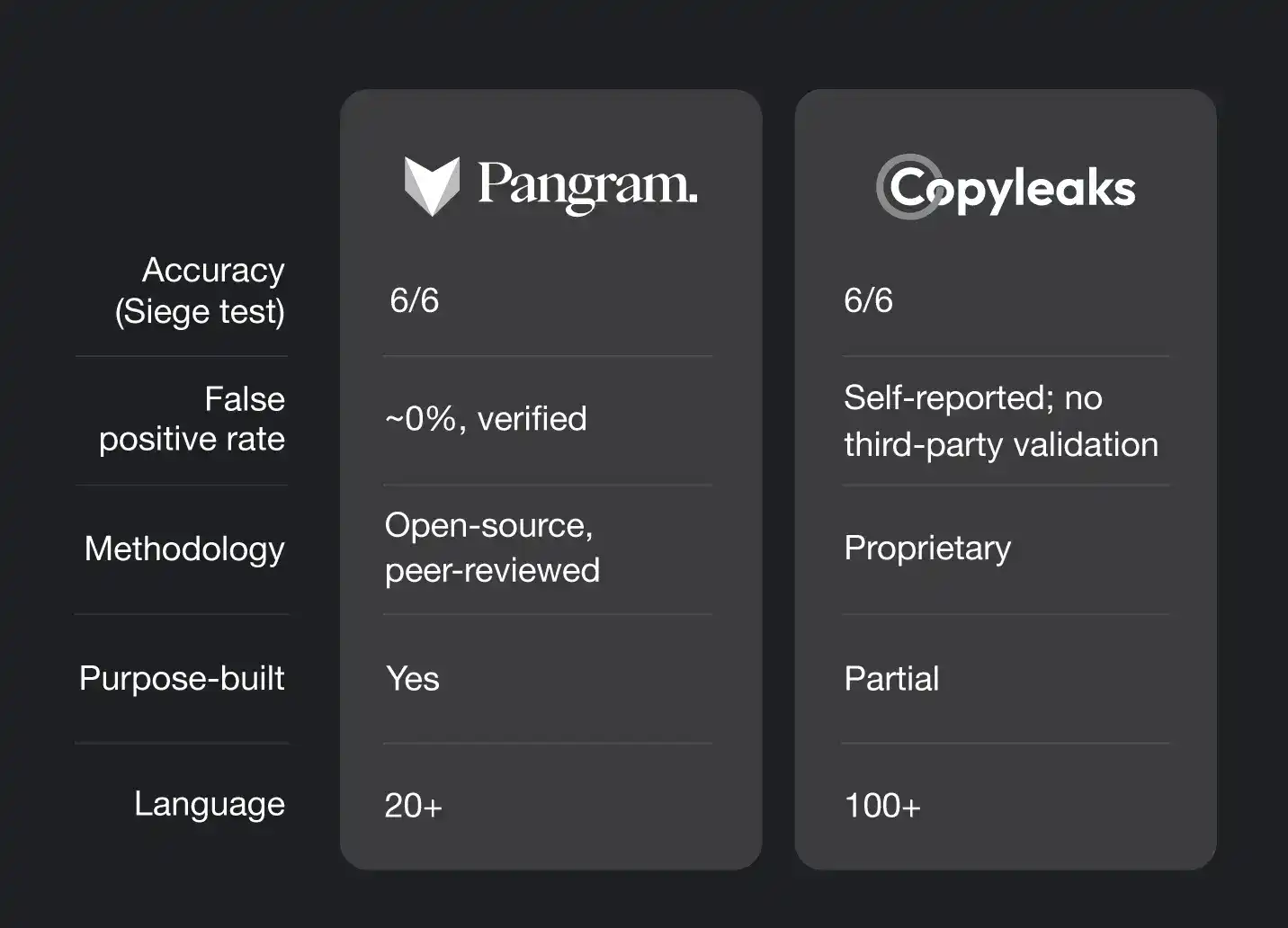
Both Pangram and Copyleaks deliver strong AI detection accuracy, but Pangram stands apart with a near-zero false-positive rate, with its methodology independently verified by the University of Chicago.
Pangram and Copyleaks are two of the more credible AI detection tools in a crowded market. Most comparisons online, though, stop at accuracy scores and leave readers without a real answer on which one to choose.
This evaluation is based on Siege Media’s testing of AI detection tools. We assessed each tool based on accuracy, accessibility, features, and pricing.
To measure accuracy, we tested three AI-generated and three human-written content samples with each tool and scored them based on the number of correctly identified pieces. Beyond accuracy, we also considered factors like usability, features, and overall value.
- Pangram vs. Copyleaks at a Glance
- Use Case Fit
- Accuracy
- Detection Methodology
- Integrations
- How To Choose
- Frequently Asked Questions
Pangram vs. Copyleaks at a Glance
Before getting into the details, the table below captures where each tool stands across the metrics that most directly affect real-world reliability.
| Feature | Pangram | Copyleaks |
|---|---|---|
| Accuracy score | 6/6 | 6/6 |
| Transparency and methodology | Publishes peer-reviewed benchmarks; participates in RAID benchmark; open to third-party evaluation | Does not appear on primary public leaderboards; has restricted evaluator API access, citing terms of service |
| Pricing | Free plan Individual: $20/mo Professional: $65/mo |
Personal: $13.99/mo Pro: $74.99/mo |
| Use case fit | High-stakes academic integrity reviews, formal hearings, and enterprise compliance | Routine institutional scanning; LMS-integrated workflows; bundled plagiarism and AI detection |
| Language support | 20+ languages | 100+ languages |
| Plagiarism checking | Yes, included | Yes, included |
Use Case Fit
The right tool depends on where detection happens and what’s at stake when a flag is wrong.
For Education
Pangram is built specifically for academic environments. That focus shows up in ways that matter day-to-day:
- FERPA-compliant out of the box
- Native Canvas integration
- Revision tracking that shows how a document evolved, not just a verdict on the final draft
- Simple enough that non-technical faculty will actually use it
Copyleaks has an education product, but it’s one mode within a platform built to serve publishing, enterprise, and compliance use cases simultaneously. For institutions where academic integrity is the primary concern, that broader scope is a real trade-off.
For Enterprise (Publishing, Legal, HR)
Both tools handle high-volume, API-driven workflows. The deciding factor is how much a wrongful flag costs:
- Pangram’s near-zero false positive rate is backed by peer-reviewed, publicly available research
- When a detection decision needs to hold up under scrutiny, that paper trail matters
- Copyleaks is a solid option for global teams that need broader language coverage and face lower stakes around individual flags
Accuracy
Accuracy is one of the most important factors when evaluating AI detectors, as even a small number of misclassifications can impact trust in the results. In our testing, both Pangram and Copyleaks correctly identified all six content samples, earning a perfect 6/6 accuracy score.
Based on these results, both tools demonstrated strong performance in distinguishing AI-generated content from human-written text.
Detection Methodology
Accuracy scores tell you what a tool claims. Methodology tells you whether to believe it. This is where the gap between Pangram and Copyleaks is most significant.
Pangram was built by AI researchers from Stanford, Google, and Tesla, and the company has open-sourced its detection research. Every accuracy claim is independently verifiable, peer-reviewed, and stress-testable.
The UChicago Becker Friedman Institute study was possible precisely because Pangram’s methods are open to outside scrutiny.
Copyleaks, like most tools in this category, operates as a black box. Proprietary methodology, undisclosed training data, no independent scrutiny possible. That does not mean the tool is inaccurate. It means there is no way to verify whether it is.
Integrations
Both tools connect to common education and enterprise workflows, though their integration depth reflects their different priorities.
Pangram:
- Canvas (native LMS integration), Brightspace and Moodle
- Google Classroom and Google Docs
- API access for custom and enterprise workflows
- Batch processing for high-volume submissions
Copyleaks:
- Canvas, Blackboard, Moodle, and other major LMS platforms
- API with enterprise and publishing workflow support
- Microsoft Word and Google Docs plugins
- Broader third-party integrations suited for multi-team or global deployments
For academic institutions, Pangram’s integrations cover everything that matters. Copyleaks offers more third-party connections, but the value of that breadth depends on whether your team actually needs them.
Choosing Pangram vs. Copyleaks
Both tools will catch AI-generated content. The decision comes down to what happens after a flag is raised and for how long it must remain raised.
Choose Pangram if:
- Detection results need to survive scrutiny, whether in a formal review, a legal challenge, or an accreditation audit
- False positive rates carry real consequences for the people being flagged
- Your institution wants transparency into how detection decisions are made, not just what they are
- Accuracy on the latest AI models is non-negotiable
Choose Copyleaks if:
- Your team needs broader language coverage for global content workflows
- You want plagiarism and AI writing detection bundled into a single platform at a lower entry price
- Routine, high-volume scanning matters more than individual result defensibility
- LMS variety and third-party integrations across multiple systems are a priority
Copyleaks is a functional tool for teams running routine content screening at scale. But for institutions or organizations where a wrongful flag has consequences, the case for Pangram comes down to something Copyleaks cannot currently offer: an independently verified, open-source methodology that makes every detection result defensible.
Frequently Asked Questions
Can Pangram Detect AI in Languages Other Than English?
Yes. Pangram supports 20-plus languages, including French, Spanish, German, Arabic, Chinese, and Japanese. Copyleaks supports 100-plus languages, making it a strong option for teams working across a wider range of global markets.
Which Tool Is Better for Universities?
Pangram is FERPA-compliant, natively integrated with Canvas, and purpose-built for academic integrity workflows. The open-source methodology also means detection results can be defended in formal misconduct proceedings, which matters when academic standing is on the line.
Which AI Detector Is Best for a Content Agency Verifying Human Writing?
Pangram is a great choice for content agencies. For agencies where wrongly flagging a human writer damages trust and client relationships, the false positive rate is the most critical metric. Pangram’s near-zero rate, validated by independent research, makes it the safer choice for high-stakes content verification.
Do Pangram and Copyleaks Offer API Access for Enterprise Use?
Yes, both tools offer API access. Pangram’s API is available on the Professional plan ($65/month) and above, with batch processing included. Copyleaks offers API access on its Pro and Enterprise tiers, with broader integration support for global and multi-team deployments.