Across 1,000 transactional prompts, 21 of the 40 most-cited domains weren’t brands at all. Based on a Siege Media and Peec AI analysis, they were affiliate and sponsorship sites — the exact channel most category leaders have spent the last five years defunding.
That analysis, conducted in partnership with Peec AI, found 52.5% of the most-sourced domains were affiliate or sponsorship-focused websites. Not vendor homepages or product pages.
If you dominate your category, your assets are doing exactly what you built them to do. But generative engines don’t rank your pages. They summarize what other people have written about you, and category leaders have been quietly reducing how much of that gets written for the better part of a decade.
Siege benchmarks put category-dominant brands at 75%-80% visibility across non-branded prompts tied to their products. Meanwhile, plenty of genuine category leaders sit closer to 50%. This difference is the accumulated result of defensible commercial decisions.
Here’s the trap. Dominance in organic search taught category leaders to defund the ecosystem LLMs synthesize from, and the numbers that justified the cut get worse as the channel gets more valuable.
- The Shift From Pages to Mentions
- How Brands Starve Their Signal Pool
- The Attribution Trap
- Diagnose The Trap in an Afternoon
- The Corrective Playbook
- Siege Keeps Category Leaders Cited
The Shift From Pages to Mentions
Traditional search is a retrieval problem. Google indexes your pages, scores them, and returns a ranked list. Generative Engine Optimization (GEO) addresses a synthesis problem where the model assembles an answer from what the web has said about a subject and then decides which sources to credit.
One system evaluates your property, while the other evaluates your reputation.
That distinction means unlinked mentions now carry a weight they never had. Google historically discounted affiliate and sponsorship placements, and reasonably so — a paid listing was a weak signal of editorial trust. In LLM synthesis, that changes.
At the decision stage, the imbalance is severe. Siege’s study on AI buying advice found that third-party sources account for 80% to 95% of citations, depending on the industry. Most tracked brands had low single-digit citation visibility. That figure is quoted as a crisis, usually by someone who conflates it with an entirely different number.
Two numbers are worth defining, because they get constantly confused:
- Citation visibility is how often your own domain gets cited as a source (single digits for most brands)
- Brand visibility is how often you’re named or recommended (for category leaders, 75% or higher)
A leader can be mentioned in nearly every answer and cited in almost none of them. The mentions come from somewhere, and that somewhere is the subject of this post.
“The popularity graph has moved from just links to also include unlinked mentions from the right type of sites. If you ignore this ecosystem, you’ll likely also miss out on a massive channel of potential influence.”
Ross Hudgens
Founder and CEO, Siege Media
Query fan-out sharpens things further. Ranking in the top 10 for a broad topic matters less than being the single answer for best for teams under 50, best for regulated industries, or best for someone switching off a competitor. Almost none of those get won on your homepage.
| What Google rewards | What LLMs reward |
|---|---|
| Pages you own and control | Descriptions you don’t control |
| Links, weighted by authority | Mentions, weighted by source frequency |
| One ranked list per query | A synthesized answer per micro-attribute |
| Discounted paid placements | Paid placements read at face value |
| Site-level authority compounding | Source-pool breadth compounding |
For a category leader, the above table summarizes the LLM loss problem. Your strongest assets are secure exactly where they now matter least for LLM answer visibility.
How Brands Starve Their Signal Pool
Nobody sets out to reduce their own visibility. The behaviors below are individually rational and, in most cases, correct on the evidence available at the time. They just share a side effect of reducing brand dominance in LLM answers.
Squeezing Affiliate Economics
Publisher placement follows publisher revenue. What you pay per lead, multiplied by how well that traffic converts, determines what a publisher earns by listing you and, therefore, where you sit on the page.
Category leaders have maximum leverage over those payouts, so they use it. Rates get optimized down one renewal at a time, and each reduction is a win for the P&L. The consequence nobody modeled is that the leader drifts down the listing while a higher-paying challenger takes the top slot on a page that now feeds every model in the category.
Cutting Review-Site and Directory Spend
The standard test for a paid listing is the monthly cost against the estimated traffic value of the page you’re on. When that delta tightens, the spend stops looking defensible. Category leaders reach that point first, carrying the most alternative demand and the most scrutiny on line items that can’t be tied to the pipeline.
Siege has made this call firsthand. As Siege CEO Ross Hudgens describes in “Generative Engine Optimization: The Definitive Guide to AI SEO,” we paused sponsorship on a major agency review site because the traffic-value delta had narrowed and the site wasn’t a significant source of citations for our tracked prompts.
“This doesn’t mean you should mindlessly spend on these services and expect the same outcome. In fact, we aren’t paying for [a major review site sponsorship] as of this writing: A major reason is that it isn’t a high citation factor in our source URLs, and the other is that its traffic value has recently dropped.”
Ross Hudgens
Founder and CEO, Siege Media
What makes the decision genuinely difficult is long stretches where no leads convert, punctuated by a single lead worth $30,000 per month that pays for years of sponsorship at once. We ran the math and stopped anyway.
Skipping the Content Types You Can’t Retrofit
Across 1,000 bottom-funnel prompts, YouTube ranked second only to Reddit in domain sourcing. Video holds up in AI answers because it’s the format AI is furthest from replicating, since people still want a human telling them what to buy.
However, this format is less forgiving; you can’t get into a clip that’s already being cited. The creator would have to unpublish and republish, which creates a new URL and throws away whatever influence the old one had. Your only way in is the next video, and for affiliate creators, that’s usually a year out.
The ceiling is real, though. It’s rare for a single video to pull more than ten citations in a core set, so paying a creator outright is hard to justify on the numbers in most industries. The realistic play is having something they want anyway, and that means affiliate upside, which a leader who has spent years trimming commissions doesn’t have to offer.
Niche publishers and newsletters fall off the plan for a plainer reason. No single placement is big enough to show up in an enterprise dashboard, so none of them get prioritized, and then they’re all missing at once.
Avoiding the Communities You Can’t Control
Reddit SEO is where this gets expensive. Reddit appears in 62% of bottom-funnel LLM responses in our AI buying advice study, outpacing all traditional publishers combined.
Large brands stay out for several reasons at once:
- No attribution path, so it never survives a budget review
- No obvious owner between social, PR, and support
- Legal review on anything posted under the brand name
- A well-founded fear of being called out for astroturfing, which lands harder on a household name than on an unknown
Every one of those is defensible. Together, they produce a total absence from the most-cited domain in the category: Reddit. This site appears nearly everywhere but carries fewer repeat-cited URLs than a strong roundup, according to “Generative Engine Optimization: The Definitive Guide to AI SEO.”
With high frequency and lower per-URL durability, absence has a high cost.
The Attribution Trap
“But in our CRM, 80% of our leads in March 2026 came from Google or LLMs. Eighty percent! That gap tells you everything you need to know about attribution in the age of LLMs. If you’re not asking users how they heard about you in your forms, you’re flying blind. And in a world where clicks are disappearing and attribution is getting murkier, that’s not just a data problem—it’s a problem for securing budget for GEO.”
Ross Hudgens
Founder and CEO, Siege Media
As affiliate and directory pages get sourced more often by LLMs, their direct conversions decline. That’s because once pages get sourced that frequently, users skip them as a direct traffic option and opt for the summarized answer.
Sit with the implication. The channel’s dashboard performance degrades precisely as its real influence grows. A leader watching last-click data sees a dying channel and cuts it.
What they’re actually watching is a channel graduating from a click source into a citation source, and the instrument they’re using to make critical decisions can’t tell the difference.
This is why the trap catches competent teams. The affiliate manager brings a deck showing declining conversions on a listing that costs six figures a year; the numbers are accurate, and the recommendation follows from the data. Everyone in the room does their job correctly, and the outcome is still wrong.
The other half of the trap is that the upside is equally invisible. At Siege, analytics show just 5% of our traffic arriving directly from LLMs. Our CRM tells a different story, with 80% of our leads in March 2026 self-attributed to Google or AI.
If your only instrument is a referral report, the channel is invisible at both ends — the decline looks real, and the growth doesn’t register at all.
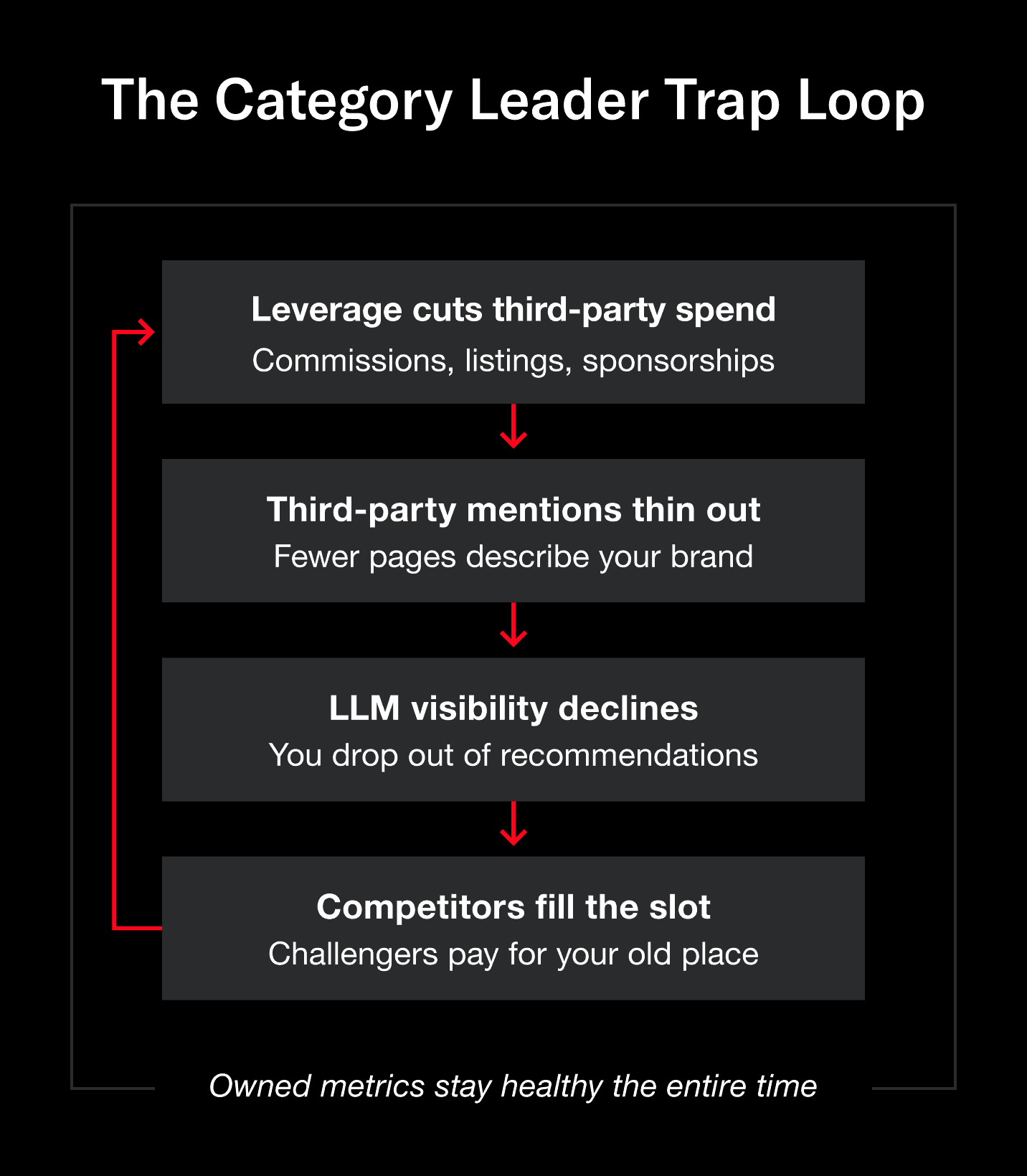
Put together, the loop runs like this:
- Leverage reduces third-party spend.
- Third-party mentions thin out.
- LLM visibility declines.
- Competitors fill the recommendation slot.
Throughout, your organic traffic, brand search volume, and owned-channel metrics stay perfectly healthy, long enough that nobody connects the first step to the fourth. The lag is the dangerous part since it’s long enough that the person who made the cut has usually been promoted before the cost shows up.
The slots you vacate don’t stay empty. Bluevine came to us as the largest small-business banking platform in the U.S. They’re competing against incumbent banks and publishers with an Ahrefs domain rating of 71 (a real authority disadvantage against the category leaders).
As our digital PR campaigns reached maturity, their LLM visibility rose from 44% to 71.1% over three months, driving more than 540 incremental citations across Gemini and ChatGPT. That’s a challenger taking recommendation share inside an incumbent’s category.
Siege’s own trajectory makes the same point from the other direction. Our visibility started at 33% in May 2025 and reached 57.6% by April 2026, without major changes to our approach, even as competitors began replicating our tactics. That growth came from staying in the source pool month after month, not from finding a new tactic.
Category leaders are the only players with the resources to step out of it without feeling the loss right away.
Diagnose The Trap in an Afternoon
The category leader trap is diagnosable. Finding and fixing most of these signals takes an afternoon with your visibility tracker and your affiliate reporting:
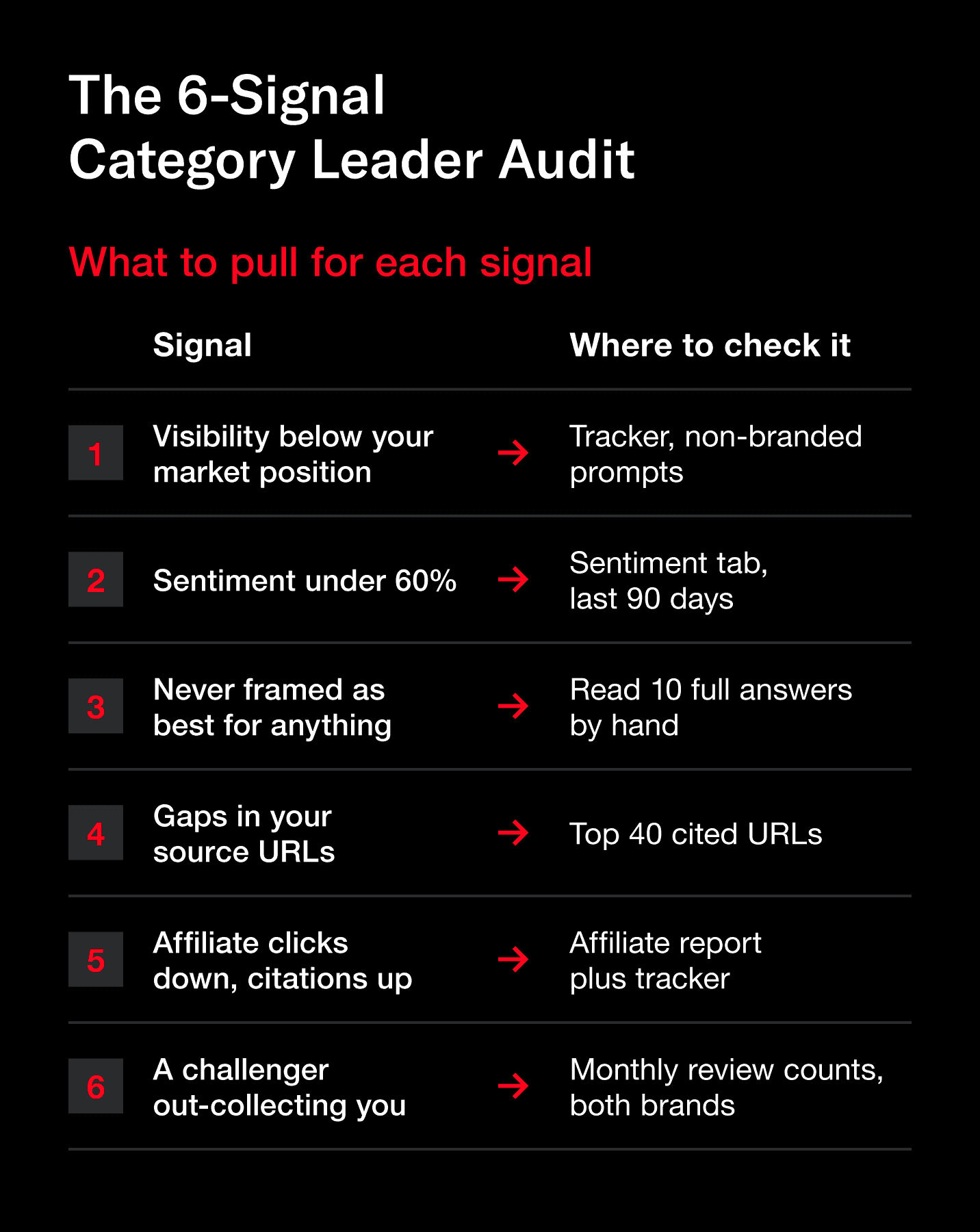
- Visibility below benchmark for your market position. If you’re the undisputed leader and sitting below 75%, you have a third-party signal problem, not a content problem. Fragmented markets are different. A leader just above 50% can be doing very well.
- Sentiment under 60% with recurring themes. Healthy sentiment is 70 to 75. Below 60 usually traces back to review sentiment, which leads to a real product or service gap, plus a review-generation gap.
- Mentioned constantly, but never framed as “best for X.” Appearing late in an answer doesn’t mean you’re the second choice, since you can appear late and still be the recommendation. What matters is whether the “best for” label stuck to you is one you’d choose. Auditing LLM brand visibility is what separates a fixable positioning problem from an assumed authority problem.
- Source-URL gaps. Pull your top 40 source URLs for the prompts you care about and count how many list you at all, and where. It’s surprisingly common to have a genuine affiliate partnership and still carry several gaps on pages that heavily influence answers.
- Falling affiliate click-through and conversion rate alongside rising citations. The signal most teams read backward. Shrinking engagement from affiliate pages can also mean those pages describe an outdated version of your brand.
- A challenger out-collecting you month over month. Your total review count can stay comfortably ahead while someone adds eight a month to your one. Leaders coast on an accumulated base, and the gap only shows up on the platform that actually gets cited.
Run your numbers against the benchmarks below before deciding which of these applies, and segment by product line while you’re at it. It’s entirely normal to have one product at 80% and another at zero.
| Assessment | Visibility | Sentiment | Position |
|---|---|---|---|
| Great | 75%–80% | 70–75 | 1–2 |
| Good | 55%–75% | 65–70 | 2–3 |
| Okay | 40%–55% | 55–60 | 3–4 |
| Needs improvement | 25%–40% | 50–55 | 4–5 |
| New product line or underperforming | 0%–25% | Under 50 | Over 5 |
Source: Siege Media benchmarks across dozens of industries from “Generative Engine Optimization: The Definitive Guide to AI SEO,” by Ross Hudgens.
The Corrective Playbook
Most of what follows below reverses a decision that was rational when it was made. Reopening a line item is a different internal conversation than proposing a new one.
“In a competitive marketplace, even pay-to-play systems result in the best companies winning out. If there are only five listings, the companies with the best products, margins, and landing pages will be the ones that can afford to pay sustainably. As an advanced example of this in action, search for ‘car insurance’ and look at the paid ads. You do not see seed-stage startups among the listings. You see companies like Geico, Allstate, and Progressive.”
Ross Hudgens
Founder and CEO, Siege Media
That durability is what makes the following six moves worth funding. They’re ordered by leverage, and the first one costs the least because you’ve already paid for it once.
Reinstate What You Already Canceled
Most leaders don’t need a new listing strategy. They need to reopen the three or four line items killed in the last two budget cycles.
Pull every sponsorship, directory listing, and partnership canceled in the past 24 months. Then, re-run the value with LLM influence included and check whether the URL you walked away from is now a top source in your prompt set. The uncomfortable finding is usually that the page got more influential after you left.
Re-running that math means valuing the citation alongside the click, which is where most reinstatement cases get made or lost.
Win the Review Race on One or Two Platforms
Splintering review effort across five platforms dilutes perception on all five. Pick one or two and go all in, choosing based on editorial bar rather than listing count.
The criteria that led Siege to its primary platform are that it declines reviews from non-clients, requires LinkedIn authentication, and gets on calls with reviewers. A platform that’s hard to game is a platform models can trust.
Picking the platform is the easy part; the reviews still have to be asked for. Collect NPS on a cadence, then go back every month to the customers who scored a 10, since those are the ones you’ll never get passively. Give one person responsibility for hitting a monthly review number.
Leaders skip this because a few hundred banked reviews feel like plenty, right until a challenger starts adding eight a month on the one platform that gets cited.
Commission the Roundup You Can’t Buy Into
Sometimes a dominant listing site has boxed you out, and no amount of money can change it. Fund the equivalent page from the next-most-cited partner who will have you.
Say the dominant source URL for “HR consulting services” belongs to a publisher that’s boxed us out.
The next-most-cited site in that space is one we already partner with, and they’ll place us wherever we ask — they just have fewer pages across the categories we serve. So we ask them to build the roundup, which either replaces the incumbent across the URLs it appears on or at least sits alongside it.
Quantify this process with traffic value plus citation frequency for your target prompts.
Fund the Creator and Editorial Circuit Again
On video, lead time is the constraint. You cannot retrofit a published roundup, so the pitch has to land before the next refresh cycle (roughly 12 months ahead of the citation you want).
Budget it like a brand investment, because that’s what the timeline resembles. A lean affiliate program is also a creator-acquisition problem, where uncapped upside is what gets you into the video.
On the editorial side, the pitch has to carry something creators can’t get elsewhere. Original research earns the mention where a product update won’t, which is why the publishers you stopped pitching are cheaper to win back than they look.
Correct the Record on Non-Affiliate Assets
In addition to your affiliate pages, other third-party assets describing you include Wikipedia, Crunchbase, social bios, award listings, and old press pages. Audit them yearly, or quarterly if your positioning moves fast, and check entity clarity while you’re there.
Ross’s book documents a company whose visibility read as 3% under the parent company name and 62% under the product name buyers actually search for. Split branding costs a category leader more than anyone, because the accumulated authority is what gets divided.
The same applies to your own comparison page framing, where listing yourself alongside two options nobody would actually pick tells a model nothing.
Fix the Instrument Before Defending Budgets
Deliberately last, because everything above depends on it surviving the next planning cycle. Add “How did you hear about us?” to every form and merge Google and AI responses in your CRM, since prospects rarely distinguish between them.
Then model the value from that number. If visibility sits at 55% and 55 customers a month self-attribute to AI, each additional percentage point is worth roughly one more customer. Without it, every move here gets defunded again based on the exact same evidence that defunded it the first time.
Siege Keeps Category Leaders Cited
Category leadership in organic search was built by owning assets. Category leadership in LLM answers is built by being described well, and often, by people who don’t work for you. Those are different jobs with different budgets, and for most dominant brands, the second has been getting quietly cut for years while the first looked fine.
Improving brand visibility in AI search starts with admitting the gap is commercial rather than technical. Start with the diagnostic and run your visibility number against the benchmark table above. That exercise reframes the internal conversation faster than any deck.
If the answer is uncomfortable, we can help. Siege Media is a full-service GEO agency including digital PR, affiliate and partnership strategy, original research, and comparison-led content. Being the category leader should be an advantage in AI search. For most brands, it isn’t yet.