A whopping 97% of content marketers report planning to use AI for content generation. With an adoption rate so high, it can only mean one thing: AI-generated and AI-assisted content is everywhere.
It’s hard to ignore the sheer volume of artificially-assisted content making its way across the web, social media, email, and more.
While spotting an AI-generated image often feels easy (I mean, just look for the missing limbs, added fingers, and elongated rooms), spotting AI-generated text is often more difficult. Despite our best efforts to learn the ways of the robot, LLMs were trained on human writing, so their language patterns and word choices often mimic ours.
This is where AI content detection tools come in. While they’re not 100% accurate all of the time, many of the best AI checkers can spot AI-generated writing from a mile away.
Below, we explore the best AI content detection tools and uncover their accuracy rates, tested personally for your (and our) benefit.
- Pangram – Best For Diverse Data
- Sapling – Best For Custom Workflows
- Winston AI – Best For Media
- ZeroGPT – Best For Casual Creators
- GPTZero – Best For Quick Detection
- Copyleaks – Best For Plagiarism
- Originality.AI – Best For Patented Tech
- Turnitin – Best For Academic Integrity
- Scribbr – Best Free Detector
- What Makes a Good Tool
- Limitations of AI Detection Tools
- 7 Tips For Finding an AI Writing Detector
- Build Authoritative Content
- Frequently Asked Questions
The Best AI Content Detection Tools At a Glance
From free to paid tools, this table provides a high-level overview of the top AI detectors, including their costs, features, and accuracy (based on our team’s testing).
Our methodology: Each tool below was selected based on a set of criteria, including accuracy, accessibility or availability, feature options, and pricing. For each accuracy score, our team tested six pieces of content (three AI-generated and three human-written) against each tool to determine a success rate. Accuracy scores listed in the table are out of six based on the success or failure of each scanned piece of content.
| Accuracy Score | Best For | Features | Pricing | |
|---|---|---|---|---|
| 1. Pangram | 6/6 | Diverse data and AI detection |
|
Free with paid plans from $15/month, billed annually |
| 2. Sapling | 2/6 | Custom and technical workflows |
|
Free with paid plans from $12/month, billed annually |
| 3. Winston AI | 5/6 | Publishers and media companies |
|
Free with paid plans from $10/month, billed annually |
| 4. ZeroGPT | 6/6 | Casual content creators |
|
Free with paid plans from $7.99/month, billed annually |
| 5. GPTZero | 6/6 | Quick detection |
|
Free with paid plans from $12.99/month, billed annually |
| 6. Copyleaks | 6/6 | Combined AI and plagiarism detection |
|
Free with paid plans from $13.99/month, billed annually |
| 7. Originality.AI | 5/6 | All-in-one patented technology |
|
Free with paid plans from $12.95/month, billed annually |
| 8. Turnitin | Unknown | Academic integrity |
|
Custom pricing |
| 9. Scribbr | 3/6 | Free AI content detection |
|
Free |
1. Pangram
- Best for: Diverse data and AI detection
- Pricing: Free with paid plans from $15/month, billed annually
- Accuracy rates
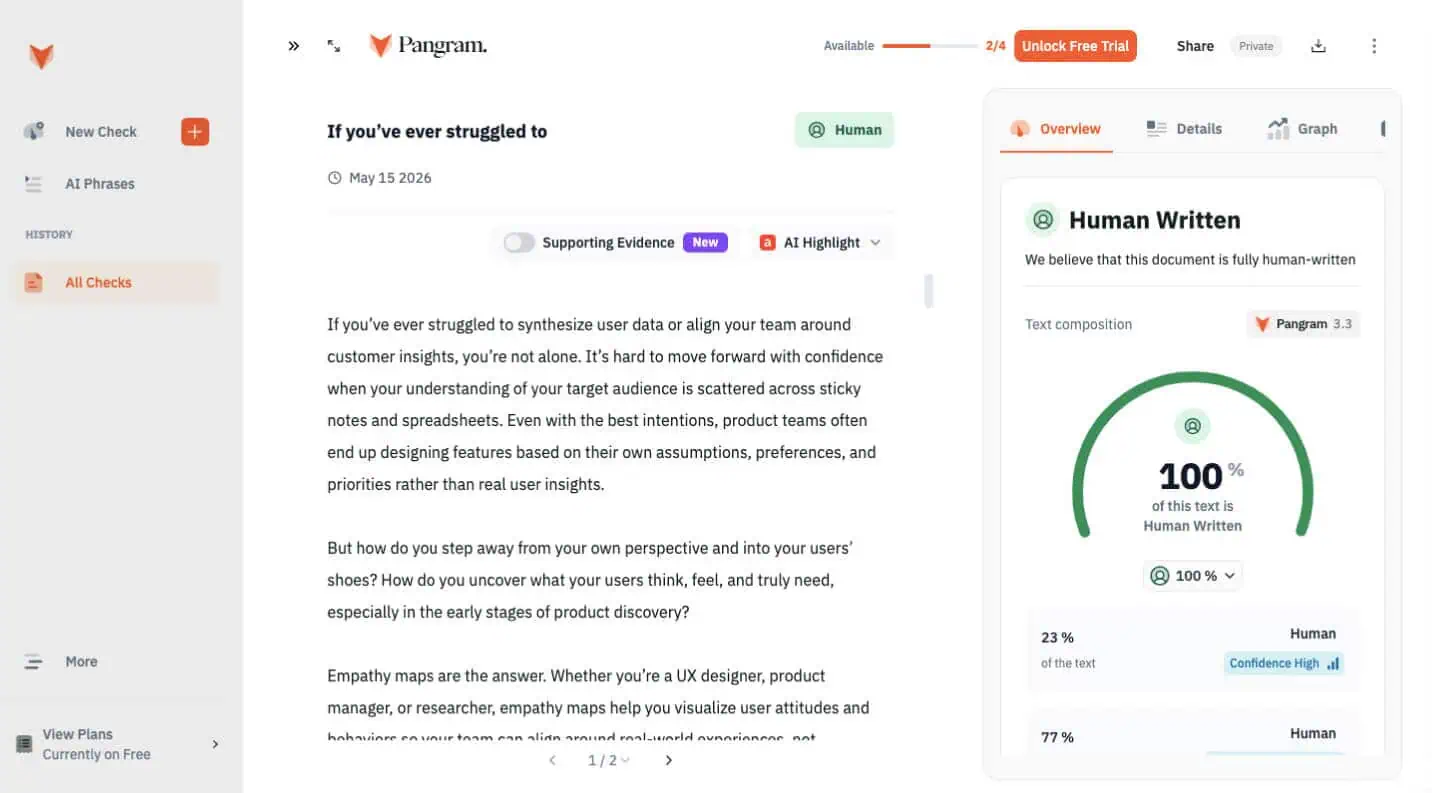
- AI-generated content: 3/3 (100%)
- Human-written content: 3/3 (100%)
With one of the highest accuracy rates in the game, Pangram (or Pangram Labs) is a user-friendly AI detector trusted by third-party evaluators. This tool combines cutting-edge AI verification with plagiarism detection to provide a comprehensive assessment of a text’s authenticity.
Pangram is also difficult to fool. Its AI segment analysis, assistance, and phrase tools highlight lightly edited content (rather than fully generated) and AI-like phrases, so you can be confident in what you’re reading or writing. Plus, it’s trained on diverse data and can scan across multiple languages while detecting content from all LLMs.
From the user’s perspective, this tool boasts superior web design and UX compared to other competitors. Pangram scans and presents its AI score in a matter of seconds, leaving clunky use cases and advertisements in its rearview mirror. And though the free plan offers only 4 credits a day, its premium-feeling features, such as supporting evidence and personal notes, are available at no additional cost.
Key features:
- Chrome extension: The installed extension labels the content you browse and tracks your feed’s health.
- Detector API: An API offering an instant result for text inputs with Python SDK and Inference API options.
- Plagiarism checker: Detects traditional plagiarism and external content across pages and text.
- Multilingual detection: Accurately detects AI-generated content in over 20 languages using text classifiers and training processes.
2. Sapling
- Best for: Custom and technical workflows
- Pricing: Free with paid plans from $12/month, billed annually
- Accuracy rates
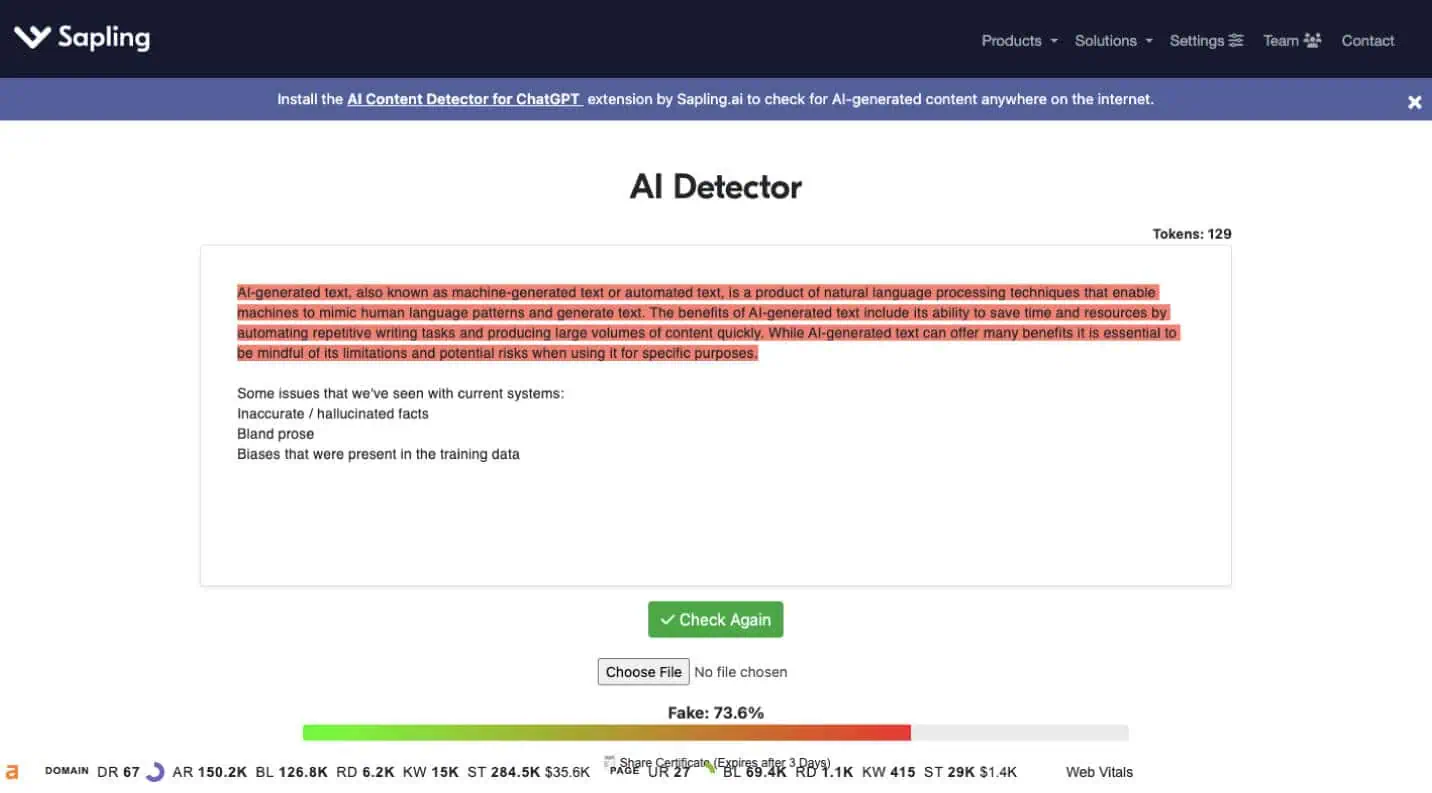
- AI-generated content: 2/3 (67%)
- Human-written content: 0/3 (0%)
Sapling started as a writing enhancement platform before expanding into AI detection, and it functions best inside existing workflows rather than as a standalone tool. The AI text detector integrates directly with Google Docs, Microsoft Word, and content management systems (CMSs), enabling detection during the writing process.
Despite Sapling’s high-accuracy claims, our independent testing found it accurate only about one-third of the time. Results are presented as a probability score, which is useful but lacks the granular sentence-level highlighting offered by some competitors. However, it may be a strong fit as a first-pass filter in an automated pipeline.
Key features:
- Multi-file support: Reads and flags copy across different files, including PDFs and DOCX files.
- Detector extension: The tool’s extension allows users to check for AI-generated content across webpages.
- Model compatibility: Sapling is regularly updated to support evolving AI models while maintaining compatibility with older models.
3. Winston AI
- Best for: Publishers and media companies
- Pricing: Free with paid plans from $10/month, billed annually
- Accuracy rates
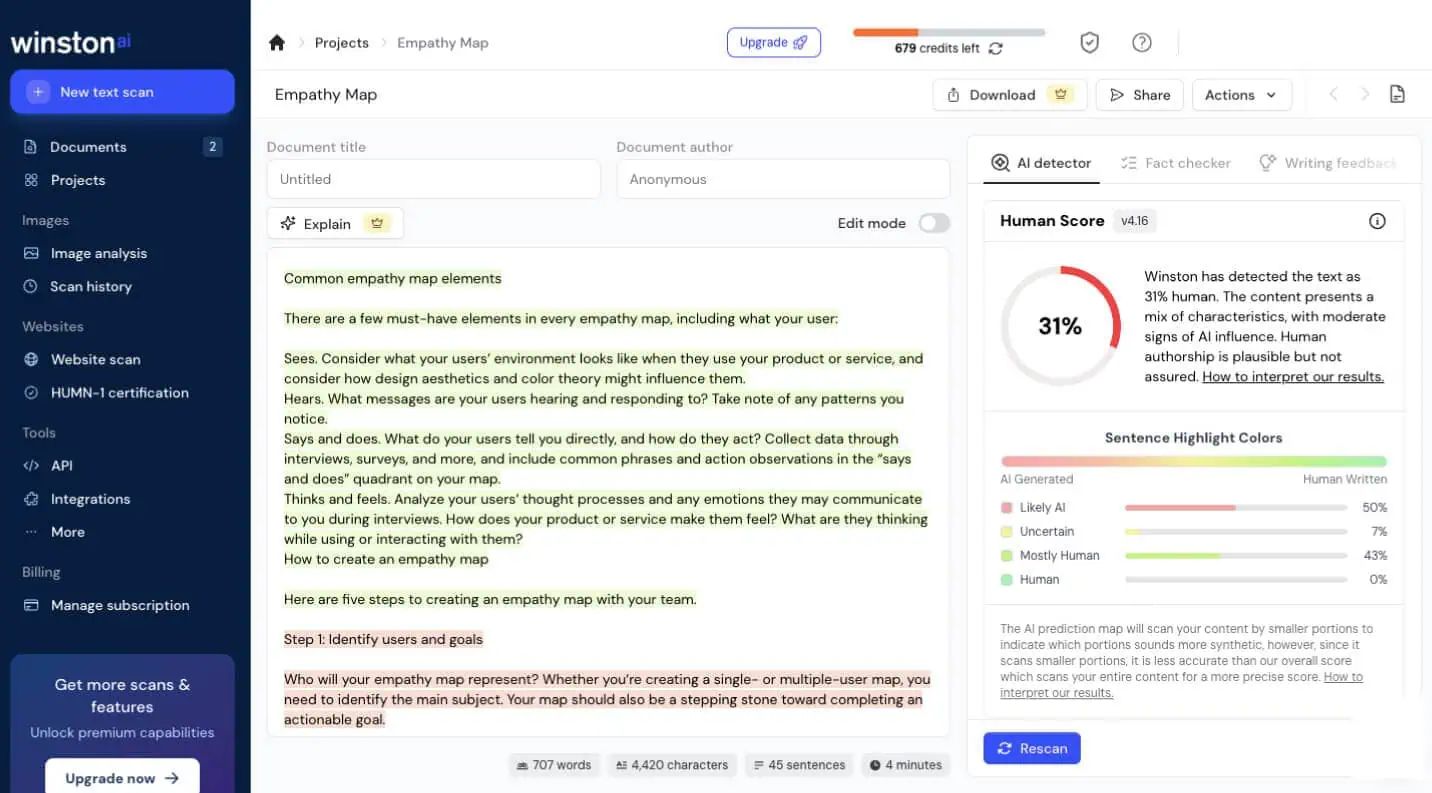
- AI-generated content: 3/3 (100%)
- Human-written content: 2/3 (67%)
Launched in 2023, Winston AI is one of the more feature-complete AI checker options in the AI detection space. This tool offers text detection, plagiarism checking, image and deepfake analysis, OCR scanning for handwritten or photographed documents, and more.
While the tool reports an accuracy of about 99%, our small test sample found it to be about 83% successful. Winston AI is more accurate at detecting AI-generated content than human-written copy or creative writing. However, the versatile, well-designed tool’s standout features make it a strong pick across the board.
Key features:
- Image analysis: Includes AI image and deepfake detection (even at the free tier) to verify the authenticity of visual content.
- HUMN-1 certification: The first human content certification for websites and blogs that certifies a site’s content is both human-created and original and acts as a trust signal.
- Text comparison: The tool includes a text comparison tool to detect similar content alongside its built-in plagiarism checker.
4. ZeroGPT
- Best for: Casual content creators
- Pricing: Free with paid plans from $7.99/month, billed annually
- Accuracy rates
- AI-generated content: 3/3 (100%)
- Human-written content: 3/3 (100%)
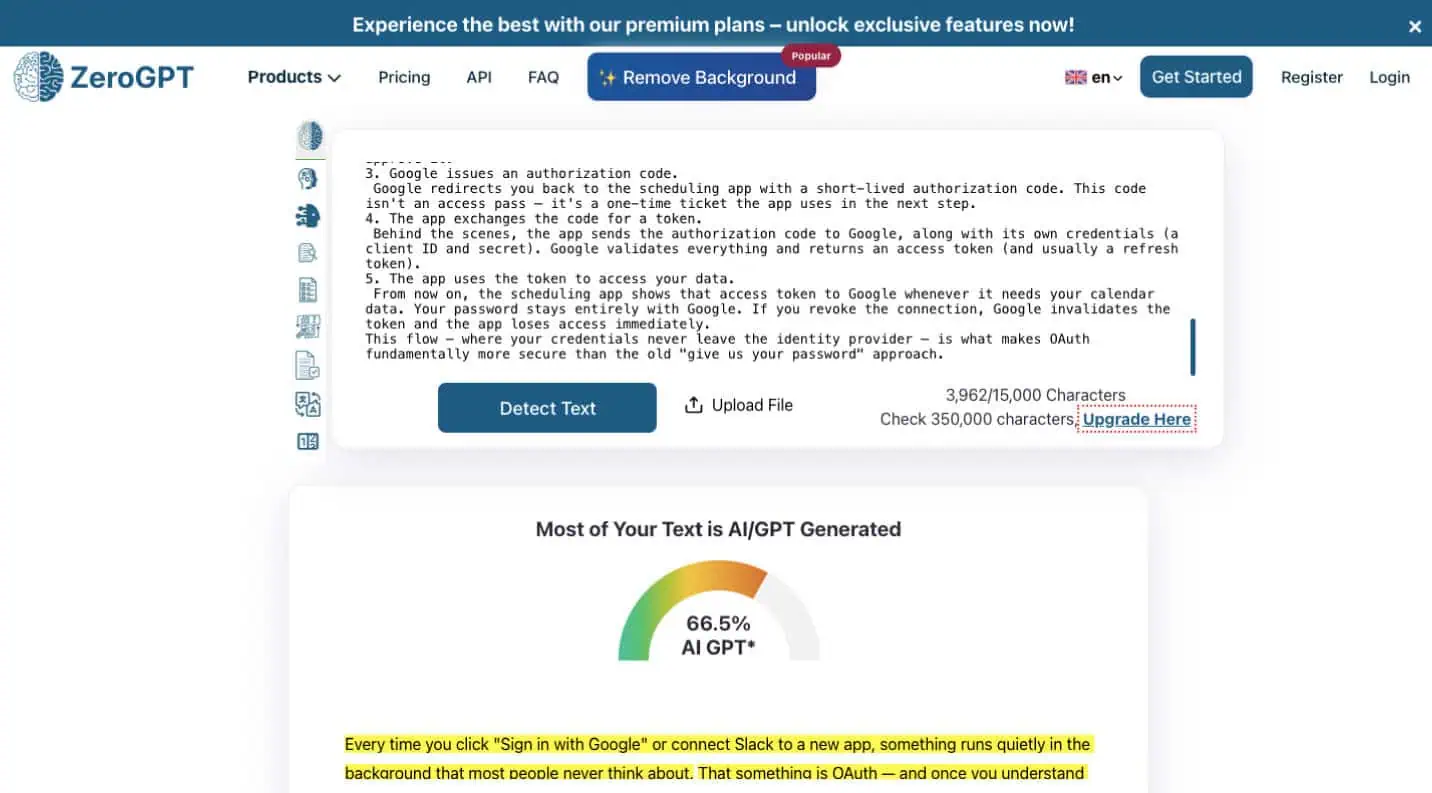
ZeroGPT is a widely used free AI detector that serves students, teachers, and content creators. The tool originally began as a standalone detector but now identifies AI-generated content, with additional features such as a plagiarism checker, a summarizer, and an AI chatbot. The free tier requires no sign-up and imposes no word limits on core detection, and the tool is available on casual-use platforms, like WhatsApp.
Like some of the other free competitors on this list, the platform’s ad-based interface slows down the tool’s analysis and impairs the UX. Also, ZeroGPT is primarily optimized for ChatGPT and GPT-4 outputs and may be less reliable for content generated by other language models.
Key features:
- AI humanizer: A feature designed to rewrite AI-generated content in a more natural, human-like style.
- Paraphrasing tool: Available across all tiers, this feature reformulates text and adjusts tone and style to improve clarity and uniqueness.
- Grammar checker: Identifies and corrects grammar, spelling, and punctuation errors without losing brand voice.
5. GPTZero
- Best for: Quick detection
- Pricing: Free with paid plans from $12.99/month, billed annually
- Accuracy rates
- AI-generated content: 3/3 (100%)
- Human-written content: 3/3 (100%)
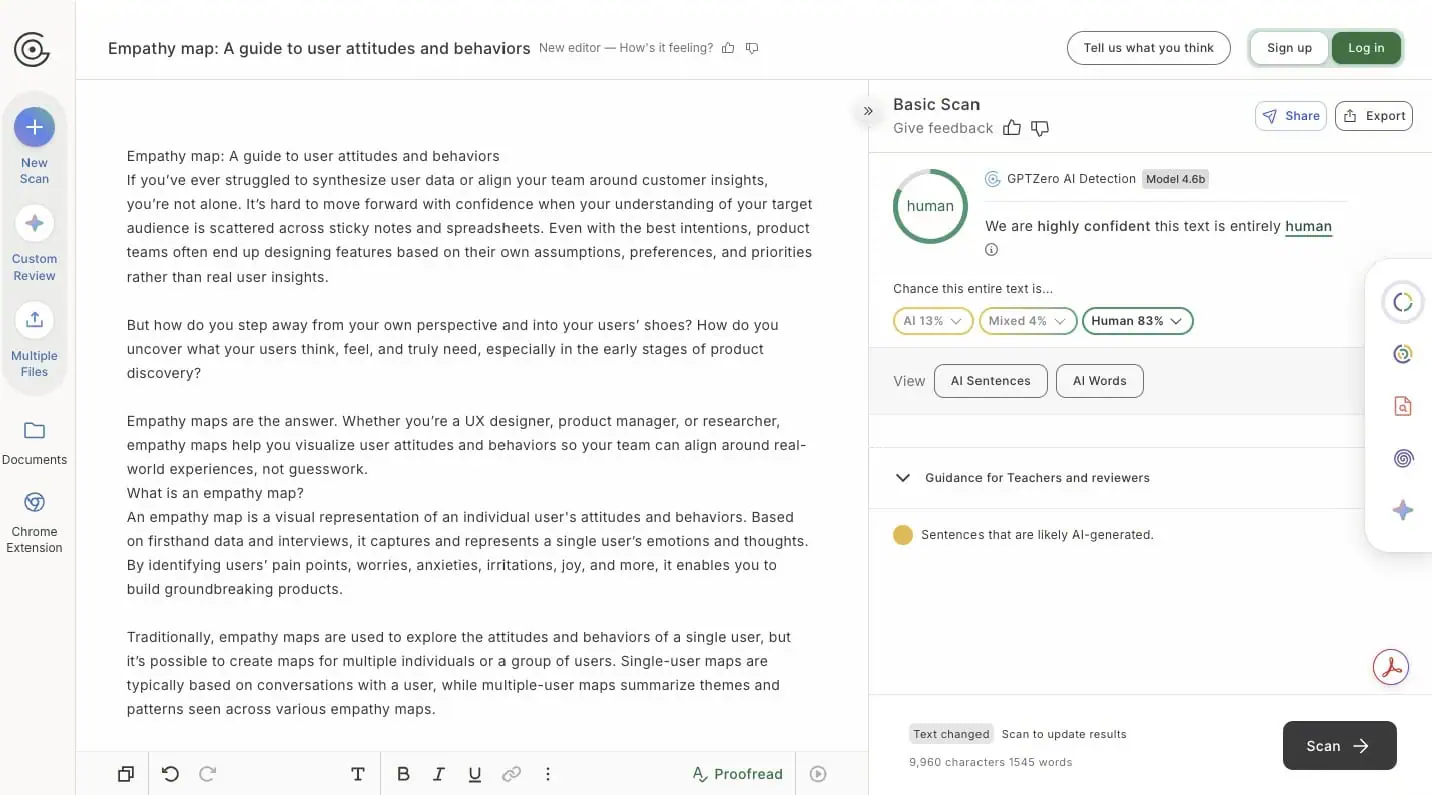
Yes, GPTZero is different from ZeroGPT, and they both deserve to be on our list. Launched in 2022 as one of the first AI detection tools on the market, GPTZero offers a free tier with monthly word limits and paid tiers with expanded features. The platform’s advanced sentence scanning highlights problematic phrases and offers standout features like hallucination identification.
Despite its prominence in the AI detection space, GPTZero often fails to label text processed by a humanization tool correctly. However, it remains a strong and reliable contender for teams running light spot-checks on unedited drafts.
Key features:
- Advanced scan: Adds an “AI Vocab” tab at the sentence level that flags word choices typically more common in AI-generated text.
- Hallucination identification: A verification process that compares citations to external sources and flags fabricated phrases.
- Expert feedback: The tool’s AI Grader allows batch uploading and combines AI detection with feedback on writing quality.
6. Copyleaks
- Best for: Combined AI and plagiarism detection
- Pricing: Free with paid plans from $13.99/month, billed annually
- Accuracy rates
- AI-generated content: 3/3 (100%)
- Human-written content: 3/3 (100%)
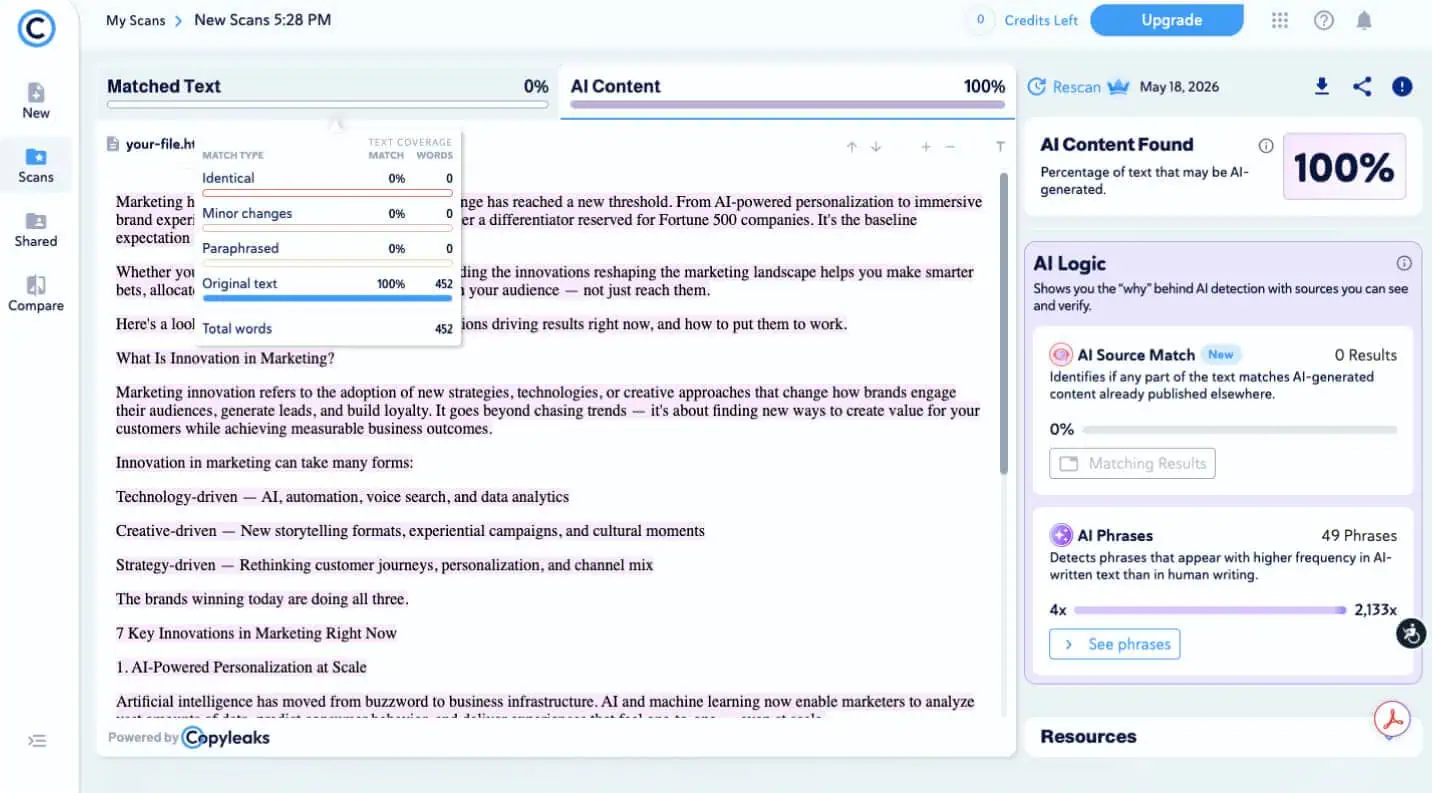
A trusted plagiarism-detection platform since 2015, Copyleaks added AI detection to its toolset in 2023. This enterprise-grade tool serves educational institutions, enterprises, publishers, and compliance teams worldwide. It also offers a wide range of features, including API access, team management, and GDPR compliance.
This tool’s accuracy is strong for both AI and plagiarism detection. However, the caveat for Copyleaks is the same one that applies across AI checkers as a whole: Accuracy scores on humanized or heavily edited AI content vary and should be accounted for. Where it earns its place on this list is the combination of depth and versatility for teams running detection at scale.
Key features:
- Multilingual support: This tool supports over 30 languages for AI detection, with plagiarism checking extending to 100+ languages.
- Source code detection: Copyleaks can detect plagiarism in code across languages such as Java and Python.
- LMS integration: Integrates directly with major Learning Management Systems (LMSs), including Canvas, Moodle, and Blackboard.
7. Originality.AI
- Best for: All-in-one patented technology
- Pricing: Free with paid plans from $12.95/month, billed annually
- Accuracy rates
- AI-generated content: 3/3 (100%)
- Human-written content: 2/3 (67%)
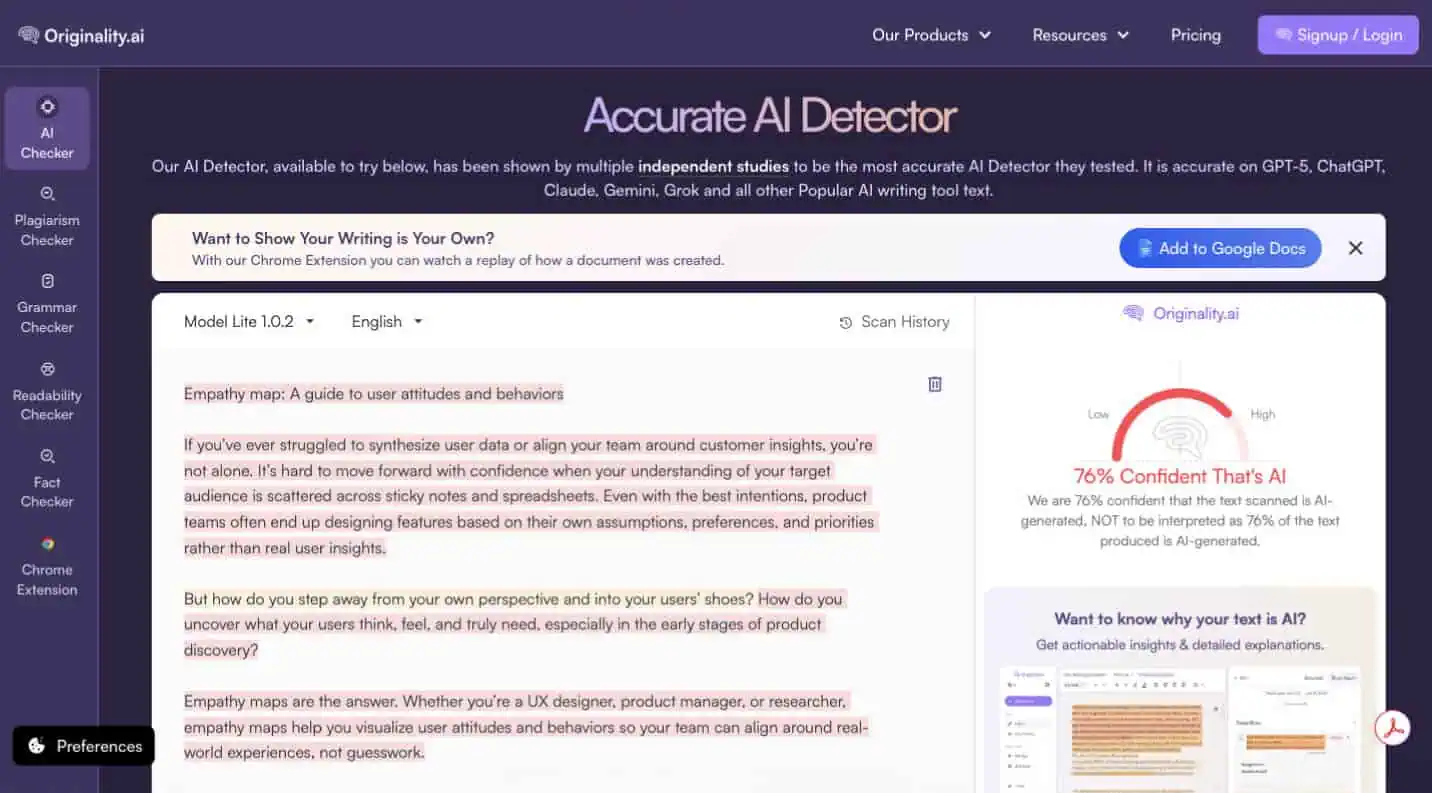
Originality.AI is another AI detection tool with free and paid options available. The tool’s free version scans up to 12,000 characters at a time. However, its daily limits require users to sign up for an account or buy credits as they go. Plus, its selection options make it easier for users to scan for AI, plagiarism, accuracy, readability, and more.
Paid tiers include additional features like increased word limits, detector reports, plagiarism detection, API access, and a suite of team tools. No matter what tier you choose, Originality.AI uses patented AI detection to analyze and verify text.
Key features:
- Deep scan: A tool that explains why copy is flagged as AI-generated and offers tips for ethical editing.
- Fact checker: A tool that helps writers ensure their content is factually accurate before publishing.
- Bulk scan: The platform’s ability to scan multiple documents, pieces of content, or entire websites at one time.
8. Turnitin
- Best for: Academic integrity
- Pricing: Custom pricing for schools, universities, and academic institutions
- Accuracy rates: Unknown for individual use
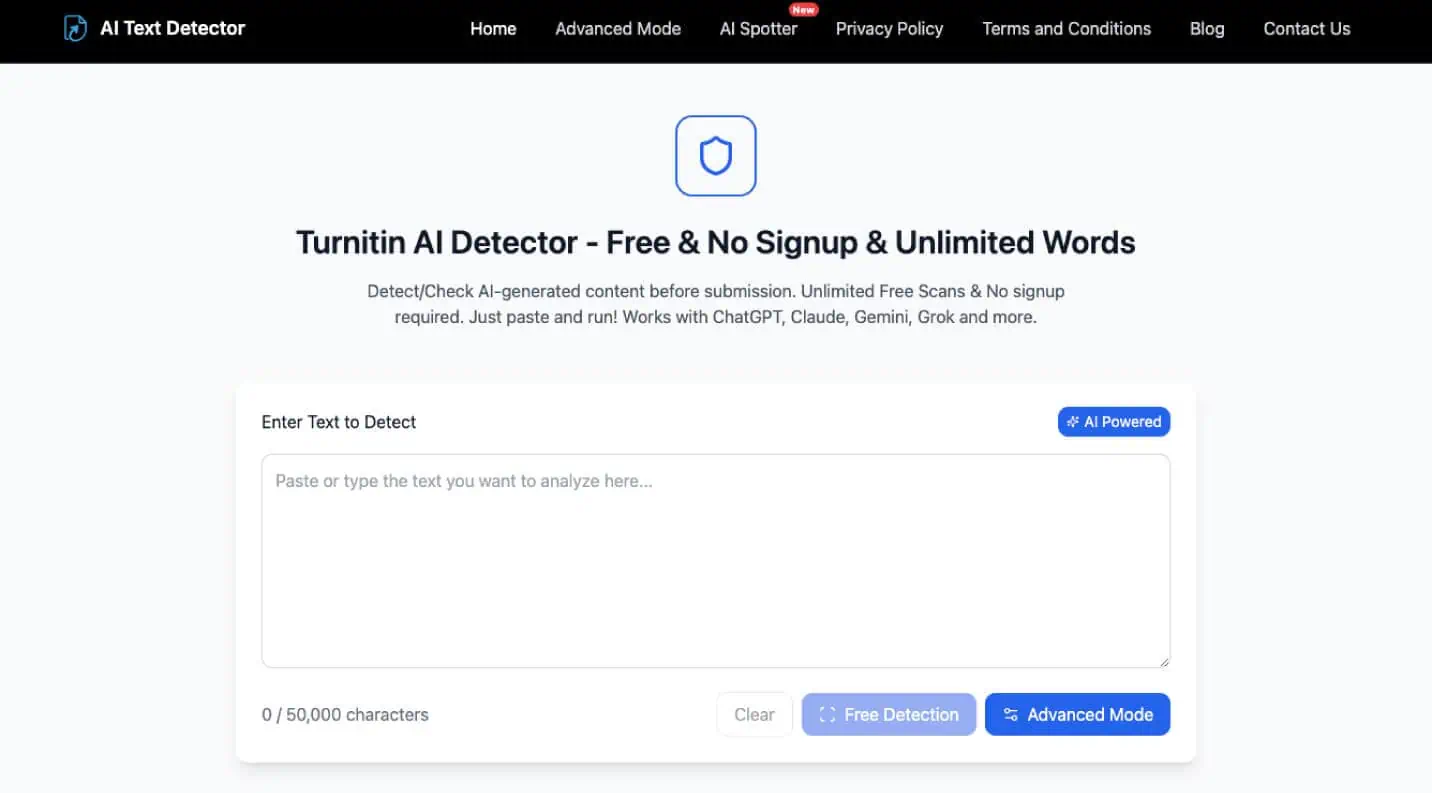
Turnitin has been a leading name in plagiarism detection for decades, and it added AI writing detection to its platform in 2023. This tool is sold exclusively to institutions on annual licenses, meaning individual or self-serve access is limited (or impossible). However, it integrates quickly and easily with LMSs, making it a clear choice for many academic institutions.
As noted, the lack of individual access makes this tool more difficult to obtain and use. Given this, we were unable to test Turnitin’s detection accuracy independently, and we now rely on its self-reported 99% accuracy rate. Plus, pricing is opaque with no public rate sheet, positioning this platform as a potential contender that will require additional in-house research.
Key features:
- Data privacy: The tool processes data in accordance with security protocols and does not store it on its servers.
- Advanced mode: Additional analysis, sentence-level detection, and comprehensive reports.
- Instant detection: Near-instant detection for texts up to 5,000 words, with longer texts scanned in under a minute.
9. Scribbr
- Best for: Free AI content detection
- Pricing: Free
- Accuracy rates
- AI-generated content: 1/3 (33%)
- Human-written content: 2/3 (67%)
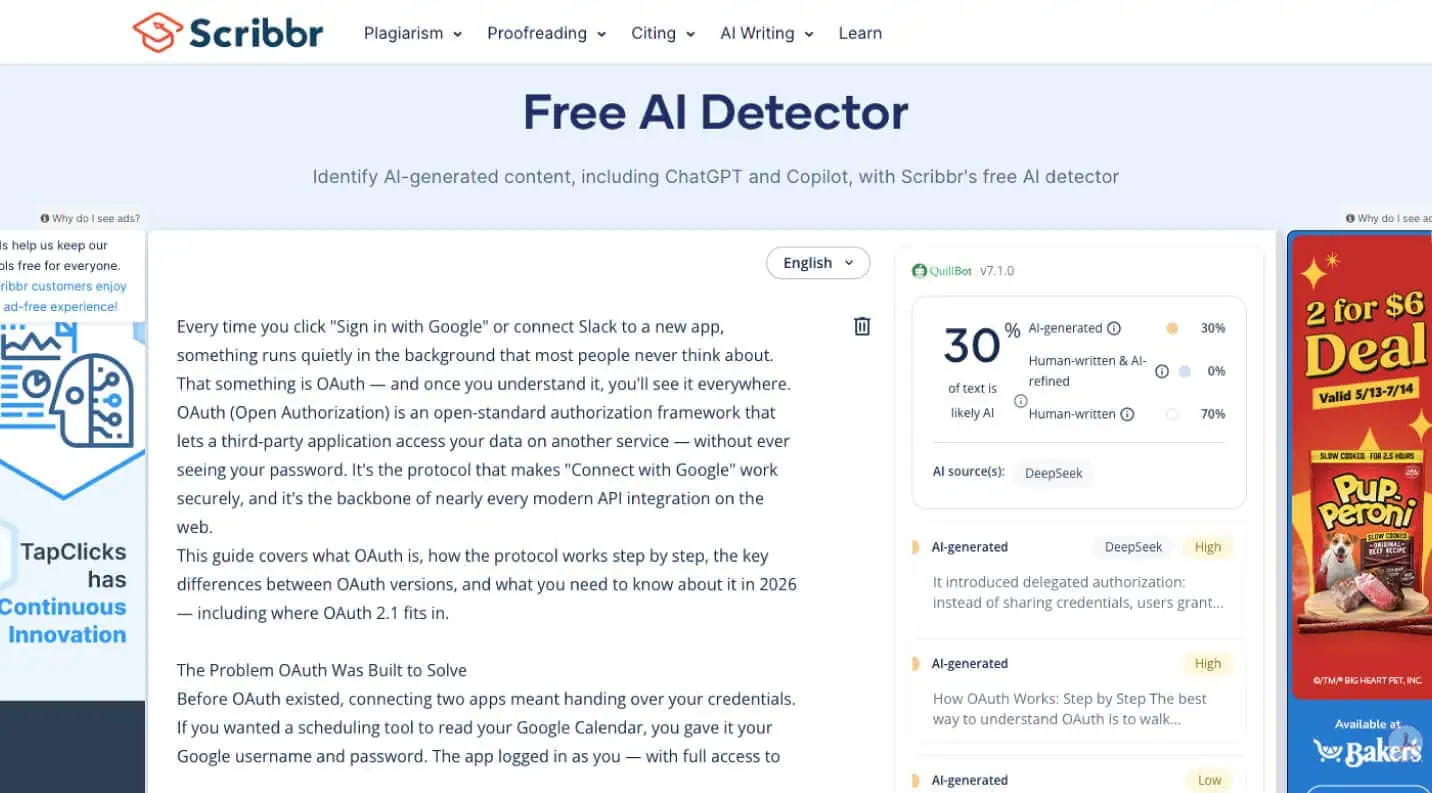
Scribbr began as an academic proofreading and content editing service before expanding into a broader writing assistance platform. Its AI checker engine, powered by QuillBot, provides sentence-level probability insights, segment-specific analysis, and percentage-based scores.
While this tool offers robust free AI checks, the trade-off is its accuracy. During our testing, we found that the tool achieved a 50% success rate, which should be a meaningful consideration for teams considering it. Additionally, the platform was primarily trained on GPT-2 and GPT-3.5, which may mean model coverage lags behind the tools most writers use.
Key features:
- Multilingual support: Supports detection across multiple languages, including German, French, and Spanish.
- Paraphrasing detection: The tool identifies fully AI-generated, AI-assisted, and human-written content.
- Unlimited free checks: Offers unlimited detection for submissions with 1,200 words or fewer.
What Makes A Good AI Content Detection Tool?
A good AI detection tool may work 75% of the time, but a great AI detector should have a near-negligible false-positive rate. In addition to their accuracy, consider these detector features:
- Model detection: Detection should work across multiple AI models with support for various languages.
- Regular updates: AI checkers should support a regular update cadence and be aware of model updates as they are released.
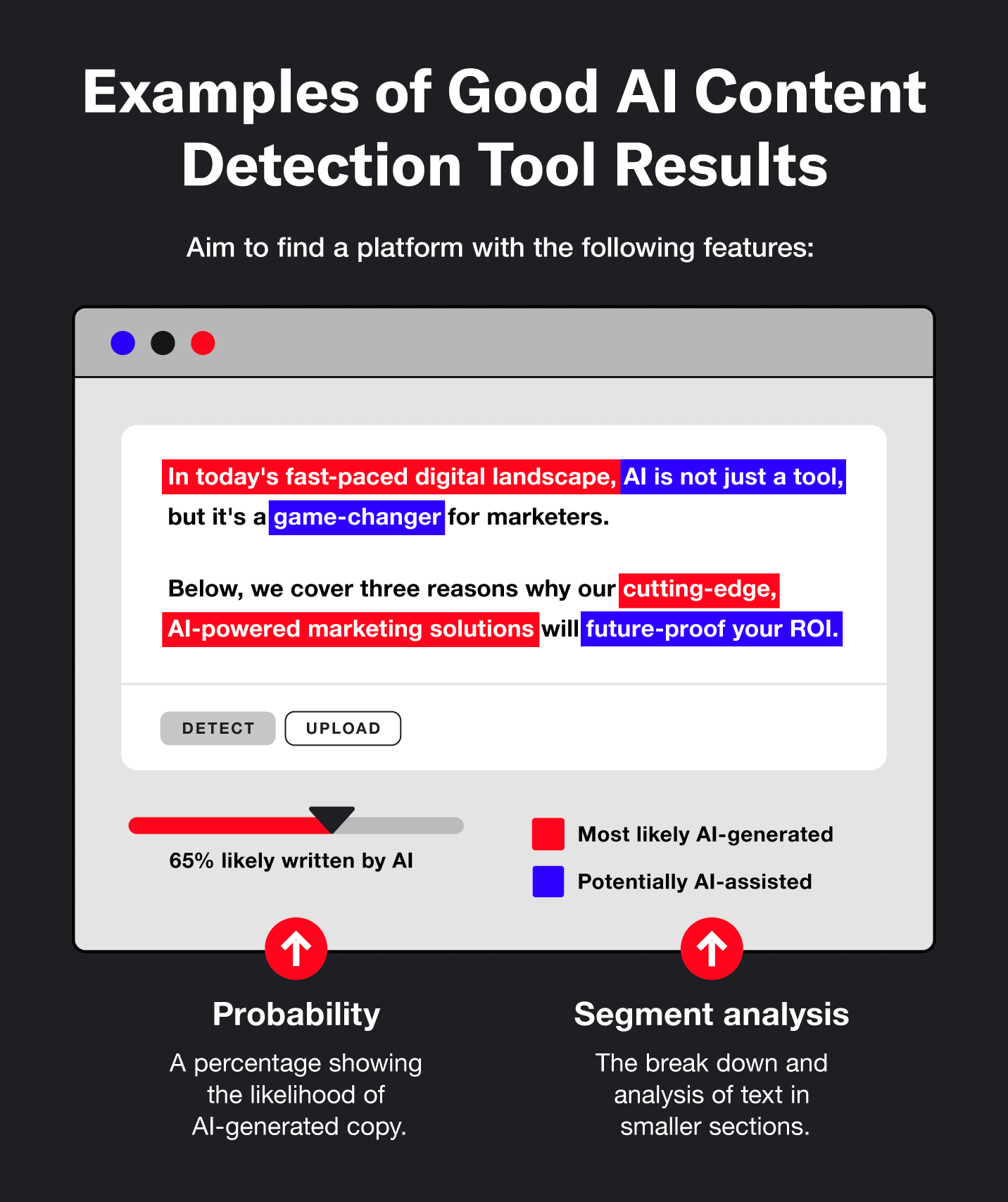
- Detailed classification: Multi-tier classification systems allow users to separate AI-assisted copy from fully AI-generated works.
- Third-party validation: Independently tested tools and accuracy validation set apart serious tools from self-reported ones.
- Readable results: Segment-level analysis lets you see what copy triggered the detector and make actionable decisions.
- Evasion detection: Tools should be trained on difficult examples to help them identify evasion attempts and deception.
What Are The Limitations of AI Content Detection Tools?
AI checkers are an effective addition to a content creation toolkit. However, there are some important limitations to be aware of before putting all your eggs in one AI detector basket, including:
- False-positive rates: AI detectors may flag human-written content as AI-generated when it is clear, concise, or follows predictable patterns.
- Model updates: Trained on outputs from specific AI models at a point in time, detector accuracy degrades as models are updated.
- Deceivable: Using paraphrasing tools or making minor text edits can significantly drop an AI score, fooling a detector into believing AI-generated content is human-generated.
- Short-form content: Detectors may perform better on content with more than 300 words, so scores for passages like meta descriptions, social copy, and product descriptions are often unreliable.
- Individual standards: With no standardized benchmark for measuring detection accuracy across tools, comparisons are difficult.
- Language bias: Some detectors disproportionately flag content written by non-native English speakers as AI-generated, raising both accuracy and fairness concerns.
7 Tips For Finding A Trusted AI Writing Detector
No AI checker is the same. Whether you’re working in B2B content marketing, finance, or some other industry, consider these tips and tricks for choosing a detection partner:
- Look for transparent accuracy rates from tools with reputable methodology and accuracy benchmarks.
- Check for update frequency and a documented update cadence that keeps pace with new model outputs.
- Use known content to test the tool and verify that the results accurately reflect the project.
- Prioritize probability scoring or text highlights over binary verdicts like “AI” or “human” labels.
- Understand how the tool uses data and ensure it complies with your compliance and regulatory requirements.
- Read user reviews alongside case studies for more reliable signals than a tool’s marketing page.
- Consider your content type and match the tool to your actual use case for more reliable results.
Build Trustworthy and Authoritative Content
Whether you’re creating an ad or writing a research report on a niche topic, your audience needs to believe that you know what you’re talking about. If they think you trusted a mistake-prone robot to handle your product descriptions or trends reports, they may not trust you as their partner.
Siege Media’s content creation services combine the efficiency of AI-supported content with the authority of subject matter experts, world-class designers, and digital PR specialists. Plus, we use AI content detection tools to prove we’re as good as we say and to show web crawlers just how much they can trust our words.
Reach out and let’s talk about how to create powerful, visible content for your brand today.
Frequently Asked Questions
What Is An AI Content Detection Tool?
An AI content detection tool is software that analyzes text to determine whether it was written by a human or generated by an LLM such as ChatGPT, Claude, or Gemini.
These tools use natural language processing (NLP) to identify structural, stylistic, and semantic patterns common to AI-generated writing. Content teams, publishers, educators, and editors can use them to verify the authenticity of written work before publication.
How Accurate Are AI Content Detection Tools?
The accuracy of AI content detection tools varies significantly. Leading detectors like Pangram may report accuracy rates above 95% for fully AI-generated content, with some claims independently verified by academic institutions.
However, this accuracy rate is typically lower across other forms of content, including hybrid copy and short-form text. It’s important to note that no tool is 100% accurate, and false positives exist.
Can AI Content Detection Tools Be Fooled?
Yes, you can fool an AI content detection tool. Using paraphrasing tools or making light manual edits can impact AI detection scores. Additionally, tools may struggle with passages under 300 words where there isn’t enough text to identify reliable patterns.
What’s the Difference Between AI Detection and Plagiarism Detection?
Plagiarism and AI detection are different:
- AI detection identifies machine-generated copy with no original source to match against.
- Plagiarism detection identifies content copied from existing sources and checks it against a database of published material.
Some tools, like Pangram and Copyleaks, may be suitable for detecting both AI-generated copy and plagiarized content.