
A customer who left a middling G2 review last quarter could now influence how an AI engine describes your brand. For marketers focused on generative engine optimization (GEO), earning a mention is only part of the equation. The sentiment behind user reviews matters, too.
This becomes especially important for commercial prompts like “Is X good?”, “X vs. Y” or “alternatives to X.” Buyers are asking AI engines to evaluate a company, not just locate one.
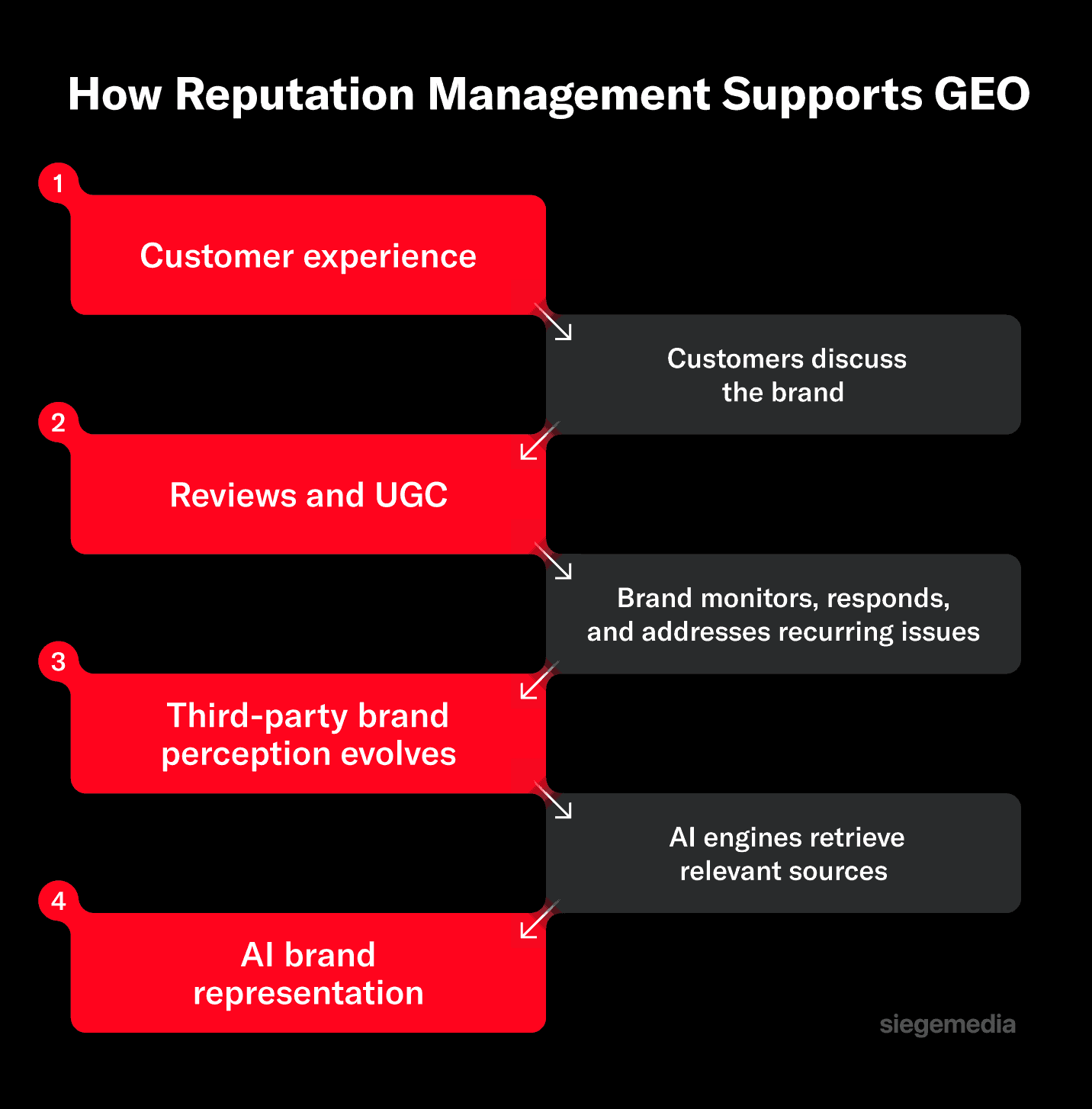
Reputation management now sits inside AI visibility, alongside customer experience. It goes beyond responding to reviews to include monitoring conversations across Reddit, LinkedIn, G2, and other third-party platforms.
This guide walks through a sentiment audit you can run this week and a reputation management playbook to help inform your GEO, content, and CX strategies.
- Why Reviews Matter for Visibility
- How To Audit AI Brand Sentiment
- Review Management Strategies
- How to Measure AI Brand Sentiment
- GEO Goes Beyond Content
- Strengthen GEO With Reputation Management
Why Reviews Matter for AI Visibility
Brand visibility in AI search is only part of the equation. Authority and relevance can help your brand earn a mention, while the sources an AI engine retrieves can influence how it describes you.
When a buyer asks an AI engine whether your software is worth the price, the answer often draws on what customers wrote on G2, Reddit, and app stores.
For commercial prompts, user-generated content (UGC) from G2, Capterra, Trustpilot, Reddit, and app stores can provide context that owned content can’t. Your homepage might call your software easy to use, but if G2 reviewers keep mentioning a steep learning curve, expect AI engines to mention it, too.
The quality of those conversations matters, too. Siege Media and Pangram analyzed 802 Reddit posts cited in AI search responses and found higher levels of likely AI-generated content in professional communities.
Tech, marketing, SEO, and SaaS subreddits averaged an AI-likelihood score of 0.215, compared with 0.001 for non-tech communities. As synthetic content spreads in the communities AI engines cite, real customer conversations will be harder to find and more valuable when you have them.
How To Audit AI Brand Sentiment
Start an AI sentiment audit with the questions your buyers are most likely to ask. Build a consistent set of commercial prompts, like “[Brand] vs. [Competitor],” “Is [Brand] good?” and “best [category] for [use case],” then run them across relevant AI engines.
For each response, track:
- Brand visibility: Note whether your brand appears and how prominently it’s featured.
- Brand sentiment: Record recurring adjectives, strengths, weaknesses, and other ways the AI engine characterizes your brand.
- Cited sources: Identify the review platforms, UGC sites, and other sources the response references.
- Competitor sentiment: Compare how competitors are described and flag areas where they’re framed more favorably.
- Recurring themes: Flag descriptions that repeat across prompts and engines. One response is an anecdote; five is a pattern.
Organize the findings in a simple sentiment matrix that tracks prompts, AI models, citations, descriptors, and competitor differences.
For example, if your brand is repeatedly characterized as “powerful but difficult to use” while a competitor is described as “beginner-friendly,” you’ve identified a specific perception gap to investigate. Repeat the audit with the same prompts over time to monitor directional changes in how AI engines represent your brand.
Review Management Strategies
Once you know which sources shape your AI reputation, use those findings to prioritize your reputation management efforts. Focus on the platforms and conversations that consistently surface in relevant AI responses rather than treating every review channel equally.
Monitor the Sources AI Engines Retrieve
Track the sources that appear across your AI sentiment audit and note which ones surface most often for high-value commercial prompts. Your CX team may already monitor major review platforms, but your audit could uncover influential Reddit threads, LinkedIn discussions, or industry-specific communities outside its usual workflow.
Tracking Reddit sentiment and conversations across other third-party platforms can help you identify recurring complaints, emerging trends, and gaps in how customers understand your brand. Share these findings with your content, GEO, and CX teams to inform messaging and address customer concerns.
When a platform allows it, flag reviews that clearly violate its policies, such as fake or fraudulent reviews, for removal. This helps prevent inaccurate feedback from distorting your overall rating and brand perception.
Respond to Reviews Systematically
Create a consistent process for responding to reviews on the platforms that matter most to your AI visibility. Aim to respond within 24 hours when possible, particularly when a customer raises a problem you can resolve.
A quick, specific response gives you an opportunity to address the issue while the experience is still fresh and may encourage a dissatisfied customer to update their review.
Avoid generic replies. Address the customer’s specific concern and explain how you’re resolving it or clarify inaccurate information when appropriate. Even if the reviewer doesn’t change their rating, your response gives prospective customers additional context and shows that your brand takes feedback seriously.
Fix Recurring Themes at the Source
Review responses can clarify individual complaints, but they can’t solve a pattern of negative customer experiences. If customers repeatedly mention a difficult onboarding process or confusing pricing, share those findings with the teams that can address the underlying issue.
Improving the actual customer experience gives future reviewers a reason to describe your brand differently and can gradually shift the broader conversation.
Reinforce Accurate Positioning
Use your audit to identify gaps between how your company positions itself and how customers actually describe it. Then use those insights to improve your content, GEO strategy, review responses, and other customer-facing communication.
Reputation management can influence the information AI engines encounter, but it can’t guarantee more positive AI sentiment. Responding to reviews and addressing customer concerns may strengthen the sources shaping your brand perception, but you can’t control how AI engines interpret or present that information.
The goal is to reinforce accurate positioning while leaving room for authentic customer opinions.
How to Measure AI Brand Sentiment
Use your initial sentiment audit as a baseline, then track directional changes in brand perception over time. Look for fewer negative descriptions and more consistent, competitive positioning in how AI engines characterize your brand.
Alongside AI sentiment, track reputation management metrics that show how effectively your team addresses customer feedback:
- Review response times: Measure how quickly your team responds to feedback, with a goal of responding within 24 hours when possible.
- Recurring customer issues: Track common complaints across reviews and community discussions to identify trends and monitor improvements over time.
- Sentiment trends: Monitor changes in positive, neutral, and negative feedback across G2, Reddit, LinkedIn, and other relevant platforms.
These metrics help you evaluate your reputation management efforts, but improvements don’t guarantee more favorable AI-generated responses. LLM outputs and cited sources can vary, making long-term patterns more useful than isolated responses.
Track AI sentiment alongside brand visibility and citation frequency, and measure GEO ROI to connect these shifts to broader business outcomes.
GEO Goes Beyond Content
Most companies already have a team handling reviews. Reputation-focused GEO takes that work further by monitoring conversations across review sites, social platforms, and online communities.
These discussions can reveal opportunities to improve your content, GEO strategy, and customer experience while helping you understand how buyers perceive your brand.
This work complements other GEO tactics. Authoritative content and digital PR to rank in LLMs can help brands earn visibility, while reputation management addresses the perception surrounding those mentions. Together, these efforts can strengthen the information AI engines encounter without guaranteeing how they represent your brand.
Strengthen GEO With Reputation Management
AI engines now summarize what customers say about you, and buyers often see that summary before they ever reach your site. You can strengthen the sources shaping your reputation, even without controlling every conversation.
Siege Media has already helped brands translate search strategies into measurable gains in AI visibility. Our work with fintech AI platform Hebbia contributed to an approximately 4x increase in LLM visibility, from 9.94% in November 2025 to 42.17% by August 2026, alongside a 192% increase in site traffic.
Our GEO services help brands strengthen their presence across AI search. We also support community engagement and reputation management across third-party platforms, including authentic participation on Reddit through our Reddit marketing services.
Contact Siege Media to build a GEO strategy that strengthens how AI engines find and represent your brand.