
Your dashboard says LLMs drive 5% of revenue. When asked, your customers say it’s closer to 35%. One of those numbers is wrong, and it’s not the one you’re showing your CFO.
That gap is killing GEO budgets, which should be growing right now. The 35% comes from our own generative engine optimization (GEO) clients, where we sit at the high end of the range. But the disconnect shows up everywhere, and it’s the reason most GEO programs get cut before they prove anything.
GEO, or optimizing for visibility inside LLMs like ChatGPT, Gemini, and AI Overviews, doesn’t get beyond the pilot stage. This is because the referral attribution looks flat. Meanwhile, your sales team hears something different.
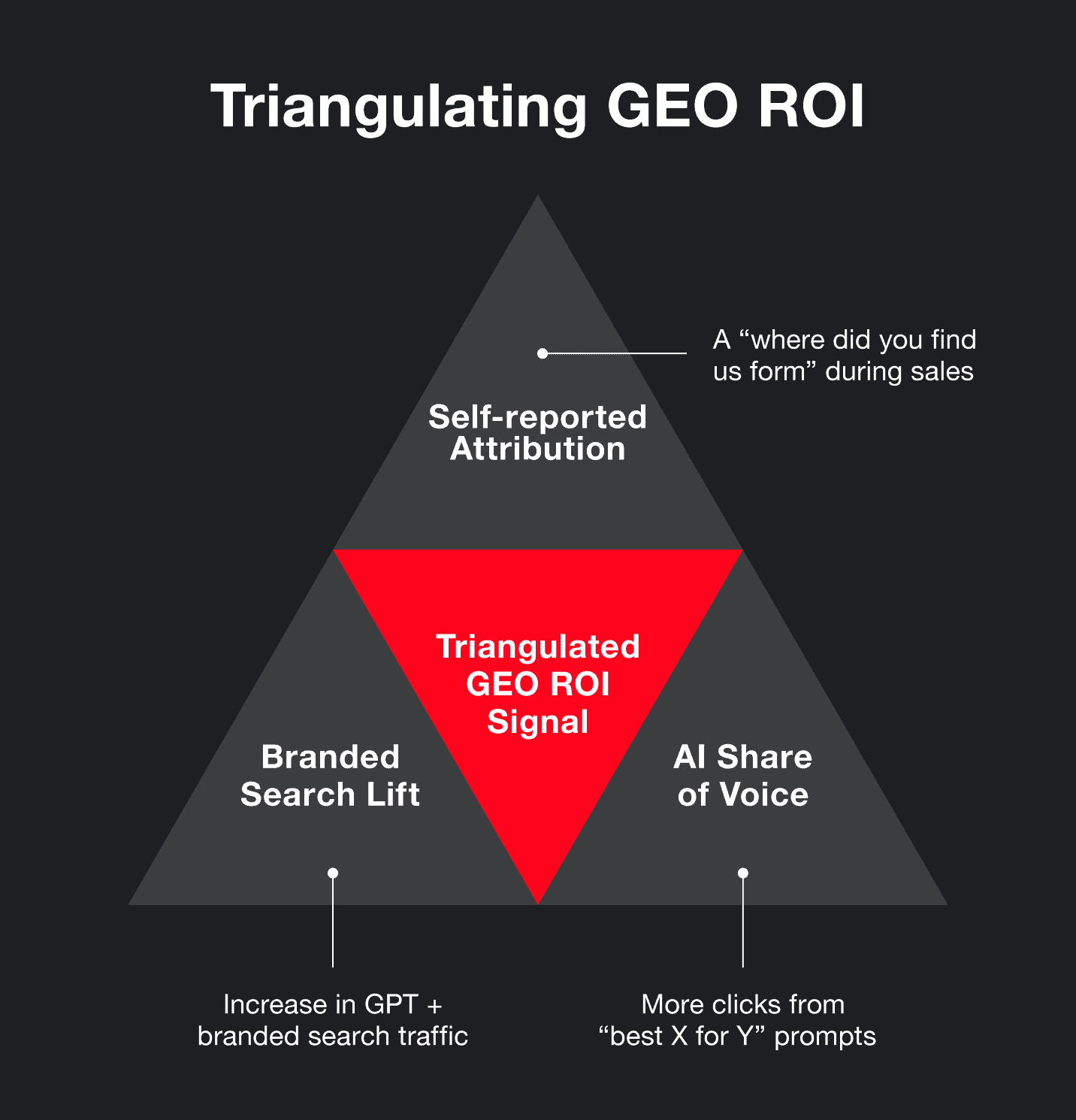
GEO ROI can’t be measured using the same visibility metrics we use for search engine optimization (SEO). Instead, it involves a three-point framework: self-attribution, branded search from LLM traffic, and AI share of voice.
Here’s what we’ll go over:
- Why Your Analytics Tool Is Lying to You
- Three-Point GEO Attribution Framework
- Costs When Measuring GEO ROI
- Improve Your GEO ROI with Siege Media
Your Analytics Tool Is Lying About LLMs
Think about how a buyer actually finds you using AI. They ask ChatGPT a question, your name comes up, and they open a new tab to Google you and learn more. In this case, the AI tool leaves no fingerprint because LLMs that drive engagement don’t pass referrer data the way Google does.
That mismatch is what marketers now call the “dark funnel,” the chunk of buying behavior happening in places your analytics can’t see. Right now, it’s where most of your mislabeled AI pipeline sits, whether with organic or direct labels.
Our self-reported number lands between 30% and 60% of sales. We’re at the high end of this range because we’re a GEO agency. But the point stands: Typical B2B brands should expect the number to be anywhere between 100 to 200% higher than what referral data shows. So if you’re showing 5%, your LLM-influenced revenue is likely closer to 10%-15%.
As agentic browsers, AI assistants, and AI chatbot discovery push the buyer journey, the share of that pipeline will grow. Teams must build a real GEO measurement model now to defend their budget through the transition. If they don’t, they risk losing their investments (and returns).
“The problem is that when we do a transactional search on LLMs, the frequency with which they reference third-party websites is much lower. And when they do reference them, they’re often unlinked.”
Ross Hudgens
CEO/Founder, Siege Media
Three-Point GEO Attribution Framework
The three-point attribution framework begins with a formula based on the visibility score, which is how much you’re seen on LLMs. You can then plug this score into the formulas for customer lifetime value (LTV) and GEO investment cost.
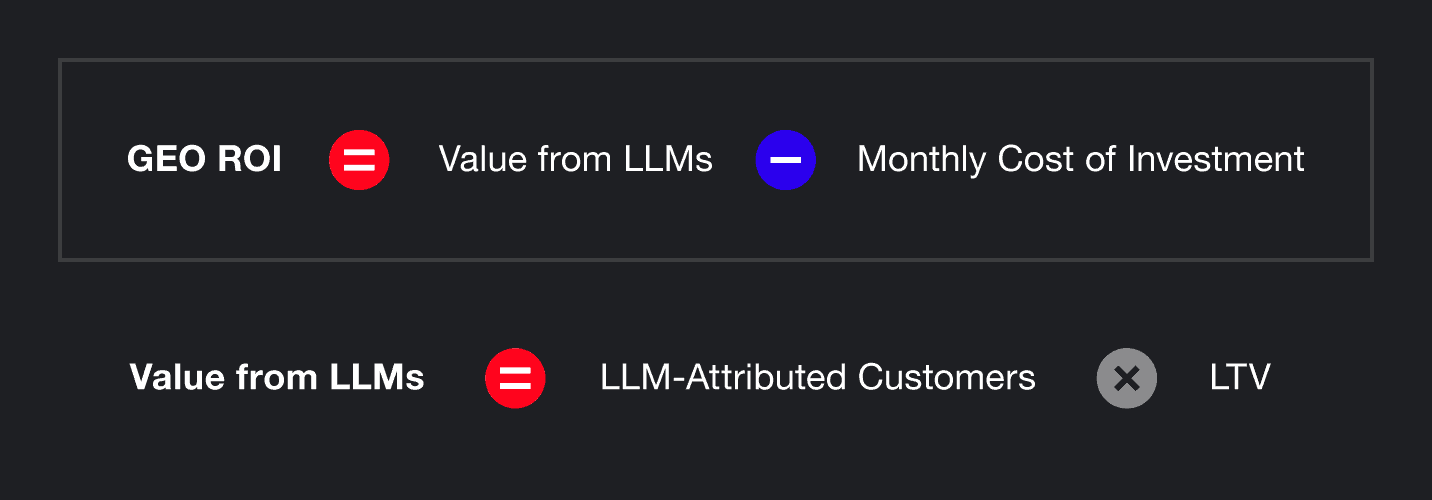
To calculate your Value From LLMs, you need to estimate how many actual customers your AI visibility is driving. You can do this by pairing your point three visibility score (which is driven by citations) with your point one self-reported attribution.
For example, if you appear in 55% of AI responses for the prompts your buyers actually run, your visibility score is 55%. If your self-reported attribution tells you that 55 customers per month are coming from LLMs, you can establish a simple baseline: one percentage point of visibility roughly translates to one customer. Using that model, here is how the math plays out:
- Value From LLMs: 55 LLM-Attributed Customers × $1,000 LTV = $55,000/mo
- GEO ROI: $55,000 Value From LLMs – $10,000 Monthly GEO Investment = $45,000 Monthly ROI
Most teams won’t have a perfect 1-to-1 ratio out of the gate, but by benchmarking your visibility score against the customers who actively tell you they came from AI, you create a defensible, easy-to-recalibrate model for your GEO efforts. Just keep in mind that these numbers are influencing AI attribution, and you may not get the full picture of all the work you’ve put into it.
Point 1: Implement Self-Attribution
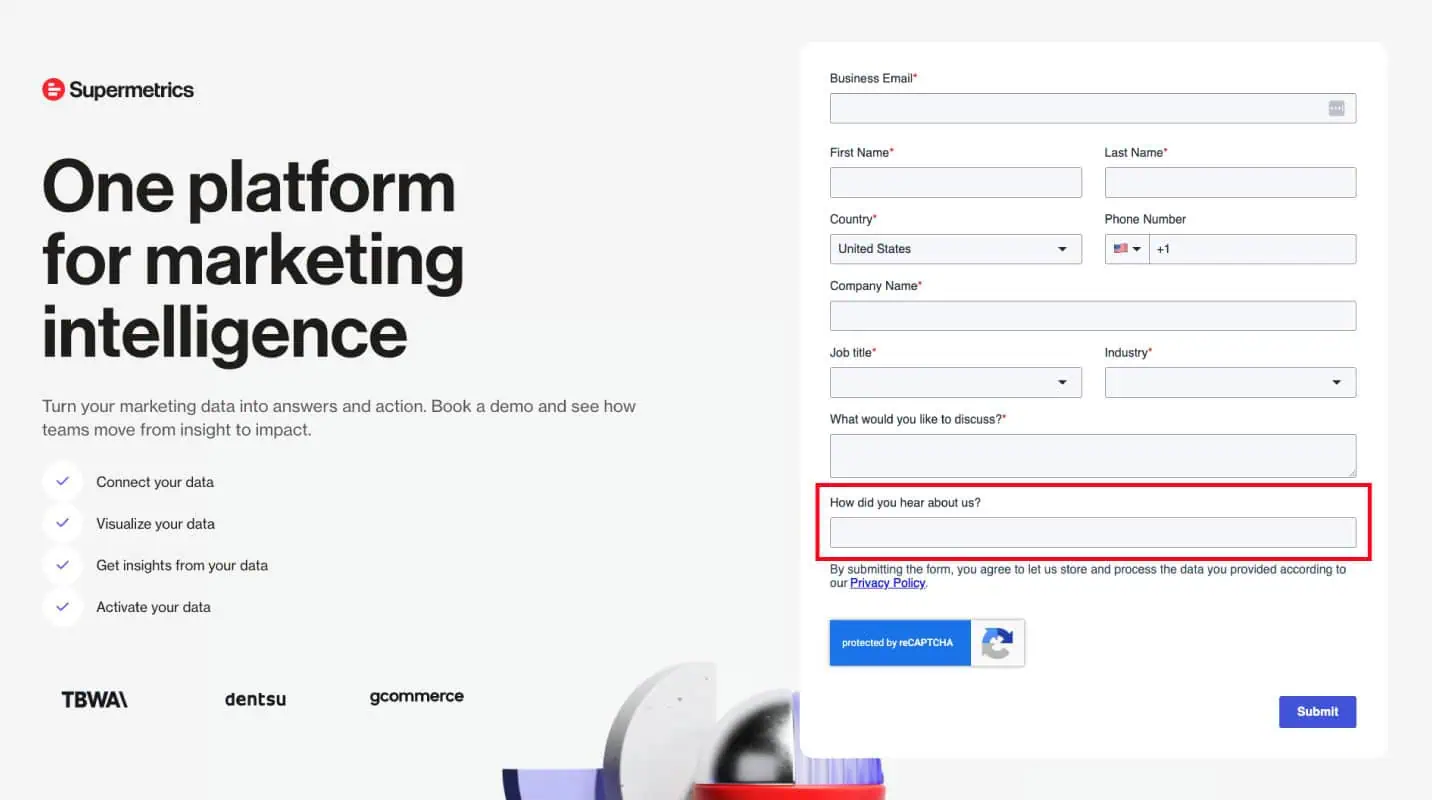
Self-reported attribution, or asking “how did you hear about us?” on a lead form, is nothing new. But it’s the most accurate signal you have for LLM influence when the technical layer doesn’t work.
Don’t bury these under “Other” or “search engine” on the drop-down list. Instead, place them in a discrete, named location next to “Google search” and “Saw it on social.” Prospects often over-report when it’s in the most prominent position.
Supermetrics has a great example of this on their book-a-demo page.
You can deploy these attribution fields on:
- Demo request and contact forms
- Post-purchase surveys
- Sales discovery calls (as a scripted question, asked the same way each time)
- Win/loss interviews
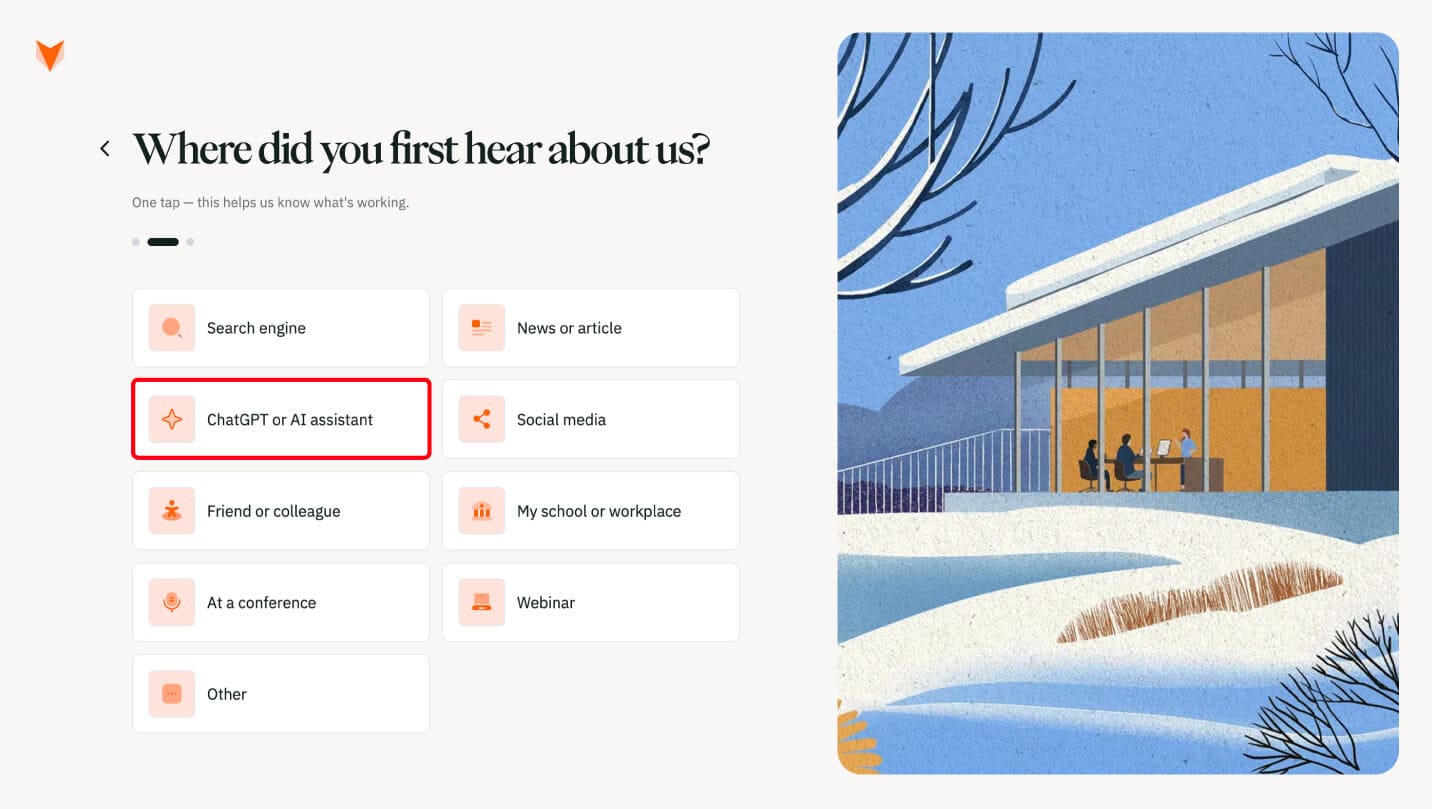
That said, if adding the field to your primary lead form reduces your conversion rates, make it optional or move it to a post-conversion thank-you page or first sales call. Don’t throw away the conversion just to get more information.
Below, you’ll see an example of a post-conversion ask from Pangram Labs:
Point 2: AI Share of Voice
AI share of voice measures how often your brand is recommended by AI tools compared to your competitors. It’s the visibility point of our model, helping you measure your share of citations relative to competitors for the prompts you focus on. You can use tools like Peec AI, Otterly, and others to find this out.
Many teams measure how often they get cited and stop there, but this ignores citation quality. Being mentioned as a top recommendation in a buying-intent answer is different from being a footnote in the comparison. Weigh the top position more heavily when you connect it to your pipeline.
Stick to tracking at least five to 10 buying-intent prompts per quarter, not 500 broad ones. For instance, appearing in “what is content marketing” is far less valuable than “best content marketing services.”
In looking across dozens of industries, here’s what we think good looks like across most LLM trackers:
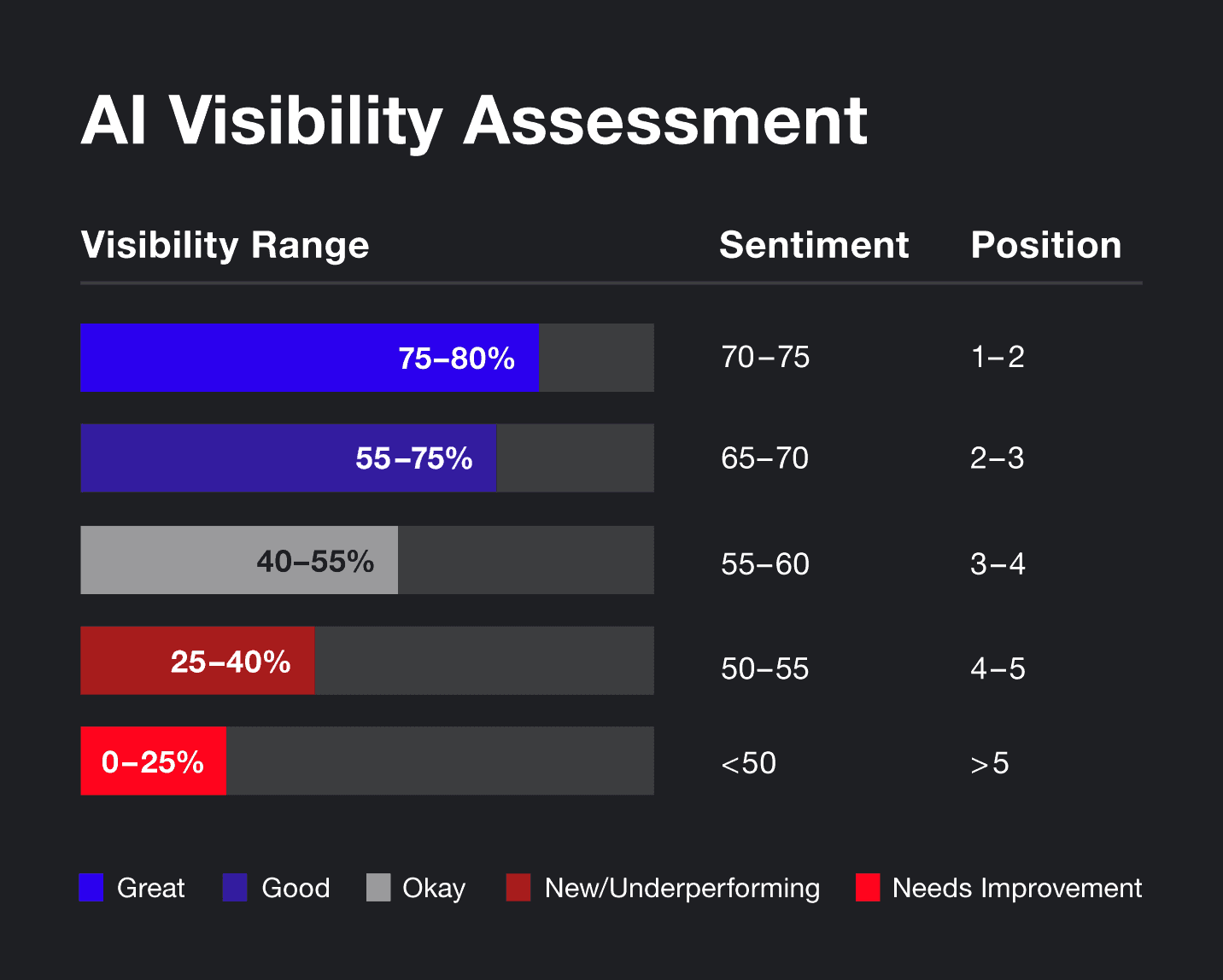
Our own AI visibility tracking on Peec AI tracks 11 buying-intent prompts across the categories in which Siege competes. Here’s what our top five visibility scores look like over the past 30 days:
| Prompt | Visibility | Avg. Position |
|---|---|---|
| what is the best content marketing agency | 96% | 1.6 |
| who is the best content strategy agency | 93% | 1.4 |
| who is the best digital PR agency | 77% | 2.6 |
| who is the best fintech SEO agency | 73% | 3.7 |
| what is the best enterprise SEO agency | 70% | 2.9 |
Including prompts not mentioned here, we hold a 53% visibility score and a 27%, leading our competitors by 13 visibility points and seven share-of-voice points. We know which prompts we own, which are up for grabs, and where we’re falling behind. This is actionable data, not just decorative.
Point 3: Perform a Branded Search Lift
When someone hears about your brand in ChatGPT, the next thing they do is Google it. Branded search volume after LLM visibility increases can be an early and clean GEO signal. It even ties AI visibility to behavior that current attribution models can measure.
Here’s the pattern:
- AI mention: A buyer asks for “best GEO services,” and Siege Media appears on the list.
- Branded search: They type “Siege Media” into Google a few seconds (or days) later.
- Click: They click the website to learn more about its GEO services.
- Conversion: They interact with your site in a way that matters to you.
While the Google session looks like an ordinary branded search, you know the originating event was the AI citation. The same pattern applies to lift on homepages, brand pages, and deep-link landing pages. Branded search is how buyers rediscover you when they only have your name to go on.
Putting this into action:
- Pull your branded search queries for the last 90 days
- Mark the date of significant LLM citation events
- Look for branded search lift during the weekly or monthly windows
Significant events include when a key prompt starts citing you, when you appear in a new AI Overviews, and when you appear higher in either a prompt or overview.
The window matters because GEO measurement is delayed and indirect. A buyer who saw you in an AI answer last month may convert this month through what your dashboard calls direct traffic. If you look at too short a time frame, you might miss this lift entirely.
Looking at a real example, Instacart is one of the strongest cases, leading competitors in LLM presence and AI Overviews in its category. Over our collaboration, branded search volume increased by 461K, with 46.5K LLM citations. We don’t claim ownership over all of this lift, but the message is clear: When a brand gains visibility in AI, branded search rises with it.
Heads up: Branded search can also come from PR placements, paid campaigns, podcast appearances, or viral content. Annotate your branded search trend with every brand-amplifying event you run, not just AI ones. The remaining unexplained lift is your defensible GEO signal.
The Triangulated GEO ROI Signal
When AI share of voice, branded search connected to LLMs, and self-attributed mentions rise at the same time, you’ve got real proof your strategy is working. No single metric tells the whole story on its own, but together, they give you a clear, undeniable picture of your GEO ROI.
Let’s run the math on a mid-market SaaS company:
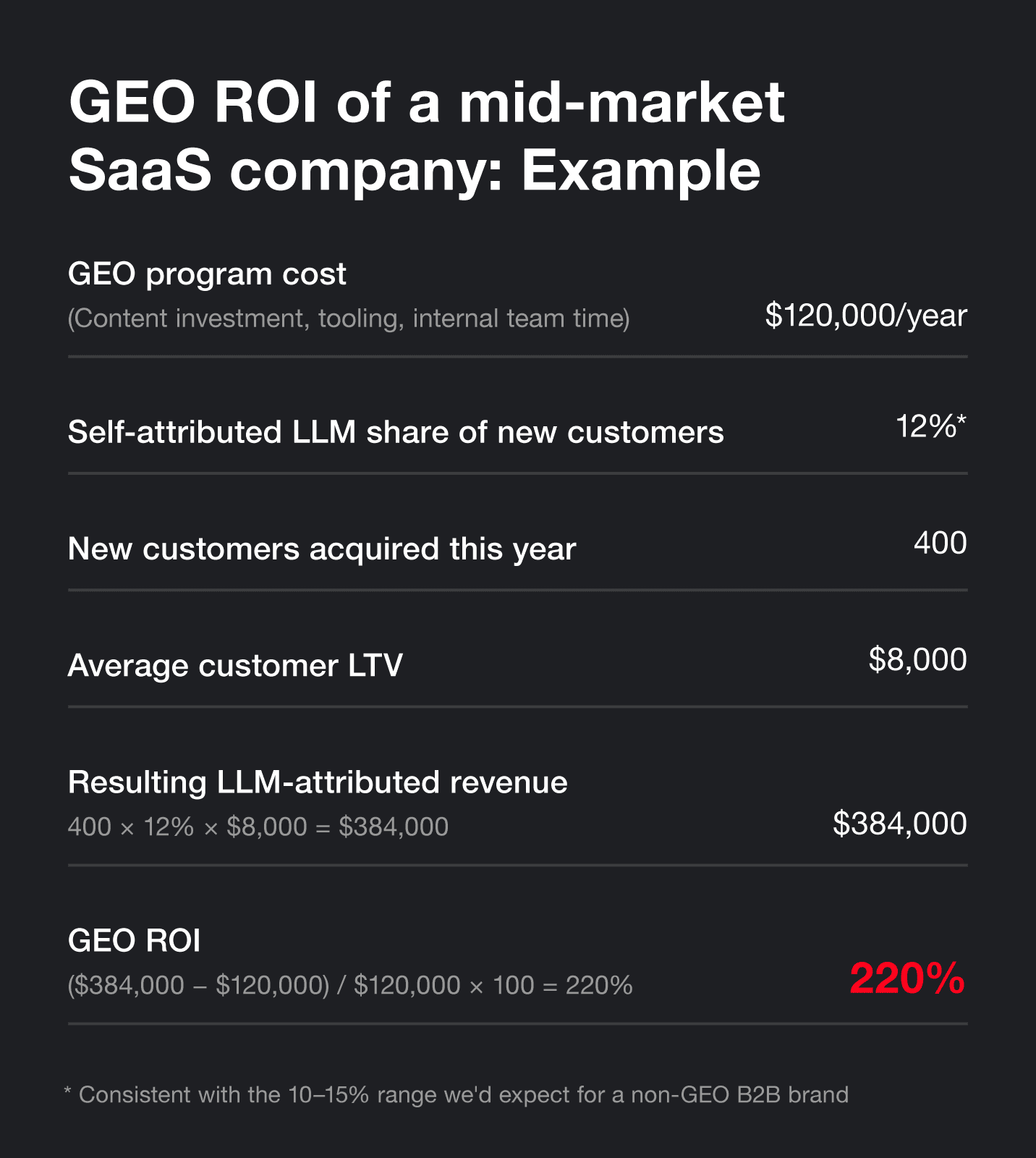
At a 12% self-reported attribution rate, a $120,000 GEO investment returns over three times the investment in measurable LTV. Even at a modest 5%, the ROI turns to 167%, which beats out a good chunk of paid campaigns.
The point isn’t that GEO ROI is huge, but it’s dramatically understated. The executive conversation shifts when the model works correctly.
The same approach works for swapping out e-commerce metrics (LTV for AOV x repeat rate) or transactional B2B (deal size x close rate). The framework is portable, and the math doesn’t change across industries.
Cost Considerations for GEO ROI
Don’t forget to account for your GEO campaign costs to track ROI accurately. Track:
- Content production: writing, editing, design, and updates to existing pages optimized for GEO
- Tooling: AI visibility platforms, attribution add-ons, GSC monitoring, dashboard build
- Internal team time: strategist, SEO lead, content lead, analytics support
- External partners: agency or consultant fees, if applicable
A program that appears to have 400% ROI without the cost doesn’t survive a CFO audit. Break out how much you’re putting towards GEO against SEO. If comingled with an SEO campaign, break down how much your costs have increased since implementing GEO changes.
“Instead of GEO as a line item, think of it as “answer engines.” Using “organic growth” is also another relevant framing that covers many of the activities used to influence these tools.”
Ross Hudgens
Founder/CEO, Siege Media
Improve Your GEO ROI with Siege Media
Your GEO ROI exists, your tools just aren’t measuring it.
As AI assistants and agentic browsers step into the buyer’s journey, the gap between what your dashboard says and what’s actually driving the GEO pipeline will widen. Teams with the right measurement frameworks will defend budgets and gain ground while competitors argue over click-through rates.
Siege Media builds GEO programs with this measurement in mind from day one. Through self-attribution architecture, branded search benchmarking, and visibility tracking, you’ll know when high-intent prompts built from our GEO efforts lead to measurable results.
If you’re trying to prove GEO ROI inside your organization, explore our Generative engine optimization services to see how we approach measurement alongside execution.