The two-way versus page is the strongest predictor of AI search traffic, but the three-way page is the opening most teams walk past.
The A vs B vs C comparison page used to look like a strategic mistake. It seemed to chase every permutation of “versus” at once, when focused pages win in SEO and generative engine optimization (GEO).
That instinct was right, until we found versus pages to be the strongest content predictor of AI search traffic (roughly twice as predictive as the next-best content type). That reframes the category of comparison content, including the case for triple-comparison pages.
An A vs B vs C page captures queries that neither two-way pages nor best-of roundups reach. For those laying the foundation for versus content, this guide covers when three-way pages are worth building and how to validate real demand for a trifecta.
- Focused Versus Pages Succeed
- Where Triple-Comparison Pages Win
- The Trifecta Test
- How To Build an A vs B vs C Page
- The “Fourth Player” Advantage
- Own the Trifecta Before It Closes
- Frequently Asked Questions
Focused Versus Pages Succeed
In our Versus-Pages Benchmark study, we correlated the volume of transactional comparison content with AI search-referred sessions. Across 116 B2B GA4 properties over 90 days, we found that versus pages outcorrelated every other transactional template, and did so consistently.
The reason is structural. When an LLM answers a comparison query, it cites pages that already exist at the exact “X vs Y” intent. Best “X” posts and alternatives roundups compete directly with discovery platforms like G2 and Capterra, while a direct versus page has less competition and a cleaner intent match.
Adding a third brand seems likely to dilute the match that makes these pages work, turning a focused page back into a roundup. It usually would, but for a narrow set of categories, ignoring A vs B vs C queries leaves the highest-intent page in the category unbuilt.
Where Triple-Comparison Pages Win
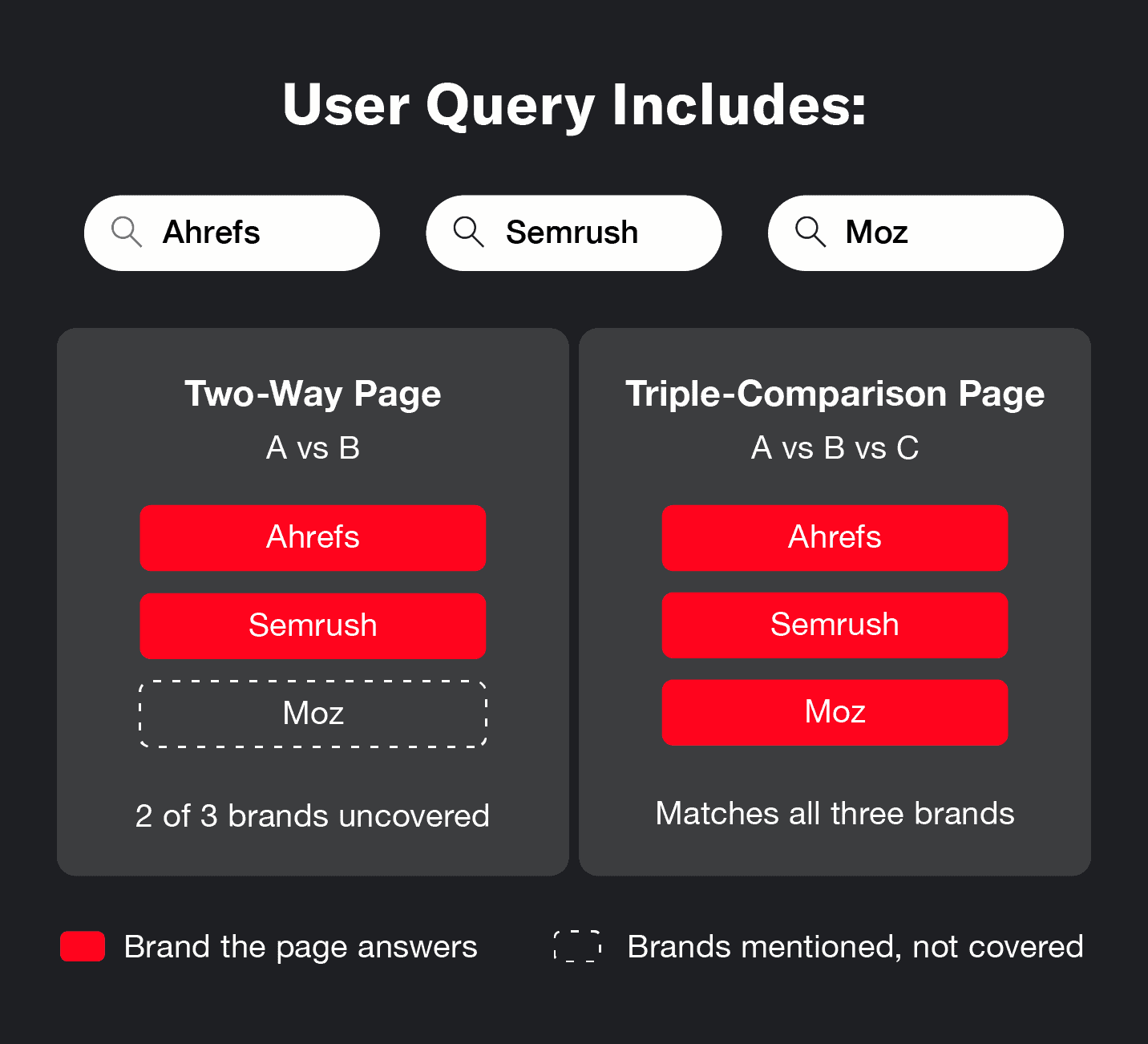
Three-brand versus pages won’t win if they’re simply chasing two-way permutations, like A vs B, A vs C, and B vs C, at the same time. But they can win when the trifecta reflects a genuine triopoly, where a three-brand comparison is how buyers actually evaluate.
A true A vs B vs C page is tightly focused on complex queries whose distinctions matter more in AI search than in traditional search. Complex, multi-brand questions are asked more naturally in a chat interface than in a search box, and transactional content tailored to that format has a better chance of impacting how your brand surfaces in LLM answers.
The two-way page is a partial answer to a three-way question that only a triple-comparison page can fulfill.
“I used to think about this content type in a negative way, as it seemed to try to capture all the different permutations of ‘A vs B’, and ‘A vs C’, and ‘B vs C’ all at once … But what I missed was how it can and should be used when there is true demand for the brand vs brand vs brand comparison in a triopoly-type market.”
Ross Hudgens
Founder and CEO, Siege Media
The Trifecta Test: How To Qualify and Validate
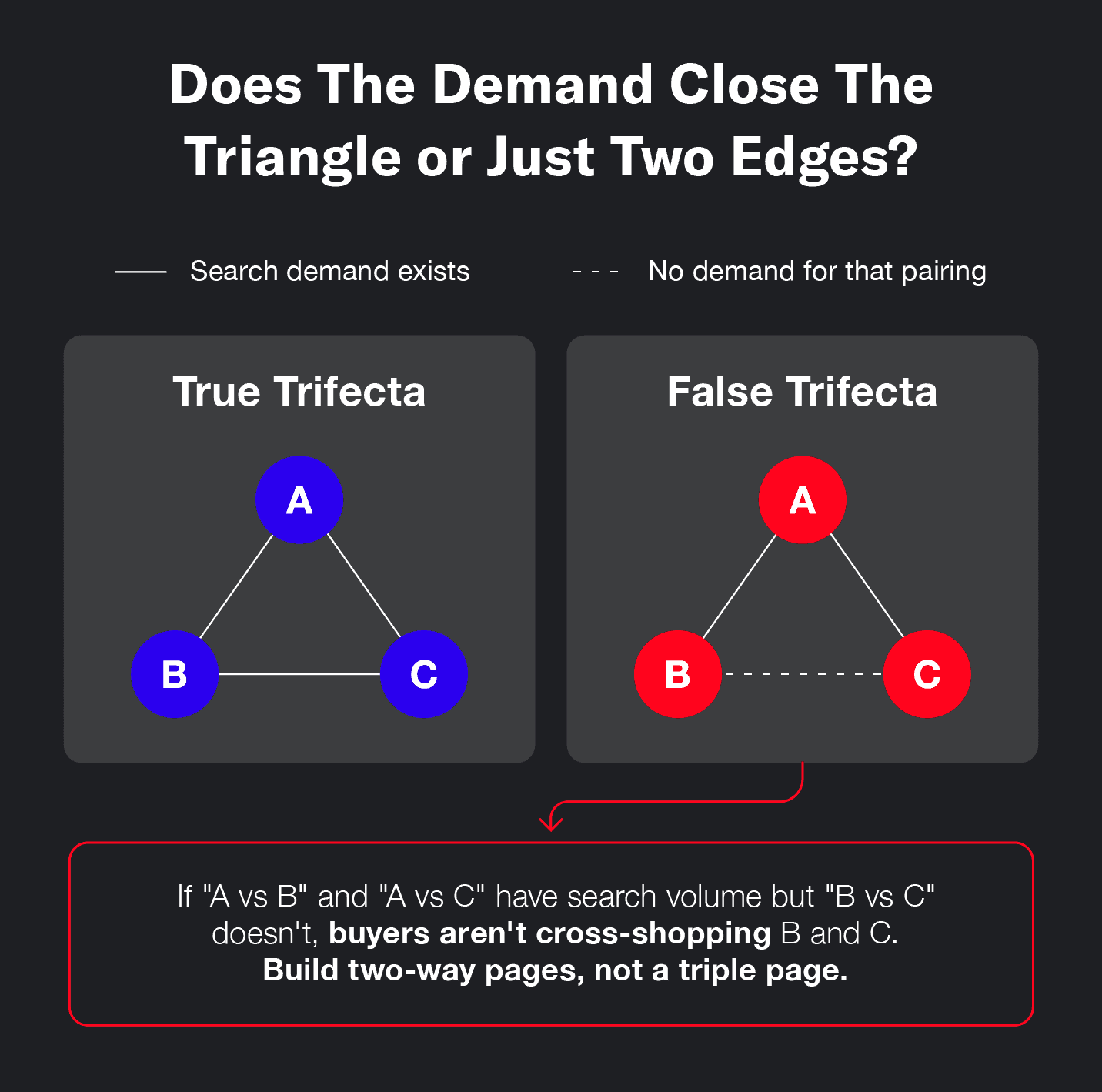
Not every category has true demand for a triple-comparison page. Before writing an A vs B vs C page, it should clear what we call the “Trifecta Test.”
The three bars to consider include:
- A real top three that isn’t made up of a dominant brand and a list of plausible competitors
- Recognizable brands where everyone in the conversation can name the same three players without prompting
- Verifiable search volume that can be confirmed via a tool like Ahrefs
A three-brand comparison query is a deep bottom-funnel topic, and volume will almost always look small. That’s expected, and it isn’t a reason to pass, since low-volume, high-intent pages routinely drive engagement disproportionate to their traffic.
Expert tip: If your category doesn’t have a clean trifecta with verifiable volume, don’t force it. However, you can search each ordering variant (for example, “A vs B vs C” and “B vs C vs A”) and add their volumes together to get the true figure for a triple comparison.
To validate a three-way query before committing to a page:
- Assemble candidate trifectas from your category’s contenders.
- Pull search volume on the A vs B vs C query and its ordering variants.
- Confirm the intent is genuine and not two overlapping queries.
- Check how LLMs answer and find a true strategic opening.
- Confirm differentiation through true, specific feature comparisons.
Cannibalization is a risk, which is why step three matters. Evaluate every query to confirm the intent truly calls for a three-way page. If it overlaps too closely with a two-way page you already rank with, a new triple page splits your equity instead of adding to it.
“If your category has a real top three, where everyone in the buying conversation already knows all three names, you have a defensible page worth writing.”
Ross Hudgens
Founder and CEO, Siege Media
How To Build an A vs B vs C Page
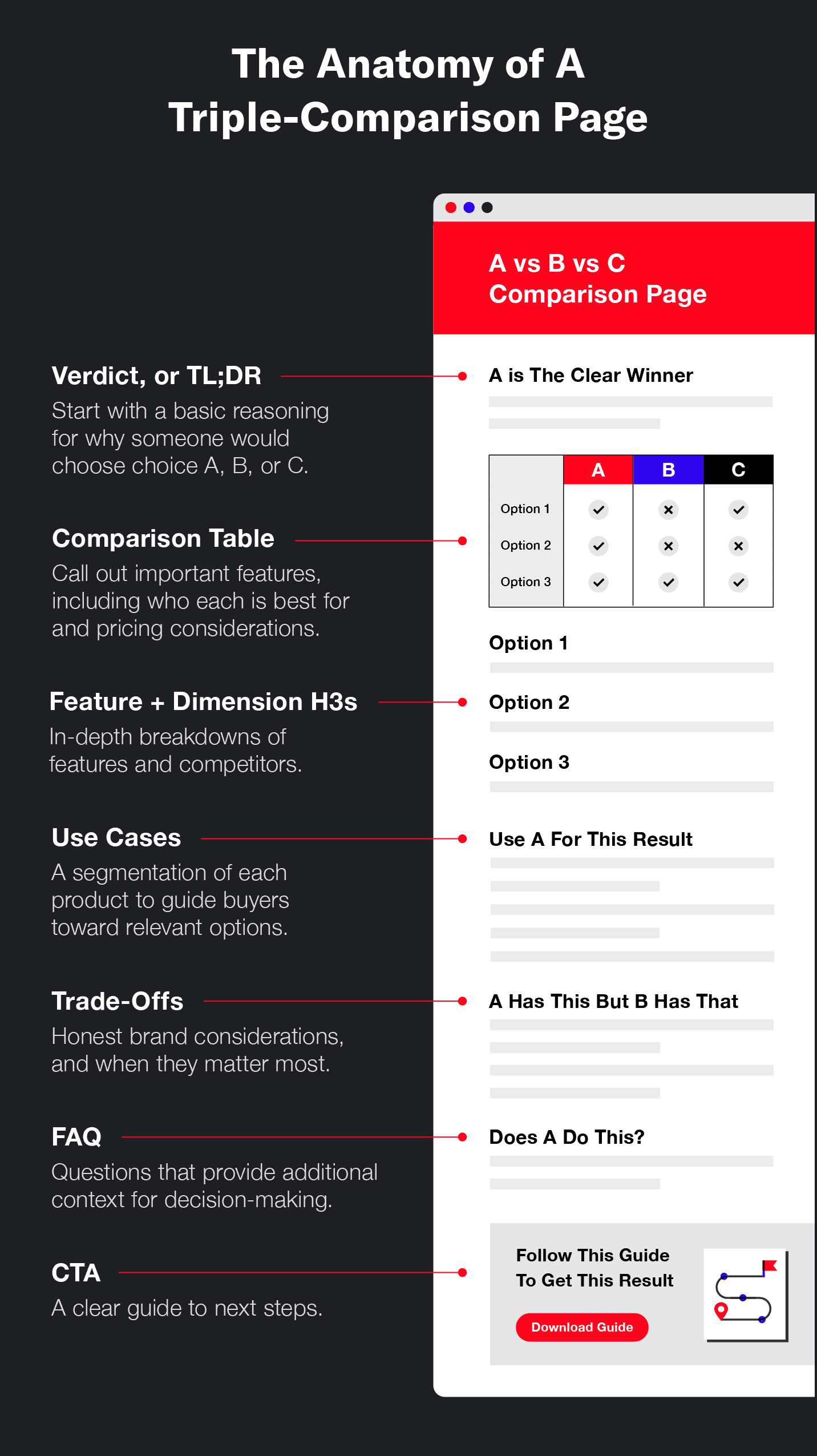
Once a trifecta clears the test, structure carries the rest. The goal is a page an LLM can lift cleanly and a buyer can act on, so lead with the answer and earn trust before you sell.
Then, build down from there with clearly built sections:
| Section | Purpose | GEO Notes |
|---|---|---|
| Verdict | One-line answer covering when to choose each option | Use a crawlable callout box (if possible) |
| Comparison Table | Scannable three-way spec sheet | Structure it cleanly and name all three entities |
| Per-Dimension Breakdown | Depth on each feature and point of comparison | Use one H3 per dimension and reference all three brands in each |
| Use Cases | Segment recommendations by buyer context | Match varied prompts, including “best for” distinctions |
| Trade-Offs | Where each option loses | Objectivity earns citations, so stay neutral throughout |
| FAQ | Satellite questions around the comparison | Q&A format to match question-shaped prompts |
Follow your post with a CTA, but don’t undercut the objectivity you’ve made a point of maintaining. A page that pretends all roads lead to your product reads as marketing, so win the comparison honestly before pointing to your own products.
Triple Comparison Examples
The clearest way to see the pattern is by looking across categories with a clear top three. Each of the following is a category with an established trifecta, each individually identifiable by buyers.
| Comparison | Angle | Dimensions | Intent |
|---|---|---|---|
| Ahrefs vs Semrush vs Moz | Best SEO software platform for your team’s depth and budget | Data and index size, keyword and rank tracking, UI and learning curve, and price tiers | An SEO evaluator choosing a primary toolset who already knows all three |
| Vanta vs Drata vs Secureframe | Fastest cloud-based compliance automation and GRC platforms | Framework coverage, automation depth, integrations, auditor network, and pricing | A security or compliance lead scoping automation with all three shortlisted |
| Salesforce vs HubSpot vs Pipedrive | The right CRM for your company’s stage and complexity | Ease of use, customization, scalability, ecosystem, and price | A revenue or ops leader matching a CRM to team size, from SMB to enterprise |
None of these works as an open-ended best “X” software list. Each is tied to a decision a buyer is actively making, which is exactly what separates a defensible triple page from a roundup.
The “Fourth Player” Advantage
In a two-way comparison, each brand’s equity and renown allow it to lock in ranks one and two whenever they choose. A challenger has no lane. Split that duopoly into three prongs, and the equity dilutes.
A fourth player (we’ll refer to them as brand D) has a better chance of injecting itself into the conversation. Also, a buyer landing on a three-way comparison page is a step higher in the funnel, and they’re often more open to reconsidering their options than a shopper who’s narrowed their shortlist to two.
This maps directly to our versus study, which found that content is the lever a fourth player can actually pull. With a triple-comparison page, a challenger may be able to wedge itself into an AI buying conversation it would otherwise be excluded from.
“When it’s only ‘A vs B’, the site equity those two have will allow them to instantly rank one and two, when they choose to. But when that’s diluted into three prongs, the ability for a fourth player to interject is higher. Not probable, but higher.”
Ross Hudgens
Founder and CEO, Siege Media
Own the Trifecta Before It Closes
Two-way pages were built for the traditional search era, where 10 links returned for every query. The three-way page is built for the synthesis era, where LLMs return a single answer (no matter how complex the query).
As AI search collapses questions into integrated responses, the pages that match the exact shape of a three-brand query stop being just one citation among many and become the answer. In a true three-brand race, you won’t win a bigger share of a query, but you’ll claim the only slot there is, with no second version for a competitor to out-publish.
Triple-comparison pages are a rare play where being early beats being prolific. If your category has a settled leading trio, our full-service GEO agency can help you find and build the page that owns it.
Frequently Asked Questions
What is a Triple-Comparison Page?
A triple-comparison page is a transactional page that directly compares three brands in one category. These pages work best in triopoly markets where buyers evaluate all three names together, and they target the more complex comparison queries increasingly searched via LLMs.
Do Triple-Comparison Pages Replace Two-Way Versus Pages?
No, triple-comparison pages are not a replacement for two-way pages. They should act as an additional layer within a brand’s bottom-funnel program, rather than substituting for A vs B or A vs C pages.
Will a Triple-Comparison Page Cannibalize My Existing Versus Pages?
Triple-comparison pages can cannibalize existing versus content, which is why intent validation matters. Evaluate each query to confirm the buyer genuinely wants a three-way comparison rather than a two-way one. If the intent overlaps too closely with a page you already rank with, you could split your traffic rather than adding to it.
Do Triple-Comparison Pages Help With GEO?
Yes, a triple-comparison page’s core advantage is its GEO effects. Complex, multi-brand questions get asked more naturally in AI search than in traditional search, and a page built to answer gives an LLM something specific to cite instead of defaulting to a competitor roundup.