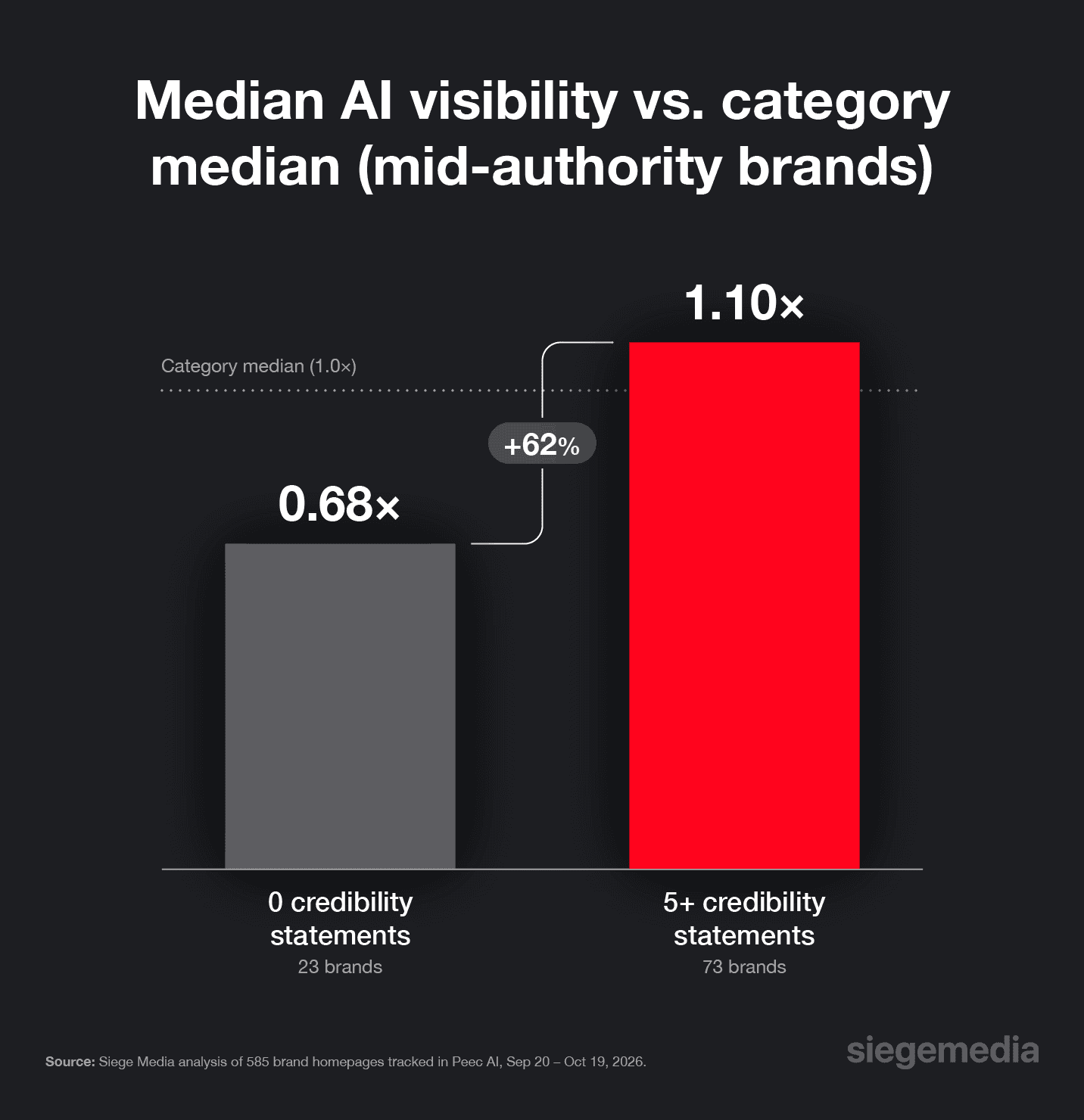
Mid-authority brands with five or more “credibility statements” on their homepage have 62% more AI visibility than similar brands with none. This improvement grows the most from zero to two statements and keeps rising until it flattens out at five statements.
We ran a Peec analysis to see whether or not there was a link between how many of these trust symbols/brand statistics existed and LLM visibility, looking at the homepages of 520 different brands we were tracking the visibility of directly or indirectly across our clients.
The data was striking:
- What Is a Credibility Statement?
- Why Is This a Mid-Market Effect Only?
- More Credibility Statement Examples
- Types of Credibility Statements
- Credibility Statements on BOFU Posts
- Text (or Alt Text) on Awards
- Get the Credibility Statements Skill
- GEO is CRO
- Methodology
What Is a Credibility Statement?
Credibility statements are reputable third-party or provable first-party data points that LLMs reference as a citation during their research.
While it’s common to pull from third-party sources to do this, the benefit of doing it on your own site is that you don’t force the LLMs to work to find this context. If you’re a mid-market or newer brand without massive existing LLM context, this can be critical for winning the answer.
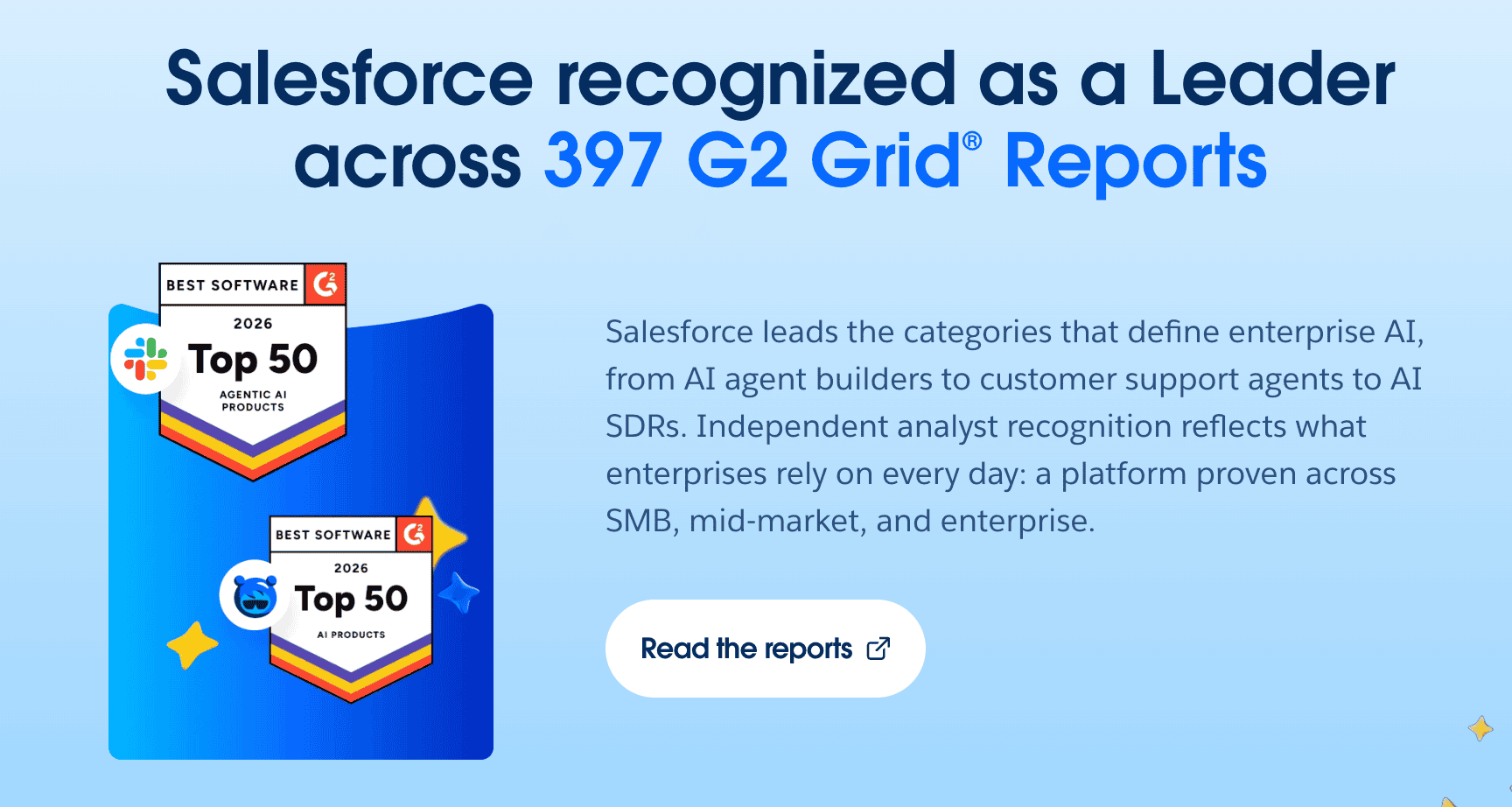
An example here is the “397 G2 Grid® Reports” block from Salesforce:
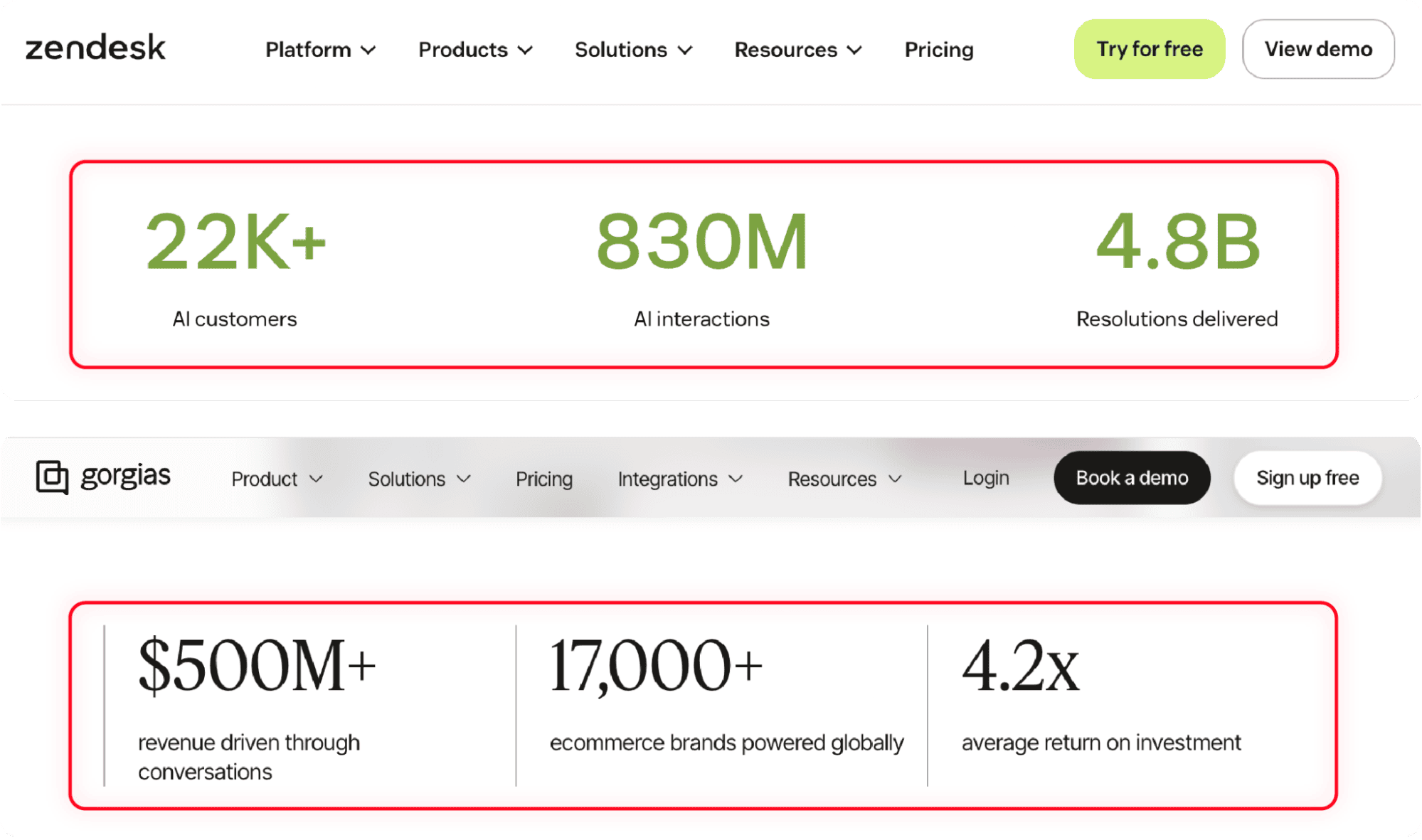
… or this “statistics block” from Zendesk and Gorgias:
Hungry for more? We’ll get back to example credibility statements soon. But first, back to the data.
Why Is This a Mid-Market Effect Only?
As noted, the improvement link was significant and linear between no statements and 5+ for mid-market brands, where it leveled out from there.
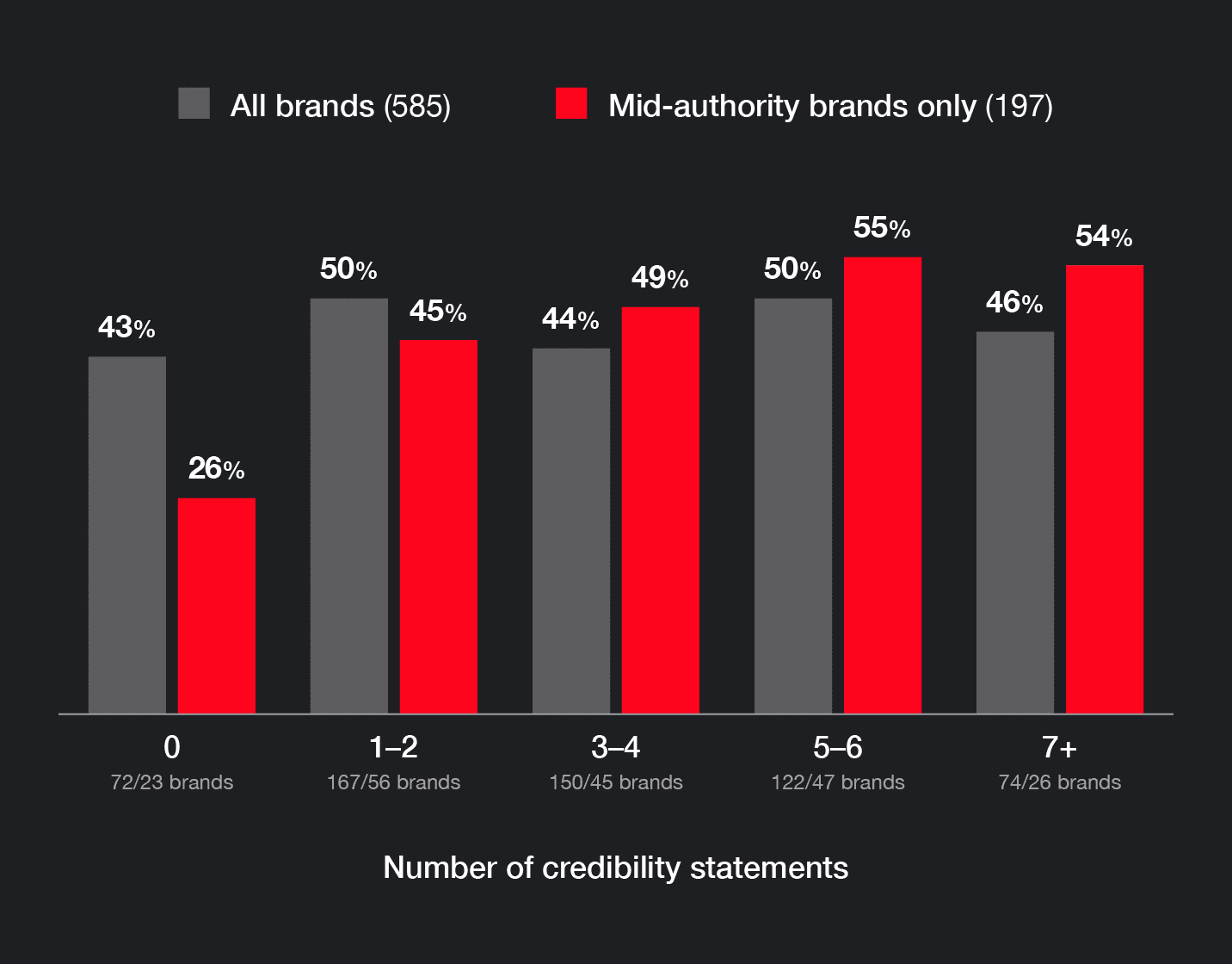
Where it got interesting was when looking at high-authority brands – there was no obvious link between these “credibility statements” and visibility for sites of authority.
This makes sense in retrospect – these brands already have significant off-site reputation that reflects in that authority, such that the LLMs don’t need to rely on them to make decisions.
But in niche markets or for upstart brands, these statements are critical for driving visibility and, more importantly, conversions because there is less of that third-party context that feeds the models.
Link authority is a uniquely reliable concept here. The more links we have, the more direct context LLMs have on the open web about who we are.
So it makes sense that for mid-authority brands (whether that means they’re dominant or not in that category), less context exists, so feeding LLMs that context can have a notable, immediate impact on visibility.
This doesn’t mean this isn’t helpful for large brands. Almost certainly, these elements are worth doing for CRO purposes alone. Yet, it’s notable that it might be less impactful for that group.
More Credibility Statement Examples
How do we know this works? We can do LLM prompts around companies with obvious credibility statements and see those same LLMs reference them time and time again.
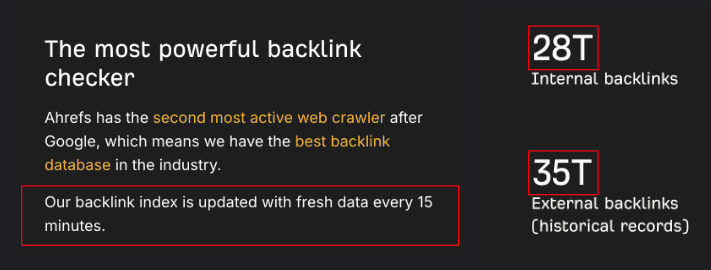
As an example of this, when I search “best link research tools,” Ahrefs’ 15-minute refresh cycle and massive link index of 35 trillion links are pulled in.
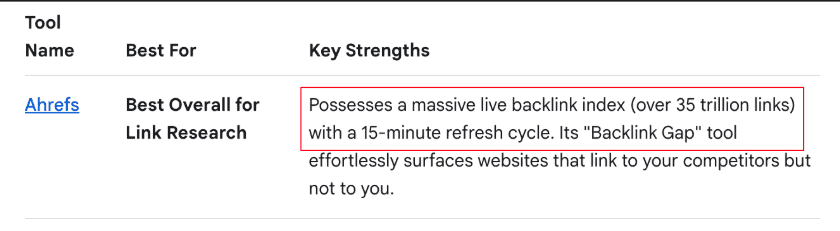
No surprise, when you look at their actual page, these data points are referenced front and center in the text:
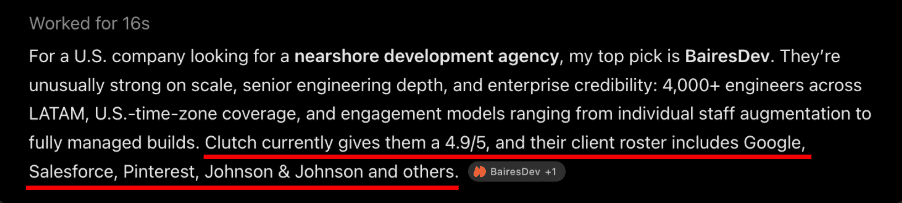
Another example is BairesDev, a nearshore dev agency. When I prompt ChatGPT for “best nearshore dev agency,” it gives me their Clutch reviews and known clients:
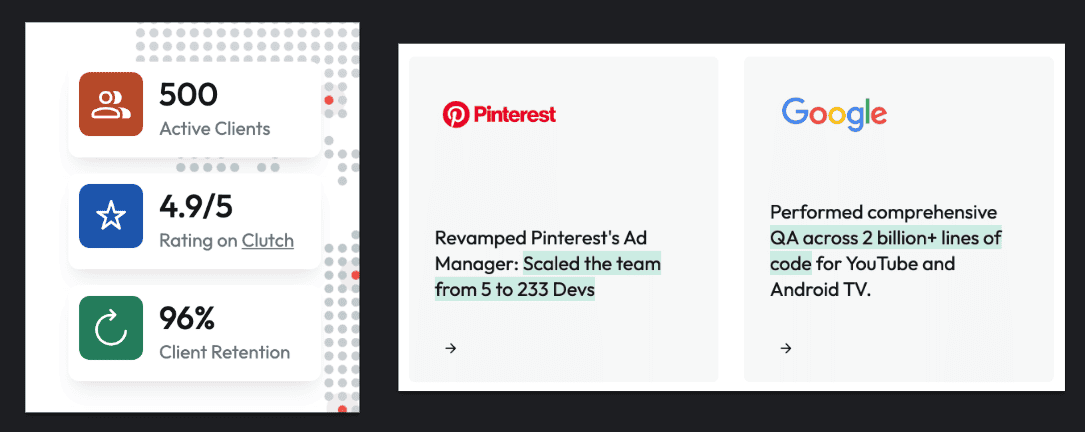
This is because their landing page clearly shows both. Maybe ChatGPT would have found that Clutch context without it, but with the client logos, almost certainly not.
Here are a few additional companies that have amazing homepages with credibility statements everywhere.
Andy Crestodina cited that homepages get 15x more retrieval than other pages, so it makes sense to spend the bulk of our energy in that place.
That said, there’s value in putting these statements everywhere, not just your homepage.
Types of Credibility Statements
As noted, credibility statements are provable first-party or reputable third-party statements about your brand. These can come in many different forms.
Here’s an example starting list to brainstorm from:
- Review rating + count
- Case studies (# and outcomes)
- G2 Grid placement
- G2 seasonal badges
- Analyst placement (i.e. Gartner Magic Quadrant)
- Usage volume (X calls/mo)
- Global reach (in 90+ countries)
- Tenure (founded in 2005)
- Uptime (99% guarantee)
- Recognizable customers/logos
I would recommend that you cite these statements wherever you can via a direct link.
As this process gets used more and more, it’s more likely to be exploited with fake or exaggerated statements. The more you can provide direct references to those credible parties, the better.
Credibility Statements on BOFU Posts
One of the core objections “best X,” “X vs Y,” and “X alternatives” posts have is that they are votes for ourselves. That’s fair – until you overcome that objection by pumping these posts full of credibility statements that make that bias fade away.
For mid-market companies, creation of these posts helps enter you into the conversation where existing context doesn’t exist, and also helps make clear you are the best option when you do.
As an example of this, on a “best SaaS GEO agency” search, our article on the subject references the named clients we’ve had in the space. ChatGPT pulls those in.
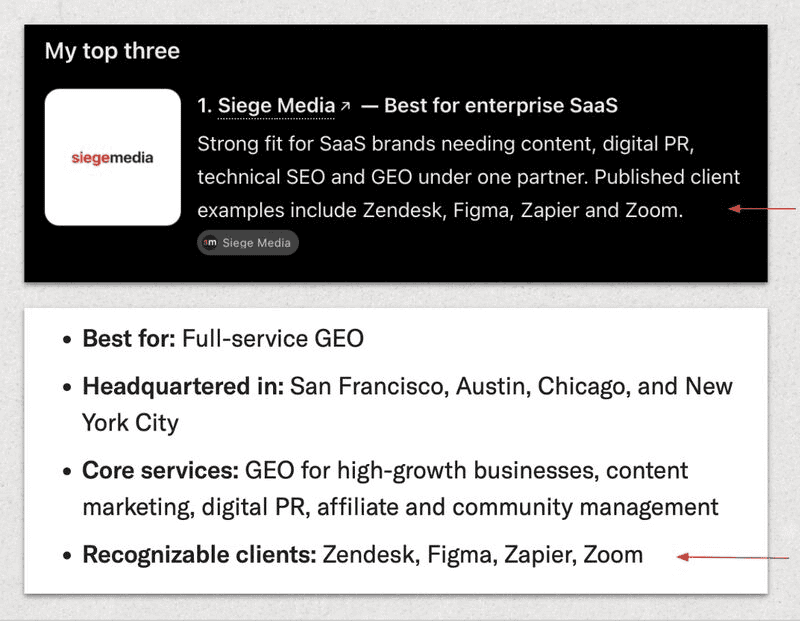
This isn’t made-up puffery about us – this is fact. From there, LLMs make their own call.
We could also include reviews, case studies, and other credibility notes here as well if we wanted.
A powerful use of these statements is to leverage them as reasons to update your BOFU content. Every time you get a new award, refresh your library with that context. This can be used in conjunction with your DataFlywheel to give you a massive repository of fresh information to differentiate and win.
Text (or Alt Text) on Awards
LLMs often struggle to render images. Many brands will leverage award images without any text, which runs the risk of the LLM never recognizing it.
The best workaround for this is simple, well-designed text around the image itself. Alternatively, alt-text gives you a better shot at recognition.
One of the best design-forward approaches to doing this is to have a “recap line” that’s impressive as a credibility statement, instead of text to describe every single image. HubSpot does this flawlessly:

Get the Credibility Statements Skill
We’ve created a skill that will work to “extract” these statements about your own company for your awareness. You may not realize you’re as credible as you need to be. Or you may realize you’re even more credible.
Get the Credibility Statements Skill
Hope you find it useful!
GEO is CRO
At the core, if we can convince an LLM to buy, we can convince a user to buy. And if that’s not fully true today, those two are increasingly converging.
So it makes sense that these statements are so powerful, especially when considering a brand you may not have otherwise heard of. This idea was originally posited to me by the aforementioned Andy Crestodina, who we talked to in our latest podcast.
If you liked this train of thought, I’d suggest checking it out in full. The CRO conversation is placed in the second half, although the first-half discussion around changing content trends is worth a listen in its own right.
Did I mention I recently published a book on Generative Engine Optimization with Wiley? In the book, I talk more about the value of CRO (and product pages) to drive LLM visibility.
Methodology
Siege Media analyzed the homepages of 585 brands, covering 520 unique sites, across the 63 competitive categories it tracks in Peec AI. AI visibility is the share of tracked prompts where a brand was mentioned in answers from engines like ChatGPT, Perplexity, Gemini and Google AI Overviews, measured from September 20 to October 19, 2026.
Each homepage was rendered in a browser on October 21, 2026. For the 64 sites that blocked automated access, Peec’s most recent stored copy was used instead.
Homepages were then scored for trust symbols, meaning specific, verifiable proof points across nine types:
- Review ratings
- Analyst and “best-of” rankings
- Press mentions
- Named customer results
- Case studies
- Customer logos
- Scale stats
- Original research
- Security and compliance certifications
Only proof points that name a source, platform or figure were counted. Scoring was AI-assisted and checked by having a second, independent scorer re-rate a sample, which ranked the pages almost identically (rank correlation of 0.90).
Because visibility depends on each category’s prompt set, brands were only compared against the other brands tracked in their own category. “Mid-authority” brands are the middle third by Ahrefs Domain Rating within their category (197 brands).
The relationship held after controlling for Domain Rating and organic traffic. It’s correlational: it shows which brands earn more AI visibility, not that adding trust symbols causes it.