

Enterprise digital PR sits in a gray area between journalism and content, using enterprise-level resources to produce unique first-party data.
I like what Paul Graham, co-founder of Y Combinator, says about hard things: that they’re worth doing specifically because they’re hard, and that difficulty itself can be a kind of litmus test for whether you should do something.
By that model, digital public relations (DPR) is worth doing not in spite of its innate challenges but because it can be harder to execute than other content types.
With an emphasis on contributing truly novel information to the SERPosphere, digital PR strategy tends to take more time, resources, and strategic vision than more standardized content marketing formats like traditional SEO posts.
I don’t say this to say traditional SEO isn’t worth doing or that it’s easy — doing SEO well is still difficult and worthwhile.
I also don’t say this to say DPR is prohibitively difficult — it just doesn’t have the kind of vastness of opportunities, innate scalability, and well-worn, iterable playbooks that simpler content formats have.
If you’re still not sold on the Paul Graham theory of hard work, consider that successful enterprise digital PR can give you a competitive advantage over competitors who may see it as too challenging to scale effectively.
Here’s why that matters, and how enterprise-level resources uniquely enable you to reap the rewards of DPR.
- The Goal of Digital PR for Enterprises
- Why Enterprise Digital PR Is So Effective
- How Enterprise DPR Strategy Compares
- How Enterprises Use Digital PR Strategy
- Examples of Digital PR Strategy
- How To Create Enterprise Content
- What DPR Success Looks Like
- Make Better Content, Get Better Links
The Goal of Digital PR for Enterprises
On paper, the goal of digital PR is link acquisition. The number and authority of links are basically the two quantitative KPIs you’d look at to gauge how effective a digital PR campaign is, but in some ways that’s a clumsy way of translating what it does.
Off paper (I guess that’s the opposite?), the goal of digital PR is to create a scalable means for establishing and communicating authority.
Through truly unique content like first-party data, thought leadership, novel trends reporting, and research reports, enterprises can signal legitimacy and reliability — things that build reader trust, market interest, positive PR, and ultimately search equity.
Think of it this way: Ranking position one isn’t an end that the means of content brought you to; it’s a symptom of a positive diagnosis.
Google, for example, or even an AI engine like ChatGPT, is more likely to see your brand as an authority whose site is worth ranking or citing if said site has proven to be a purveyor of quality information.
Earning links from high-authority news outlets or research institutions signifies that they trust your information, which boosts your site’s credibility.
A Note on Product-Led Digital PR
To maximize the real business impact of digital PR, enterprises should also be leaning into product-led digital PR. That is, centering digital PR strategies on the products/services they offer.
For example, if your bespoke sketchbook company is conceiving an industry trends report, the trends you’re reporting on should easily map back to your bespoke sketchbooks.
Reportage on trends in deforestation might theoretically make sense, since your product is made of paper, but people coming to your site to read that report probably wouldn’t want to peruse your premium saddle-stitched bundles of tree corpses.
Reportage on Gen Z trends in physical media hobbies like journaling, sketching, notetaking, writing, scrapbooking, and collaging might make sense.
People who come to your site may reasonably be interested in using your bespoke sketchbooks to sketch, and would increasingly see your brand as a trusted authority.
Why Enterprise Digital PR Is So Effective
Digital PR is effective because, by design, it thrives on uniqueness, authenticity, and novelty. Here are a few ways that bear out specifically for enterprises:
- Journalists gravitate to DPR content naturally, building organic link growth.
- Enterprises have built-in brand awareness (and likely media relationships), so they don’t need to build publicity channels so much as maintain and optimize them.
- DPR campaigns can readily map to products, passing traffic to money pages.
- DPR assets and campaigns are typically low-risk by design.
- Successful DPR content gains links over time and usually needs regular low-lift updates.
- Successful DPR naturally builds momentum, with success leading to more success as authority, reputation, and visibility grow.
- Successful DPR can’t be easily replicated in increasingly oversaturated SERPs and social feeds.
Keep in mind that effective traditional enterprise SEO should also be intrinsically unique, authentic, and novel. But because it’s more readily iterable, it doesn’t have those qualities woven into its fabric the way enterprise DPR does.
How Enterprise Digital PR Strategy Compares
DPR is related to a few other common enterprise digital marketing solutions and folds in some elements you’d find in both digital and traditional approaches. Some of these differences might be fairly nuanced, and specific strategies for one discipline may also apply to another.
If marketing is a buffet — which I’d argue it is (probably because I’m currently recovering from my first trip to Golden Corral in my 30s) — then DPR is like the nacho cheese pump: You don’t have to pick it instead of other options, but instead can layer it on, next to, or even (if you’re a real pro), on top of everything else on your plate.
Check out the digital PR examples below to see what I mean.
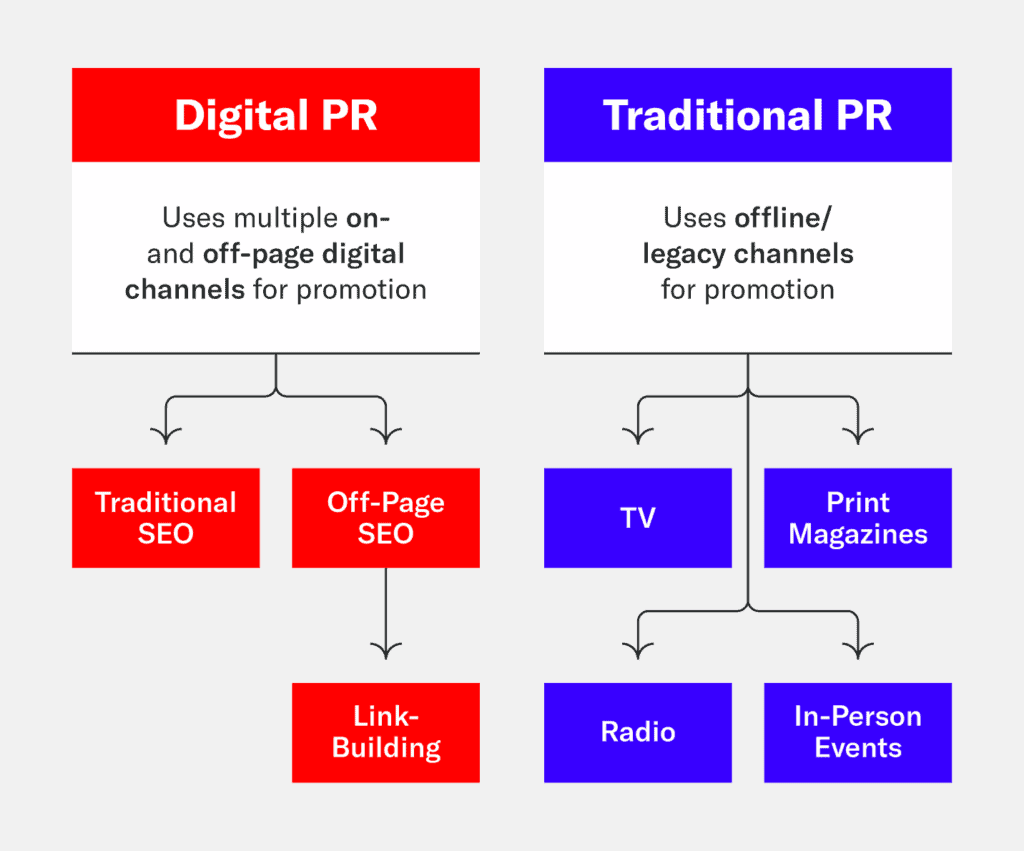
Digital PR vs. Traditional PR
The obvious difference between digital and traditional PR is the medium.
Traditional PR uses the internet as part of a broader strategy to promote brand reputation through media outlets like TV, magazines, radio, etc., to influence public perception and discourse.
Meanwhile, digital PR exists solely on the internet, using blogs, websites, social media, podcasts, and the like to impact online engagement and visibility.
| Examples | |
|---|---|
| Digital PR | Traditional PR |
| Pitching a customer engagement initiative as a story for relevant bloggers and social media influencers to cover | Featuring a customer engagement campaign in a live morning show on TV |
Digital PR vs. Traditional SEO
From a content perspective, digital PR is sort of the opposite of traditional SEO.
Where traditional SEO looks to successful existing content as a roadmap for what content can gain traffic organically based on commonly searched terms, DPR is novel by design and may not even draw much traffic organically.
The goal of enterprise SEO is to take users from question (aka, search query) to your site (aka, your content ranks well for that query). The goal of DPR is to promote unique data directly to journalists, while also optimizing and pitching so media outlets can find and cite it.
| Examples | |
|---|---|
| Digital PR | Traditional SEO |
| Crafting a detailed data study with a unique methodology to come up with novel trends, which you then pitch to journalists to cover | Compiling a comprehensive list of trends from existing sources that align with a high-volume search query for general users to find organically |
Digital PR vs. Off-Page SEO
Off-page SEO specifically uses tactics that exist beyond your website — like guest posting, social campaigns, and manual link acquisition — to drive traffic and links to pages that already exist on your site.
Meanwhile, digital PR uses some off-page SEO tactics to support on-page SEO by bringing attention from targeted third parties to new content you’ve created specifically to appeal to them.
The goal of both digital PR and off-page SEO is similar: Drive authority and brand visibility. You could think of off-page SEO as the PR element of digital PR — without it, there’s not much of an acronym left.
| Examples | |
|---|---|
| Digital PR | Off-Page SEO |
| Relevant journalists link to new content in their own reportage | The publisher pitches guest posts on other websites to link back to their new content |
Digital PR vs. Link Building
Purely as a dedicated effort to gain links from other websites, link building is just one element of off-page SEO, which is a core element of digital PR.
Once you create linkable assets on your site, link building helps you find relevant writers and websites so you can connect them to your content in hopes that they link back to it.
Using digital PR for link building isn’t about organic KPIs like clicks and impressions. It’s used to support organic performance by improving site authority (and thus rankability) across your site.
| Examples | |
|---|---|
| Digital PR | Link Building |
| A new piece of content is created explicitly for manual promotion potential, which is then pitched to journalists after publication | Social, influencer, and journalist outreach are all incorporated into a holistic effort to gain links to various high-value site pages |
How Enterprises Use Digital PR Strategy
What’s unique about how enterprises use online PR strategy is that they’re uniquely able to draw from existing assets: name recognition, social following, media relations, previously created content, user/customer data, etc.
What that looks like in practice is a somewhat muddy smattering of content formats, asset types, and promotional tactics I’ve arranged into a handy-if-sprawling bullet list.
- Internal proprietary data: If you’ve got a million users taking a hundred million actions per day, you’ve got about a zillion data points you can analyze for trends to create brand-aligned reports no one else can replicate.
- Surveys: They’re novel by design, and journalists love them, making them perfect for DPR. Competition is usually low, but keep in mind that just about any competition may render a survey ineffective if journalists have already exhaustively covered the story.
- Data studies: Without your own first-party data, you can create unique data studies from existing third-party data like government reports. Just remember, you’ll still need to find novel trends no one else has discovered yet.
- Trends reports: These collect data at generally annual watermarks to find patterns year over year. Trends reports work well with internal data but can also use data from third-party sources if they’re consistently updated.
- Press releases: For big, resource-intensive reports, a press release can help get the word out, especially for seminal annual reports that journalists and industry analysts wait for.
- Gated content: Since gated content may not have as high an organic hit rate as non-gated content, promotional tactics can drive qualified users to high-value proprietary content.
- Manual promotion: While manual promotion isn’t perfect, it’s often the bread and butter of DPR. Once you’ve got the content, cold calling journalists, bloggers, and influencers can help bring eyes — and links — to your page.
- Organic link acquisition: For data-driven content that can be clearly tied to high-volume keywords and data-seeking intention, you can also use typical on-page SEO tactics while maintaining data recency to rake in those sweet, sweet links over time without having to ask for them.
- Social media: DPR campaigns can live entirely on social media if they’re designed to drive links and traffic back to your website content. You can also use social media to promote your content to your network or to reach out to writers or influencers.
- SME interviews: If you’ve ever asked a math person a math question, you know subject matter experts love talking about the subject matters they’ve spent their lives becoming experts on. You can publish these unique conversations or enrich other content by incorporating quotes you’ve strategically prompted during your chat.
- Relationship nurturing: Like the many fiddle leaf plants I’ve killed and thus complicated this metaphor with, journalist relationships need nurturing to bear fruit (or I guess just leaves, in my case). By maintaining a consistent stream of quality information to journalists, you can keep a predictable influx of quality links coming in.
- Influencer marketing: Enterprises also tend to have the visibility (and, let’s face it, budget) necessary to hold influencers’ interest. By sharing your content with household social media or industry names, you can get your content in front of a whole ‘nother qualified audience.
- Content repurposing: You’ve taken weeks, months, or even years to create a big, sprawling piece of content. Let it live on in other forms by repurposing your data into assets like infographics, webinars, social posts, trends reports, op-eds, videos, and podcasts.

Examples of Digital PR for Enterprises
I could talk in abstract all day, but it’s probably better to just show you what I mean. These digital PR examples may not all be specific to enterprise brands, but their approaches (and successes) are scalable at the enterprise level.
Enterprise DPR Example 1: Survey
Kraken | Survey: 63% of Crypto Holders Say FOMO or FUD Negatively Impacted Their Strategy
| Key stats | Why it works |
|---|---|
|
|
The cleanest DPR strategy may just be a survey: It’s unique, the data is proprietary, you can easily align the subject to your brand and offerings, and journalists will always have a use for it.
As a bonus, it’s also a content type that can’t be readily scaled by AI, since it requires (ideally) 1,000+ humans to take the time to answer your questions. And as a bonus bonus, your competitors can’t replicate it — once you’ve told the story, they need to find their own.
While Kraken did this survey the old-fashioned way by enlisting an online survey platform to poll a randomized sample of American adults, as an enterprise, you may have the audience you need to run informal surveys in-house with your users, customers, followers, or subscribers.
The downside of a survey is also what makes it effective: You’ll probably need to pitch it manually to would-be linkers. That kind of promotion is time-intensive, but can have a high hit rate if you can find the right journalists.
Surveys tend to have very tenuous connections to practical search queries, meaning organic traffic is hard to come by, and the publicity generated by journalists is typically the best way to help them gain search traction.
Enterprise DPR Example 2: Data Study
The Zebra | The 10 Most Dangerous Roads in the U.S.
| Key stats | Why it works |
|---|---|
|
|
One of the key problems with producing survey content is… you need to run a survey. But, you can still produce viable DPR campaigns with content centered on (often) freely available, reputable data.
Take this data study from The Zebra. As a purveyor of (among other things) car insurance, a study on dangerous roads — while admittedly a bit dark — perfectly ties a buzzy, search-friendly data-centric topic to one of their core offerings.
This gives them natural authority signals, boosts their authority in their product vertical, and creates equally natural throughlines to product pages.
This study takes freely available, highly reputable data from NHTSA, churns it through hours of considered analysis and expertly crafted spreadsheet calculations, and produces useful information that wasn’t previously packaged so cleanly to solve a clear user intent.
This study fills an information gap while also giving journalists, bloggers, media reps, and even educational resources a convenient, data-backed source to link back to.
Enterprise DPR Example 3: Statistics Roundup
Panda Security | Ransomware Statistics Vital for Security
| Key stats | Why it works |
|---|---|
|
|
At its best, enterprise DPR content hinges on proprietary data you can intrigue The New York Times journalists with. But even the best DPR content can be outperformed by seriously savvy stat sourcing, known by absolutely nobody as The Four S model.
While good opportunities for stats posts are much more limited than standard SEO guides or DPR content like surveys, they have major benefits:
- Easy to create
- Easy to maintain
- Organically drive links over time
- Require no proprietary data
- Require no manual promotion
- Extremely low-risk
- Can readily cite your own proprietary data from other posts
A good stats roundup is like (apologizing in advance for this one) a chain in a chain factory: It just keeps getting links. All you have to do is update the data regularly with the most recent sources, and if it’s ranking well, creators will source back to it over time.
Enterprise DPR Example 4: Trends Report
Embroker | Top 16 Cybersecurity Threats in 2025
| Key stats | Why it works |
|---|---|
|
|
Another approach to rehashing third-party data into first-party DPR insights is the trends report. This one from Embroker cites data from across sources ranging from Verizon to AT&T to Embroker itself that fit cleanly into themed buckets and tell a story about the state of the industry.
These can be tedious to compile but also have the benefit of leaning on the hard work other publishers put in to run detailed surveys and studies.
As a business insurer, Embroker can cover a lot of high-leverage topics for corporate stakeholders.
So while cybersecurity threats may not be perfectly aligned with their offering, it falls under the umbrella of their offering and helps the company position its product as a trusted solution with proven authority.
Enterprise DPR Example 5: Gated Content / State-of-the-Industry Report
Huntress | The State of Cybersecurity for Mid-Sized Businesses
| Key stats | Why it works |
|---|---|
|
|
The thing about gates is that they need something worth protecting. Gated content doesn’t really work if the content you’re trying to gate is something readers could get for free from ChatGPT in under two seconds.
That means the thing about gated content is also that it has to be so good that it’s worth what you pay to access it (usually your contact info).
If you’re like me, you don’t fork over your email address to the first landing page with a sleek sign-up form and sans serif font.
What makes this example from Huntress so effective is that it offers an industry-wide report with the type of insights that can legitimately impact bottom lines. It’s targeted at a stakeholder audience, but the subject is also of interest to tech journalists and tech workers.
Pitching gated content is probably a tough sell in most cases, but as an annual state-of-the-industry benchmark, it can build anticipation and drive organic links over time, building momentum for future reports that, like Jeff Bezos, get richer by the year.
How To Create Enterprise Content That Naturally Attracts Media (at Scale)
Unlike traditional SEO content or traditional PR, DPR has some scalability limitations.
Given the complexity of the content, its resource-intensiveness, and the available opportunities, you probably can’t effectively produce it at a high velocity (though maybe you can with the help of digital PR services).
And while manual promotion — whether emailing journalists or enacting social campaigns — can be highly effective, it’s also not an especially scalable way to drive visibility.
Manual promotion can help your content get its sea legs, but ideally, your content will continue passively earning links in the long term. Here’s how to help that happen.
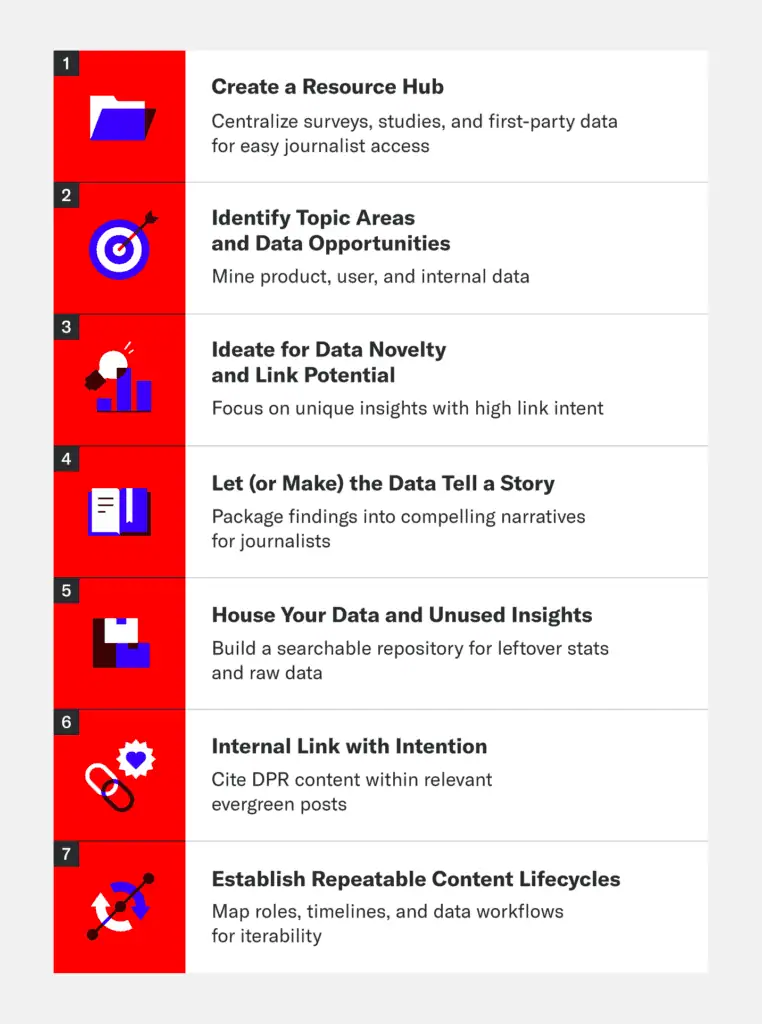
1. Create a Resource Hub Where Assets Can Easily Be Found
Ultimately, you want your DPR content to naturally encourage links over time, which means you also want your DPR content to be easy to find.
Would it be great to get links to your standard organic search posts? Sure. But that’s not necessarily their intent if they’re meant to get traffic from answering common search queries.
By creating a separate resource hub to park all your tediously constructed surveys, data studies, gated content, and other content packed with first-party data, you make it easier for journalists looking for unique, citable data to find.
That also means making that hub easy to find — parking it prominently in your main nav with evocative anchor text while highlighting successful pieces in the dropdown should help.
2. Identify Product-Relevant Topic Areas and Existing Data Opportunities
Where’s the easiest place to look for anything? Exactly where you are.
The same is true for DPR content. Before launching a fleet of expensive surveys on quasi-relevant topics, look to your current products, users, and network first.
At enterprise scale, you may have a bounty of first-party data to create studies with that’s not just product-relevant but literally your product.
For examples, you also need to look no further than where you already are: the Siege blog. Here are some recent data studies we’ve created from years of our own data:
- ChatGPT Referral Traffic
- Homepage Traffic from AI Overviews and LLMs
- Content Refresh Frequency
- Content Marketing Trends
3. Ideate for Data Novelty and Link Potential
If there’s one theme that I think should be clear by now about DPR, it’s novelty. The ability to establish and use novel data that has a high probability of earning links starts with ideation. Here are some elements to consider when ideating content for DPR:
- Prioritize keywords with high link intent (i.e., that correspond to a high number of links present in ranking pages), rather than just click or search volume.
- Or, don’t prioritize keywords at all if you plan to promote manually and no relevant ones with notable search volume exist.
- In lieu of keywords to tell you what content to create, brainstorm around data-driven topics related to your product or brand.
- Look to what journalists, bloggers, and influencers in your space have covered recently to brainstorm topics you could provide new data on.
- See which pieces of content have drawn the most links for competitors.
Refine your search when researching competitor content. In your preferred SEO analytics platform, filter competitor content hubs by data-signaling phrases in URL H1s like “data,” “survey,” “trend,” “statistic,” and “report,” ranking in descending order of links earned.
4. Let (or Make) the Data Tell a Story
In case it’s not obvious yet, I’m not much of a math person. But I am, like everyone, a story person.
What I like about data isn’t the math part, it’s the story part — that you can use numbers like plot points, rearrange them, reinterpret them, and build a narrative with real impact and emotion.
That’s both especially true and especially important in promoting a data-driven piece of content.
… Especially in Manual Promotion
Ideally, compelling narratives will form organically from your survey or data study, but even when that’s the case, you’ll still need to package that narrative in a way that makes it clear why it matters — especially when pitching to journalists.
Compress your whole study down to one key idea that connects to specific journalists’ interests so they have a hand-delivered story right to their crowded inbox that they can take and run with.
… Even if You’re a Data Person
And if you are more of a numbers person, AI is whatever kind of person you need it to be. Try feeding your chatbot of choice your data and using a prompt like this, subbing in the brackets as needed:
Here are [survey results] on [how Americans feel about bespoke sketchbooks]. Please identify [five] key [stats / trends in the data] and package them into compelling headline concepts I can share with journalists that will have a high likelihood of encouraging them to write a story about my survey and link back to it.
5. House Your Data and Unused Insights for Future Use
Data doesn’t do much good on a shelf. You put a lot of work (and probably expense) into collecting and managing it, but your 100 unused data points don’t have to go to waste.
Maybe not all your data supported your central narrative, but that doesn’t mean it can’t be useful.
If you compile each of your studies into repositories (even if that’s just a fancy word for “spreadsheets”), you can weave them into content that may not necessarily have been meant to have DPR intent, injecting them with first-party data that makes them more linkable.
You could also compile them into sharp shareables like PDFs or bonus graphics to share with journalists or house on your website as additional gated assets.
If you’ve ever watched a reality survival show and seen a contestant use fish bones for a hook and bird liver for bait on a fishing pole made from sticks and a tin can, you know every scrap of an asset has a use — data’s like that, too. Just less gross.
Create a searchable first-party data repository. Using your database management tool of choice, include key stats, links to raw survey data, and essential details in a platform that’s easily searchable so you can access past data when creating new content later.
6. Internal Link With Intention
You may not be able to guarantee organic link acquisition success, but you can guarantee link acquisition failure without link due diligence.
That’s an admittedly unnecessarily ominous way of saying you should internally link to your DPR content.
It’s fairly standard best practice to link back to any new content from established pages on your site, as this helps search engines discover it efficiently.
Those customary links are a good baseline, but the gold standard is strategically referencing first-party data from your new DPR content on other pages.
For example, you could reference data from a study on generational trends in journaling in an SEO post on how to DIY your own journal, citing your own work as a resource.
This passes along link equity, enriches an organic-intent post with first-party data, and positions your brand as an authority.
7. Establish Repeatable Content Lifecycles
At the enterprise level, DPR content lifecycles, like a castle wall, should always account for scalability. (My 2-year-old daughter is very into dragons right now.)
I consider scalability to be the intersection of replicability, predictability, and qualitability (not a word, but I’m committed to the bit).
At a baseline, that means reducing content processes into component parts with clear roles, handoffs, and time expectations, just like any other scaled work.
For DPR content more specifically, it also means accounting for supplemental processes.
Do you need time to run surveys? Will the surveys need specific platforms with varying completion horizons? How much time will data collection and synthesis take for a data study? How long will manual promotion take?
Beyond all those workflow-specific questions are two more real-time considerations:
- Are there any deadlines you need to align with for seasonal content?
- Will the results of one study be useful for the execution of another?
I like to think of DPR content as progressive, capable of compounding in-depth piece-over-piece as your pool of research grows.
What DPR Success Looks Like for Enterprises
Let’s clear up the easy answer: Sure, success will depend on what your unique visibility goals are. Nothing new there.
More broadly speaking, as an enterprise-level brand with enterprise-level quantities of links coming into your enterprise-level website, you’re looking for three things.
Quality of Links
Quality can be relative to your goals, but as an enterprise, you may not want to get out of bed for links from websites with a domain scoring less than ~40 (depending on your platform, this may be called domain authority or domain rating, measured on a scale of 1-100).
There’s nuance to that, and I’ve seen sites as authoritative as Bloomberg vary by upwards of 50+ points depending on the scoring platform, so it’s not gospel.
But in some ways this is something you can vibe-check by looking for sources like news outlets (vs. blogs), organizations with legitimacy signals like copyright or .org domains, publications with mastheads, and purveyors of recent original content ideally written by named authors.
Intentionality of Links
The ebb and flow of trends in content marketing has shown that nefarious, or at least dubious, tactics in link acquisition don’t tend to yield sustainable results. There’s really no replacement for real, intentionally given links.
Links should have relevant, original anchor text that shows a real human went out of their way to include a link to your page in their own content.
Linking to your brand name is generally okay, too, especially if the context is natural in the text itself.
The full name of your post isn’t ideal since it doesn’t necessarily prove the linking person actually read it, while the raw URL as anchor text tends to signal less intentionality.
Velocity of Links
In scaled DPR, success should beget success. High-performing content should continue driving links over time, with new high-performing content layering on those results, too.
Meanwhile, improved authority signals across your site should raise the visibility and performance of your other pages, naturally leading to better organic performance and more links.
Rather than looking to a simple number of links as a marker of DPR success, look to sitewide or hub-wide link growth by assessing the number of links gained over a given period (a year) and dividing it (by 12) into component parts (to show a monthly rate).
Then, compare this period over period to see not just if you’re gaining links, but if the rate at which you’re gaining links is increasing — which is what you’re looking for.
Make Better Content, Get Better Links
One of my life philosophies is that you should always carry antacids when you travel. Another of my life philosophies is that means have shortcuts; ends do not. I’ll let you decide which of those is relevant to this post.
What I mean is, you should take shortcuts that streamline your work with no quality drop-off (like using AI to assist data interpretation), but you shouldn’t expect there to be shortcuts to value-based goals (like expecting low-quality content and dubious links to raise your authority).
Enterprises have a lot of channels to send marketing efforts down, and for those who decide DPR is one of them, it’s worth keeping in mind that enterprises have unique aptitudes that make them better able to produce quality DPR campaigns that scale.
Remember that all anyone really wants from content is a solution to a problem. For DPR, that usually means systematically providing answers to questions.
Give answers no one else has, more accurately or more comprehensively than anyone else has given them. Then tell everyone about it, and do it again.
And if resources and execution are your questions, our content marketing services may be your answer. We produce end-to-end digital PR campaigns that drive links, build authority, and ultimately drive organic growth at scale for enterprise brands. Let us show you how.