

Thanks to AI and changing consumer habits, digital marketers’ work is no longer entirely tied to Google performance. But that comes with its own challenges.
It’s not easy to be a content marketer today. AI’s rapid evolution is constantly introducing new ways to create attention-grabbing content and track performance, and it’s difficult to keep up. But our new data shows marketers are up to the task.
For our fourth annual content marketing trends report, we polled around 353 workers in the content marketing and SEO space. We asked 13 questions about their plans for content strategy, AI, and budgets in 2026 to understand where the future of content marketing is heading.
Read on for our findings, including strategies to thrive in this year’s organic search landscape.
Key Takeaways
- Content marketers are feeling good about their business. Ninety-seven percent say their program is successful to some degree, up from 73% in 2025. (Notably, 27% of people say their program is very successful, up from 11% in 2025.)
- 31% of people budget between $15,000 and $45,000 per month for content marketing, up from 19% in 2025. Only 25% of people budget less than $5,000 per month on content marketing, an all-time low.
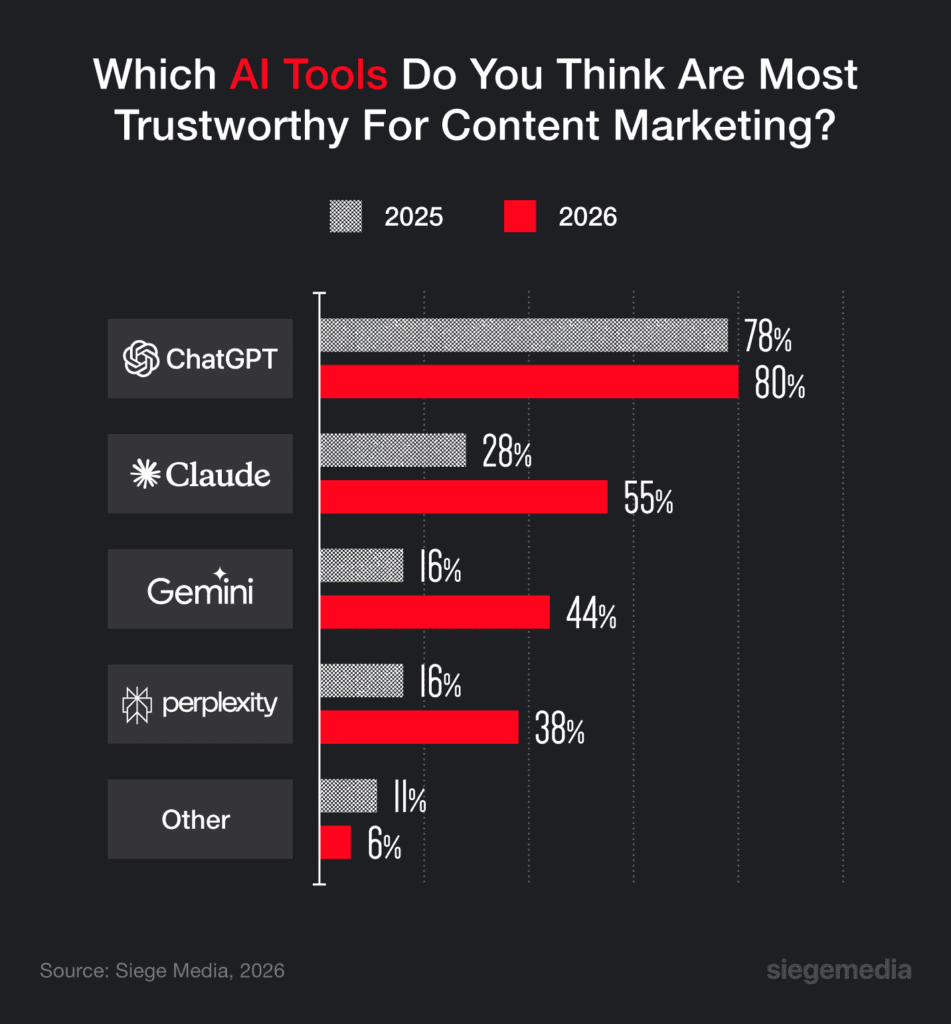
- ChatGPT still ranks number one in trust among content marketers, but 55% now say Claude is one of the most reliable AI tools for their job, up from 28% in 2025. The percentage of people who say Gemini is the most reliable has more than doubled YoY, from 16% to 44%.
- Video and social media aren’t going away any time soon. Fifty-two percent of content marketers are planning to shift spending towards video or multimedia content in 2026.
- Content Marketing Budgets Are Climbing
- AI Is Now a Fundamental Part of Content Marketing
- The Question Is: How Do We Use AI the Right Way?
- LLM Performance Is Going To Be More Important Than Ever
- With the Right Strategy, LLMs Can Direct Traffic Your Way
- Don’t Call It a ‘Pivot to Video,’ but Video Is Dominating
- Despite Uncertainty, Many Content Marketers Are Thriving
1. Content Marketing Budgets Are Climbing
Across the board, teams are investing more funds into content and bringing in more resources to meet their needs. But not every industry has deep pockets.
Nearly 1 in 6 Content Marketers Handle Yearly Budgets of Over Half a Million
Content marketers have bigger budgets today than they did just a few years ago. The percentage of people spending less than $5,000 per month on content marketing has nearly halved since 2023, from 48% to 25%. And after an initial jump in 2025, the percentage of people spending $45,000 or more every month is holding strong:
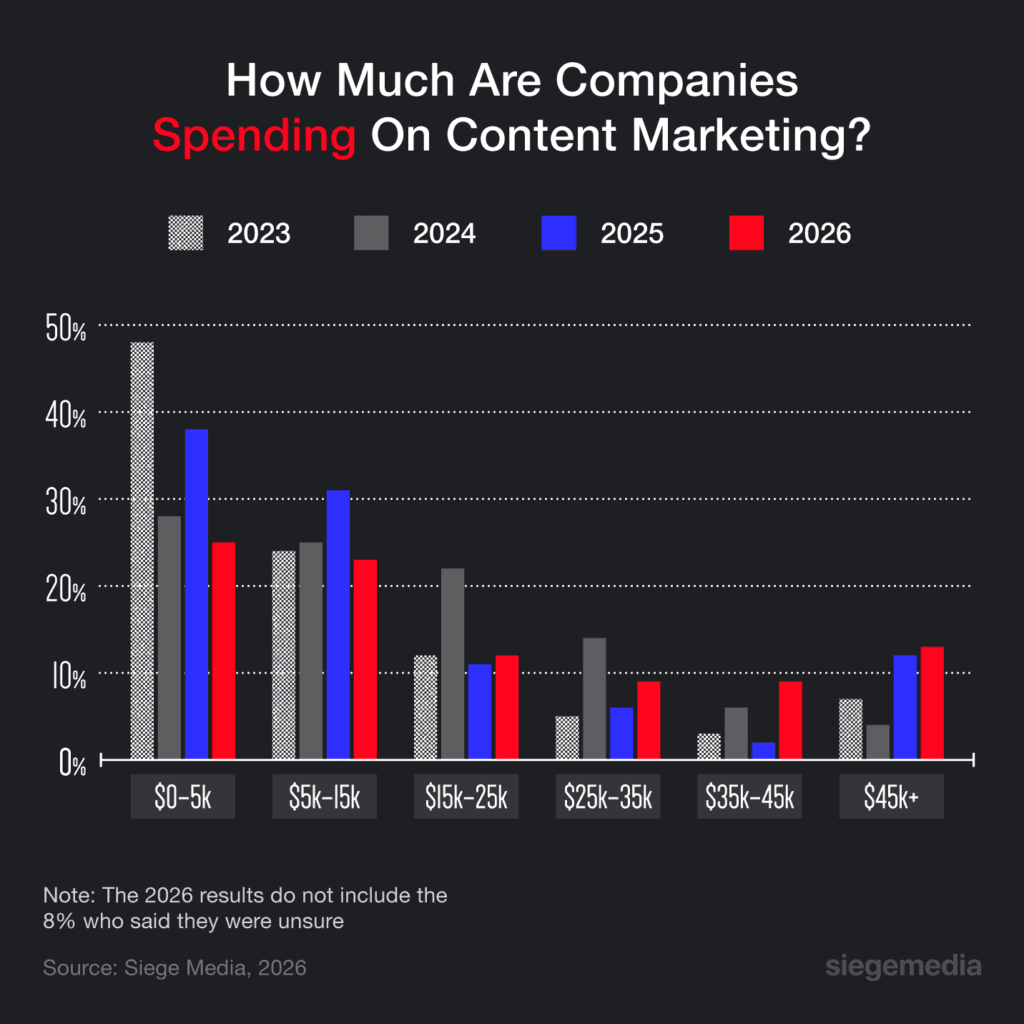
When looking at different industries, specifically, we noticed that nearly one-third (30%) of B2B content marketers spend less than $5,000 per month, compared to 26% of B2C marketers. But otherwise, despite the fact that they’re very different industries, there isn’t a substantial difference in their budgets.
The big difference comes from content marketers who dip into both industries. Around 1 in 6 (16%) content marketers whose industries are both B2C and B2B spend $45,000 or more per month, compared to only 10% of B2C and 10% of B2B marketers.
Despite algorithm changes and a rapidly changing content industry, content marketing is clearly still making money. What’s more, the data shows that the widespread use of AI hasn’t led to shrinking content budgets.
Instead, AI has played a major hand in changing marketers’ key metrics. We all know that you can’t put a keyword-stuffed blog post on your site and wait for the clicks to roll in anymore. But today, you can’t spend all your focus chasing Google’s algorithm, either.
Between LLM search results and off-page SEO, companies and marketers alike are leaning toward bigger budgets and good talent to find new ways to get their brands noticed.
More than 1 in 5 Content Marketers Are Outsourcing The Majority of Their Content
As teams try to meet their content needs while allocating their resources wisely, we’re seeing a sharp uptick in the amount of content budget teams are outsourcing.
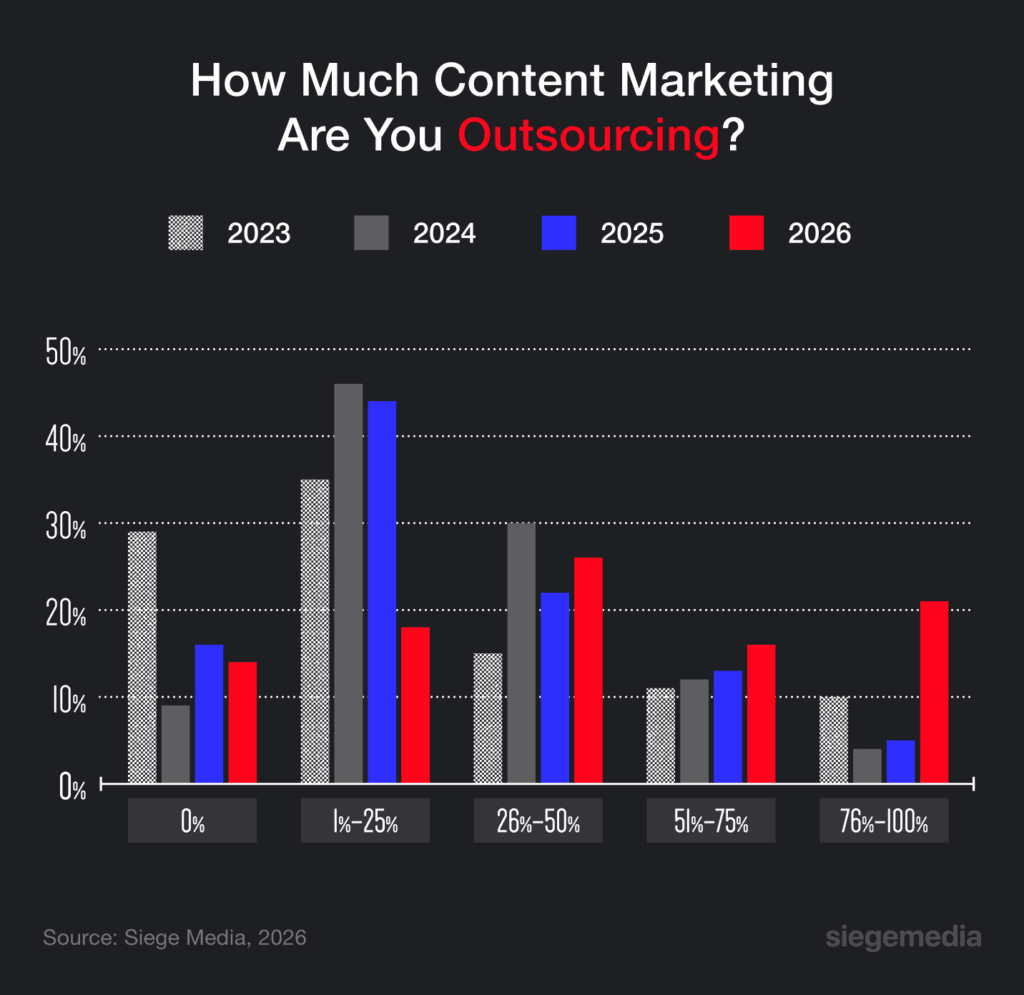
Today, 21% of content marketers outsource somewhere between three-quarters to 100% of their content budget, up from only 5% last year.
Still, most commonly, 26% of content marketers only outsource about a quarter to half of their content budget, a percentage that hasn’t changed dramatically since 2023. Another 14% don’t outsource any of their content budget at all, but that’s actually down from 29% in 2023:
While teams with tight budgets often outsource work to relatively affordable freelancers, some of this growth can be attributed to people with larger budgets who need more hands to help them fulfill deadlines.
Case in point: B2B/B2C marketers, who tend to be big spenders, are also more likely to outsource most of their work. More than 1 in 4 (27%) outsource somewhere between three-quarters to 100% of their content budget, compared to only 20% of B2B marketers and 16% of B2C marketers.
Theoretically, outsourcing content and analysis to AI could save money and improve content marketers’ profit margins. But while AI use is now almost universal in marketing, most are still giving their work a human touch.
2. AI Is Now a Fundamental Part of Content Marketing
Maybe it goes without saying that AI touches every industry. Today, it’s even easier to forget that the rise of AI is still very recent. In 2023, only 65% of content marketers said they planned to use AI content generation tools, and 17% said they didn’t plan to use them at all.
Times have changed. The percentage of content marketing programs that use AI rose from 83% in 2024 to 90% in 2025. Today, it’s a whopping 97%.
However, that doesn’t mean that content today goes directly from ChatGPT to a CMS without any oversight. Most commonly, 48% of content marketers say their program uses a moderate amount of AI. In other words, AI touches about 11% to 40% of their work:
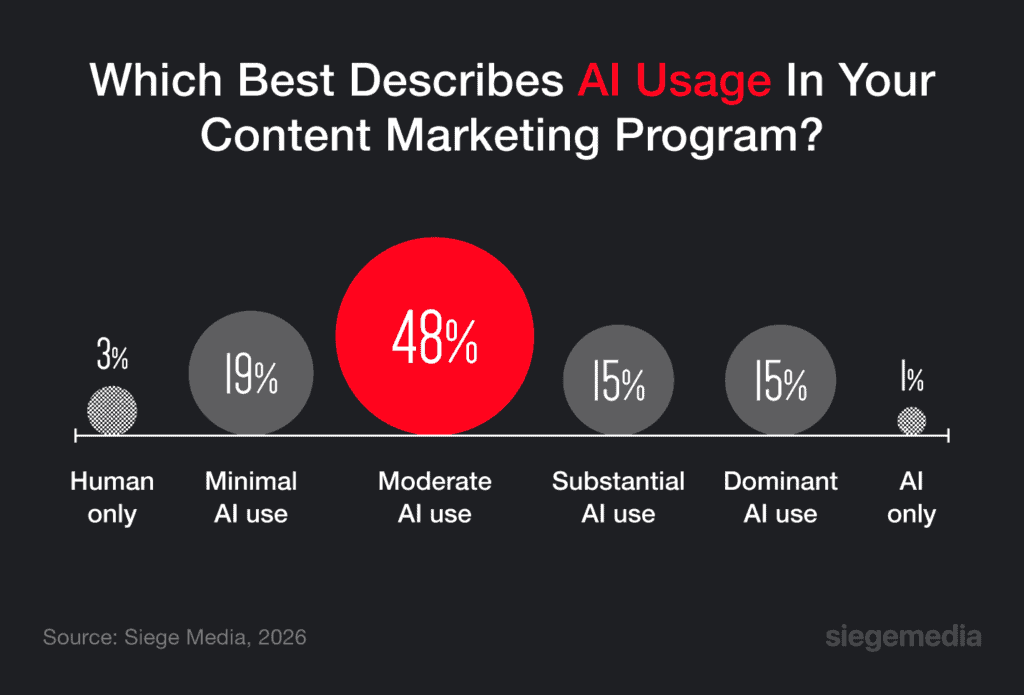
All in all, only 1% of content marketers say their work is 100% AI. Once AI-generated content online became popular, Google quickly specified that its rankings reward original, high-quality, and people-first content with a high place in search rankings, not spammy or irrelevant content. Content always needs a human touch to ensure accuracy and to keep the number of em-dashes to a minimum.
Nowadays, ChatGPT Isn’t The Only LLM Worth Using
When we say content marketers are using AI, we don’t just mean they’re using ChatGPT for everything. But don’t be mistaken — more than three-quarters (80%) of content marketers say ChatGPT is the most reliable and trustworthy tool for content marketing. It’s still the most trusted generative AI on the market. However, after several years as an undisputed market leader, ChatGPT now has some competition.
But it’s no longer the only reliable AI on the market. The percentage of people who say Anthropic’s Claude and Google’s Gemini are the most trustworthy LLMs has roughly doubled YoY (From 28% to 55% for Claude and from 16% to 44% for Gemini).
Some of this rise can be attributed to the fact that many people now use multiple AI chatbots for everything from basic searches to complex problem-solving. But some people have specifically soured on ChatGPT. Sometimes, that’s because they’re unhappy with the quality of its responses, as seen after the GPT-5 update.
We also noticed that Gemini’s popularity spiked last fall, around the same time ChatGPT made headlines due to links between the chatbot and AI psychosis, as well as growing privacy concerns.
Realistically, ChatGPT will be the most popular LLM on the market for a while. But as most tech companies invest heavily in AI, others are catching up.
3. The Question Is: How Do We Use AI the Right Way?
We’ve found that people often use AI at the very beginning and the very end of creating content, not during outlining or writing copy. But this wasn’t always the case. The percentage of people using AI for brainstorming and outlining fell from 72% in 2025 to 61% in 2026, and the percentage of people using it to draft content fell from 57% to 44%.
On the other hand, 38% of content marketers now use AI for editing, up from 19% in 2025. And 74% use it for content ideation.
Generally, content marketers are more flexible with using AI for design and research. Nearly one-half (47%) of respondents use it for generating design ideas, up from 25% in 2025. And 55% use it for strategy brainstorming, such as crafting audience personas. That’s up from 42% in 2025.
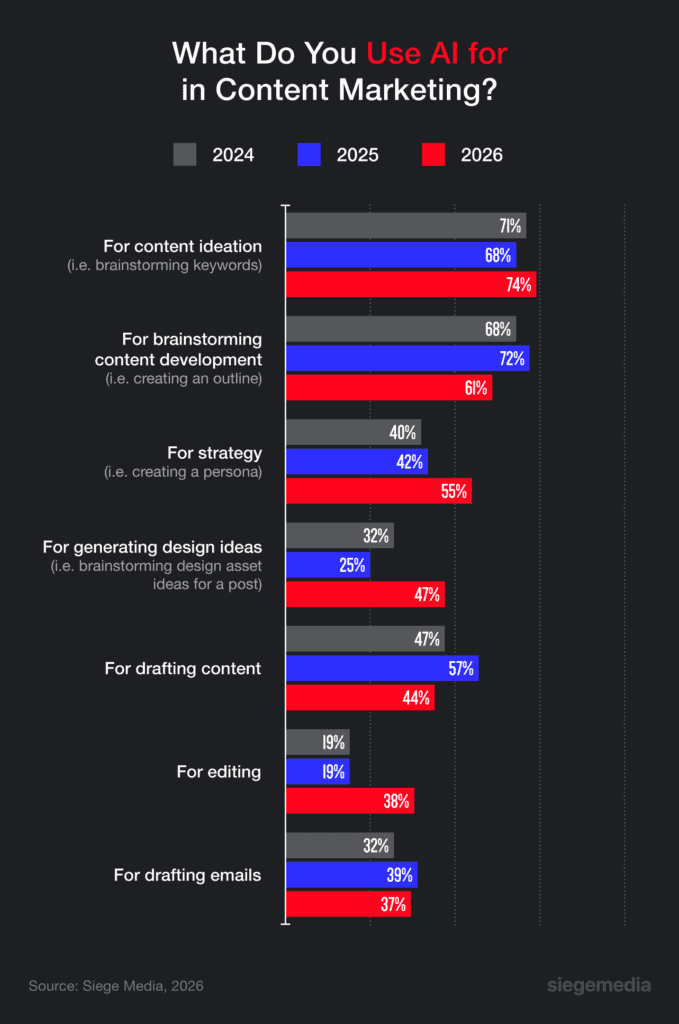
Our findings show content marketers may be concerned about using AI during the critical drafting stage. AI is prone to hallucinations and can make other major factual errors, and many companies like OpenAI are trying to fix that.
But until AI is advanced enough to avoid making basic errors, it’s more important than ever to know when and how to use LLMs to elevate your content. AI just isn’t suitable for blindly creating content and pushing it online.
Think of it this way: AI isn’t too different from rubber duck debugging. Use it when you’re stuck or brainstorming new ideas.
4. LLM Performance Is Going To Be More Important Than Ever
We know now that AI is fundamentally changing content creation, from the first brainstorms to our final measure of client success. And when it comes to client success, there’s always been more factors at play than your position on the SERP. But today, we’re increasingly seeing brands track their LLM performance, too.
The reason is that a staggering number of people are using AI chatbots to ask questions they once Googled, like “Best restaurant near me” and “How do I fix my dishwasher.” And being mentioned in those results by ChatGPT will get you in front of a lot of users. AI search visitors are expected to surpass traditional search visitors by 2028, according to Semrush.
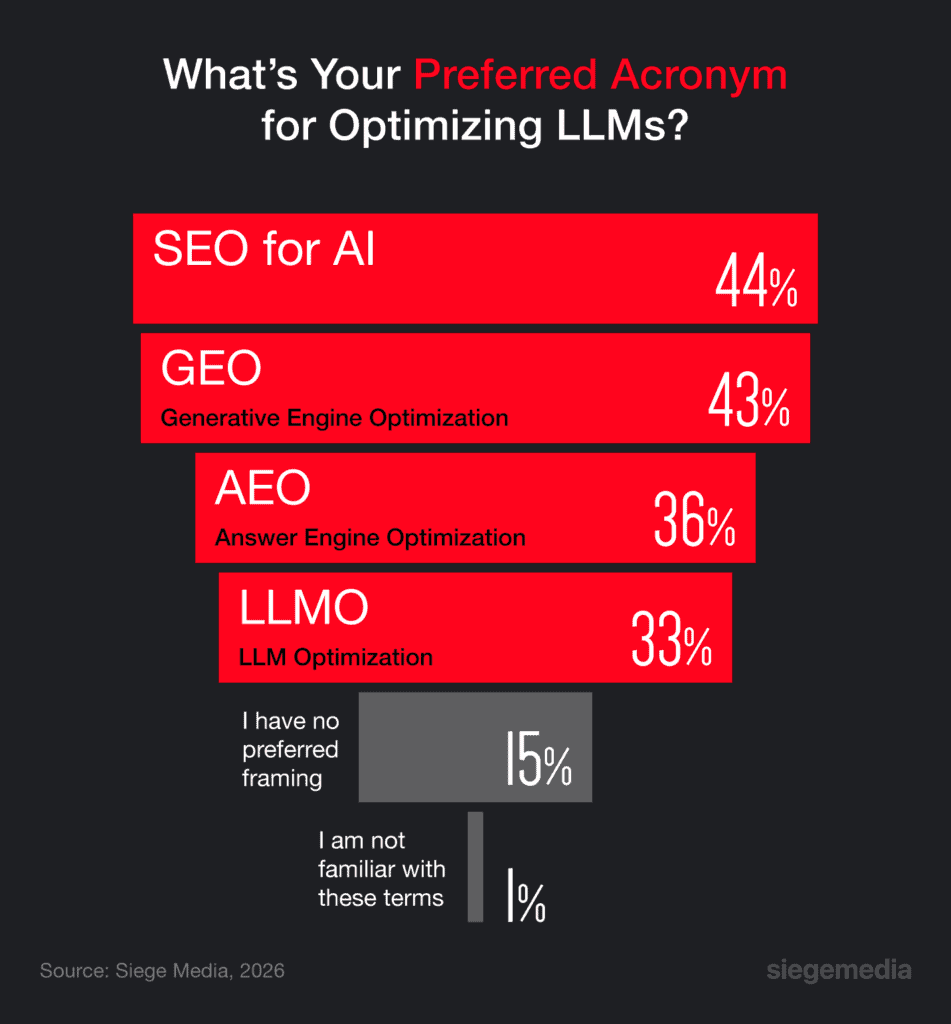
As more marketers tailor their content to AI results and track their brands’ LLM performance, we noticed there’s no industry standard regarding terminology. When asked, a roughly equal percentage of people say they either call optimizing their content for LLMs “GEO,” or Generative Engine Optimization (43%), or simply “SEO for AI” (44%).
But many also say they call it Answer Engine Optimization (AEO) or LLM Optimization (LLMO):
AI Is Best for Fine-Tuning Details, Not Pushing Out Content Unchecked
With new ways of being noticed come new tools to track performance. Enter LLM performance measurement tools. Most of them, like Ahrefs Brand Radar, are probably nestled within tools you’re already familiar with. And we’ve found the majority of content marketers are spending at least some money on them today.
The majority of content marketers spend up to $500 on LLM measurement tools each month. Most commonly, 25% of content marketers spend less than $100 a month on these programs, and 24% spend between $100 and $249.
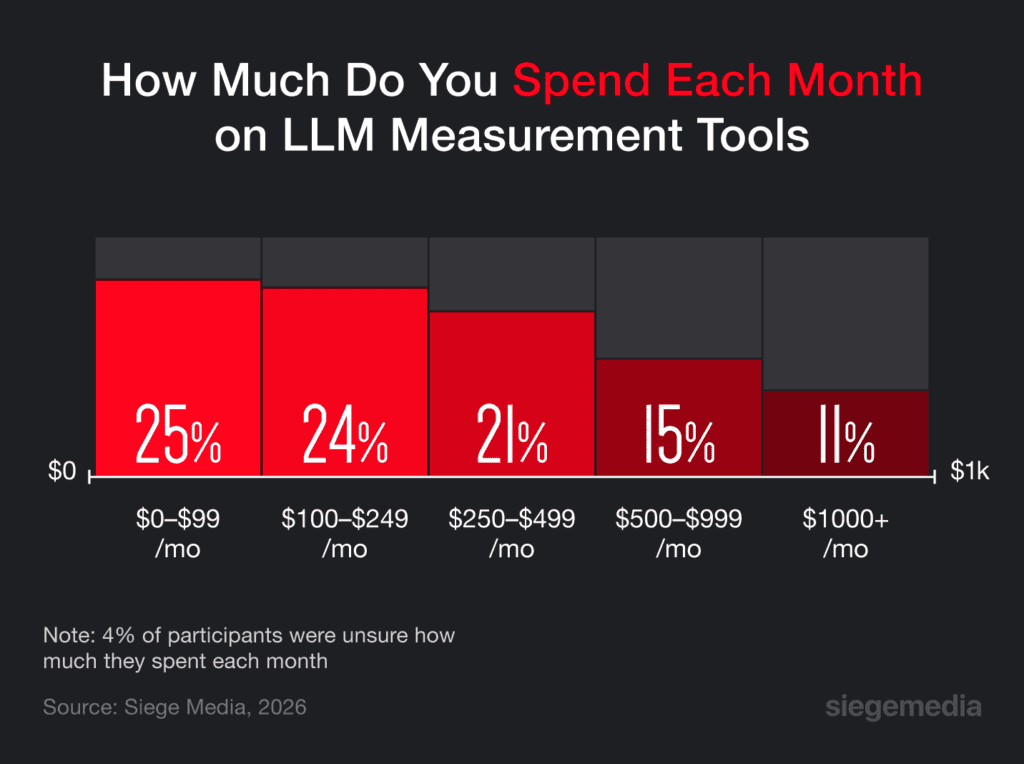
Given these figures, it’s likely that people are investing in between one to three different LLM performance tools at a time. Pricing can vary widely, especially if you tack them onto existing SEO tools.
Ahrefs Brand Radar, for example, is $199 a month when you add it to an existing plan (and you may be adding it to an enterprise tier, which costs $1,499 a month already). Scrunch charges $100 or $500 a month, depending on the plan, and charges custom pricing for agencies and enterprise accounts.
5. With the Right Strategy, LLMs Can Direct Traffic Your Way
When it was introduced, Google’s new AI Overview feature caused panic among media, content marketers, and anyone else who makes a living off their words on the web.
The problem was that Google had begun sourcing answers from web pages without requiring users to click into them. Users may have been getting their answers faster than ever, but content creators were afraid their work would be seen and they would have nothing to show for it.
Two years later, did Google’s AI Overview in fact kill content as we know it? No, not by a long shot. But it has changed the way we create and view content.
Take Mentimeter, for example. Mentimeter is a presentation tool for workplaces and education, which is a tight space with big-name competition, like Microsoft and Canva. When Siege Media paired up with Mentimeter to revamp its content efforts, we both had to shift focus.
Siege Media took advantage of Mentimeter’s new strategic rebrand and created a whole new content strategy to refresh its identity and refine its message. Our agile and collaborative team stayed in constant communication with Mentimeter as we introduced new bottom-funnel content to cement Mentimeter as an authority in this competitive space.
Check out our case study on Mentimeter to learn how we supported their new content goals and LLM ranking.
AI Overviews and LLMs tend to direct high-intent users away from actually landing on brands’ websites. But Siege Media’s new content roadmaps included software comparison posts and other bottom-funnel content that drew users back to Mentimeter. In the end, Mentimeter received 3,4000 conversions in one month and 124,000 ChatGPT sessions in a six-month period.
6. Don’t Call It a ‘Pivot to Video,’ but Video Is Dominating
Remember that viral trend of people posting their “in”s and “out”s for 2026? We found that people plan to pivot away from spending money on outdated long-form or interactive content in 2026. Instead, what’s “in” is once again short-form video and social media.
TikTok and Instagram are practically their own line items in 2026. More than half (52%) of content marketers are planning to shift more spending towards video or multimedia content this year. Short-form content is very popular, too, at 42%, as is thought leadership and proprietary data content, at 41%.
At this point, video-based social media has been a primary focus in marketing for years, especially TikTok. But TikTok’s future in the U.S. has been uncertain.
Since 2020, American lawmakers have been pressuring ByteDance, TikTok’s parent company based in Beijing, to either divest its U.S. operations or be taken offline Stateside. After several false starts that spooked users, the White House cut a deal that allows TikTok to be used in the U.S.
It’s not clear how much the platform will change with the change of ownership, but it is clear that Americans will continue to use TikTok for just about everything, at least for now. It’s unlikely brands will shift their focus away from TikTok any time soon.
On the other hand, many people aren’t interested in featuring Substack or other blogging platforms on their content calendars. Most commonly, 2 in 4 (39%) content marketers say they’re shifting spending away from blogs or long-form content, and 33% say they’re moving away from interactive content, like tools, quizzes, and calculators.
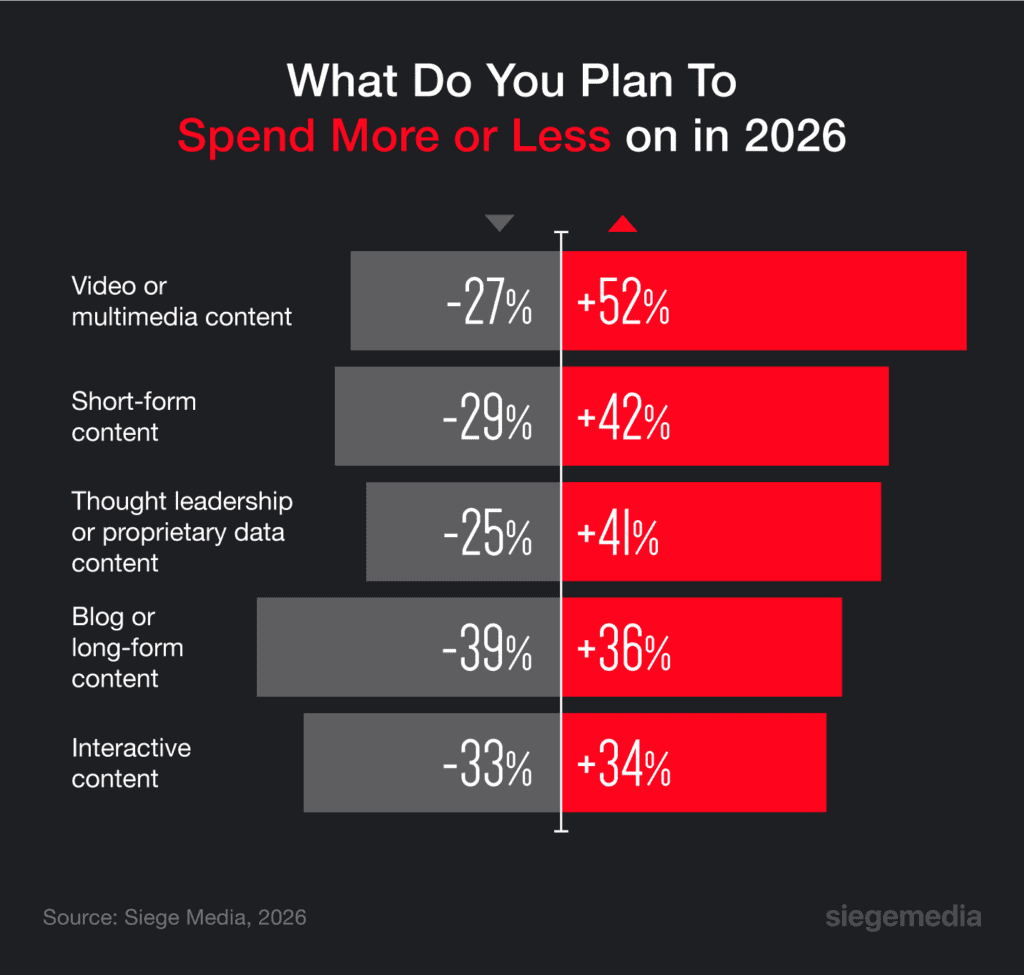
Calculators still often perform well, but, like long-form content, they can be time-consuming to create and may require more technical skill to execute well. As more people outsource their content, they may want to stick with tried-and-true mediums that are simpler to produce and known to drive immediate results, such as short-form content.
Still, not everyone is making radical changes — 35% of people say they’re not changing how they spend their budget.
7. Despite Uncertainty, Many Content Marketers Are Thriving
No matter their weapon of choice, whatever most content marketers are doing to boost their rank and produce high-quality content, it’s clearly working. Nearly all (97%) people we surveyed say that their content marketing program is successful to some degree. That’s a big jump from the 73% who said the same last year. Notably, 27% of people say their program is very successful, up from 11% in 2025.
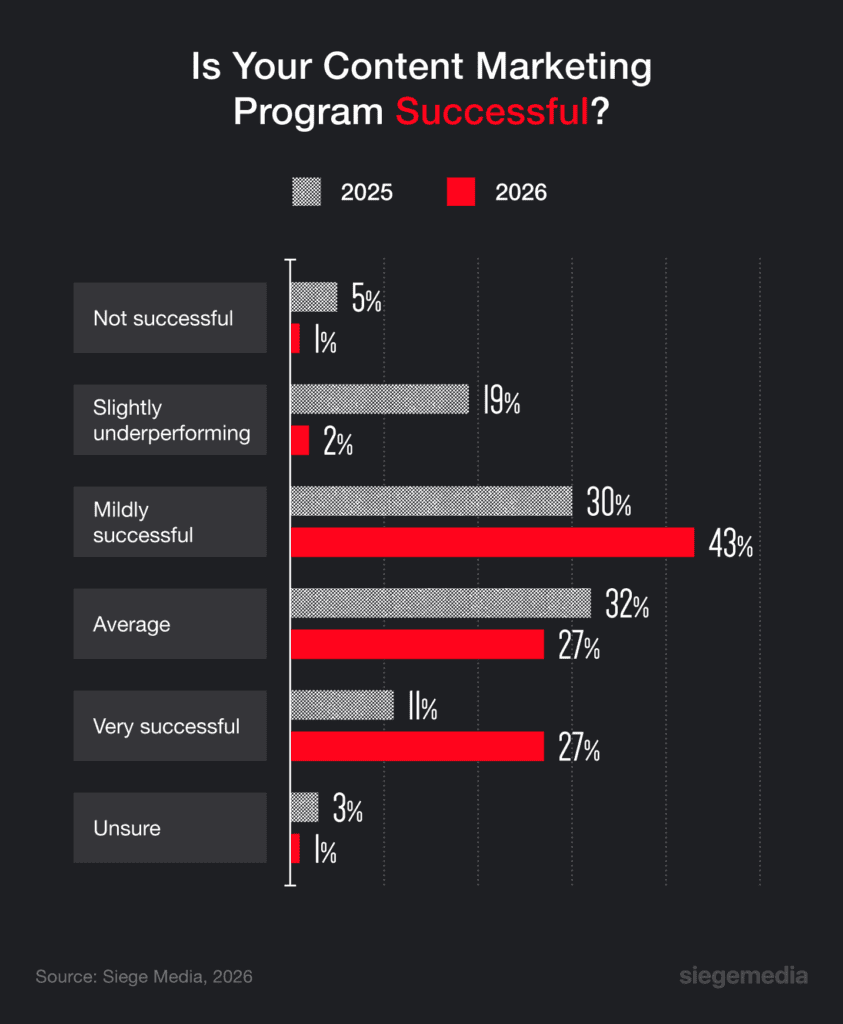
There was little difference in success between respondents working in either B2B or B2C, but there was a difference between individual industries:
- Content marketing programs in finance and health and wellness are reporting the most success right now. More than half (53%) of financial marketers say they are very successful, the highest percentage of any industry (Health and wellness is number two at 44%).
- Perhaps unsurprisingly, only 16% of people in online media and publishing say they’re very successful, the lowest percentage of any industry. Still, the vast majority (98%) rate their programs as at least mildly successful.
When financial and health and wellness content is successful, it can be a significant revenue driver for both big ad firms and independent shops alike. But the best financial and wellness content also usually has licensed, professional oversight and expert content creators behind the helm. In other words, it can cost a lot to produce.
When this content is done poorly, it can materially harm readers and tarnish a brand — it’s why Google scrutinizes both types of content heavily.
With that in mind, producing content in these fields isn’t a surefire win: 3% of people in the financial industry say their content marketing programs are unsuccessful. That’s a slim percentage, but it’s also the highest of any industry.
Methodology
In November and December 2025, Siege Media polled 353 marketing professionals across three Google Forms surveys. The surveys were sent to influencer, marketing, and social media audiences across multiple platforms. The results are unweighted.
Partner With Siege Media To Stay Ahead of Content Marketing Trends Into 2026 and Beyond
As budgets grow and KPIs continuously shift, it still isn’t possible to guarantee going viral or generating thousands of conversions with a single link.
What is guaranteed is that it’s more important than ever to focus on what you do best and bring in pros to do the rest. It’s why 86% of content marketers are outsourcing at least some of their strategy — help from world-renowned content marketing agencies can help you stay afloat.
At Siege Media, we can help you put these trends into motion, elevating your content marketing strategy with data-driven insights and creating unparalleled content focused on your customer. The results speak for themselves. Reach out today to learn how we can help you reach your content marketing goals in 2026.