Google and other search engines are constantly improving. The same should go for your content marketing strategy.
Major algorithm updates, the rise of AI-driven search results, and shifts in user behavior have changed the game in recent years, but one thing remains constant: helpful, high-quality content still rules.
And brands are betting big on it. Our latest trends research found that 31% of companies now budget between $15,000 and $45,000 per month on content — up from just 19% who budgeted the same in 2025. If you’re investing thousands a month, you need a strategy built to deliver.
That’s where some teams fall short. A modern content strategy has to work on two fronts: earning traditional organic rankings, optimizing for GEO (generative engine optimization), and structuring content so AI systems are more likely to surface and cite it.
Not sure where to start?
We’re here to walk you through the basics of a strong content marketing strategy while providing you with real case studies and a framework to build out your own marketing plan.
- What Is Content Strategy?
- Why Is Developing a Content Strategy Important?
- Content Strategy Examples
- How To Create a Content Strategy Framework
- Final Content Strategy Notes
What Is Content Strategy?
Content strategy combines SEO, GEO, and content marketing to identify the content that will bring the most value to your business.
To create a highly effective content strategy, you’ll need to consider your brand, competitors, and the market.
- Brand: Your brand is essentially who you are — think about your mission, voice, values, and target audience.
- Competitors: Look at what your competitors are doing well, review their content, and consider how you can improve it.
- Market: Analyze the overall market to identify growth potential and the topics most relevant to your business.
- AI & Search Evolution: Consider how AI-powered tools like Google’s AI Overviews, ChatGPT, and Perplexity are changing how your audience finds content. A strategy built only for traditional search may miss an increasingly large share of how people get answers.
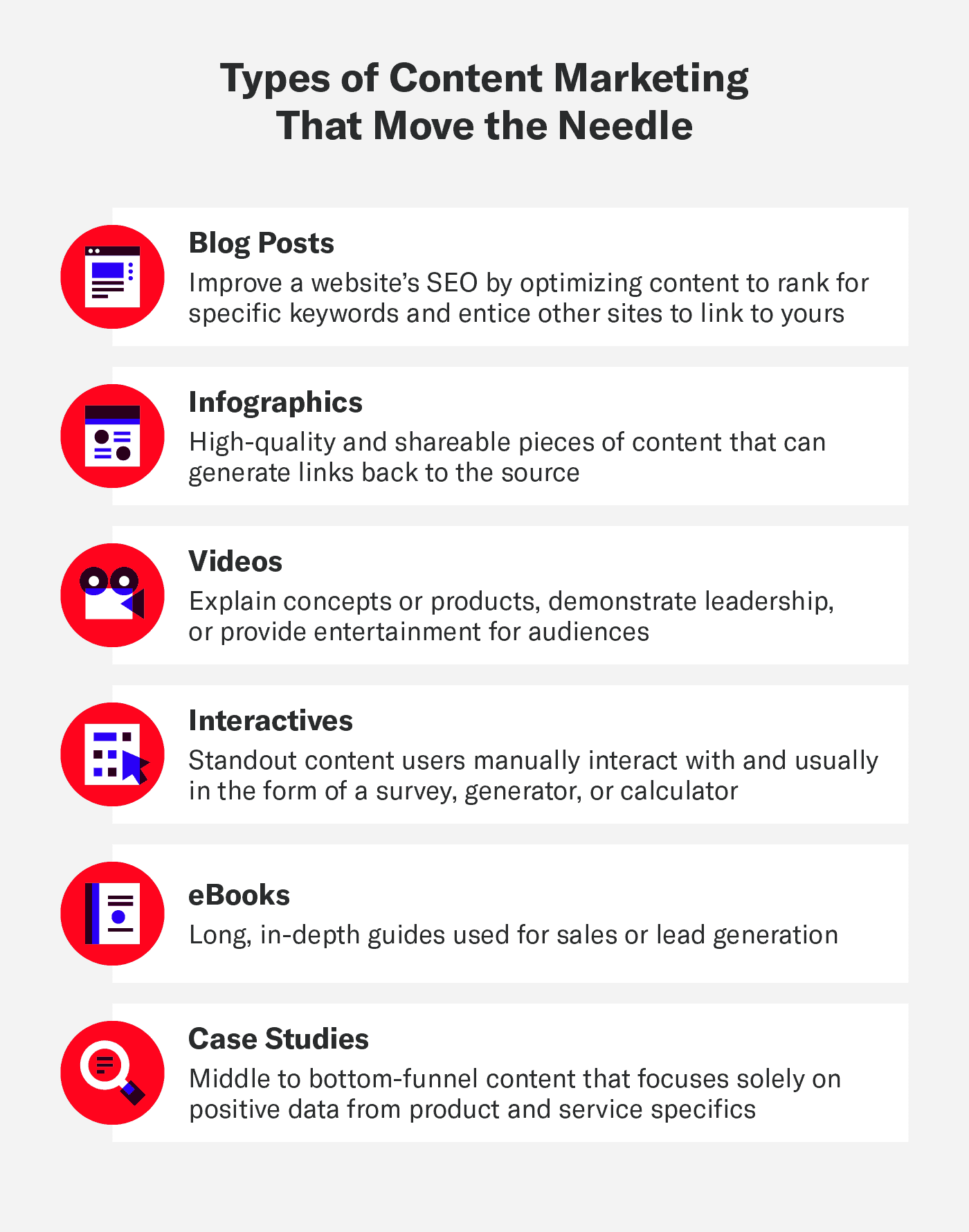
Before we get into how to execute a content strategy, let’s first check out the different types of content you can deploy below.
Why Is Developing a Content Strategy Important?
A solid content strategy helps you reach your KPIs as quickly and effectively as possible. Without one, it’s hard to know what will actually move the needle.
Here’s what a good one allows you to do:
- Support your business goals: Track how your content efforts map to conversions, traffic, and revenue. Adjust based on what the data tells you.
- Test new methods: Identify what’s working (and what isn’t) by tracking which topics and content types drive traffic and conversions over time.
- Publish more consistently: A strategy gives your team a clear publishing cadence and direction, so you’re not scrambling for ideas or posting sporadically.
- Stay organized: A content strategy keeps your team on the same page so you can capitalize on seasonal trends and industry moments, rather than scrambling to catch up after they’ve passed.
Content Strategy Examples
Not every business should have the same content strategy. Certain tactics work better for one brand over another.
Nevertheless, there are tried-and-true content strategies you can customize to your industry and niche. To better understand where these opportunities lie, let’s jump into some business-driven examples.
1. Blog Content Strategies
Best for: B2B and B2C companies
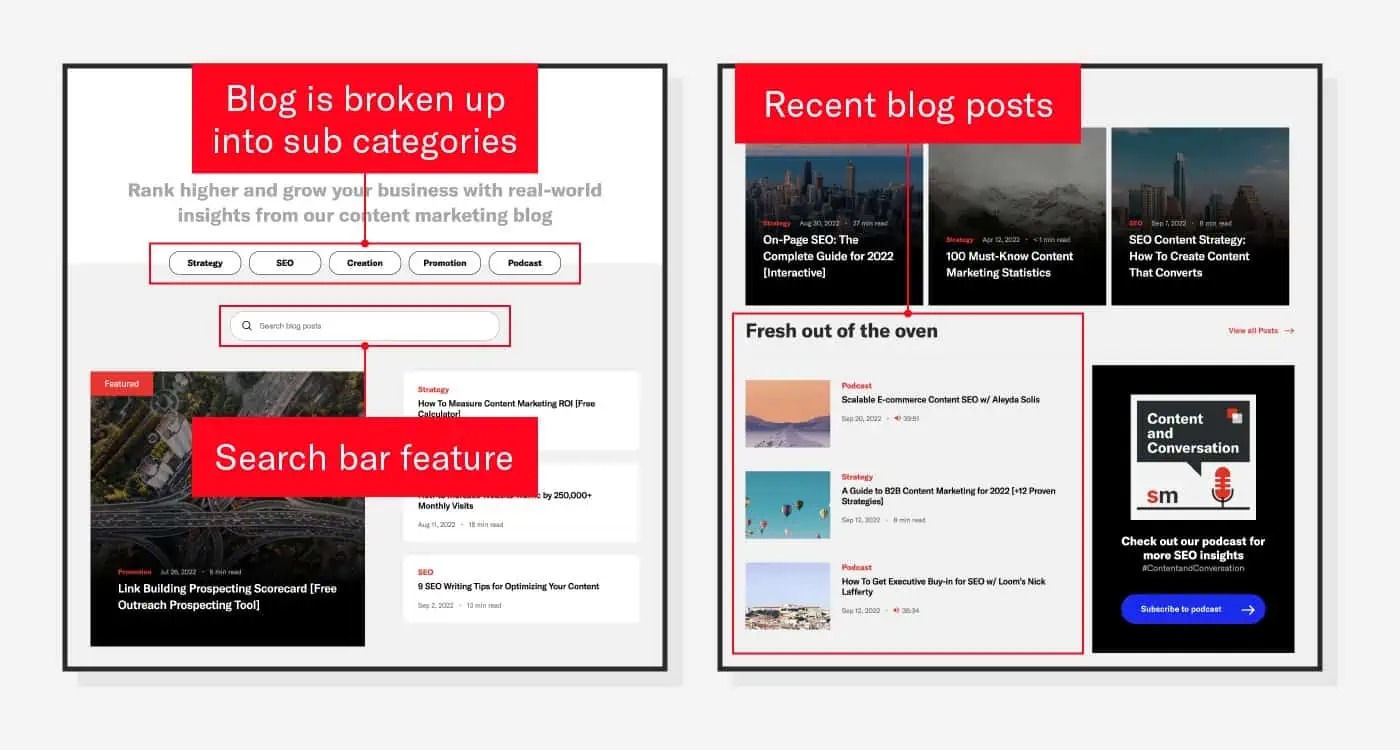
A common content strategy example is implementing blog design and hub best practices.
Blog optimization is important so more people can find your site and boost overall traffic. It’s also a great way to map out development ideas to improve the user experience.
Blog Navigation Best Practices
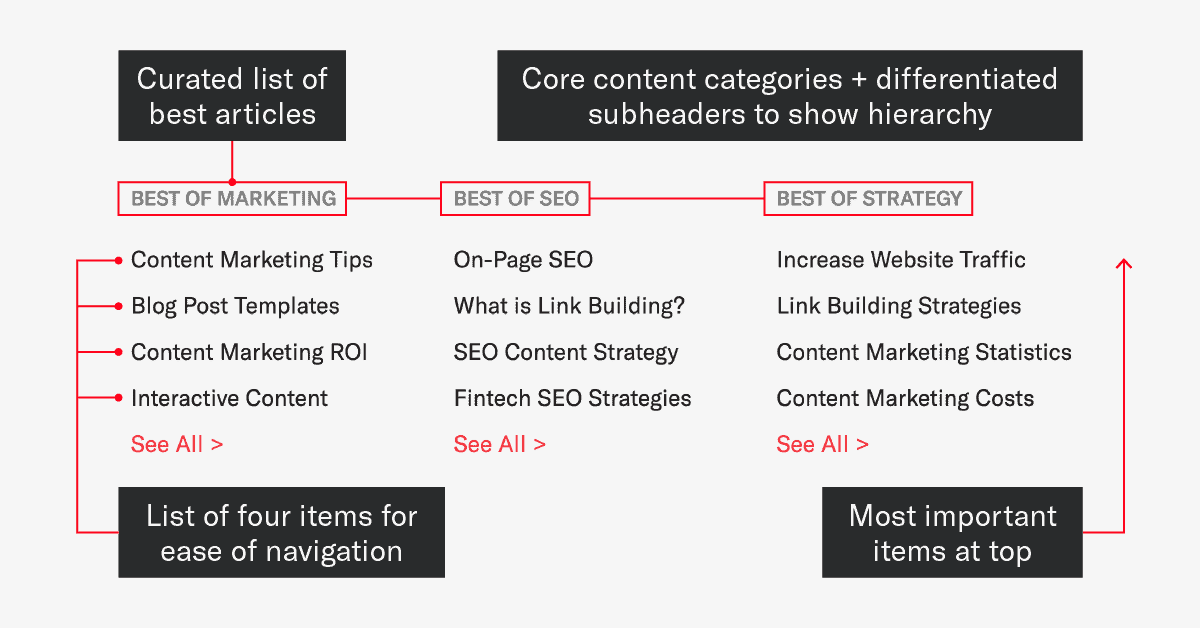
Review your site’s current navigation for opportunities to optimize the blog drop-down. Audit for the following elements that are key for a high-performing navigation to ensure you are promoting an overall good user experience:
- Include a link to each core content category.
- Change the font of subheaders to help show hierarchy.
- Curate “best of” content list or most recent blogs.
- Avoid including more than seven items vertically to improve navigation.
- Keep the most important items at the top, as they are most likely to be clicked.
Blog Index Best Practices
Blog indexes display all blog posts regardless of category, tag, author, or publishing date. Examples of blog index best practices include:
- Include a search function to let users quickly find what they want.
- Highlight the most recent blog posts for freshness, preferably at the top, or you can go the “library” approach.
- Create a curated section and select popular SEO posts to boost users and links. The closer to the homepage something is, the better it’s likely to perform.
- Have a preview list of a few articles from each category, ideally the most recent pieces.
- Choose thumbnails with plenty of variety to maintain visual interest.

An example of a site that does a good job of using blog index best practices is Help Scout. Here are a few blog best practices they implemented that have helped them bring in 400,000+ in monthly organic visits:
- Include a search function.
- Add a library of the most recent posts.
- Create visually appealing thumbnails.
- Include a preview list of articles from each blog category.
Category Page Best Practices
Category pages aren’t very different from a blog hub, except they are customized sections for a specific category or display of different content.
Category pages aim to create visual differences from the homepage to maintain engagement. They are ideally one to two sentences of descriptive copy on top of the category name to build uniqueness for SEO.
An example of a category page is Semrush’s blog, which is broken down into the following categories:
- SEO
- Advanced SEO
- Channels
- Content
- Marketing
- News and research
- Semrush
Blog Post Best Practices
Your blog posts are where the magic really happens — this is where you should spend most of your time to create something different.
Here are a few features to try to stay competitive and build a blog post that’s great:
- A “quick answer” area that provides users with the answer to their query, fast.
- Include unique HTML elements that allow for scaled quality for blog content.
- Add a relevant call to action post-body and/or a narrow header with a sign-up button with contrast that follows you.
- The text is readable (16px+, ideally 18px+), legible (not gray on white), and the column width makes it easy and pleasurable to track to the second line (ideally 50-60 pixels, or ~75 characters).
- Include related links to 3-4 posts, but consider image size for page speed.
- Include an effect on hover, and give related linking thumbnails 18px+ font for readability.
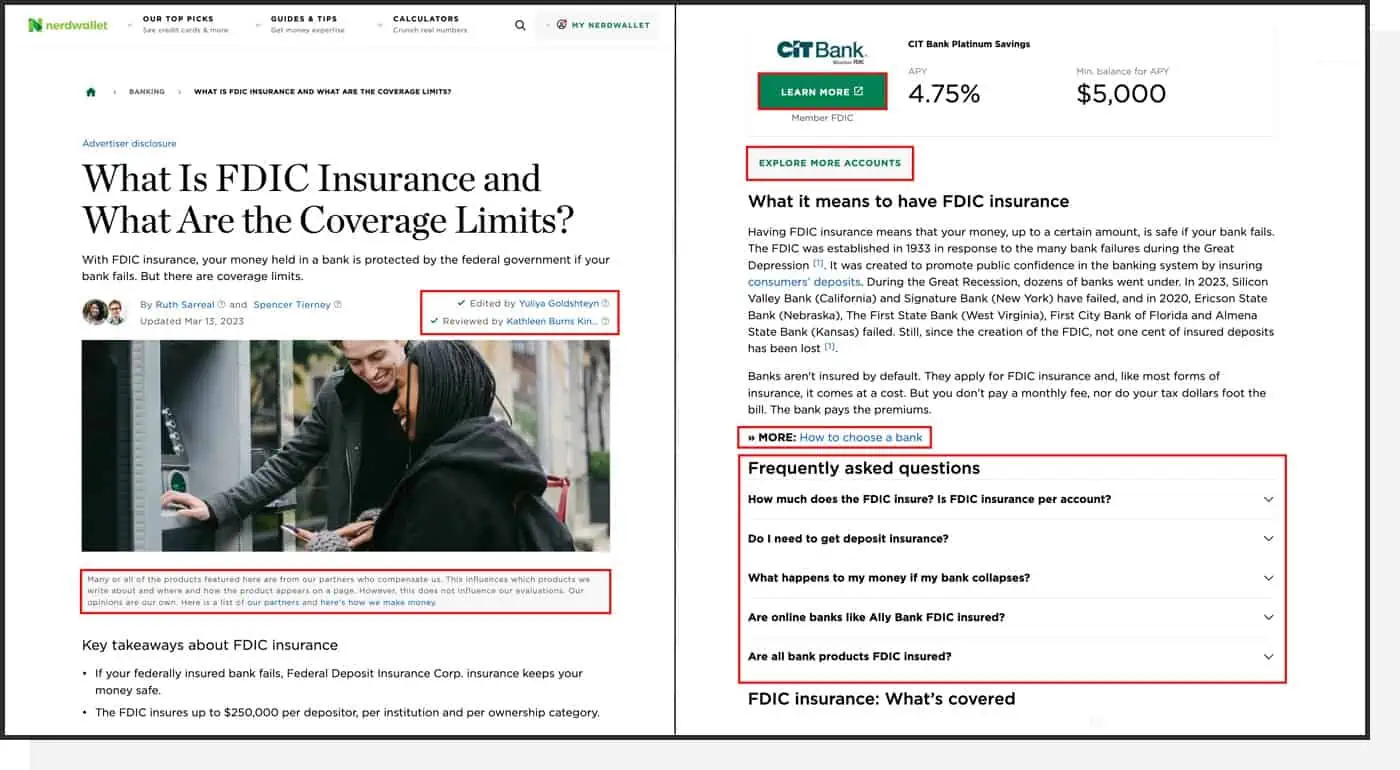
A good example of blog post best practices is NerdWallet, which uses frequently asked questions, related readings, and call-to-action buttons, and ensures its text is readable and that there is an effect when you hover over a section.
2. Comparison and Versus Pages
Best for: B2B SaaS companies
If you’re in the B2B content marketing industry, we’ve got content strategy examples for you. If you are not in the B2B space, continue reading onto the next section.
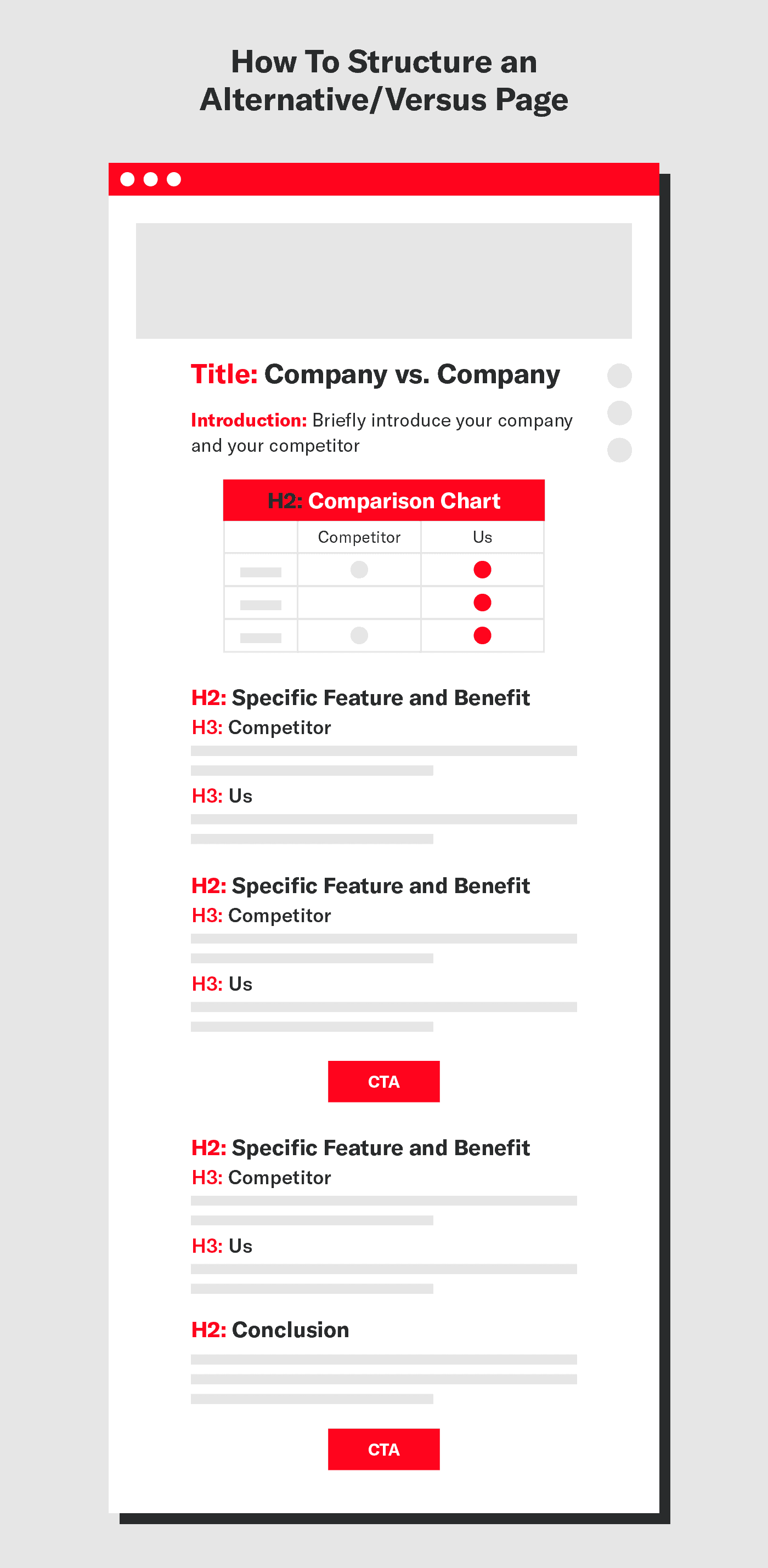
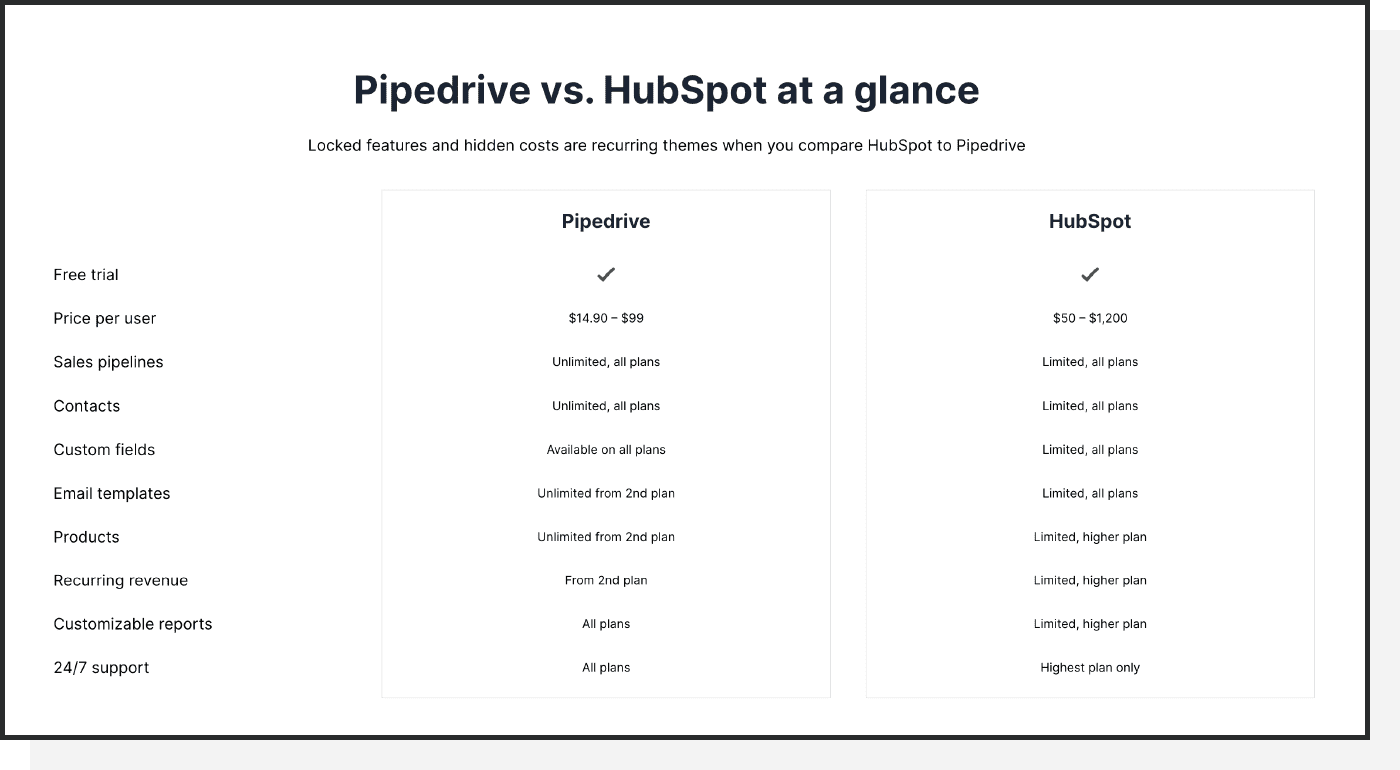
Building comparison and versus pages works well for B2B companies since they are prime bottom-funnel opportunities.
Pages that highlight alternatives to competitors are typically low volume but high value. It’s important to build these search queries into pages to keep users on your site and improve the likelihood of conversion.
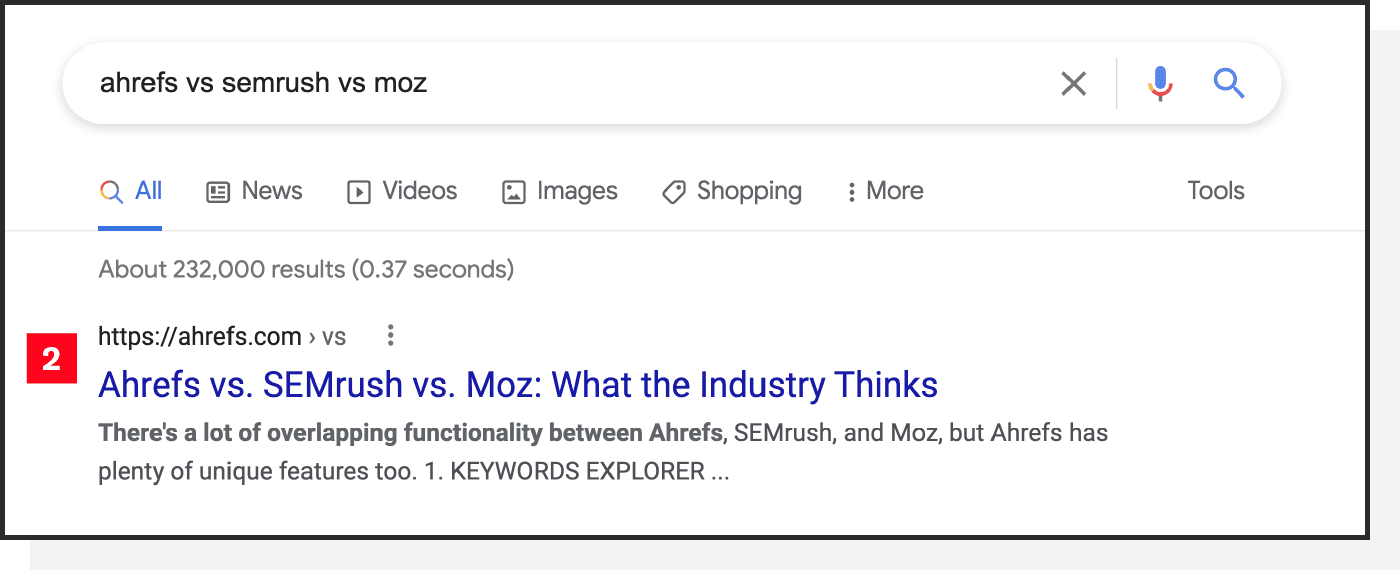
As an example, if you search “Ahrefs vs. Semrush vs. Moz,” you’ll see that Ahrefs ranks #2. Ranking for this keyword allows Ahrefs to own the conversation before Semrush, Moz, or any other third party that can add to the conversation, which drives more conversions for their brand.
The easiest way to conduct keyword research for comparison purposes is to go to Google and insert your brand or competitor and add “vs.” to see the results in the waterfall dropdown.

You can also build comparison pages of “competitor vs. competitor” to get your name out there if a potential customer hasn’t heard of you (yet). By conducting this research, you might discover alternative pages that may be worth building separate pages for.
You might also want to build out a hub to make it easier to internally link to these pages. If you prefer to avoid mentioning your competitors’ names in the navigation or footer, linking to a comparison hub in the footer is a way to lower friction.
When it comes to executing this content strategy example, it’s important to always include a crawlable chart to make it easier for users to find quick, scannable information.
3. Long-Form Content Strategy
Best for: B2B, B2C, and SaaS companies
When it comes to a content strategy, creating long-form guides should be at the forefront to show your audience you are the expert on certain topics.
In-depth, authoritative guides not only signal your expertise to readers, but also align with Google’s emphasis on experience-driven, trustworthy content in its latest updates.
Long-form content also performs well in AI-generated search results. LLMs are more likely to cite comprehensive, well-sourced guides than thin content when answering user queries.
These long-form guides are intended to thoroughly explain a topic from start to finish, and are the perfect opportunity to cover multiple long-tail keywords and related ideas in one post.
Long-form guides are also used to build authority among readers. Providing folks with all the information they’re looking for and then some can create trust. Over time, the creation of these long-form guides will help your authority and could even boost your domain rating.
Here are a few things to include in your one-stop shop posts:
- Provide real value instead of rambling and creating a fluff piece.
- Look for ways to break up the text using bullets, numbered lists, and headings.
- Include post images throughout the piece to keep readers engaged and break up longer sections.
- Strategically place CTAs to help drive conversions for readers who might skim through the page.
This post from Gallant was intended to help them build their brand’s credibility and educate their customers. As a result of creating pet marketing content, Gallant grew to 80,000 monthly organic visits, with an estimated monthly value of $64,500.
4. Interactive Content Strategy
Best for: Fintech — industries whose audiences have a job to get done
Interactive content (think calculators, generators, quizzes, surveys, or other tools) can significantly boost engagement and deliver long-term results. What do all interactives have in common? They provide extra value for the user.
Key benefits of developing interactive content include:
- Increase in engagement due to people participating in an activity for a purpose based on a specific search query
- Increase in organic links due to being a magnet for link building and increased shareability
- Differentiate yourself among competitors by filling a gap and providing users with something more useful than text-based content
For example, maybe parents are unsure what to name their newborn and are looking for a tool to help them ideate potential names. Instead of listing out a bunch of names, create a baby name generator for parents.
Or instead of writing a whole guide on grocery spending, you could create a tool readers can use to figure out their budget. Our team helped create a monthly grocery budget calculator that’s ranking in 16,000+ monthly organic visitors and more than 450 links.

With Google continuing to prioritize helpful, experience-rich content, investing in standout interactive assets (even though they require more resources) can set your brand apart.
A single high-value interactive can keep paying dividends in engagement and links over the long term.
5. Schema Markup & GEO
Best for: Brands that target a lot of recipe, how-to, or FAQ-related searches
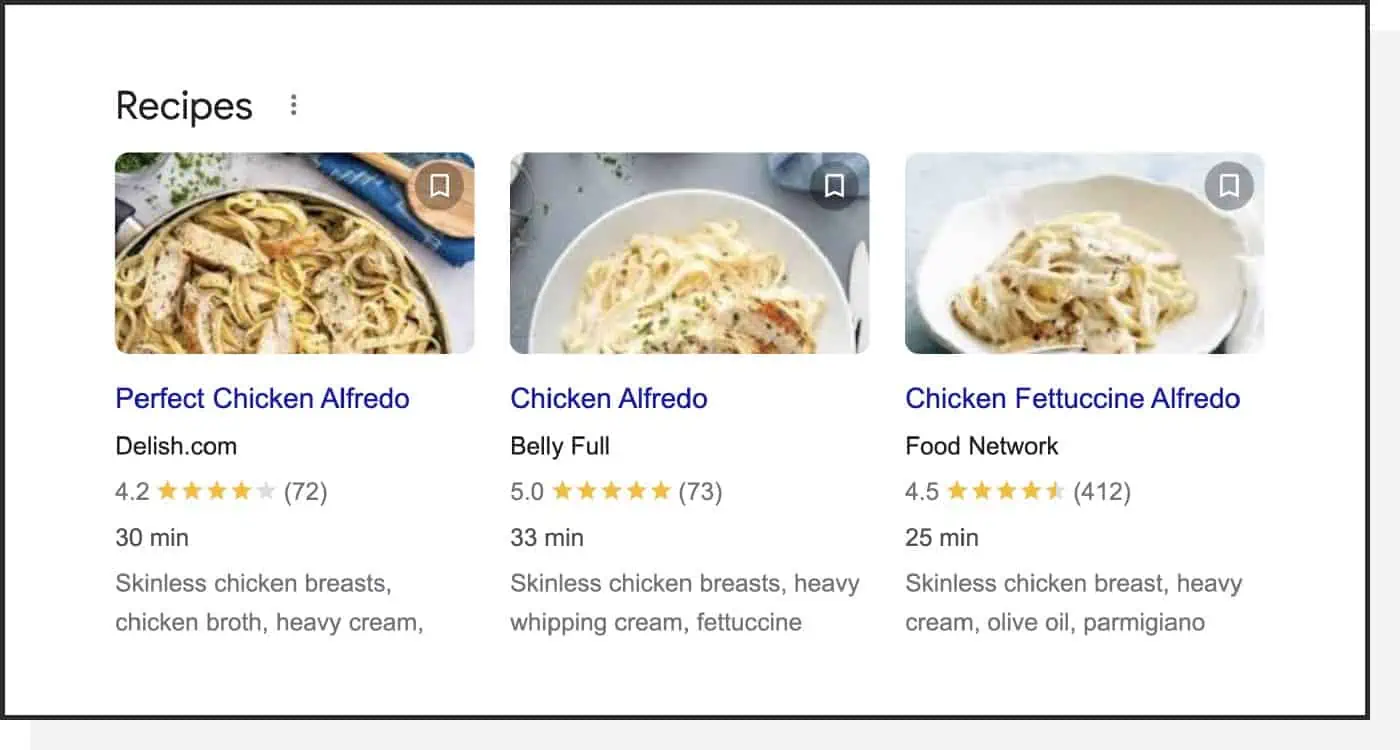
While implementing schema is often overlooked, it’s an important factor to consider including in your content strategy.
Schema markup is a way for search engines to better understand your content by creating enhanced descriptions, or rich snippets, that provide more context for your web pages.
This means that schema can improve your organic search rankings and make your content more prominent in the SERPs. Recent data is also showing that schema can help drive LLM visibility.
Here are a few common ways to use schema markups:
- Articles
- Events
- Products
- Local businesses
- Reviews
- Recipes
- Medical conditions
After you add the schema markup to your site, search engines like Google will display this information via Rich Snippets.
How Schema Helps With AI-Driven Search (GEO)
As AI Overviews and LLMs increasingly answer queries directly, the structure of your content matters as much as the content itself. Schema markup signals to AI systems what your content is about, who authored it, and why it can be trusted — increasing the likelihood of being cited in an AI-generated answer.
Clear authorship signals, FAQ schema, and well-organized factual content all contribute to GEO performance.
6. Multimedia Strategy
Best for: Brands that rely on visual content to reach their audience
Podcasts and video content are forms of multimedia that can elevate your content strategy. Video, in particular, is more popular than ever — 93% of online users watched videos, making it a crucial component of modern content strategies.
That momentum is only growing, as 52% of content marketers plan to increase spending on video and multimedia this year, with short-form content close behind at 42%.
Videos are versatile forms of content that connect with your audience on a face-to-face level. Viewers can gain a deeper understanding of the person or brand behind the product or service.
Podcasts and video content go hand in hand because you can repurpose the audio and turn it into its own entity. The podcast market is crowded, but you can dominate with expert insight. Unique niches thrive in the podcast space because folks can captivate their audiences without visual content.
Here are a few benefits of multimedia content:
- Capture your audience’s attention without text.
- Reach a wider audience across multiple platforms.
- Boost rankings on search engines that tend to favor video content.
This post from Kitchen Cabinet Kings educates its customers with the steps to easily measure for kitchen cabinets. As a result of creating video content, Kitchen Cabinet Kings received 289,000+ views.
Here are a couple of other good examples of blog posts that use multimedia content:
How To Create a Content Strategy Framework
We know you just went through a ton of information surrounding content strategy examples. Now we’ll get into simple, quick steps for executing a more enticing lead-in.
Here at Siege Media, our first onboarding project for clients is to create a content strategy deliverable in the form of a slide presentation or PDF.
At a high level, this plan analyzes current content marketing efforts, pulls insights from industry competitors, and lists content types we know will make the biggest impact in terms of reaching specific goals.
To execute this, we analyze all copy on a website, gaps in the competition, and note ways to improve rankings.
Here are a few strategic sitewide improvements that will impact overall organic content performance, including:
- Poor titles/URL structure
- Content freshness
- Post structure
- Number of links compared to competitors
- Level of expertise, experience, authority, and trust (E-E-A-T)
- Design formatting issues
- On-page SEO
This allows us to get ahead of potential roadblocks that might prevent our content from ranking. Here’s a quick rundown of each step in this deliverable.
Market Overview
In this section, we use Ahrefs data to dissect direct competitors and see how they stack up.
We use this data to see where competitors are winning from a domain authority, links, or traffic perspective. From there, we prioritize and allocate resources based on content goals.
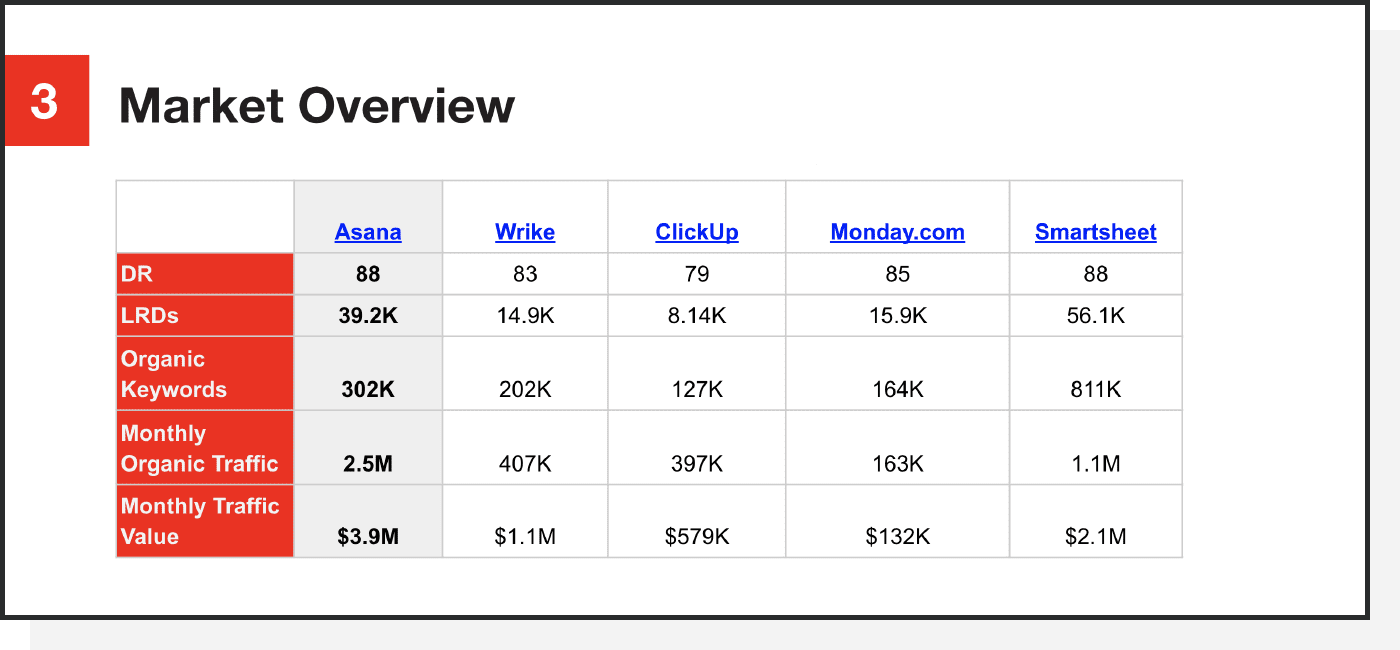
Things to look for in Ahref’s domain comparison tool:
- Link velocity: This measures how many links a competitor earns on average per month, calculated by subtracting the number of links from last year from today’s total and dividing by 12.
- Domain rating: This indicates how authoritative a website is and, indirectly, how easily it can rank for higher difficulty keywords.
- Organic keywords: These are the unique keywords for which a site ranks in the top 100 search engine results pages.
- Monthly organic traffic: This refers to the traffic coming to a competitor’s website from keywords that rank in the top 100.
- Monthly traffic value: This represents the equivalent value of a site’s organic search traffic if it had been acquired via Google Ads.
Competitor Strategy Overview
This step is used to better understand the content strategy, content types, and content quality that competitors use, to inform our scoping and any potential recommendations.

Here are a few questions and angles to consider when analyzing your competitors:
- Is the competitor’s strategy mostly keyword or link-driven?
- Is their strategy based on quality or quantity?
- Are there pages that bring in a lot of blog traffic, and why?
- How about their social media? Check if they promote blog posts on their social channels and where most of their traffic comes from.
- Are there themes/hubs/approaches that can be used as a source of inspiration?
- Where does this competitor get their data (e.g., own research vs. links out to other sources)?
- How do they establish trustworthiness with their readership (e.g., experts, editors, interviews, etc.)?
- How does this competitor include CTAs (e.g., how often, where, what format, etc.)?
- What does this competitor do well and how can you achieve similar/better results?
Blog Analysis
There is always room for improvement in content, which is why you should conduct a content audit. Review your content to make sure it’s high-converting and high-performing.
Based on a recent Google content update, it’s more important than ever to continually audit your website content to cut out low-performing and off-topic content.
The most common opportunities we see with the biggest payoff involve analyzing pages that aren’t performing well. If any pages look outdated and could use a refresh, then add this opportunity to your content marketing plan.
However, you shouldn’t refresh each piece of content on a monthly basis — our general rule of thumb is to wait at least six months before diving deeper into your content’s analytics and figuring out what you need to change in a post.
Here are a few steps to updating older content:
- Conduct an audit: Look at posts that aren’t increasing traffic and conversion rates.
- Find content gaps: Compare your content to what is currently ranking on the SERP and what’s cited in AI-generated answers.
- Refocus the content: Refresh outdated portions of the content to remaster it into a new and improved piece.
- Re-promote: Push the updated content to the top of your blog, promote on social, and add the link to other relevant content on your website.
The above information should give context to the type of content you should create most often.
In this section, we’ll list examples of that content as well as example outcomes.
For example, if your KPIs are highly focused on building links, and competitor research shows that significant organic links are earned through “what is” type posts, a good next step would be to consider exactly how definitions will display on your site and how they’ll look on your blog index.
Define Goals
This might seem obvious, but the first step to creating a content strategy is clearly defining your goals. Think about why you want to create content and the purpose of it.
A few examples of defining goals include:
- Want more links? Focus on an organic link strategy.
- Looking to improve trust/credibility? Stick to creating long-form guides.
- Trying to increase organic traffic? Prioritize optimizing your blog.
- Looking to improve visibility in AI-generated search? Focus on structured, authoritative content optimized for GEO.
Conduct Audience Research
Your products and services are intended for a target audience, so your content should cater to these individuals. Again, it may feel obvious, but understanding your audience is key before you create your content.
Ask yourself the following questions to get started with audience research:
- What is your audience’s age group?
- Which income bracket do they fall under?
- How do they spend their free time?
- What is their career and where do they want to be?
- What are their likes and dislikes?
Execute a KOB Analysis
Now that you understand your audience and have reviewed the competition, it’s time to find high-value topics. As we mentioned above, the keyword opposition to benefit analysis (KOB) is the step where you’ll identify topics within your industry with the highest ROI.
Start off using Google, your preferred search engine, or AI-powered research tools to conduct keyword research based on general terms related to your business. You can also review content your competitors are creating to see if it’s a good opportunity to outrank them or fill a potential gap.
From there, use keyword research tools like Ahrefs to analyze keywords related to your industry and the terms your competitors are ranking for. Make sure you are looking at low-difficulty topics that could generate passive links to your posts.
Run a Competitor Analysis and Content Audit
Entering the competition means you must run a competitor analysis to see how to level up your marketing efforts. Potential customers need to understand why they should choose your offerings over competitors’.
Here at Siege, we conduct a comprehensive market and competitive analysis to identify our competitors’ strengths and pain points. This data helps us determine which pieces of content we think we should tackle in our KOB.
(It’s no wonder that more than one in five content marketers outsource the majority of their content — an outside perspective can help you spot opportunities you might miss.)
Here are a few things to consider when conducting competitor research:
- Figure out who your competitors are.
- Look at what products your competitors are offering.
- Analyze your competitors’ marketing efforts and ranking performance.
- Review any market gaps you can fill with your content.
Running a content audit helps us see if there are any pieces we can optimize to improve their rankings, kind of like low-hanging fruit. We can also see where we have gaps in the current content library compared to competitors.
If you want more tips on how to execute the best KOB analysis for your content strategy needs, check out the video below.
Identify Organic Link Opportunities
In most cases, we quit sending targeted cold emails each month to gain more links for our clients’ content.
We noticed the results were more significant when we incorporated more search-volume-driven content rather than the manual outreach method.
Organic link acquisition is the method of acquiring links without manual outreach. This content marketing strategy involves identifying low-difficulty topics that could generate links naturally and add value.
Pro Tip: Implementing this technique early on in a campaign can show high-quality results in a shorter time span.
We recommend looking at the following keyword frameworks:
- “Types of”
- “What is”
- “How to”
- “Ideas”
An example of this would be “types of coffee” for a coffee provider, since this KW has high search volume and generates an average of over 80 links.
Build an SEO and GEO Roadmap
An SEO/GEO roadmap is essentially your content strategy that organizes your SEO/GEO-related tasks and prioritizes action items. Using the findings from your KOB, you can start mapping out your plan.
Here are the steps to creating your SEO/GEO roadmap:
- Use KOB research to map out your content while prioritizing organic link opportunities, content formats, and scalable topics. Factor in GEO as well, identifying topics where structured, authoritative content is more likely to surface in AI-generated answers.
- Brainstorm shareable topics that are unique but relevant to your business, and will ultimately solve a problem or answer a question for your audience.
- Maintain a consistent voice to build authority, express your core values, and stay true to your overall brand.
Track Performance
You’ve made it to the end — it’s time to start building out your content. Once you have a few pieces of content published, you can begin tracking performance.
Here are a few tools you can use to track your content performance:
- Ahrefs: analyze keyword performance and link goals
- Google Analytics: track your performance and goals
- Google Search Console: review how your content is performing
Final Content Strategy Notes
Creating a content strategy is important to keep your marketing efforts fresh and innovative. The industry is constantly changing and requires regular strategy updates.
Now that you’re more familiar with content strategy examples, it’s time to level up your marketing efforts. You’ll be shocked by the results when you put these strategies into action.
Feel free to browse through our catalog of work to see how we’ve helped similar companies exceed their goals. If you’re still unsure which strategy to build out, contact our marketing team to see how we can help you level up your business.