
We learned what users are actually searching on ChatGPT — and it’s not what you think.
Using prompt data from Profound, which identified the 1,000 most popular ChatGPT prompts, we found that more than one-quarter of AI users rely on large-language model (LLM) tools to act as personal planners and local guides.
And the rest of the data is in: Users are learning how to speak AI’s language, and brands that understand these patterns can turn chatter into insight.
Finding the balance between conversation with a robot and speaking into the void can feel like an unnecessary game of telephone. But it doesn’t have to be, especially because getting lost in translation isn’t an option when effective prompt writing can be the difference between success and failure.
Key Takeaways
- AI is transitioning from curiosity to utility: AI now exists in everyday workflows. Over one-third of all prompts are centered around planning, scheduling, and template requests, signaling a shift from play to productivity.
- Context is key: Role prompting reveals that users expect personalized, context-aware outputs. People want answers that reflect local intent, industry, or tone of voice.
- Prompt literacy is growing: Diverse LLM prompting focused on structure, tone, and specificity shows that users are learning how to get more from AI.
- The human element still leads: A large percentage of prompts (44%) prove that the future of engagement won’t come from automation alone, but from AI that understands human motivation, creativity, and nuance.
An Overview of the Most Popular Prompt Categories
While ChatGPT engagement often fluctuates from month to month, high-intent channels are becoming a cornerstone for high-quality traffic.
What and where people search is changing. And how they search is evolving, too. Gone are the days when informational queries dominated, and here to stay are the days where more than 37% of LLM queries are generative.
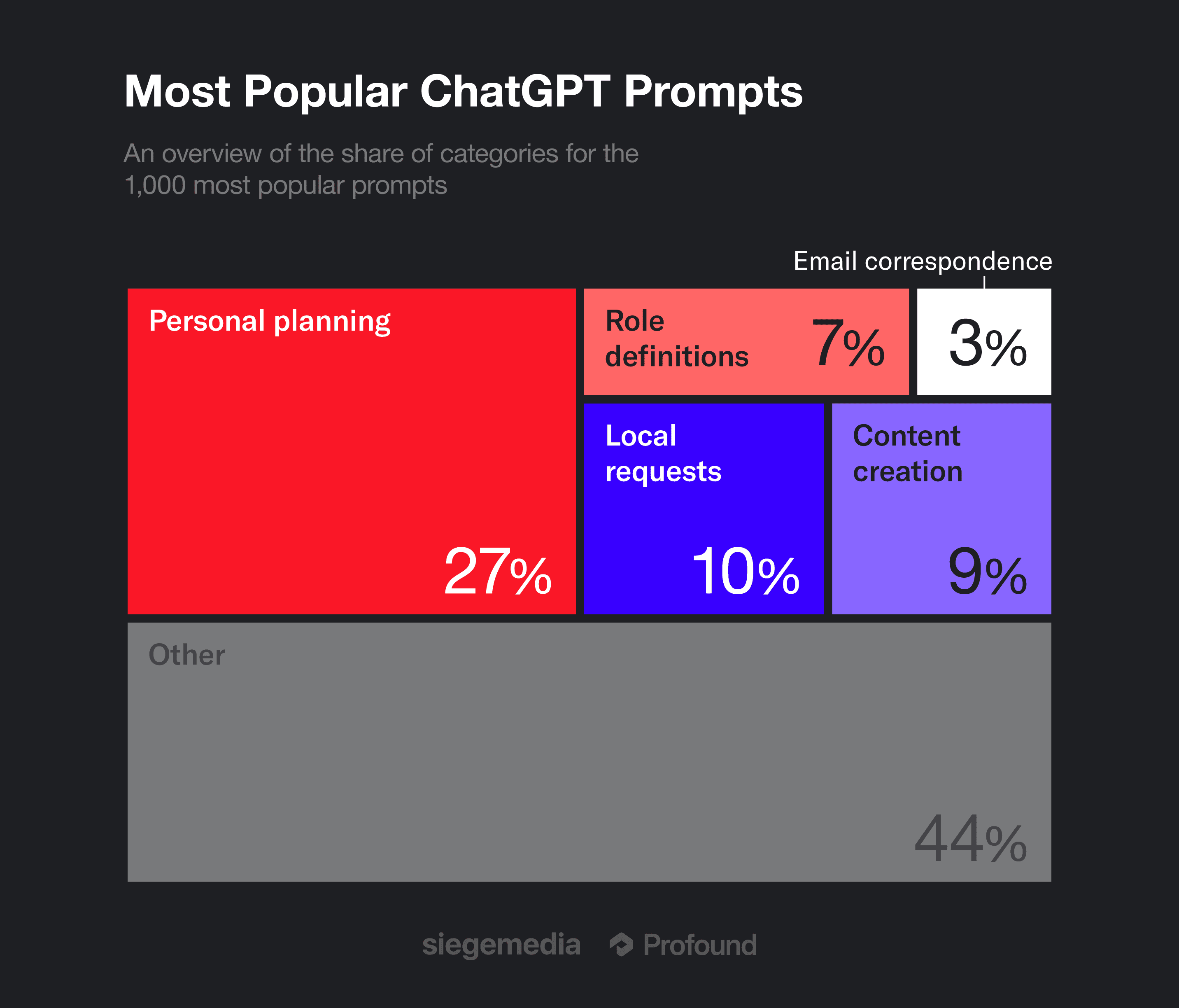
The best place to see this shift is in the language itself. By categorizing the 1,000 most popular three-word ChatGPT prompts, here’s what we found:
| Prompt Type | % of Prompts | Common 3-Word Examples |
|---|---|---|
| Planning and Scheduling | 27% | Every single day, Hours per week, Long-term goals |
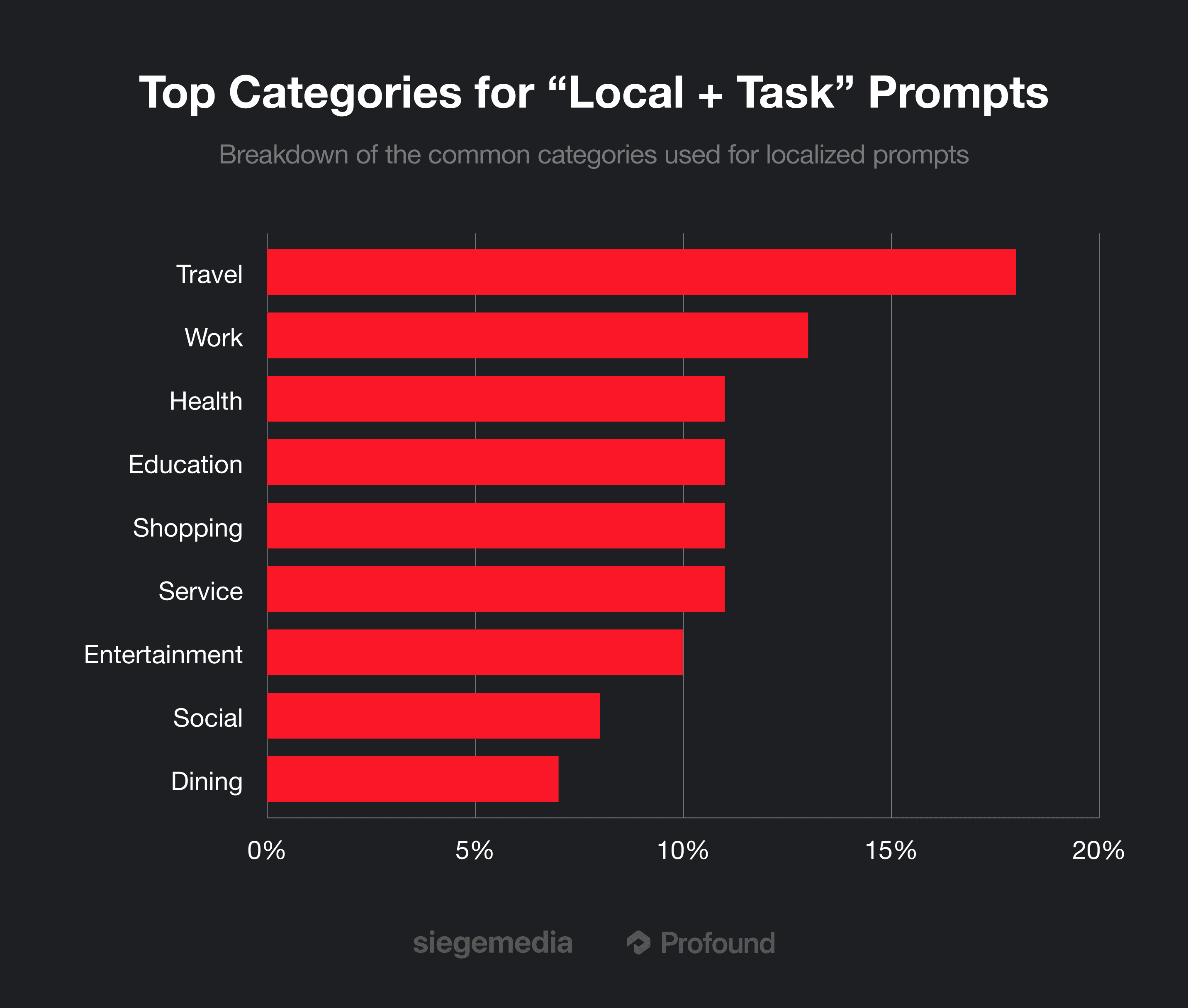
| Local or Task Requests | 10% | New York City, Los Angeles CA, Salt Lake City |
| Channel-Specific Creation | 9% | Social media posts, Landing page copy, Facebook ad copy |
| Role Definitions and Templates | 7% | Business development manager, Chief executive officer, Digital marketing manager |
| Email and Correspondence | 3% | Thoughts best regards, Response best regards, Soon best regards |
| Other | 44% | AI-powered tools, Real-time data, Frequently asked questions |
Trend #1: 27% of Users Look to AI for Personal Planning
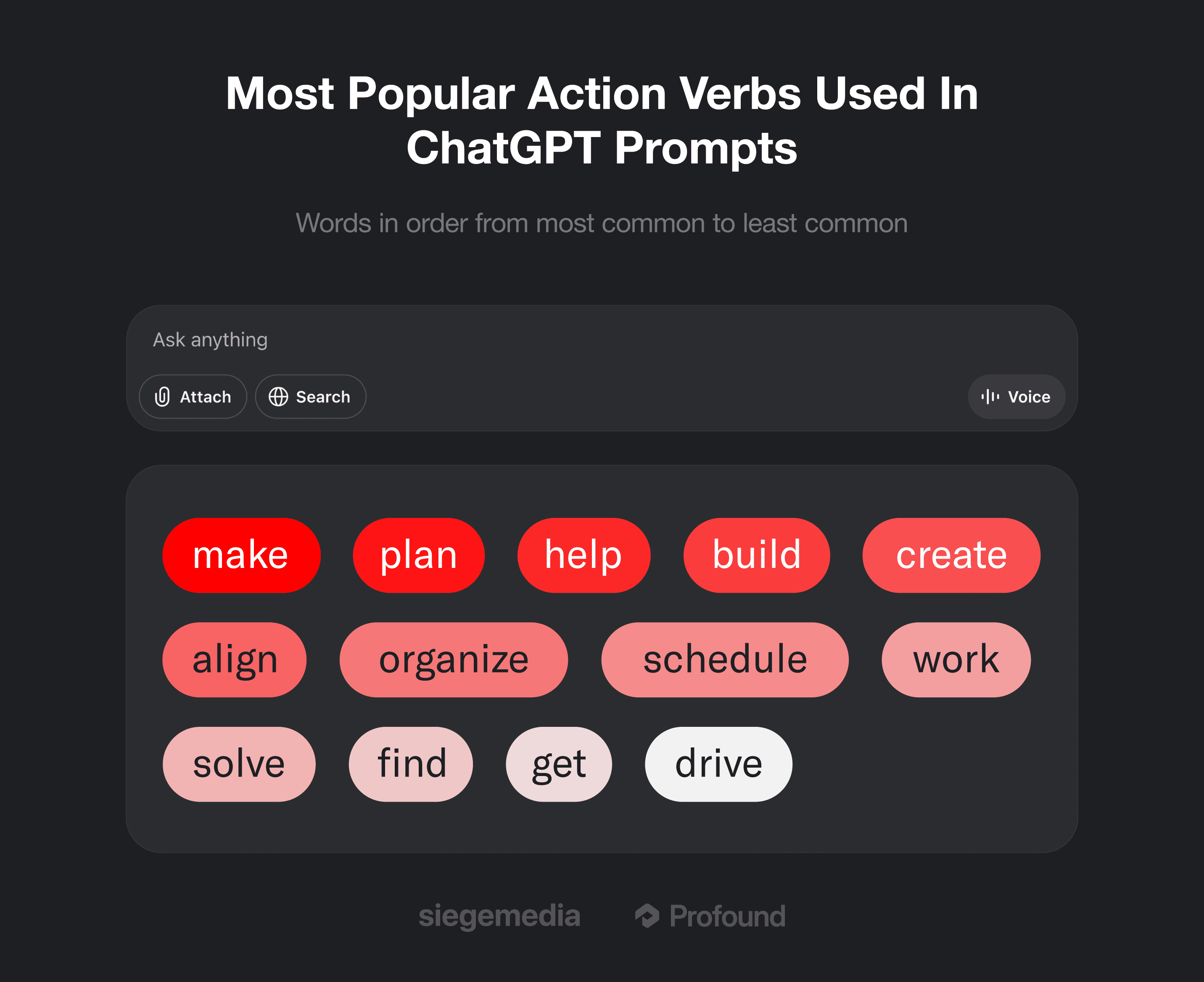
The data doesn’t lie: Over one-quarter of users use AI as a personal assistant for daily life, including planning, scheduling, and organizing everything from workouts to travel itineraries.
Plenty of the most popular prompts showcase this, like:
- Call next week
- Every single day
- Long-term goals
- Time management skills
People rely on LLM tools for structure and spontaneity. The rise of “planning” and “routine” queries suggests users are offloading executive function tasks to AI. This represents a profound shift in behavior, where AI is no longer just answering questions but also structuring users’ days.
| Key Takeaway: Service and solutions need to move beyond inspiration and focus. Instead, they should focus on enabling outcomes, saving time, and achieving goals. |
|---|
Trend #2: Local Search and Generative AI are Starting to Merge
Get this: Local intent isn’t disappearing, it’s becoming conversational. Instead of running to the yellow pages, people are turning to AI for localized recommendations.
This marks a subtle but massive shift in user intent. AI is beginning to replace traditional Google search behavior with location-based discovery. For example:
| You used to ask Google: | Now you prompt LLMs: |
|---|---|
| Restaurants near me | Recommend an affordable Italian restaurant near me with vegetarian options. |
| Flights from NYC to LA | Help me find the cheapest nonstop flight from New York to LA next weekend. |
| Things to do in Chicago | Plan a two-day itinerary in Chicago for someone who loves art and unique food. |
By blending discovery, decision-making, and conversation, users are rewriting the rules of local search, which was once Google’s core domain.
| Tip: Think beyond keywords to AI context matching and content localization. Align your brand’s structured data and tone with how people naturally phrase prompts to train for contextual discoverability. |
|---|
Trend #3: Content Creation Prompts Account for 9% of AI Prompting
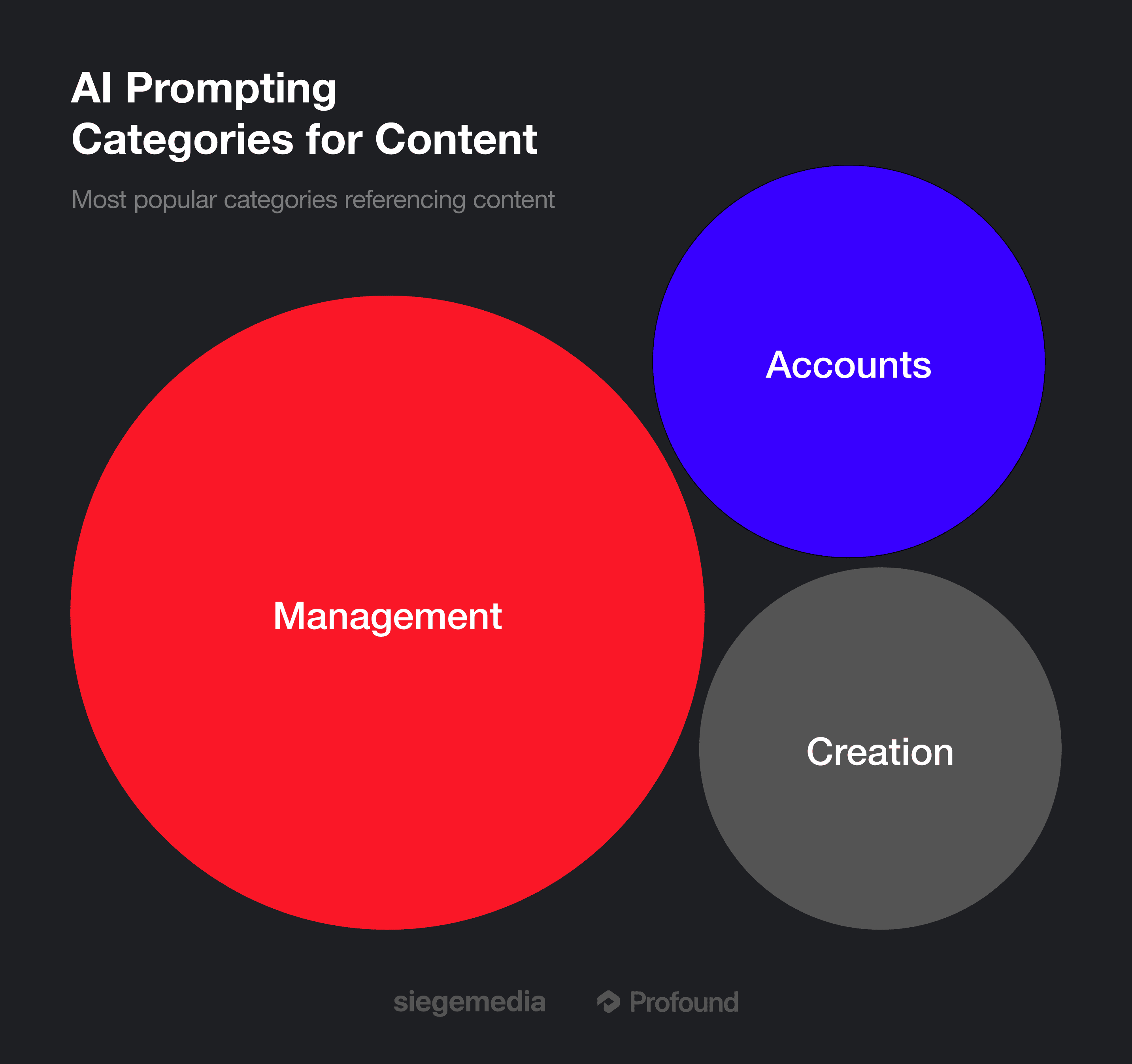
The creator economy is spilling into AI, and nearly one-tenth of short-form prompts focus on content creation. These include examples like:
- Long form content
- Short form videos
- Social media posts
- Social media ads
- Social media campaigns
As users realize they can ideate, script, and optimize content directly through conversational AI, these tools nip at the heels of long-standing giants like Canva templates and social post generators. The future is simpler: Instead of opening five tools, content creators can write one prompt (to rule them all).
| Key Takeaway: Knowing how to phrase a request effectively is a skill, and brands that teach, guide, or scale that behavior will gain authority and retention. |
|---|
Trend #4: Role Definitions Dominate User Prompts
Task completion may dominate AI conversations, but role definition has its foot in the door. People use many of the most popular prompts to gain the role clarity necessary for upskilling, training, and improved decision-making. These common prompters include:
| Role Category | Prompt Examples |
|---|---|
| Marketing | Digital marketing manager, direct response copywriter, and social media manager |
| Sales | Business development manager, denior account executive, enterprise account executive, and real estate agent |
| Customer Success | Customer success manager and customer service team |
| C-Suite | Chief financial officer, chief product officer, chief technology officer, chief marketing officer, and executive vice president |
The consistent use of these role-based prompts suggests that AI is functioning as an organizational coach, helping users navigate complex workplace structures.
However, this pattern also signals a growing need for professional clarity and communication outside the text box of an AI tool. AI can help bridge knowledge gaps, but only if teams provide structured role definitions and contextual guidance.
| Tip: Integrate AI-driven role clarification into the workplace to empower employees to operate more confidently and efficiently in an AI-enhanced workplace. |
|---|
Trend #5: Demand Is Growing for Emotionally Intelligent Responses
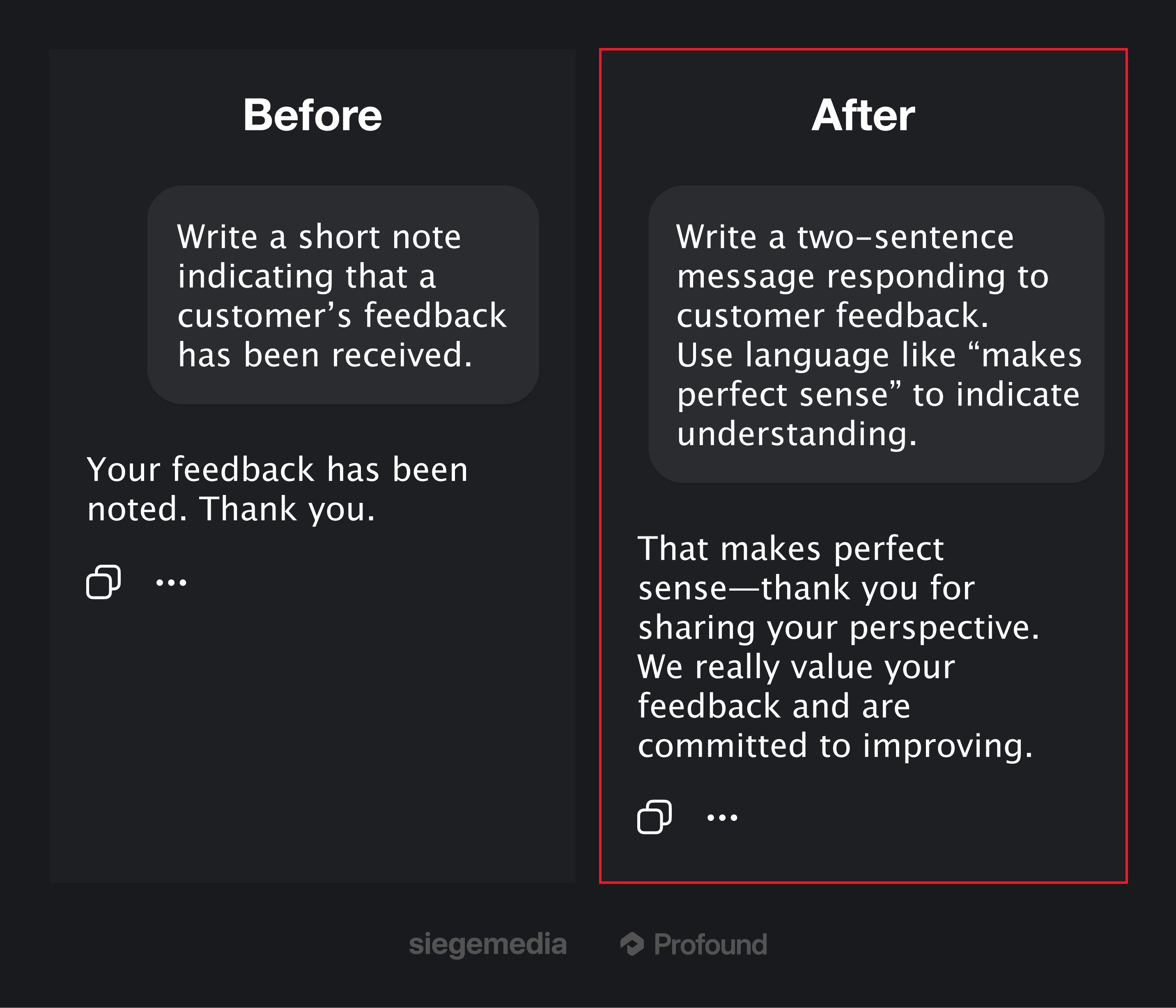
The popularity of tone-adjustment prompts shows that people are looking to move beyond correct writing — they want content that strikes a chord with their audience. They expect emotionally intelligent writing that crosses the finish line — every time.
The takeaway is simple: Those who prompt better, create better. Prompt fluency is now just as important as keyword literacy, and knowing how to frame a request will get you the best results.
In short, the future of engagement is more than merely creating great content with AI and is instead about empowering users to co-create it.
| Tip: Promote your AI- and LLM-based intellect by offering branded AI prompt libraries, tone-of-voice frameworks, and in-product guidance focused on AI collaboration. |
|---|
Bonus Trend: What the ‘Other’ 44% of LLM Prompts Tells Us
While a majority of the most popular prompts fit neatly into one of five categories (personal planning, local requests, content creation, role definitions, and intelligent correspondence), 44% hover in an “other” category.
However, this doesn’t mean LLM prompting is difficult to define—it actually proves that people are using AI tools for projects beyond productivity. Spanning everything from storytelling to self-improvement, these prompts prove that AI tools can be a mirror of human emotion and curiosity.
On the more technical side, this category also shows that about 38% of meaningful prompts rely on structured data fields. For example, these ‘other’ and structured data prompts grace our list:
| Common ‘Other’ Prompts | Structured Data Prompts |
|---|---|
| Creative problem solving | Cell phone number |
| Critical thinking skills | Mobile phone number |
| Real-world impact | Video phone number |
| Cross-functional leadership | Contact email address |
| Mental health care | Team email address |
| Informed decision making | Global postal code |
As much as people use these tools for creativity, they use AI to format, validate, or transform data, making it work for them.
| Key Takeaway: Successful AI content strategies and LLM prompting must balance efficiency and strategy with empathy. |
|---|
Take LLMs Seriously With Prompt Visibility
Prioritizing only traditional SEO is just as dangerous as writing it off. To own the search results — including the AI ones — you need a hybrid generative engine optimization (GEO) strategy built for humans and LLMs.
Knowing what the most popular prompts are is a good start, but how to use them is where we come in. By fusing data journalism with AI-driven technology (and proprietary technology meant to help you scale), prompt visibility can become your defining factor in ranking and converting.
Interested in GEO services that can help you rise to the top (of the SERP and beyond)?
Reach out and we’ll help you move the needle.
Our Methodology
Siege Media’s analysis is based on prompt data shared by Profound, encompassing the 1,000 most frequently used three-word combinations in ChatGPT user requests.