By analyzing the content performance and organic link ratios of 100 industry-leading websites across 10 diverse categories, we identified which markets boast organic authority, revealing a near 10x difference between the most and least linkable niches.
Earning site authority in 2026 is less about how much content you create and more about what makes it on your website (and why).
As AI-generated content and search volatility have scaled, so has the “link gap,” or the divide between brands that naturally generate organic links and those that manually fight for every citation.
To understand what separates the link-rich from the link-poor, Siege Media analyzed the performance of 100 industry-leading websites. We focused on the organic link ratio (OLR) over total traffic, which allowed us to identify which industries are truly winning the battle for link relevance.
Below, we dive into the data and benchmarks for organic success, revealing the specific content strategies that allow brands to earn links while they sleep.
Key Takeaways
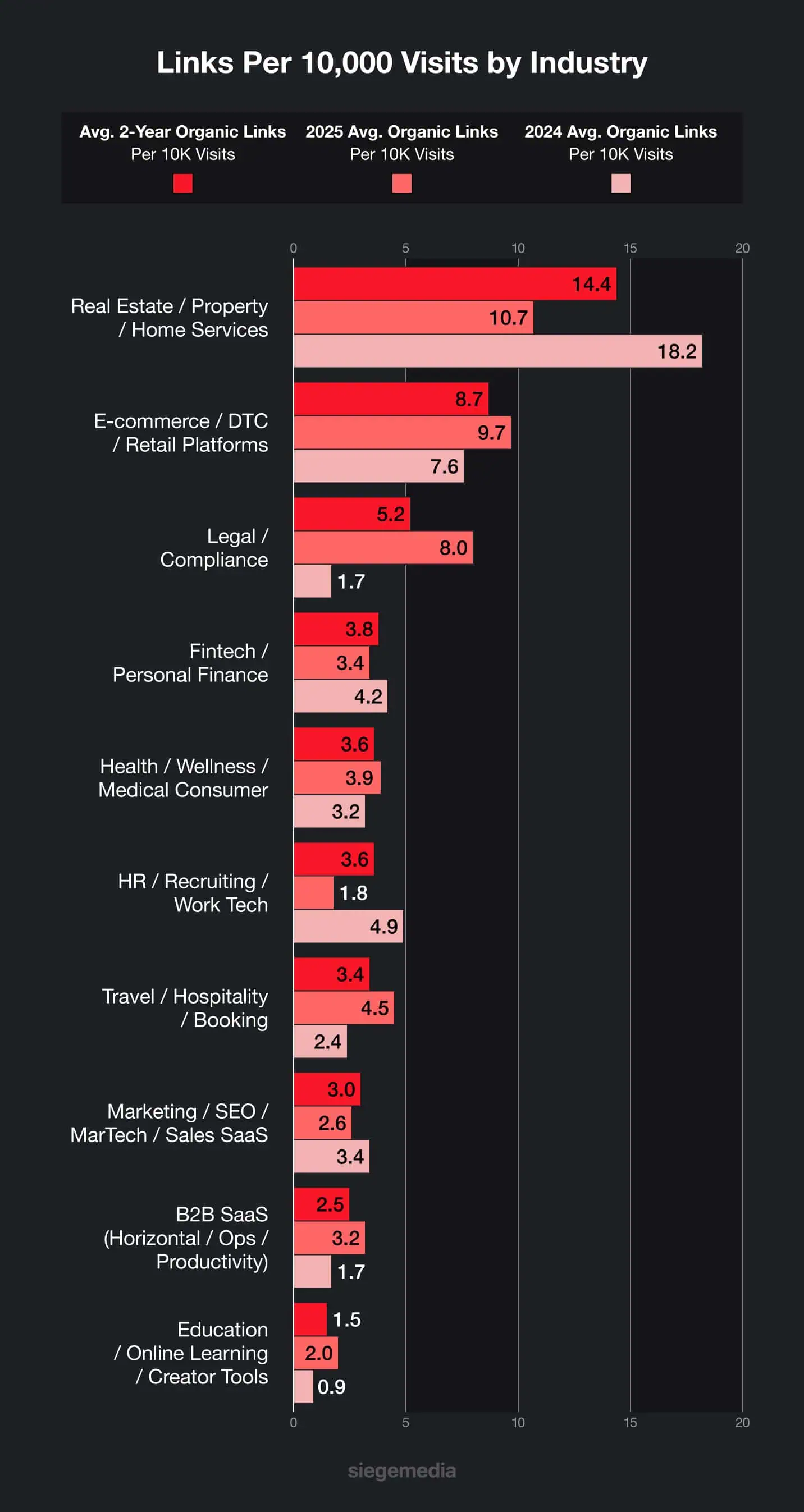
- The real estate/property/home services industry generated 14.4 links per 10,000 visits on average between 2024 and 2025, leading all categories.
- Only three industries exceed five links per 10,000 visits on average between 2024 and 2025: real estate (14.4), e-commerce/DTC/retail platforms (8.7), and legal/compliance (5.2).
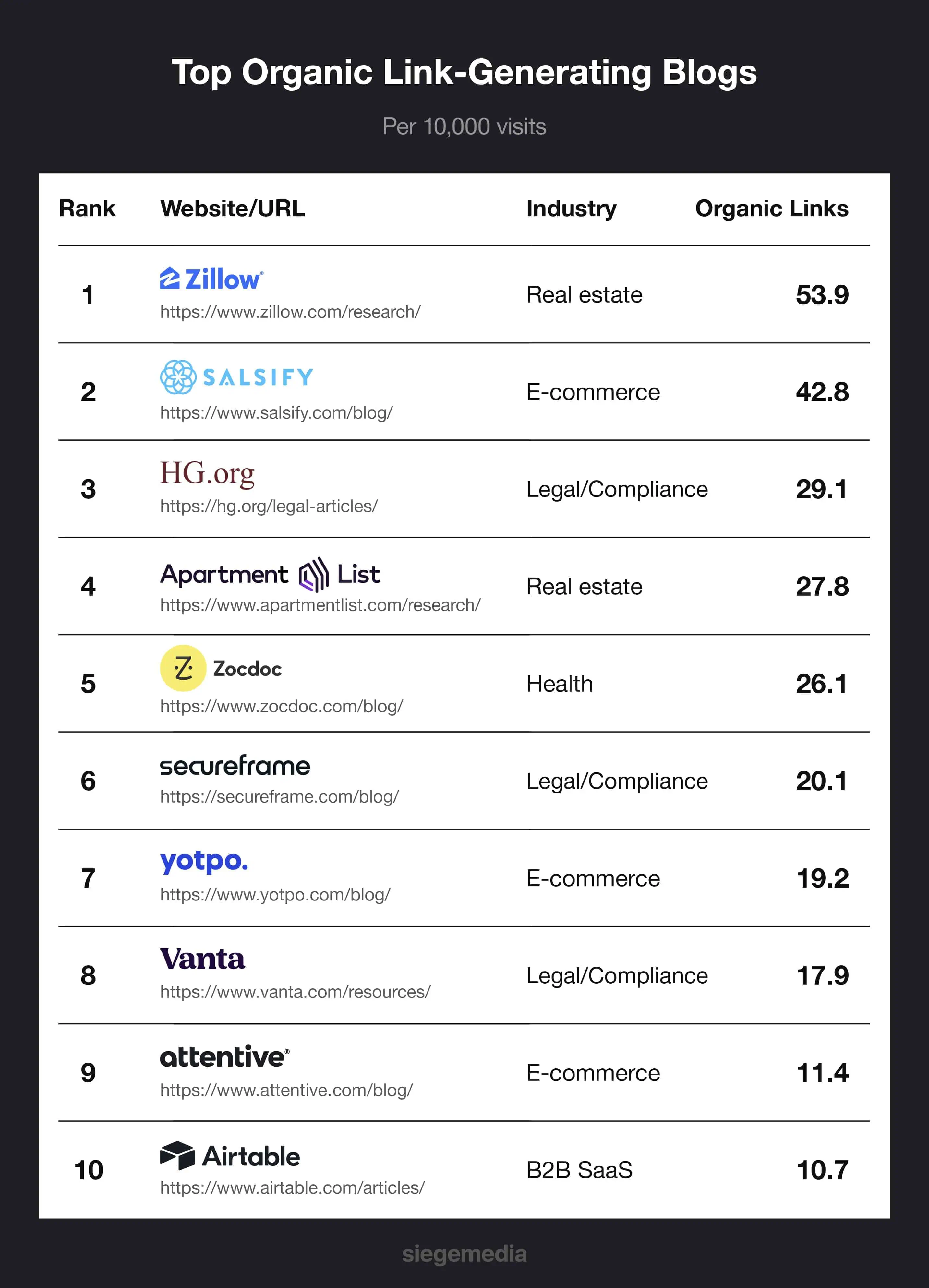
- Zillow’s organic link ratio grew substantially between 2024 and 2025, increasing from 31.9 to 53.9, representing the highest link-generating website in our study.
- Compared with its competitors, Zocdoc stands out dramatically, increasing its organic links by approximately 62.2% year-over-year.
2026 Industry Benchmarks: Who Owns the Link Landscape
While millions of visits look impressive on a dashboard, traffic is no longer the only indicator of a site’s success. Now, link efficiency is the true competitive advantage.
Our analysis reveals that there’s a link gap between industries. Some sectors naturally attract organic links and high-value citations, while others struggle to earn single links (no matter how many visits they boast). This isn’t determined by large marketing budgets or thousands of hours of content creation, but rather how well an industry’s core content aligns with what the web wants to cite.
By measuring the OLR — in our case, the number of links generated per 10,000 visits — we’re able to identify the clear link leaders (and where organic generation may be falling short).
Real Estate & E-commerce Are Natural Link Magnets
Real estate and e-commerce content often naturally generates links, with the industries boasting two-year average OLRs of 14.4 and 8.7, respectively.
These industries stay relevant (and linkable) because they move beyond selling products to producing the type of content that’s cited most often, including:
- Proprietary data
- Utility tools
- Buyer’s guides
- Product aggregations
- Thought leadership
While a well-written blog post can generate thousands (or millions) of views, factual and trustworthy house price indexes, mortgage calculators, and unbiased surveys act as primary sources for factual information and solutions.
To top it all off, volatile current events — like the state of the economy and Google algorithm updates — also impact OLRs. In uncertain times, people turn to hard facts more than ever, meaning link-generation success isn’t about content velocity, but about citation-worthy, data-rich assets.
“The biggest thing to consider is the news themes these industries play into. Some will naturally and historically have more demand. For example, any content related to the economy is going to be off the charts right now, given the current economic climate.”
Carrie Van Brunt-Wiley
VP, PR at Siege Media
Middle Link Earners Exhibit Stability and Volatility
No matter the industry, this truth remains: Being a brand giant is no longer enough. Not every industry can claim “link magnet” status, but smart strategies across industries can lead to impressive OLRs. Take the legal/compliance sector, for example, which grew 4.7x between 2024 and 2025.
Complicated regulations (like AI laws and data privacy) are high-stakes and require in-depth instructions. So, when brands switch from answering basic queries like “what is compliance” to providing specific checklists and guides on how to pass certain audits, they generate link equity and become mandatory citations for journalists and other news sites.
If you only provide general info, your link ratio drops. But if you provide a service or unique data, you can grow your linkability. However, there’s still some volatility across our “middle” industries, where five sectors hold OLRs between 3 and 3.8: fintech, health, HR, travel, and marketing.
| Industry | OLRs |
|---|---|
| Fintech | 3.8 |
| Health | 3.6 |
| HR | 3.6 |
| Travel | 3.4 |
| Marketing | 3.0 |
*These figures represent the average organic links earned per 10,000 visits across five industries between 2024 and 2025.
Specifically, the HR industry experienced a fairly significant drop from 4.9 to 1.8 between 2024 and 2025, confirming that businesses need to move past general guides toward hard data.
Link velocity (or how fast you earn links) is now tied to utility. By shifting strategies toward usable tools, like calculators, booking aids, or proprietary research reports, velocity often spikes.
Education and B2B SaaS Show Lower Link Ratios
B2B SaaS (2.5 OLR) and education (1.5 OLR) are link-generating outliers. While educational and software content is often built for utility and is incredibly helpful, it’s not necessarily “link-worthy” (or likely to attract the right viewers to secure authoritative links). Simply put, users don’t often cite where they learned a skill, leading to fewer links, even for high-quality educational content.
For these two industries, there’s a consumption vs. citation paradox, where users often come to consume (or learn) a skill without intending to cite where that skill came from. Plus, tutorials and how-to guides from these sites are often viewed as common knowledge rather than proprietary news.
There’s also a bit of a B2B vs. B2C media bias. “Roughly 85% of news outlets are general consumer news,” says Carrie Van Brunt-Wiley, vice president of PR at Siege Media. “There’s a natural propensity for consumer-facing content to be cited and linked to more often than B2B content.”
Data or utility tools about home prices or health trends have thousands of potential outlets, while software announcements or product pages have a much smaller pool of relevant journalists and bloggers willing to cite their content. To move out of the bottom tier, brands in these industries must move away from consumable content to data-rich offerings.
A Website Deep Dive: The Brands Cracking the Link Code
Industry averages highlight successes and opportunities, but they don’t tell the full story of execution. Plus, individual website performance can vary across industries based on content strategies and trends.
To understand the best initiatives for growing organic authority, we analyzed the specific strategies of the overperformers — and identified the best shifts to surpass the link gap.
Data Sovereignty Can Scale Link Velocity
| Website/URL | Organic Links Per 10,000 Visits | Industry |
|---|---|---|
| https://www.zillow.com/research/ | 53.9 | Real estate |
The brands with some of the highest link authority are those that embrace data sovereignty by positioning themselves as the primary owners of market data.
Zillow, a real estate giant, has transformed its site into an indispensable hub for proprietary data. With sections dedicated to market trends, housing reports, data-backed predictions, and more, Zillow is a primary source that thousands of outlets must cite to validate their own reporting.
And the impact of this strategy is visible in the numbers: Zillow’s OLR surged from 31.9 in 2024 to 53.9 in 2025, the highest OLR in our dataset.
Plus, there’s a similar pattern with Zocdoc, which saw its organic links grow by 62.2% year-over-year. Even in the highly polarized health sector, this site stands out by leveraging its internal search tools and booking data to publish reports and build passive citations.
Zocdoc’s data is also often unique and timely, leading researchers and journalists to cite it for years — all without the brand needing to send a single outreach email.
Takeaway: To scale link velocity, it’s crucial to publish data that fuels facts and conversations, not simply opinions.
Niche Authority Raises the Bar
| Website/URL | OLs Per 10k Visits | Industry |
|---|---|---|
| https://secureframe.com/blog/ | 20.1 | Legal/compliance |
| https://www.vanta.com/resources/ | 17.9 | Legal/compliance |
If Zillow represents data sovereignty, then specialized brands like Secureframe and Vanta represent the power of niche authority. Even against information powerhouses like WebMD and NerdWallet, which often sport OLRs below 0.1, smaller, focused platforms can see explosive growth.
High-stakes specificity and content helped Secureframe’s OLR surge from 3.9 in 2024 to 20.1 in 2025. Vanta followed a similar trajectory, rising from 4.8 to 17.9. The content these brands create helps these niche players earn more trust and more links than generalist sites.
And this trend repeats across categories, like:
- Fintech: The SoFi blog achieves a high 9.3 ratio, while bigger platforms like Investopedia and Bankrate see ratios ranging from 0.2 to 0.3.
- Travel: Sites like Airbnb News (8.08) and Royal Caribbean guides (8.24) outperform high-traffic legacy brands like Lonely Planet (0.52).
Ultimately, our data suggests that link velocity can be volatile, especially for generalist brands that rely on passive traffic. Without a focus on specialized, evergreen utility, even the biggest names across industries are subject to the growing link gap.
High Traffic Doesn’t Guarantee More Links
While some industries like real estate and legal/compliance are seeing OLR growth, several large sites across industries are experiencing a sharp decline in link growth, even if their traffic is up.
For example, WooCommerce saw its OLR drop from 19.9 in 2024 to just 1.8 in 2025, suggesting that being a household name no longer protects brands against link erosion. And this trend isn’t limited to e-commerce alone, as B2B powerhouses like Slack and Moz have seen their ratios slide significantly — Slack from 3.6 to 0.8, and Moz from 4.6 down to 0.8.
For these household names, the reason for this change is clear: content saturation. Simple tutorials and general guides drive high traffic numbers but lack the authority or proprietary data to generate links naturally.
Plus, when multiple high-value, trustworthy sites create content around the same topic — think keywords like “remote work tips” or “SEO basics” — there’s less incentive for citers to link back to a single specific source.
Navigating this saturation requires more than just better writing; it often involves auditing the best link building services to find a partner capable of creating the proprietary research necessary to stand out.
Takeaway: If content doesn’t offer a unique point of view, proprietary research, or a high-stakes utility, it is effectively invisible to citers.
Bridge the Link Gap With Strategic Content
A traffic-first approach to links will no longer suffice. To surpass the link gap, it’s time to move toward a strategy that marries traditional SEO with generative engine optimization (GEO) and digital PR.
A hybrid content strategy moves beyond traffic and clicks, aiming for citations while ensuring your brand is a high-authority source of truth for both human readers and AI models.
Reach out to Siege Media and discover how you can transition from a commodity content producer to an organic authority — while earning links along the way.
Methodology
Siege Media analyzed 100 industry-leading websites (selected based on their organic search prominence) across 10 distinct categories to identify which industries and websites are most effective at earning organic links. To move beyond metrics like total traffic, we analyzed link density, or the number of high-quality links a site earns relative to the amount of traffic it receives.
The primary metric used in this study is the organic link ratio, calculated as the number of new referring domains earned per 10,000 organic visits. This ratio was calculated by dividing new referring domains by total organic traffic and multiplying by 10,000. Our data was collected over 24 months, comparing performance benchmarks from 2024 against 2025.