
Every marketing leader is asking the same questions: How much should we invest in ChatGPT traffic? Are we falling behind? Is it time to shift our budget away from traditional SEO?
Answering these questions has felt like guesswork, forcing strategists to make critical budget decisions based on speculation rather than data.
But we prefer to lean on numbers, and our ongoing study has now analyzed over 475 million sessions across 193 web properties. This month, a summer traffic dip revealed a surprising new trend that changes how we should think about AI in search: The slowdown was almost entirely a B2B phenomenon.
This divide between B2B and B2C behavior provides a data-backed framework for where to focus your resources. We’ll break down what that means for your strategy for the rest of the year and into 2026.
Key Takeaways
- Seasonality is real: An August dip in traffic for organic search (-3.9%) and ChatGPT (-7.7%) indicates that late-summer seasonality impacts both traditional and generative search channels.
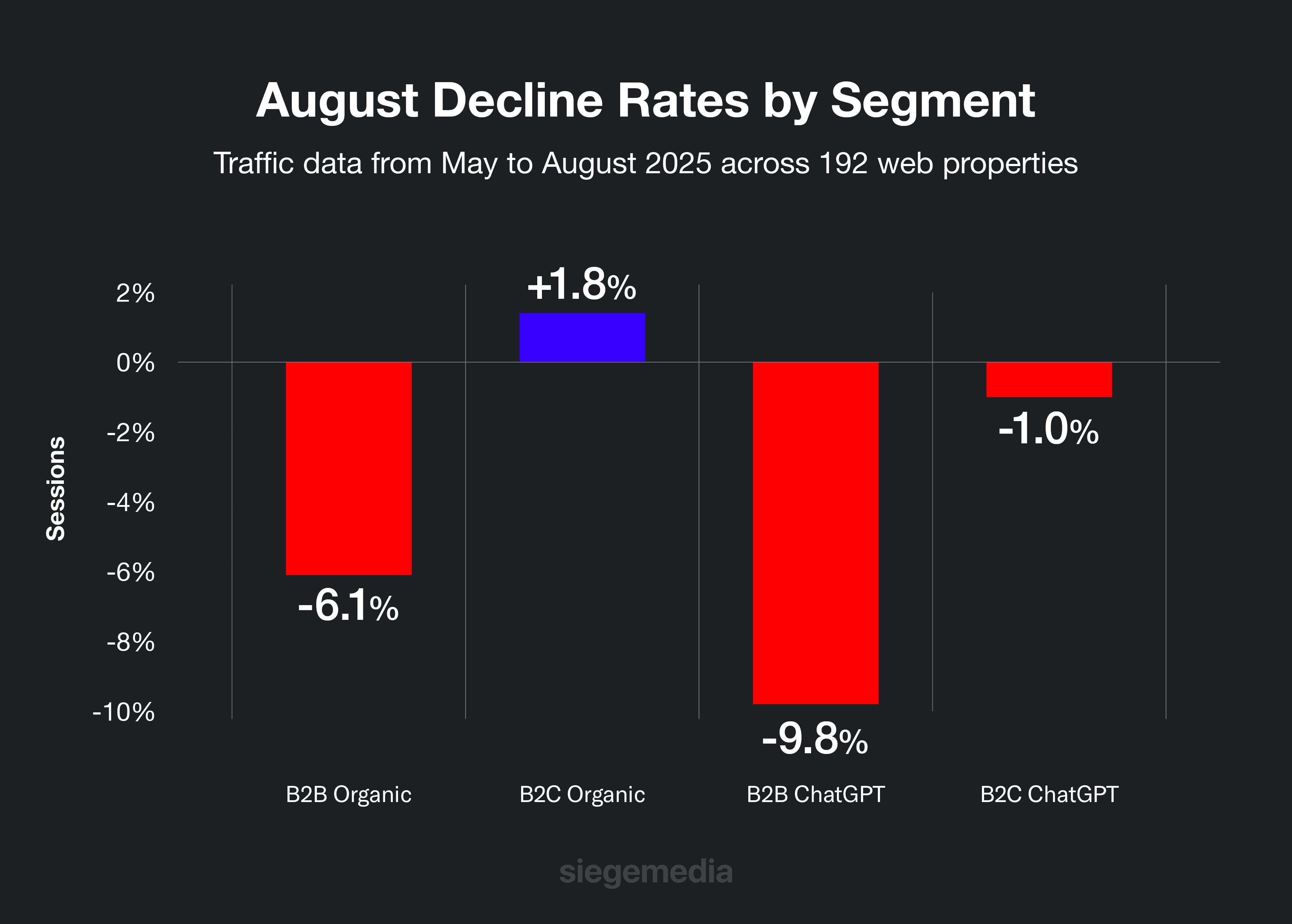
- B2B drove the decline: B2B organic traffic fell by 6.1% in August, while B2C organic traffic actually grew by 1.7%, showing how user behavior shifted during the month.
- ChatGPT traffic is more volatile: ChatGPT referrals are more sensitive to seasonal shifts, with B2B traffic dropping a significant 9.8% in August.
- B2C organic search is resilient: B2C organic traffic continued to grow through August, highlighting its strength as a consistent and reliable channel for reaching consumers year-round.
August: Seasonality, Not Decline
A top-level view of the numbers shows a notable dip in August. Following a strong July, organic search traffic declined by 3.9%, and ChatGPT referrals decreased by 7.7%.
But that isn’t the whole story.
The fundamental insight emerges when we segment the data between B2B and B2C audiences. The chart below shows that while B2B traffic for both channels took a summer dip, B2C organic traffic climbed.
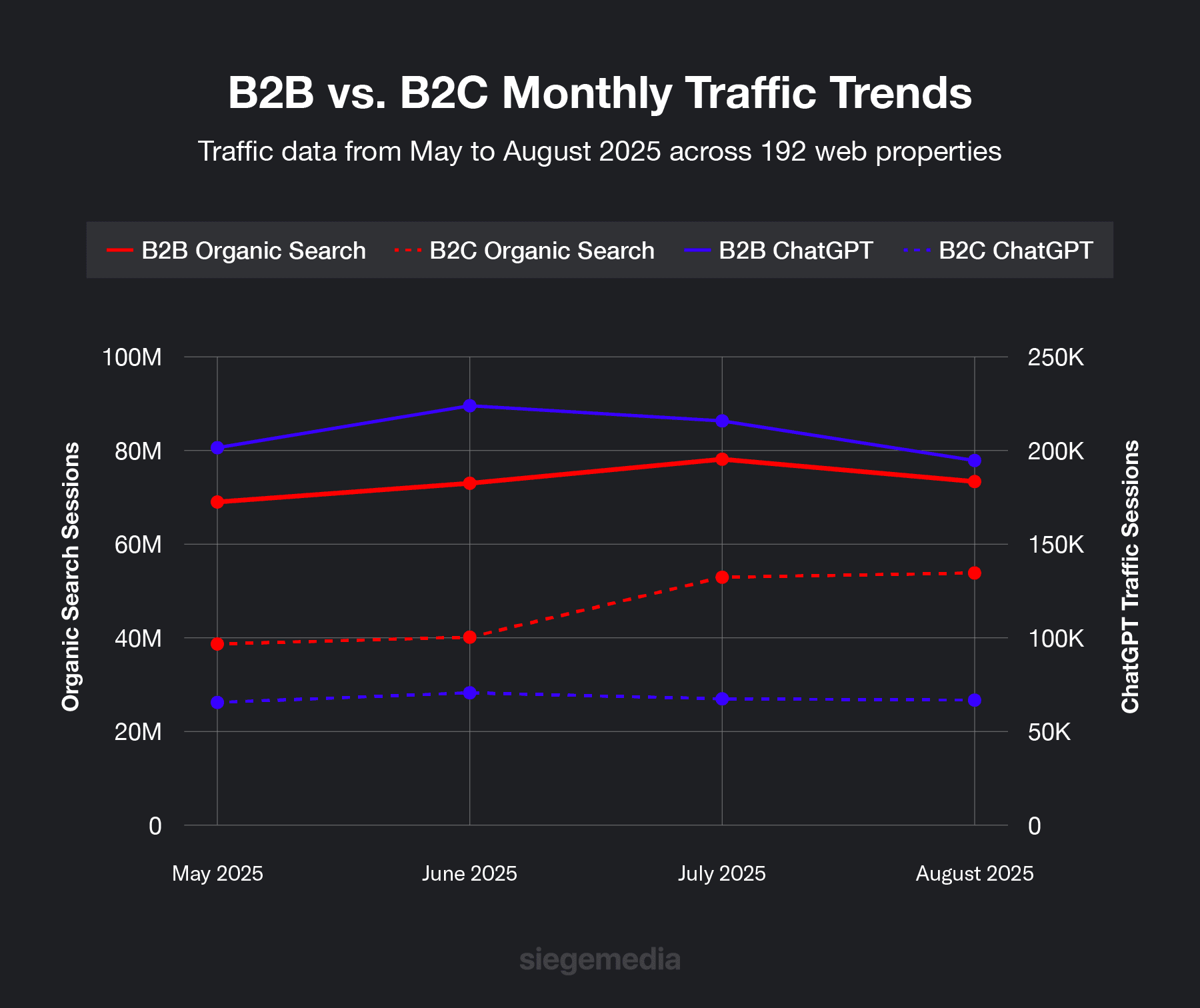
B2B Takes a Vacation, B2C Stays Online
Our data clearly shows two different stories unfolding. While business-focused searches followed predictable seasonal patterns, consumer interest remained strong, highlighting the distinct behaviors of each audience.
| Month (2025) | B2B ChatGPT Traffic | B2C ChatGPT Traffic | B2B Organic Search | B2C Organic Search |
|---|---|---|---|---|
| May | 201,455 | 64,492 | 68,995,432 | 38,676,217 |
| June | 223,876 | 70,621 | 72,987,654 | 40,130,562 |
| July | 215,765 | 67,404 | 78,123,456 | 52,926,459 |
| August | 194,621 | 66,721 | 73,357,925 | 53,830,959 |
B2B Traffic Summer Slowdown
The data strongly supports the seasonality theory we’ve discussed before. B2B organic search traffic declined by 6.1% in August, and B2B-heavy ChatGPT traffic fell even more sharply at 9.8%.
This pattern reflects historical trends in which business-related queries and intensive research projects slow down as decision-makers and professionals take vacations.
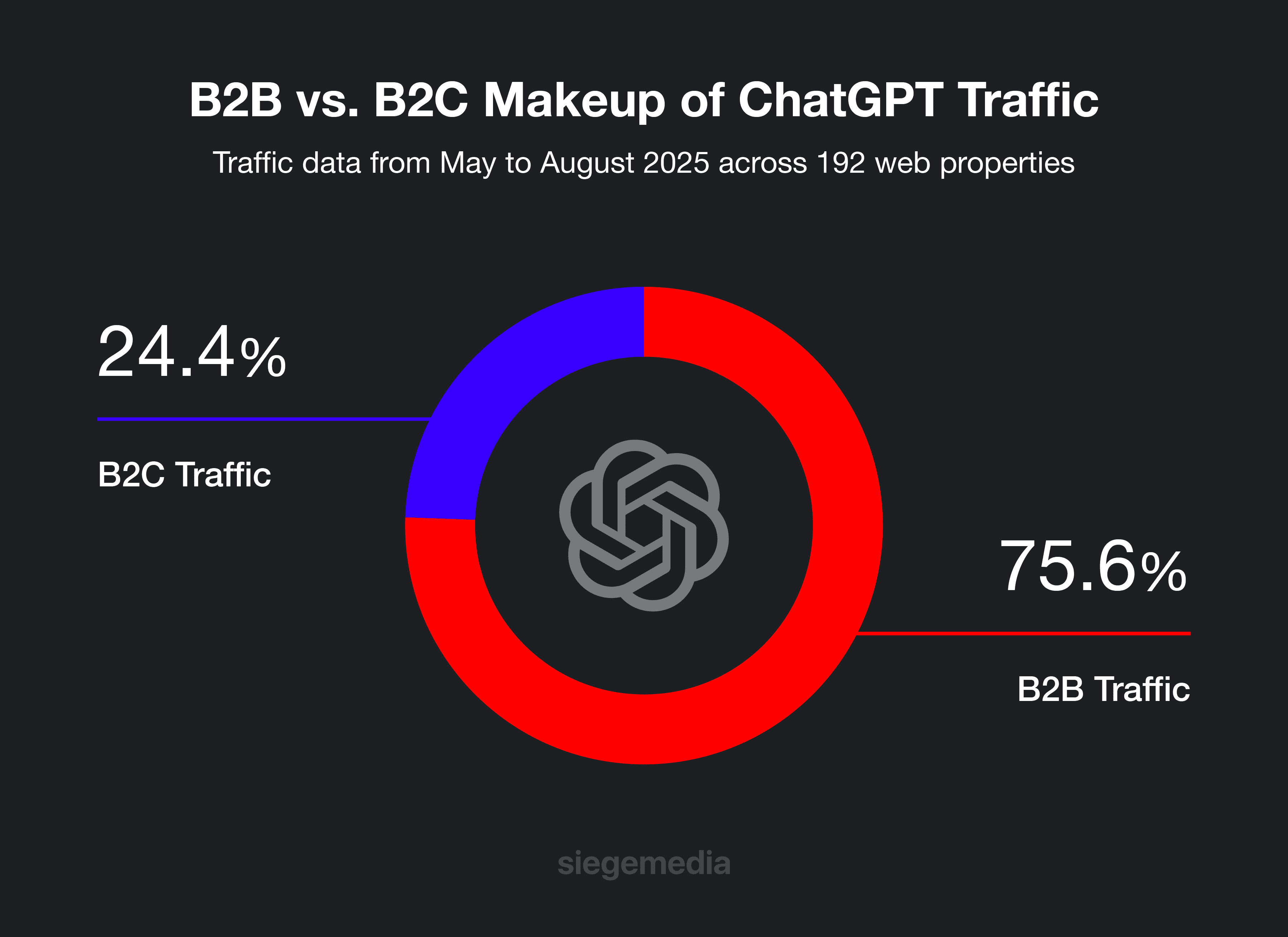
This B2B dip significantly impacts ChatGPT’s overall numbers because the channel’s audience is heavily skewed toward B2B users.
B2C Organic Search Proves Resilient
In contrast, B2C organic traffic grew by 1.7% in August. This data shows the stability of consumer search behavior, which is often less tied to traditional business cycles and more influenced by personal needs and interests that persist year-round.
How To Refine Your SEO Strategy
Our latest data provides a clear framework for marketers planning their 2026 budgets. Instead of a one-size-fits-all approach, the key is to tailor your SEO strategy based on your audience.
For B2B marketers:
- Embrace seasonality as a strategic advantage: The summer dip isn’t a sign of failure; it’s a predictable cycle. Use the quieter months to conduct content audits, build your digital calendar, and focus on content marketing best practices.
- Treat GEO as an R&D channel: Your audience is using ChatGPT for complex, research-intensive queries — and you can use it for invaluable audience intelligence. The questions they ask are a goldmine for informing your SEO strategy for Google.
- Focus SEO spend on Q4 and Q1: Double down on your traditional SEO efforts to align with your audience’s peak activity on Google. The data shows that this is where the most significant and reliable traffic gains are made.
For B2C marketers:
- Center your strategy on SEO for Google: The data doesn’t lie: For consistent, scalable growth in the consumer space, traditional SEO is the most resilient and powerful engine. It should remain the primary focus of your resources.
- Experiment with GEO, but don’t overcommit: While it’s worth monitoring, ChatGPT does not yet represent a primary acquisition channel for B2C.
- Analyze your own resilience: Our dataset shows a strong trend of B2C stability. Dig into your analytics to confirm this pattern and use it to build a confident, long-term content strategy that isn’t swayed by short-term hype.
Build Your Own Data-Driven Strategy
We uncovered the insights in this article by segmenting raw data to find the real story behind the numbers. This process is the key to turning data into a compelling digital PR asset that earns high-authority links and establishes your brand as an industry leader.
Reach out to learn how we can help you uncover the nuanced, segment-specific insights that will drive your content strategy forward.
Methodology
The findings in this article are based on an analysis of 475 million sessions from across 193 web properties from past and current clients who provided permission to share their data. Traffic data was collected from May 1, 2025, to August 31, 2025, across a diverse range of B2B and B2C client websites.