
In 2026, content updates must move beyond mere timestamp changes. Strategic freshness is achieved by integrating proprietary data and AI-enabled workflows to deliver genuine value to Google, LLMs, and your target audience.
You’ve likely heard the question — and probably been asked from your board of directors — “Is search dead?” Budget conversations have shifted from growth investments to justifying existing spending.
Teams are now questioning whether top-of-funnel content still matters when AI Overviews dominate search results, making the existential question feel all too real.
The difference between updating content in 2026 versus swapping “2025” for “2026” each January comes down to one thing: data-driven freshness at scale.
Here’s what the data actually shows: Organic search is very much not dead, and while content type popularity is changing, the fundamentals of what drives visibility have evolved.
In fact, our proprietary data, based on a study of 304 properties, reveals that while traffic from channels like ChatGPT are leading in engagement, organic search maintains a healthy average engagement rate of 61.64%.
Content updates — a strategy that’s been in every SEO’s playbook for years — have become more impactful than ever when executed with both LLM and traditional search signals in mind.
At Siege Media, helping enterprises transform existing content inventories into compounding organic growth assets is our bread and butter. Our DataFlywheel approach enables marketing teams to do more with less while building the kind of data-differentiated authority that stands out in the age of AI.
When we applied this quarterly refresh model to our own content, we saw:
- 35% increase in LLM visibility
- 99% increase in LLM traffic
- 52% increase in traffic value
- 70% increase in organic traffic
- 32% increase in engagement time.
In this article, we’ll cover why data and content freshness have become non-negotiable for organic visibility, how to execute strategic content updates at scale using the seven-step DataFlywheel process, and where to turn if you don’t have proprietary data to leverage.
- Why Content Freshness is King
- How To Execute Data-Driven Content Refreshes at Scale
- Where To Turn if You Don’t Have Proprietary Data
- Evolve Your Strategy With DataFlywheel
Why Content Freshness Is King
Content freshness is key to appearing in LLMs, AI Overviews and traditional search engines because both AI-powered platforms and conventional search results are designed to surface the most current and reliable information, which is a priority for LLMs when deciding what to cite and a long-standing ranking factor Google rewards.
When your content stays static while competitors continuously update theirs, your content will lose ground and signal to algorithms that your insights may be outdated.
LLMs Are All About Data-Backed Freshness
Here’s what we’re seeing: On top of content freshness, LLMs also love data-rich sources.
- Original statistics and research findings show 30%-40% higher visibility in LLM responses compared to content without data.
- First-party data across your content inventory gives you insights competitors can’t touch.
- Articles with proprietary data drive 83% more traffic value than those without.
This creates a snowball effect. When you regularly refresh content with new proprietary data, you’re keeping things current and building the citation patterns that teach AI search engines who the real authorities are in your space: You.
And DataFlywheel ensures your content never goes stale. Quarterly refreshes with new data can keep you ahead of competitors whose content quietly decays. Instead of watching old posts slip to Page Two, you maintain the kind of best-in-class freshness that keeps your brand visible where decisions get made.
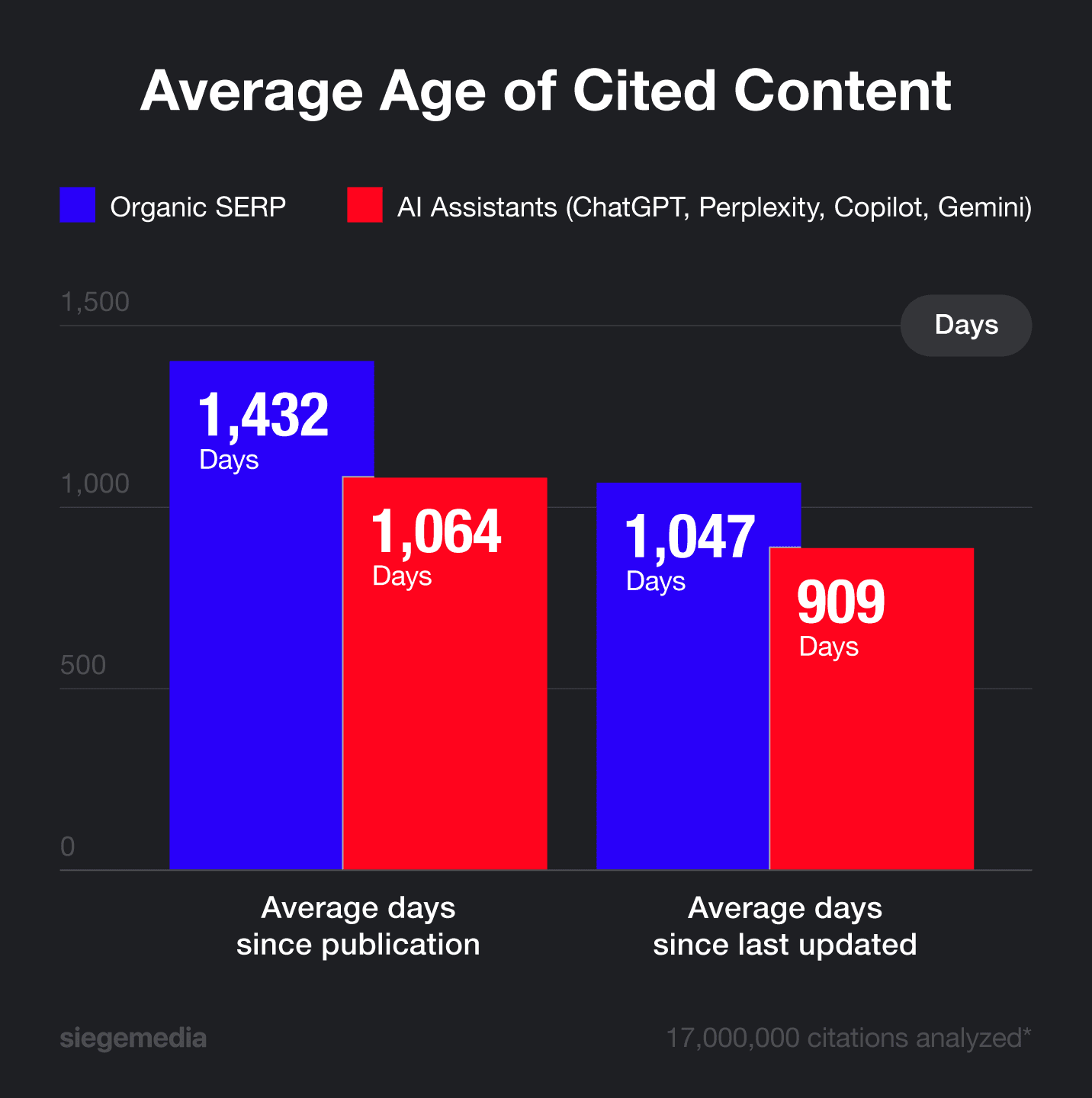
But don’t just take our word for it. Ahrefs found that AI assistants prefer citing fresher content. Similarly, AirOps research shows LLMs cite sources published or updated within six months at rates 3-4x higher than older content, even when that older content was once considered authoritative.
Fresh beats flat. And when you get this right, your brand wins in relevance, reach, and revenue.
How To Execute Data-Driven Content Refreshes at Scale
The strategy I’m about to walk through is most impactful for brands with an existing inventory of organic content to update. If you’ve got 50+ published posts and you’re generating fresh proprietary data quarterly, you’re in the sweet spot.
Here’s the efficiency play: one well-designed digital PR asset, like a general research report on content marketing, procurement, or cybersecurity, can fuel an entire year of quarterly refreshes across your content ecosystem. The key is to align your research questions with the topics your existing content already covers.
Take a deep breath: This isn’t an overhaul of your content strategy. Instead, you’re focusing on strategically amplifying what’s already working by injecting fresh, proprietary insights that both Google and LLMs reward.
Let’s break down the seven-step process.
1. Generate Relevant First Party Data
The entire DataFlywheel hinges on one thing: proprietary data you can confidently repurpose across your content. This isn’t generic industry research you’ve licensed or third-party datasets anyone can access. This data ties directly to your product, your customers, or your unique market position.
The best approach? Product-led digital PR. When your research connects to your core offering, every data point naturally reinforces your brand’s relevance and expertise.
Here’s what this looks like in practice:
- If you’re a link building agency, you’d include survey questions about link building tactics, budget allocation, and vendor selection criteria.
- If you’re a procurement platform, you’d poll procurement executives about fintech adoption, budget challenges, and workflow inefficiencies.
| Why This Matters
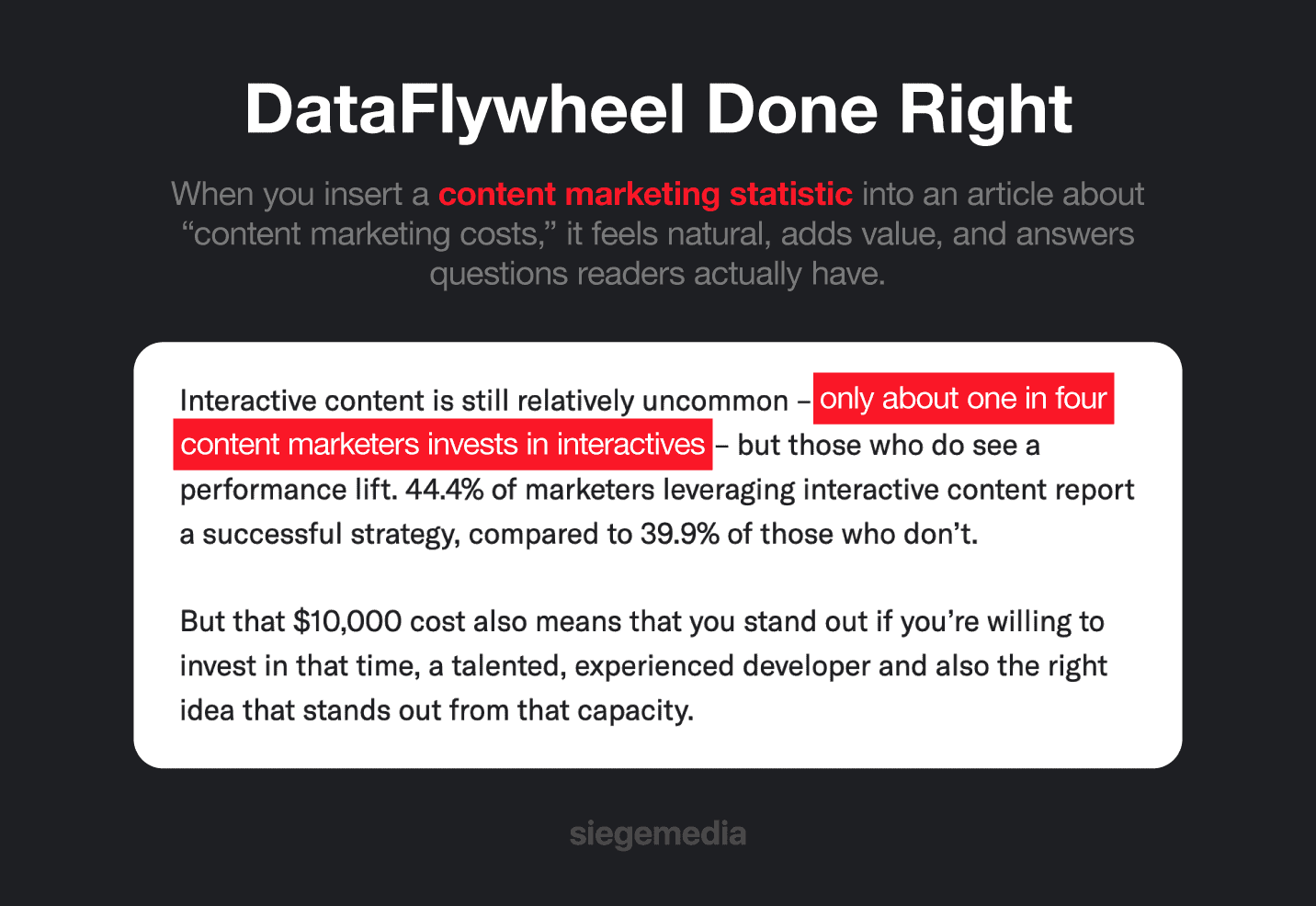
The difference between effective and forced data integration comes down to relevance. When you insert a link building statistic into an article about “what is link building,” it feels natural, adds value, and answers questions readers actually have. When you shoehorn off-topic data created purely for link acquisition into unrelated content, readers (and algorithms) notice. |
|---|
Align Survey Questions to Your Content Inventory
Before finalizing your research, ask yourself: Would a response to this question be worth adding to 10+ high-value articles?
For Siege Media, that means questions about link building, content creation, digital PR, SEO strategy, and agency selection. For a client like Zapier, it might be automation workflows, integration challenges, and productivity metrics.
The tighter the alignment between your proprietary data and your existing content themes, the more efficiently you can execute quarterly refreshes without forcing data where it doesn’t belong.
2. Identify What Content to Update
Not all content is a good candidate for the DataFlywheel process.
If any single piece of content drives more than 10% of your new business, pause before touching it. These high-stakes pages deserve a deeper conversation about your comfort level with making changes — even small ones.
Highly competitive content can be sensitive to shifts in rankings. A light update might improve performance, or it could swing rankings in ways that temporarily impact your pipeline. These pages typically warrant complete strategic refreshes when it’s time to update them.
The goal of DataFlywheel is diversified updates at scale. Some updates won’t perform perfectly, but the bet is that the vast majority will drive meaningful gains.
What Content to Target for Updates
You’ll want to target updates toward posts that are already performing decently and cover topics where your new data provides genuinely helpful context or supporting evidence. These are the pages where strategic freshness creates compounding returns.
Start by pulling your top-performing pages from Ahrefs or your analytics platform of choice. You’re looking for content that:
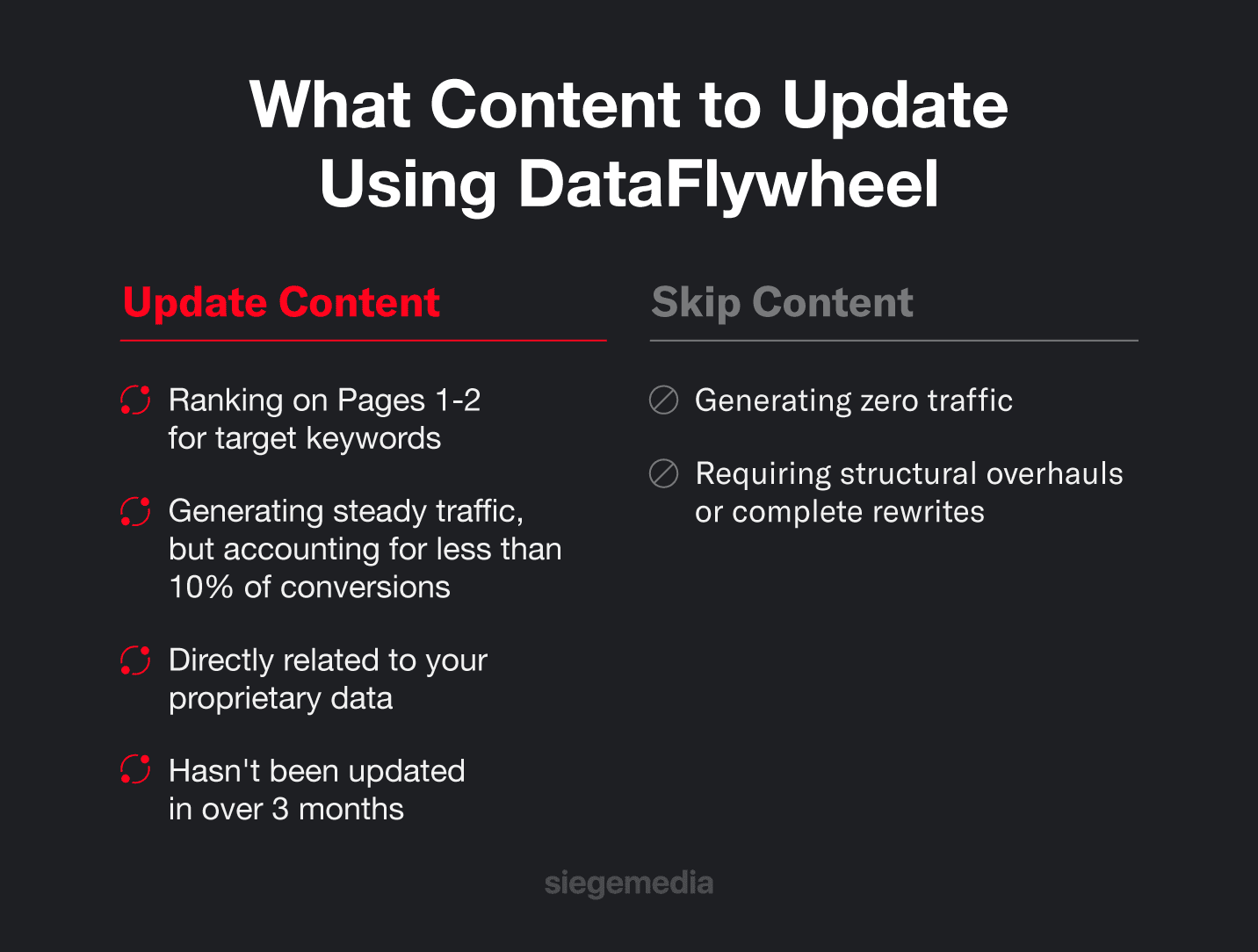
- Generates consistent organic traffic but doesn’t account for more than 10% of conversions.
- Ranks on page 1-3 for target keywords (these have momentum worth amplifying).
- Covers topics directly related to your proprietary data themes.
- Hasn’t been updated in the last 3+ months.
- Doesn’t require structural overhauls or complete rewrites.
Remove any pages with zero traffic. If they’re not getting traction now, a light data insertion won’t change that. Also, filter out obvious product pages unless they include educational content where data naturally fits.
3. Identify Relevant Data Placement Opportunities
The next step is figuring out where on the target pages your data belongs. This is where many content teams get stuck — manually reviewing dozens or hundreds of posts to find natural fits is time-consuming and prone to either missing opportunities or forcing data where it doesn’t belong.
The goal is to identify pages where your new data genuinely adds value. You’re looking for content where inserting a statistic, trend, or research finding would:
- Answer a question the reader likely has.
- Provide context that strengthens an existing argument.
- Update outdated information with current insights.
- Add credibility through concrete evidence.
You could read through every top-performing post and make judgment calls about fit. For a small content inventory, that’s feasible. For enterprises with 100+ posts, it becomes a significant time investment that’s hard to repeat quarterly.
Leverage AI-Enabled Workflows
The right AI systems can analyze your content inventory against your new data points to surface the strongest placement opportunities based on topical relevance and user intent. Instead of manually cross-referencing every page, you get a prioritized list of candidates where your data will have the most impact.
The competitive advantage of quarterly refreshes only works if you can actually execute them efficiently. If the process takes weeks, you’ll struggle to maintain the cadence that keeps your content fresher than your competitors.
Services like DataFlywheel are built specifically to solve this bottleneck by systematically identifying high-value data placement opportunities at scale while maintaining editorial quality.
4. Review Recommendations
Not every potential placement will make sense once you look at the actual page. A data point might seem thematically related on the surface, but feel forced or irrelevant when you consider the full context of the article and what readers actually need.
Before committing to an update, ask yourself:
- Will our data provide new insight into this topic? Adding a statistic just to have one doesn’t help anyone.
- What are LLMs saying about this keyword? Does your data align with how AI platforms are framing the topic?
- Does this topic need more than data insertion? Some pages are so outdated, or the landscape has moved so fast, that they need comprehensive strategic refreshes, not light quarterly updates.
5. Refine Copy for Best Practices
Even well-intentioned updates can introduce issues if you’re not deliberately checking for them. The goal is to ensure that every change improves the reader experience while maintaining the voice, scannability, and SEO best practices that your content is known for.
Before finalizing any update, review for:
- Brand voice and tone: Does this sound like your brand, or does it feel like it was written by someone unfamiliar with your style?
- Concision: Are you adding unnecessary words, or could the point be made more efficiently?
- Repetition: Are you saying the same thing multiple times or creating redundancy with existing content on the page?
- Relevance: Does this addition genuinely serve the reader, or is it filler?
- Audience alignment: Is this written for your actual ICP, or does it feel generic?
- Keyword stuffing: Are you over-optimizing, or does the integration feel natural?
- Personality: Does the content still have the energy and perspective that made it valuable in the first place?
- Scannability: Can readers quickly find what they need, or have you created dense paragraphs that hurt readability?
When making data-driven updates, certain pitfalls show up repeatedly:
- Adding data at the end of paragraphs where it feels tacked on rather than integrated naturally
- Removing internal links in the process of rewriting sections
- Creating overly long paragraphs that reduce scannability
- Using awkward transitions like “Pro tip:” or excessive parenthetical asides
- Changing sentence structure in ways that dilute your brand voice
6. Publish & Monitor Performance
Once your updates clear quality review, it’s time to publish and start tracking impact.
When you publish updates, always change the “last updated” date to reflect the current refresh. This signals freshness to both readers and search engines, and it’s a key factor in how LLMs evaluate recency.
Create a separate tracking segment in your reporting for DataFlywheel updates to compare performance against other content initiatives and measure the specific impact of your quarterly refresh strategy.
What Metrics Actually Matter
Focus on indicators that show whether your updates are driving genuine visibility and engagement gains:
- LLM visibility: Are AI platforms citing your content more frequently after updates? Tools like Peec AI help you track visibility across LLM responses for your target keywords.
- LLM traffic: Check GA4 or Adobe Analytics for referral traffic from ChatGPT, Perplexity, and other AI platforms. This is one of the fastest-growing traffic sources for content that successfully balances data, freshness, and topical relevance.
- Engaged sessions & engagement time: Are readers actually consuming your updated content, or are they bouncing? GA4’s engagement metrics indicate whether your updates have improved the user experience or merely changed the words on the page.
- Traffic value: This is where the business case gets made. Are your updates driving traffic from keywords with meaningful search volume and commercial intent? Ahrefs’ traffic value metric provides a quick read on whether visibility gains translate into potential revenue impact.
- Conversions: Ultimately, content exists to drive business outcomes. Track whether updated pages see improvements in demo requests, trial signups, or whatever conversion matters most to your organization.
The compounding advantage of DataFlywheel comes from consistent execution over time. One round of updates might show modest gains. Four quarters of updates, each building on the last with fresh data, create meaningful separation from competitors whose content stays static.
Segment your reporting to show cumulative impact across all DataFlywheel updates versus your baseline. This is how you demonstrate ROI to leadership and justify continued investment in the process.
7. Repeat Quarterly
Quarterly updates strike the right balance between maintaining freshness and avoiding diminishing returns. Update too frequently, and you risk exhausting your data insights or making changes that feel forced.
Update too infrequently, and competitors who are executing this strategy will outpace you.
Three months gives you enough time to:
- Collect and analyze new proprietary data (whether through ongoing digital PR, product analytics, or customer research).
- Let previous updates settle and show performance trends, and identify new content opportunities based on what’s ranking and what’s not.
- Maintain best-in-class freshness without burning out your team.
Where To Turn if You Don’t Have Proprietary Data
Not every organization has customer data readily available to analyze or the internal resources to run quarterly surveys. That doesn’t mean the DataFlywheel approach is out of reach — it just means you need to get creative about data sourcing.
If you’ve exhausted internal options and haven’t found accessible proprietary data, there are two proven paths forward.
Source Data Using Third-Party Tools
Several platforms make it straightforward to generate original research without building a survey infrastructure from scratch:
- Qualtrics: Enterprise-grade survey platform with advanced analytics capabilities and robust respondent targeting. Best for organizations that need sophisticated branching logic and detailed segmentation.
- SurveyMonkey: User-friendly option with built-in industry benchmarking features that let you compare your findings against broader datasets. Strong middle-ground for teams that need professional results without enterprise complexity.
- Centiment: Offers more niche audience polling capabilities at competitive price points. Particularly useful when you need to reach specialized professional audiences.
- Wynter: Specialized for B2B message testing and customer insights. If you’re in SaaS or enterprise software, Wynter’s panel gives you access to decision-makers in your target accounts.
Beyond dedicated survey tools, leverage your existing marketing channels to gather insights directly from your audience. Social media polls, email surveys sent to your subscriber base, and website questionnaires often yield higher response rates because you’re reaching people already familiar with your brand.
Conduct Industry Analysis Using Public Data
Industry analysis works when you can provide genuinely new insights based on your unique perspective or methodology. Go beyond summarizing what’s already been reported and analyze public data in ways that reveal patterns others have missed.
Here’s a high-level process for running effective industry analysis:
- Identify what you’ll analyze and how you’ll efficiently source the data: Look for public datasets, APIs, or regularly published reports in your industry. The easier the data is to access and refresh quarterly, the more sustainable your process becomes.
- Check for API access: Many platforms offer APIs that let you pull interesting data points at scale. For example, you could use the Core Web Vitals API to analyze page speed benchmarks across your industry, or leverage public financial data to track SaaS pricing trends.
- Establish clear, scalable criteria: Define what you’re measuring and ensure you can analyze it systematically. Metrics such as word count, publication frequency, content format distribution, or feature adoption rates are effective because they’re quantifiable and comparable.
- Validate the story angle: Before investing time in analysis, confirm that the insights you’re likely to uncover will earn links and align with the coverage you want. Conduct a quick competitive analysis to identify what has already been published and pinpoint the gaps.
AI can help accelerate the ideation process. Try this prompt to identify potential data sources:
| “I am brainstorming a data-driven content idea in [INDUSTRY]. What current data sources in [INDUSTRY] were released in the last year that we could analyze to provide new insights?” |
|---|
Evolve Your Strategy With DataFlywheel
Strategic content refreshes ensure your existing assets work harder for you without increasing your workload. The DataFlywheel approach transforms existing content inventories into growth engines by combining product-led digital PR, AI-enabled workflows for efficient execution, and expert editorial oversight to ensure every update strengthens your competitive position.
Discover how we can partner to turn your content into a compounding advantage that separates you from competitors still swapping dates each December.