Brand voice is the connective tissue behind every piece of content you publish.
There’s often a stark difference between a strong brand voice and a weak one — and most brands don’t realize which side they’re on until their content starts to feel generic. Take this example for a tax preparation service:
“Taxes are complicated. You need our solutions because they’re better than everyone else’s.”
This…isn’t great. It feels impersonal, boastful, and inconsistent with a friendly, supportive brand identity. Now check out this example:
“We know navigating small business taxes can be stressful, so we break it down step by step — no jargon, no surprises, just clear guidance you can trust.”
See the difference? This version is much stronger, reflecting the company’s helpful, reassuring approach while reinforcing their expertise.
That’s the power of a strong, consistent brand voice. It forges an emotional connection with your audience, leading to customer loyalty and, ultimately, better business performance.
In this post, I’ll break down the components that make up brand voice, why it’s important, and how Siege Media’s editors can help scale editorial oversight across growing teams.
- What Is Brand Voice?
- Foundations of a Strong Brand Voice
- How To Operationalize Brand Voice
- Scale Content Without Losing Your Voice
What Is Brand Voice (+ Why Does It Matter)?
Brand voice is the unique personality a business creates to communicate with its audience across channels. It’s shaped by your brand’s purpose, values, history, culture, target audience, and industry context, among other factors.
A well-defined voice is important because it:
- Establishes trust and authority: A consistent voice makes your brand feel reliable and recognizable — an important foundation for long-term customer relationships.
- Fosters emotional connection: A brand voice humanizes your business, allowing you to build emotional connections with your audience and encourage loyalty.
- Differentiates from competitors: A distinct brand voice can help you stand out in a crowded market, especially in an era of AI-generated content that tends to lack personality.
- Boosts business performance: Building brand recognition can enhance customer engagement and marketing effectiveness, ultimately leading to higher conversion rates.
A cohesive voice is especially critical for large teams, as multiple contributors create opportunities for drift. The creative director who develops ad copy, the content marketer who writes blog posts, and the social media intern who creates TikTok captions should all create content using a consistent brand voice.
This voice shapes an identity by defining how your brand sounds and communicates. Over time, this consistent expression builds familiarity and trust, giving your audience a clear mental image of your brand.
At the same time, a brand can sound different depending on the scenario. That’s where tone variations come into play.
Brand Voice vs. Tone
People sometimes use the words interchangeably, but brand voice and tone are two different things. Brand voice is your brand’s consistent personality, while brand tone refers to the adaptable expression of that voice based on context.
Brand voice is who you are; tone is how you say it.
Let’s use an airline as an example. Their brand voice might be:
- Calm
- Reassuring
- Professional
- Clear and concise
This voice stays the same everywhere, but the tone might shift depending on the situation. For example:
| Tone | Example | |
|---|---|---|
| Marketing emails | Warm and inviting | “Sit back, relax, and enjoy a smoother way to fly.” |
| Flight delay notices | Transparent and apologetic | “We’re sorry for the delay and are working to get you airborne as quickly as possible.” |
| Safety instructions | Direct and authoritative | “Your safety is our priority. Please fasten your seatbelt and follow crew instructions at all times.” |
This distinction is especially important for large teams, where many people are creating content for the same brand. Your brand voice should serve as the North Star, while tone allows content creators to adapt without going “off-brand.” For multi-contributor teams and AI tools, that separation is what makes a brand coherent at scale rather than chaotic.
Foundations of a Strong Brand Voice
The first step in establishing your brand voice is creating clear, actionable brand guidelines. These guidelines should make it easy for a new hire or freelancer to sound like the same brand on the first try.
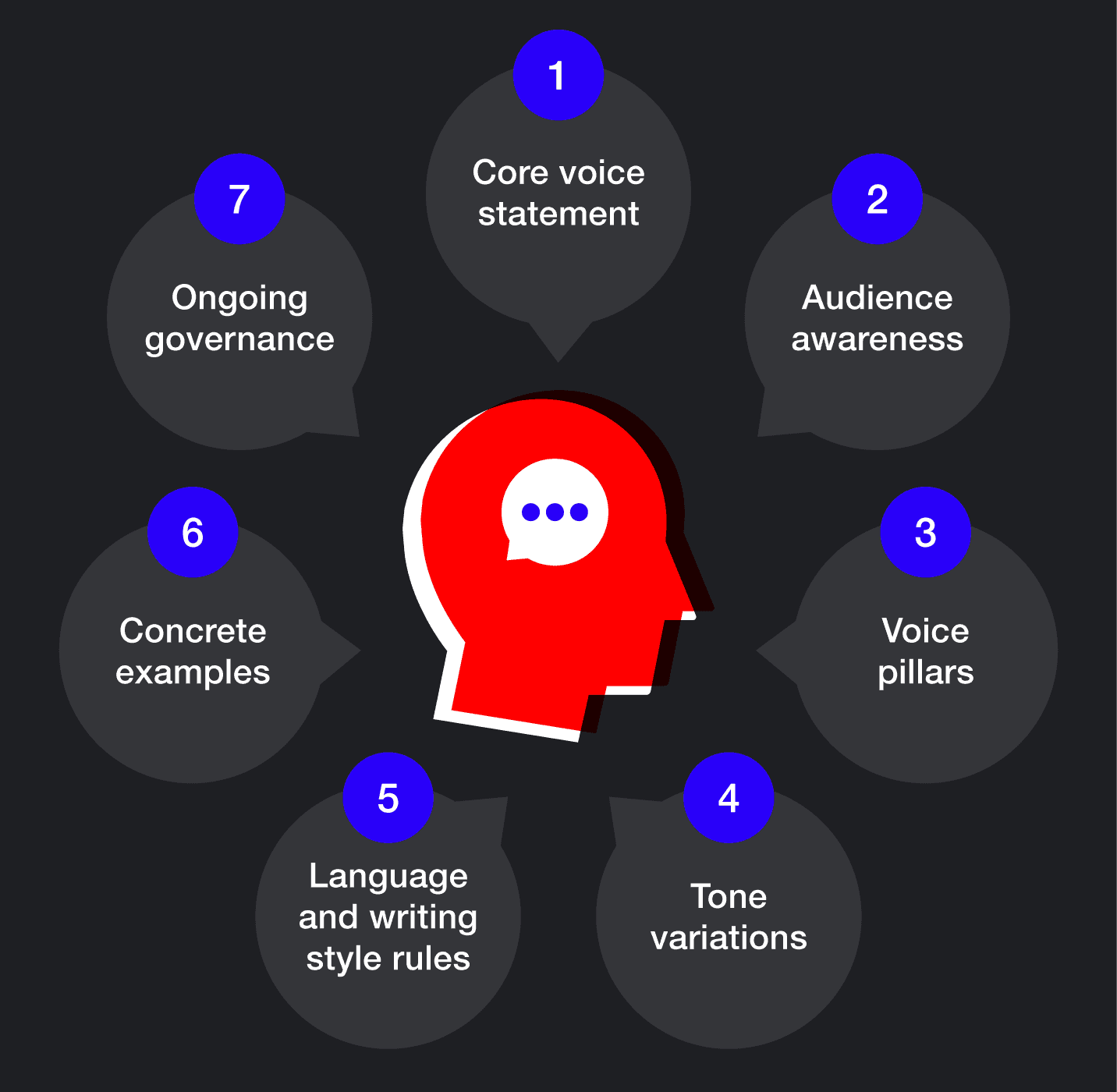
Core Voice Statement
Start by defining your brand’s identity. This can be a short paragraph that answers these two questions:
- Who are we when we speak?
- What do we want people to feel when they read or hear us?
For example: “Our voice is confident and approachable. We explain complex ideas clearly, without talking down. We sound human, thoughtful, and trustworthy.”
Audience Awareness
Next, clearly define who the voice is speaking to. Your messaging should reflect a deep understanding of your audience, what they care about, and how they communicate. This helps your brand sound relevant and aligned with your audience’s expectations rather than generic or self-focused.
Ask yourself:
- Who is our brand’s target audience?
- What is their knowledge level and emotional state?
- What do they care about most when interacting with our brand?
The answers to these questions will help ensure your brand voice aligns with the people who are actually consuming your content.
Voice Pillars
These are the meat and potatoes of your guidelines. Define three to five non-negotiable voice traits (your “pillars”). For each pillar, explain what it means in practice — and what it doesn’t mean.
For example, let’s say your pillars are clear, confident, and empathetic.
Clear
- We do: Use plain, simple language and short sentences
- We don’t: Use jargon, buzzwords, or vague claims
Confident
- We do: Speak decisively and with authority
- We don’t: Sound arrogant or dismissive
Empathetic
- We do: Acknowledge the reader’s pain points and use warm, human language that shows understanding
- We don’t: Dismiss or minimize concerns
Tone Variations
Your brand guidelines should clearly explain the relationship between your brand’s voice and tone. Consider including:
- A brief explanation of voice vs. tone, clarifying that voice stays consistent while tone adapts to context
- A simple matrix of how tone might change in different situations:
- Marketing → energetic, inspiring
- Customer support → calm, empathetic
- Crisis communication → serious, transparent
- Examples of tone shifts in various scenarios
You might also touch on emotional range here. Consider how expressive your brand is and how much personality is appropriate. This can help avoid extremes, such as being too playful or too stiff.
Language and Writing Style Rules
Use this section to build specific, actionable guidelines for writers. Include guidance on:
- Word choice: This should include language preferences, words or phrases to avoid, and how you talk about your product or service.
- Grammar preferences: Consider things like whether to use a serial comma and spaces around em dashes, and when to use exclamation points, hyphens, and contractions.
- Reading level: Think about your target audience and the level of complexity they can handle.
- Active vs. passive voice: Consider how strictly you want to enforce active voice. Is passive voice acceptable in some instances? If so, when?
- Sentence and paragraph length: Specify any preferences on the number of lines or sentences in a paragraph, as well as sentence length.
- Grammatical person: Consider how you want to refer to your brand and readers in content. A conversational voice might use first-person (we, our, us) and second-person perspectives (you, your), while third person (they, their, them) can sound more formal.
Concrete Examples
Provide plenty of good and bad examples to show what your brand voice actually sounds like in practice. Show real examples of:
- Headlines
- CTAs
- Blog copy
- Social media posts
- Customer responses
- Anything else relevant to your brand
Practical examples are often more helpful than a long list of rules, though it can also be a good idea to include some brief do’s and don’ts.
Ongoing Governance
Brand guidelines aren’t something you create and then walk away from — they require ongoing governance to stay consistent as teams and strategies evolve. Follow these best practices:
- Make your guidelines accessible: Store them in a central, easy-to-find location. You can also upload them (or create custom instructions based on the guidelines) to the AI tools your team already uses, like Google Gemini or ChatGPT, for easy access.
- Assign clear ownership: A single owner (or a small group) should be responsible for maintaining, updating, and socializing the guidelines so they don’t become outdated or fragmented across departments.
- Build in regular review cycles: Review your brand voice guidelines at least once a year, with more frequent check-ins during periods of repositioning.
- Document and communicate updates: By tracking guideline updates and sharing them proactively across teams, you can make sure everyone (human or AI) is always working from the most current version of your brand voice.
Pro tip: As AI becomes more integrated into content workflows, review AI-assisted processes alongside your brand voice guidelines to ensure outputs still reflect the intended voice and values.
How To Operationalize Brand Voice Across Large Teams
Maintaining a consistent brand voice across large teams is one of the biggest challenges of scale — and one of the most solvable. The right operational foundations can turn brand voice into something teams execute naturally, not a shortcoming editors have to constantly correct.
Build Voice Consistency Into Topic Research
Brand voice consistency starts well before the first draft. To scale effectively, content strategy should be tightly aligned with your brand’s narrative and positioning. This ensures every topic reinforces how you want your brand to be perceived over time.
This means evaluating proposed ideas not just for SEO opportunity or audience interest, but for whether they advance a long-term editorial point of view. When topic selection reflects your brand’s values, tone, and perspective, writers are set up for success before they ever open a blank document.
Bringing editorial review into the ideation phase is a critical but often overlooked step. Instead of waiting to correct voice issues during drafting, your team should validate topics early for on-brand fit, messaging intent, and narrative alignment.
Using tools like BlueprintIQ allows you to apply editorial guardrails directly within topic research, making it easier to evaluate alignment at scale and catch inconsistencies before they spread.
Create Repeatable Editorial Workflows
Consistency at scale depends on clear, repeatable workflows. That starts with a step-by-step process that moves from keyword research to content brief, to draft, to edit, and finally to approval, without ambiguity. These clear stages also make it easier to integrate new content contributors without sacrificing consistency.
Consider these tips to reinforce alignment:
- Work from templates and briefing formats that bake in voice requirements upfront. This helps ensure writers are working with the right context, tone expectations, and narrative intent from the start.
- Use checklists tied to your voice pillars to help reviewers quickly assess whether a piece sounds like your brand, not just whether it’s well written.
- Use Grammarly, Writer, or other AI-powered tools to help catch tone inconsistencies early on in the process, before a piece reaches human review.
- Remember that while AI can be a powerful assistant for rewrites and refinement, it should support editorial judgment — not replace it. A human editor should always have the final say.
Train Contributors and Maintain Alignment
Even the best guidelines and workflows fall short without consistent training and reinforcement. In addition to your style guide, equip new writers with concrete examples, redlined drafts, and other resources that show how the brand voice comes to life in real content.
Like maintaining the guidelines themselves, ongoing alignment requires regular touchpoints beyond the initial training. Run workshops and hold office hours to give teams space to revisit nuanced tone rules, ask questions, and stay calibrated as the brand evolves.
Lastly, periodic content audits can help identify voice drift over time. AI tools can help surface potential deviations across large content libraries, which human editors then approve.
Scale Content Without Losing Your Voice
Maintaining a strong brand voice at scale isn’t about choosing between creativity and consistency — it’s about building the right systems to support both. With clear ownership, accessible guidelines, repeatable workflows, and thoughtful use of AI, your team can move faster without losing what makes your brand distinctive.
At Siege Media, we help brands achieve this balance every day. We can upload client brand kits to BlueprintIQ to develop a deep understanding of the company and its audience. Our collaborative workflows ensure alignment across strategy, ideation, and execution, while experienced human editors maintain oversight to protect nuance and quality. The result is on-brand content that scales confidently and supports long-term growth.
Explore our content creation services to see how we can help your brand today.