
AI tools are giving marketing teams in technical industries a strategic edge in SEO, helping them uncover new keyword patterns, rapidly group search intent, and outpace competitors in complex markets.
Content marketing strategies for technical sectors are high-risk, high-reward — think B2B SaaS, specialized manufacturing, biotech, and fintech, among others.
Search terms in these verticals are highly specialized, often low-volume but high-value, and deeply rooted in professional jargon. And the margin of error shrinks as competition for top-of-funnel terms intensifies.
Manual brainstorming alone simply can’t keep pace with the scale of data required to map these complex semantic relationships. Additionally, evolving user search patterns and the depth of technical subject matter create a major bottleneck for teams attempting to build organic authority. Keyword research now requires AI to manage this complexity at scale.
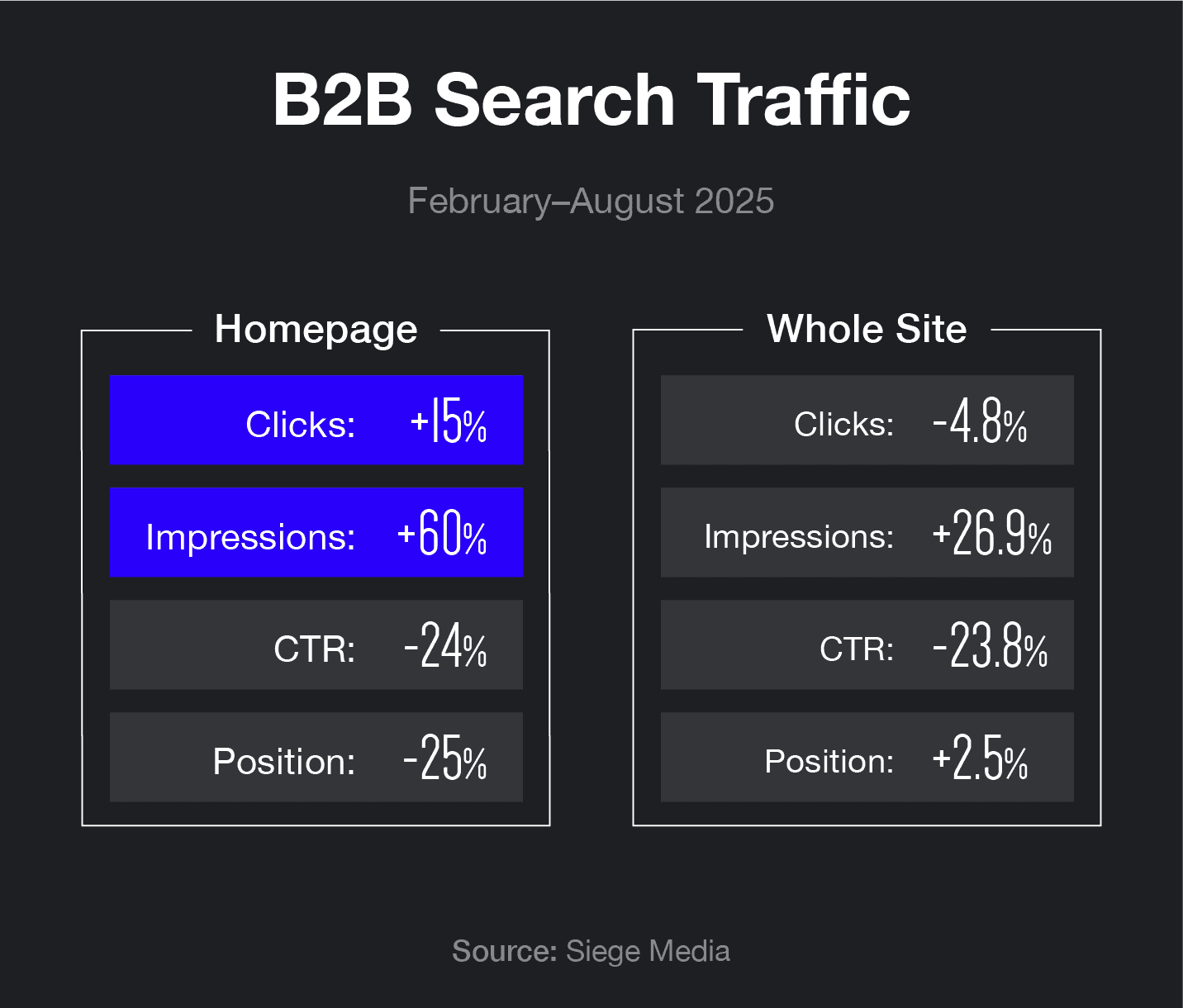
In fact, our recent 50-site study showed a sizable shift in how search traffic behaves in the AI era.
While overall B2B sitewide traffic sometimes declined during the three months measured in 2025, homepage traffic, which historically converts best, increased. AI-driven content and visibility on platforms like LLMs can move users toward higher-value, bottom-of-funnel pages, creating measurable brand impact even as search patterns evolve.
AI helps specialized teams quickly sort through huge amounts of technical information and precisely group what people are searching for. This allows human experts to concentrate on what’s most important: validating the information and creating content that establishes them as industry leaders.
This article explores the concrete limitations of traditional keyword research methods and outlines how to use AI to build a faster, smarter, and future-proof SEO strategy.
- Why Manual Keyword Research Falls Short for Technical Verticals
- How AI Accelerates Topic Ideation
- Why Future-Proofing Your Keyword Research Is Key
- How To Build Long-Term Expertise with AI as a Partner
- 6 Ways to Maximize AI for SEO in Technical Industries
- Use AI for a Smarter, Faster SEO Strategy
- Frequently Asked Questions
Why Manual Keyword Research Falls Short
Manual keyword research leads to a catch-22 in technical marketing: To identify the right specialized terms, you need deep technical acumen. However, most marketing projects start without that detailed knowledge.
You can easily find surface-level, high-volume keywords with traditional tools, but your content team can’t rely on those keywords alone. You’ll end up missing specialized, high-converting queries that truly build pipelines. This manual bottleneck leads to a content strategy that is often rushed and generalized.
| Example: A content team strategizing for a database management client might target “cloud computing” with manual keyword research, but using AI to identify the hyper-specific, high-value keyword “Kubernetes observability dashboards using OpenTelemetry” could drive more conversions for their client as it relates more specifically to the client’s customers’ intents. |
Reviewing thousands of terms, cleaning data, and clustering intent can take days or weeks of analysis. And the resulting content is often outdated before it’s fully executed, leading to generalized topics that fail to capture the specific pain points of technical decision-makers.
In other words, it’s content that generates traffic but doesn’t lead to high-quality conversions. The truth is, manual processes simply lack scale.
Traditional SEO tools offer limited help with the complex relationships between technical search terms. Human analysts alone can’t manually process the sheer volume of “People Also Ask” (PAA) data, niche forum discussions, and more to identify subtle, evolving search intent patterns.
As a result, they miss semantic trends and direct strategies that lack the competitive precision needed to rank well in highly technical SERPs.
How AI Accelerates Topic Ideation
AI’s primary benefit is its ability to digest large, unstructured datasets and rapidly generate hundreds of on-brand topic ideas from information like:
- Existing content
- Competitor URLs
- Brand guidelines
- Dense product documentation
While human strategists excel at contextual judgment and creativity, evaluating and expanding ideas can be time-intensive. AI provides a strong starting foundation by rapidly surfacing a wide range of potential topics for human refinement and prioritization.
AI also streamlines keyword targeting by automating semantic clustering, a critical but often laborious task for technical industries. It groups highly nuanced technical search intents based on underlying search relationships. It’s smarter SEO: Every piece of content targets a precise and relevant audience, boosting its conversion potential.
| Example: A content team brainstorming topics for a SaaS client could use AI to automatically separate generated keywords, such as “CI/CD pipeline monitoring best practices” versus “CI/CD security policies and compliance,” to better target the respective potential customers that would convert from each piece of content. |
Additionally, AI can ingest and analyze a competitor’s top-ranking pages and entire content map, cross-referencing that data with your brand’s existing authority. This reveals specific, high-value content gaps where your brand has technical authority but is missing essential content, allowing for much faster, data-driven content creation.
Why Future-Proofing Your Keyword Research Is Key
Search behavior is fundamentally changing. The future of SEO with AI tools, such as voice search, generative search results, and large language model (LLM) integration, means users are now asking complex, multifaceted questions. They want complete answers, comparisons, and technical definitions delivered in conversational language.
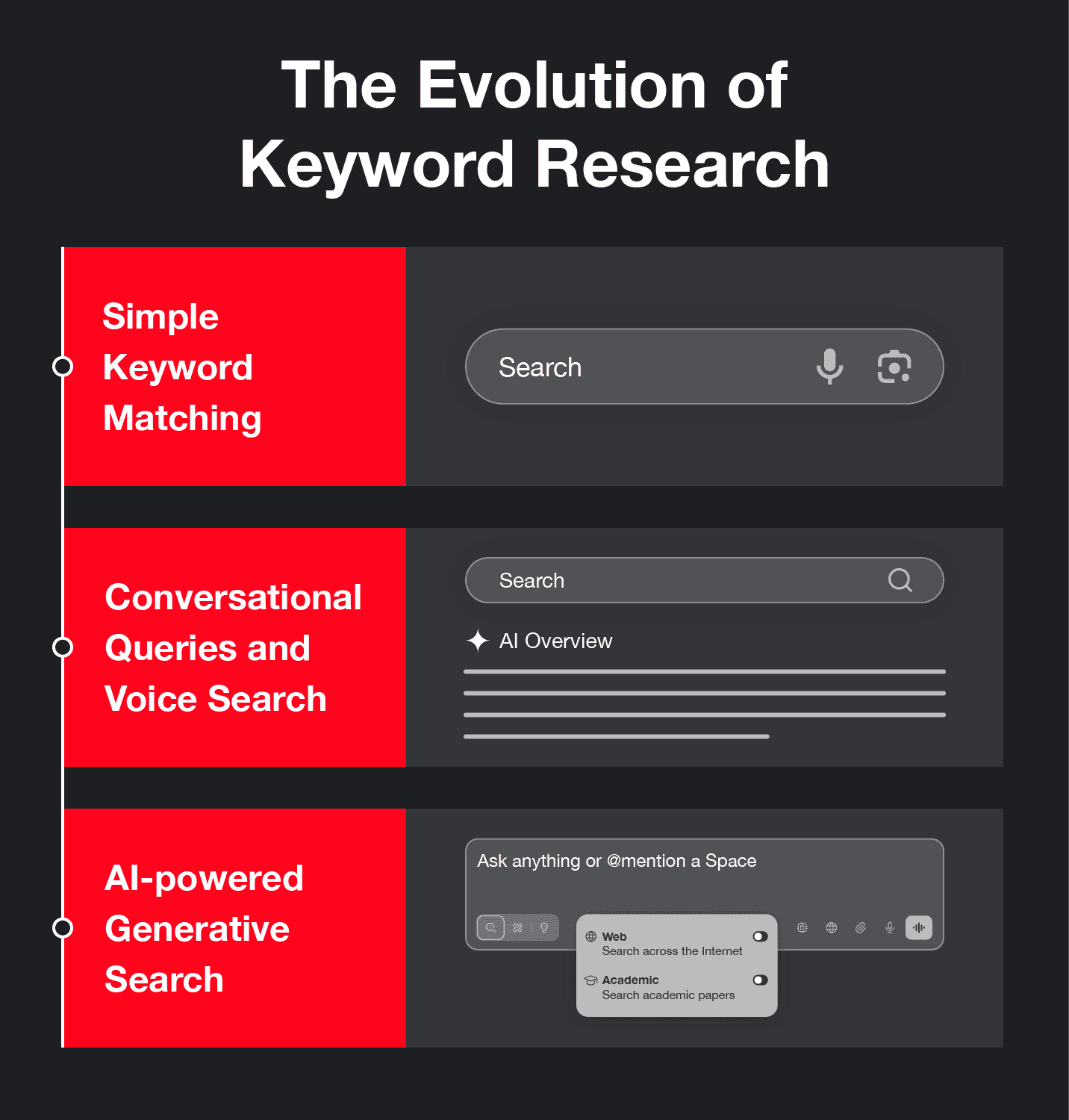
AI keyword research is perfectly suited to identify and map these emerging voice and semantic trends because it processes language contextually, far beyond simple word counts and toward deep intent modeling.
To future-proof your strategy, your keyword research strategy needs to shift from simple query matching to sophisticated, cluster-based intent modeling.
This future-proofing requires specific strategic adjustments:
- Focus on long-tail questions: Prioritize complex, long-tail questions that rank for zero-click searches and snippets, signal high user intent, and are often conversational in nature. For example, “What are the security implications of using serverless functions in a hybrid cloud environment?”
- Model for multiple touchpoints: Design comprehensive content clusters that answer a full user journey, from initial problem identification to product comparison, rather than targeting a single keyword.
- Validate against domain context: Use AI to generate comprehensive content outlines, but validate all technical details and concepts with subject matter experts (SMEs).
- Embrace structured data: Utilize schema markup to help AI systems and search engines understand the complex entities and relationships within your technical content, providing explicit context.
Preparing for the evolving future of keyword research helps technical brands ensure their content ranks for queries today while seamlessly serving the conversational and generative search experiences of tomorrow.
How To Build Long-Term Expertise With AI as a Partner
You should view AI as an ongoing strategic partner that aids learning by analyzing competitive landscapes, identifying trending topics, mapping audience intent, and suggesting gaps in content coverage that might otherwise go unnoticed.
It’s true that AI presents large datasets of clustered, organized, and intent-mapped opportunities. But it’s not just a shortcut for data entry. AI allows human strategists to quickly identify market patterns, understand audience pain points, and internalize the specific technical language used by the target audience.
This effect is visible in real-world outcomes.
We already covered how AI Overviews and LLM adoption have shifted search traffic toward high-value pages: Homepage clicks have increased by 15%, and impressions have surged 60%, even as sitewide clicks dipped slightly. AI can help teams prioritize the content and pages that matter most, maximizing both visibility and conversion potential.
Content marketing strategists can now spend more of their time on high-level strategic analysis and content planning instead of cleaning up spreadsheets.
In fast-moving technical markets such as cybersecurity, decentralized finance, or advanced manufacturing, content strategy can change on a quarterly or even monthly basis. The insights generated by manual, slow research quickly become obsolete.
However, AI provides strategic SEO insights grounded in real-time data and domain context. This enables marketing teams to pivot their content strategy faster and more confidently than they could with legacy, annual market reviews.
With this speed, teams can help brands consistently capture first-mover advantage on emerging topics and rank in AI search results.
6 Ways to Maximize AI for SEO in Technical Industries
Leveraging AI in technical SEO is an art of balance. The goal is to maximize the velocity and scale AI offers without sacrificing the precision, factual accuracy, and trust SMEs and experienced strategists can provide.
- Choose the right AI tools: Avoid relying on a single, generalized tool. To prevent keyword bias or limited scope, integrate specialized AI tools for topic clustering and intent mapping with broader platforms focused on trend analysis and competitive benchmarking.
- Leverage industry-specific language and expertise: Technical content demands the highest standards of E-E-A-T (Experience, Expertise, Authority, and Trustworthiness). Ensure your AI inputs (and content outputs) consistently reflect this. This means feeding the AI proprietary data, referencing specific and relevant technical standards, and including unique, highly relevant SME quotes and insights.
- Combine AI with human expertise: The AI generates the detailed map, but the human expert drives the content strategy. Strategists should vet all AI-generated clusters for real-world application and ensure the final content aligns perfectly with the brand voice, technical factual accuracy, and high-value business goals.
- Focus on semantic clustering: Shift the primary objective of your research from finding single, high-volume keywords to identifying groups of related, high-intent queries. This is where AI truly stands out, enabling you to build comprehensive content clusters that satisfy the full information needs of a technical user on a specific topic.
- Monitor real-time performance: Implement AI-powered analytics to correlate keyword cluster performance with downstream conversion data. Use this feedback loop to rapidly update content based on which subtle intent signals are converting best.
- Leverage ethical and quality control: Implement strict guardrails to prevent over-automation. All content based on AI research should undergo rigorous factual and technical review to maintain quality, avoid generic output, and comply with internal data privacy and usage standards.
To maintain highly accurate, trustworthy, and effective SEO efforts, particularly in capturing technical authority, treat AI as a powerful tool for scaling your work instead of as a substitute for essential domain knowledge.
Use AI for a Smarter, Faster SEO Strategy
The future of competitive SEO in technical industries isn’t about replacing the human strategist. It’s about augmenting them with technology capable of handling complexity and scale that was previously impossible.
AI keyword research transforms a reactive, manual process into a proactive, strategic advantage, ensuring your brand captures authority and qualified leads in the most complex search environments.
To succeed in the rapidly evolving technical search landscape, you need a partner that understands both the mechanics of AI keyword research and the nuances of deep industry expertise. Learn more about how Siege Media uses AI-powered tools like DataFlywheel to help technical B2B brands scale authoritative content strategies with tangible results.
Frequently Asked Questions
What Are the Biggest Challenges When Integrating AI Into Keyword Research for Technical Industries?
The primary challenge is maintaining factual accuracy and domain-specific relevance. AI excels at scale and pattern recognition, but it often struggles with the nuanced context, highly specialized jargon, and subtle factual distinctions common in technical topics.
To avoid this, keep humans in the loop at all stages of your content strategy. They can make sure that the AI is consistently trained or guided by high-quality, vetted, industry-specific data sources and product expertise before any content is generated.
How Does AI Improve Understanding of Complex Search Intent in Technical Topics?
AI improves intent understanding by automating semantic analysis and clustering at a speed and scale impossible for a human team. It identifies subtle, non-obvious relationships between thousands of queries, organizing them into precise topic groups. This reveals not just what a user is searching for, but why they are searching.
Marketers can use this granularity to match content to the exact stage of the buyer’s journey.
Can AI-Generated Keyword Research Replace Human Strategists?
No, not at the strategic level. AI and SEO require a human touch for strategic success.
AI is an indispensable tool for data organization, speed, and volume, but it cannot replace the human mind. Human strategists are essential for three key functions:
- Translating research into brand alignment and voice.
- Providing the necessary subject matter expertise validation to ensure factual integrity.
- Connecting keyword opportunities directly to high-value business goals, pipeline generation, and market leadership positioning.