Most teams aren’t losing the GEO budget conversation because their program isn’t working. They’re losing it because they can’t prove it is.
Pull up your GA4 referral report, and you’ll probably see somewhere around 5% of your pipeline tagged to AI sources. At Siege, that’s exactly what we saw. Then we added a self-reported attribution field to our contact form and asked people how they actually found us.
The number jumped to 40.
GA4 was built to track clicks. LLMs don’t work that way. By the time a prospect who found you through ChatGPT actually visits your site, there’s no referral trail left. The influence has already happened.
That disconnect is why GEO budgets keep getting rejected. Leaders are walking into executive rooms with the wrong number and losing the argument before it starts.
Let’s look at a four-layer attribution stack that starts with a single form field and ends with a pipeline model you can present to your CFO.
- Your Analytics Weren’t Built for AI Search
- Add a Self-Attribution Field to Your Lead Form
- Use Branded Search as a Directional Signal
- Build a Citation Share Baseline
Layer 1: Your Analytics Weren’t Built for AI Search
ChatGPT, Perplexity, and Claude don’t pass UTM parameters when they send someone to your site. So that traffic lands and gets filed under “direct.” No source. No credit.
This is why GEO looks underpowered in most attribution reports. The citations are happening. The referrals are real. They’re just invisible to the tools you’re using to measure them.
You can’t fix this by adding a new UTM or tweaking your GA4 setup. With AI search, there’s no click to track. The influence already happened before anyone landed on your site.
Here’s what that looks like in action:
- A prospect asks ChatGPT for a recommendation. Your brand comes up.
- They close the tab, go back to work, and Google you two days later.
- GA4 logs it as direct traffic. ChatGPT gets no credit.
Multiply that across your pipeline, and the clearly undershot 5% number starts to make sense.
Below, we walk through four layers of attribution that work together to give you a true picture of GEO’s impact on your pipeline.
Each layer captures something the others can’t. Used together, they replace the black box with a model you can actually act on.
Layer 2: Add a Self-Attribution Field to Your Lead Form
The simplest fix in this entire stack is also the most overlooked. Add an open-ended text field to your lead or contact form that asks: “How did you hear about us?”
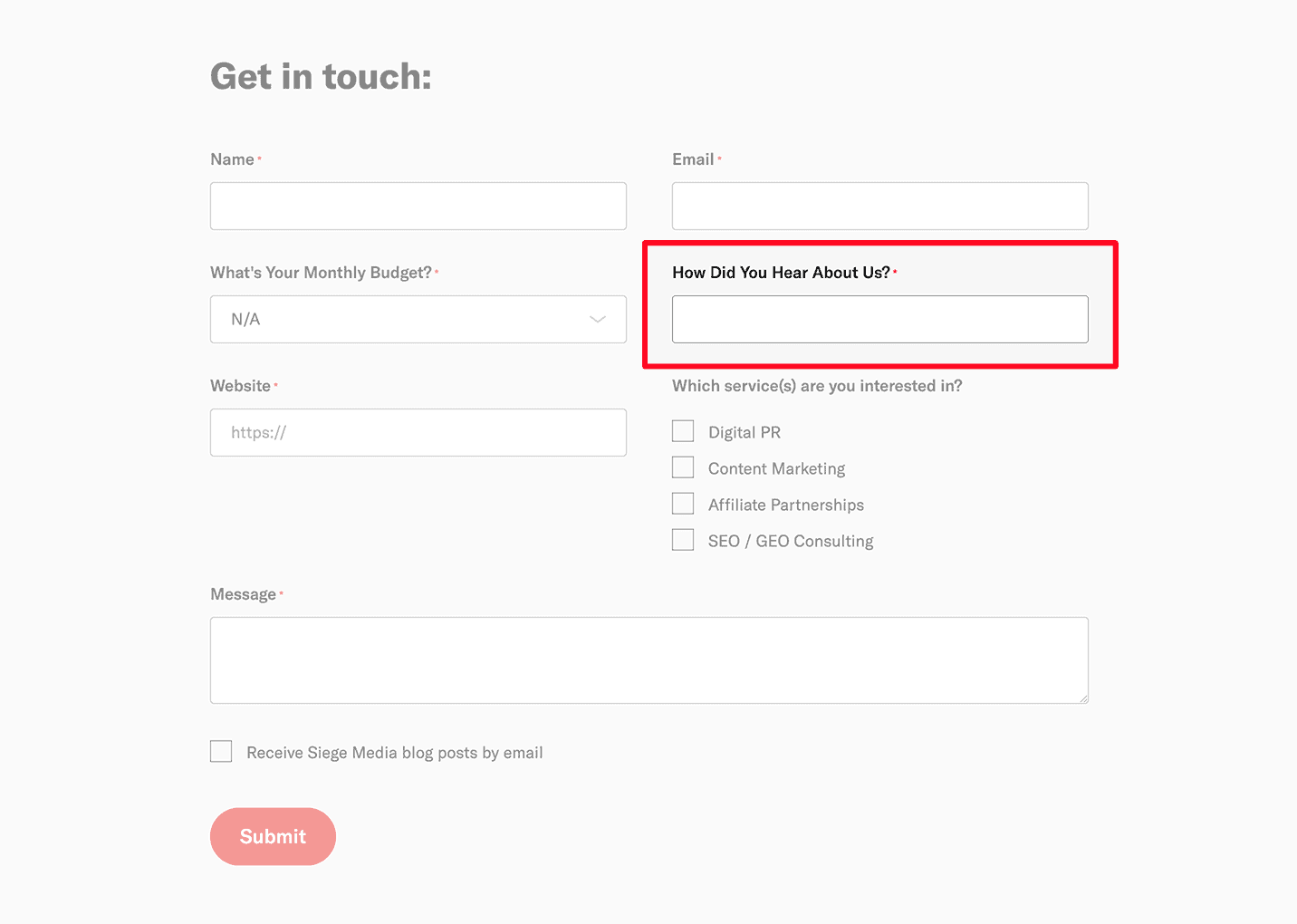
One field captures what months of analytics cannot: the real reason someone reached out. People will tell you they found you through ChatGPT, through a Perplexity answer, through a podcast they heard last month.
All sources that your UTM parameters would never have caught.
Pro tip: If you’re limited to a dropdown, use “AI Recommendation” as the option label rather than naming a specific model, like ChatGPT or Perplexity. It covers all LLMs and stays accurate as the landscape changes.
Open-Ended Beats Dropdown Every Time
A dropdown forces people to choose from options you already thought of. And when nothing quite fits, they’ll pick whatever’s closest and move on. The data looks tidy, but it’s built on guesses.
An open-ended field removes that ceiling. Instead of picking from a list, people tell you exactly how they found you. That’s how you start seeing responses like “ChatGPT recommended you” or “I came across you in a Perplexity answer.”
Pro tip: For B2B, add the field directly to your main contact or demo request form and make it required.
For e-commerce, place it post-conversion only. Asking pre-checkout risks hurting your conversion rate. Post-purchase, a multi-choice dropdown works fine since the effort bar is lower.
Layer 3: Use Branded Search as a Directional Signal
Branded search is one of the most underused signals in a GEO measurement stack. When AI tools recommend your brand consistently, people start searching for you by name.
They heard about you somewhere, they want to know more, and they go straight to Google. That uptick in branded queries in Google Search Console is AI influence made visible.
It’s a lagging signal, typically 30 to 60 days behind a citation share spike, but that delay is actually useful. If your prompt visibility improves in January and branded search climbs in February, you now have a directional correlation you can point to.
Paired with your self-attribution data, it shifts the conversation from “we think GEO is working” to “here are two independent signals validating GEO.”
How to track it:
- In GSC, filter for branded queries only and pull month-over-month data.
- Set this baseline before you start any GEO work. Without it, you have nothing to measure against.
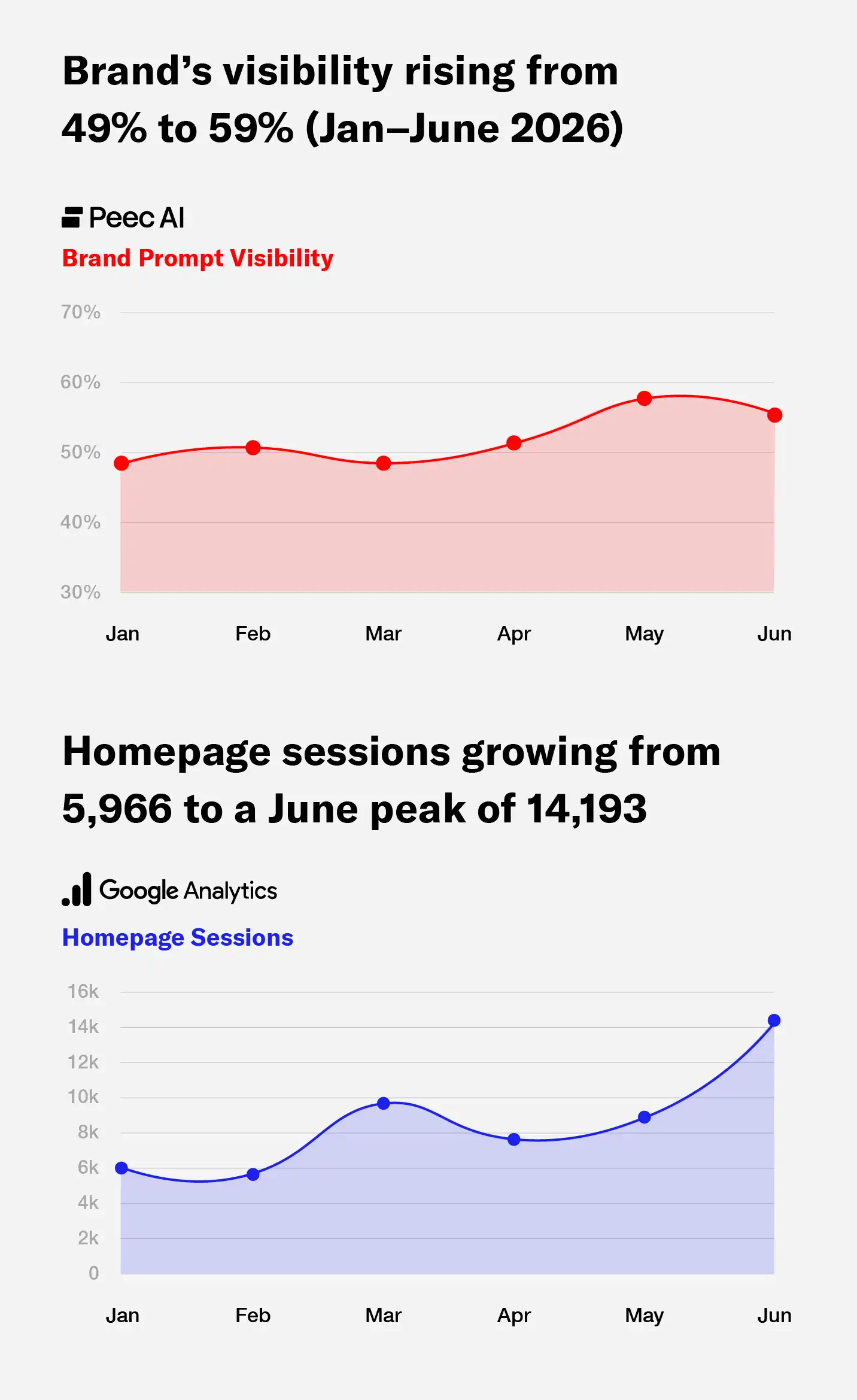
The charts above show this in practice. Prompt visibility climbed steadily from January through May. Homepage traffic followed, peaking in June — roughly 30 days later.
That’s the lag effect playing out in real data. Pair that timing with your self-attribution field, and you shift the conversation from “we think GEO is working” to “here are two independent signals that say it is.”
Layer 4: Build a Citation Share Baseline
Self-attribution tells you AI is driving leads. Branded search tells you awareness is building. But neither tells you where you actually stand in AI answers relative to your competitors. That’s what citation share does.
Think of it as your GEO share of voice. It tracks how often your brand appears in AI responses across a defined set of queries in your category. Without it, you can’t tie visibility to the pipeline or calculate what a 10-point improvement in prompt visibility is actually worth.
Tools like Peec AI, Profound, Semrush’s AI toolkit, and Ahrefs brand radar all track this. Pick one and start. Even 30 days of data gives you something to work with.
What to track:
- Prompt visibility % — how often your brand appears across your tracked query set
- Citation position — are you appearing first or getting buried further down?
- Competitor share — are you gaining or losing ground against the brands you care about?
Turn GEO Visibility Into Revenue
The brands winning GEO budget conversations right now aren’t doing anything revolutionary. They added a form field, pulled existing data, and built a simple model that linked visibility to revenue. That’s the entire stack.
Ready to build your GEO attribution stack?
As a full-service GEO agency, Siege Media helps brands build the measurement infrastructure and content programs needed to win in AI search. If you want to see what that looks like for your business, let’s talk.