Don’t throw good money after bad (content marketing).
According to Cision, the content marketing industry is expected to grow by more than $417 billion.
In fact, 2025 has seen content marketing budgets continue to climb – 88.2% of teams increased or maintained their content spend into this year, and 11.3% of content marketers plan to invest over $45,000 per month (nearly triple the share from 2024).
This means literally billions of dollars are being deployed in content marketing this year, and there’s an expectation of a return on that investment in the near future.
Additionally, 21% of content marketers report that measuring ROI is the biggest challenge when developing content (Siege Media + Clearscope).
Additionally, about two-thirds (66.5%) of marketers aren’t confident about where to allocate resources, underscoring that proving content marketing ROI remains as critical (and challenging) as ever.
Whether you’re an entrenched veteran of content marketing or a new player contributing to the industry’s growth, understanding ROI from your content marketing is essential and what this post is all about.
Content Marketing ROI Estimation Calculator
In our content marketing ROI calculator, we use SEO as the primary channel for driving organic visitors and results because it’s the channel with the highest ROI in content by a long shot. Recent data reaffirms this: organic search accounts for about 52.7% of B2B revenue on average, far outpacing other channels in ROI potential.
We also offer users the ability to calculate ROI based on their business model and actual performance metrics or estimations from tools like Ahrefs and Semrush.
Disclaimer: This calculator can be used to estimate ROI but is no guarantee that you will be successful in your content marketing efforts. If you want a more accurate assessment of your needs and ROI, contact the professionals.
View this video for a walkthrough of how to use the ROI calculator.
Choose Preferred ROI Calculation:
What Is Content Marketing ROI?
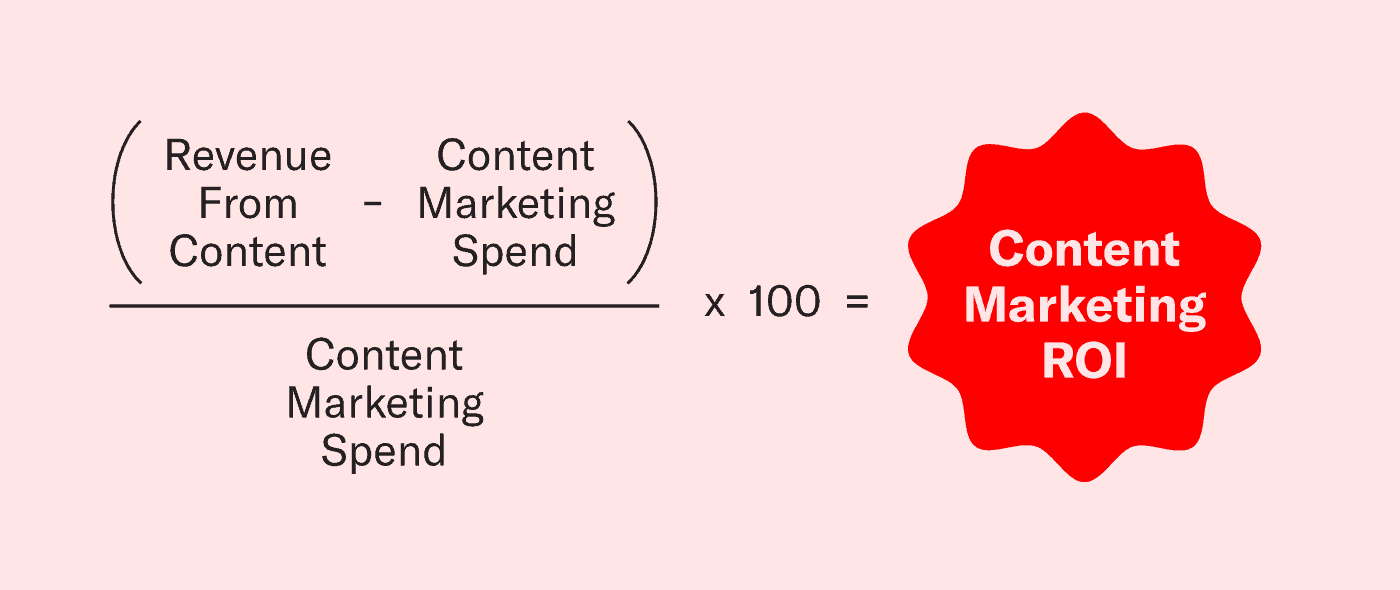
Return on investment (ROI) in content marketing is how you can measure the net positive revenue from your content marketing investments after expenses, expressed as a percentage.
In other words, it compares how much you earned from content to how much you spent, to show whether your content efforts are profitable.
The basic formula for ROI is:
Content Marketing ROI Formula
Let’s clarify with an example:
If you spent $200,000 on content marketing last year and your content generated $1,000,000 in revenue, your ROI would be:

What’s a Good ROI In Content Marketing?
A good ROI in content marketing is dependent on your industry, your domain rating and authority, and more. But, if your ROI calculation results in a number greater than zero, you at least broke even on your investment.
When we’re evaluating a potential client, we like to see our ROI estimates between 300-400% (3x to 4x), if not more, to have confidence in our work being value additive.
One consideration that isn’t priced into many ROI estimates, but should be in actual ROI calculations, is the lifetime value of a piece of content in your industry. If your content is consistently driving traffic and conversions for three+ years, your ROI will therefore be much higher than what you estimated on a 12-month timeline.
It’s no secret that quality content marketing has one of the most significant marketing ROIs out there – provided you give your content time to mature and continue delivering value over the long run.
How To Calculate Content Marketing ROI and Goals
Depending on your business model, your method for estimating and calculating ROI may be slightly different. There are a few nuances to consider before modeling your returns from content:
What Is Content Worth in Your Industry?
A simple way to estimate the value of a piece of content in your industry is to take the traffic value of a top competitor, then divide that by the number of content pieces on their site.
Traffic value is a metric from Ahrefs that is the monetary value placed on organic traffic via keywords that people would bid on in PPC ads.
If you have an accurate valuation of what a piece of content is worth based on your own existing content, that’s great — but if not, you should identify the value of content in your market by analyzing your top competitors.
At Siege, we do this for clients by reviewing some top competitors and averaging the traffic value for the top 50 pieces of content. We believe using the traffic value from the top 50 pages of a competitor’s blog or learn center is comparable to the types of content we would create for them.

It’s worth noting that if your initiatives include more than landing page content, you can broaden this analysis to the root domain instead of just /blog/, /learn/, or /resources/ routes.
It’s also worth noting that the process of projecting content marketing ROI is opaque at best. We use traffic value from Ahrefs as a directionally accurate metric, but with the full understanding that it is not exactly correlated with revenue and ROI.
If content doesn’t appear super valuable at first glance, you might consider researching what a link is worth in your market.
What Is Organic Traffic Worth to Your Business?
If you don’t trust traffic value as reported by Ahrefs, or it simply doesn’t feel like the right metric for your business (that’s fair!), there is another way, as long as you have a firm grasp on what organic traffic means to you in terms of conversions and revenue.
In that case, you can instead identify the average organic traffic to content in your industry and run the numbers based on your conversion rate and the average order value (AOV) or average contract value (ACV).
Let’s say that the average piece of content in your market drives 500 organic visitors per month, and you’ve consistently converted 2% of visitors into customers with an AOV of $100. This would mean that the average post drives $1,000 per month. If you were to publish five posts per month, by the end of 12 months you would have 60 posts published and then drive $60,000 per month in revenue from content, on average.
This said, it’s worth noting that clicks continue to decline due to AI Overviews, AI Mode and users transitioning to other LLMs. Traffic may not hold up as a metric into 2026, so you should consider that when weighing ROI calculations.
What Is Your Time Horizon?
Content and SEO are a long game.
It can take anywhere from nine to 18 months or longer for you to break even and start seeing returns on your investments. One thing to keep in mind is that while your expenses are likely increasing month over month, assuming more and more high-quality content is published. Results should begin to compound in later months to catch up and exceed expenses.
This means you most likely won’t see results begin to bear fruit until six+ months and will start to approach a break-even point around month 12+:
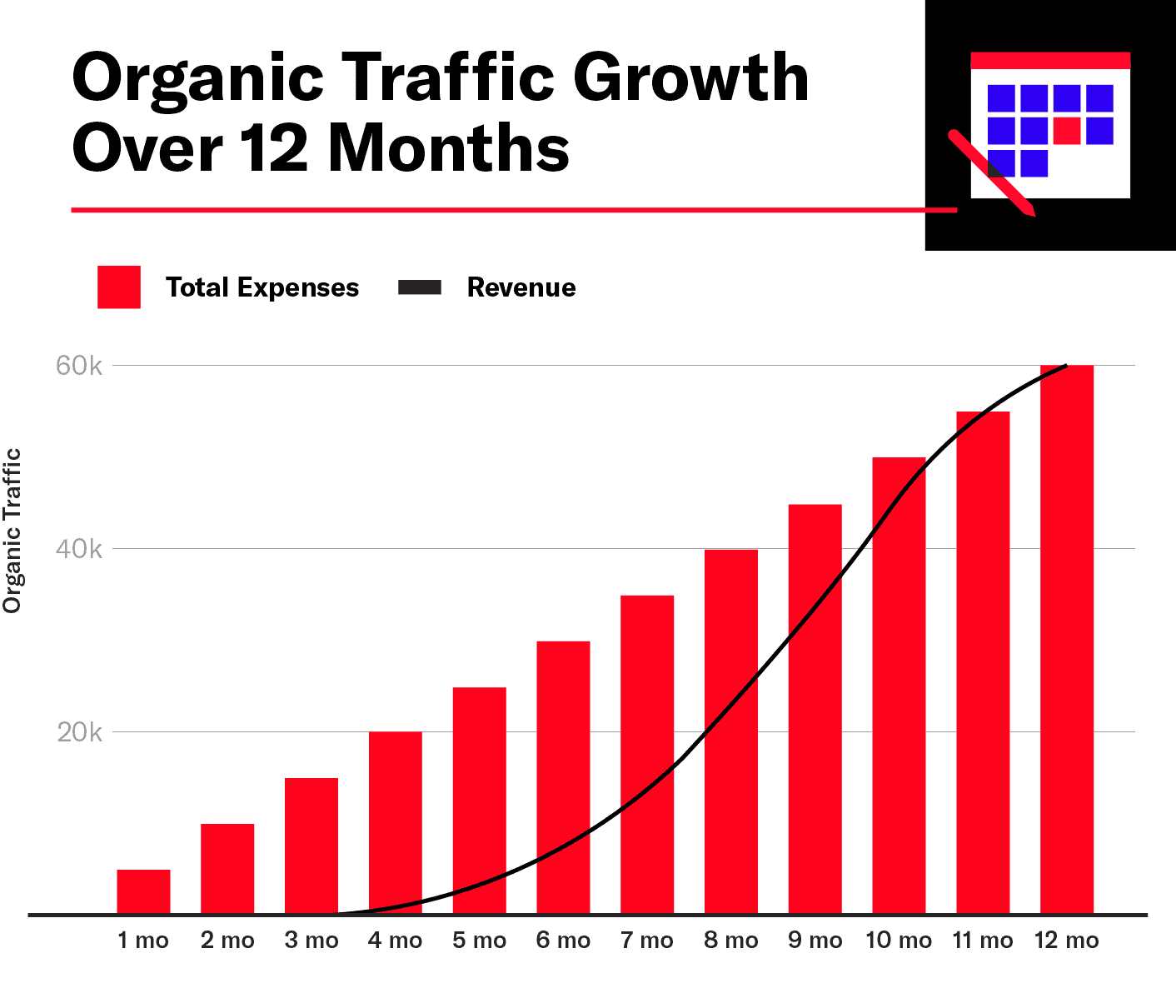
Indeed, the majority of content marketers (62.8%) reported traffic growth year-over-year from 2024 to 2025, illustrating how compounding content value often rewards a long-term outlook with increasing ROI over time.
Estimating ROI: Competitor Analysis in Content
The first and most approachable way to estimate your content’s ROI is to identify the average value of content using your top competitor.
A natural starting point is by comparing apples to apples in terms of the type of content you plan to produce over the course of your content marketing campaign. Take the average monthly traffic and traffic value, as reported by Ahrefs. Then include the number of content pieces you plan to execute per month, as well as your monthly budget/spend to project growth in traffic and traffic value.
It’s also important to understand that a top competitor might have established authority in the space and can rank more easily for highly competitive keywords and therefore derive more value on average.
If that’s the case, you can take your competitor’s current performance and discount it accordingly to arrive at a reasonable expected ROI based on your current domain rating.
Calculating ROI: Specific to Your Business Model
In content marketing, we typically face two broad business models:
- Direct Traffic Monetization
- Traffic Conversion Monetization
The first, what we’ll call “Direct Traffic Monetization,” is any business whose revenue is linearly correlated with traffic — usually an advertising model.
The second is a business that must convert traffic into a lead or customer, so revenue is only loosely correlated with traffic. If you’re measuring the ROI of content marketing for B2B companies, for example, it’s important to understand how your traffic converts into leads and your win rate for turning leads into customers. Once you have that information, you can calculate ROI based on your average contract value (ACV).
An e-commerce site, on the other hand, simply uses its conversion rate paired with its AOV to identify the value of traffic and generate an ROI calculation.
Some considerations for attribution: ensure you attribute conversions appropriately – e.g., last-touch vs. multi-touch – so that content’s influence is properly accounted for in ROI calculations.
Content Marketing ROI Metrics To Observe
You want to monitor your content marketing ROI closely, but how can you make the task more manageable while focusing on data-driven information? As your content marketing ROI is a metric itself, you may be surprised to hear the answer is more metrics. Many metrics relate to one another, so keeping your eye on a few at a time can help you obtain the most complete picture.
Watch for these related content marketing ROI metrics:
- Brand awareness: After creating content, determine if your brand mentions and searches become more frequent or remain the same.
- Conversions: See if your content creation efforts lead to additional conversions and if certain content types or topics convert more.
- Email rates: Determine if your subscribers open and interact with your email newsletters.
- Leads: See how your content marketing efforts affect the leads you obtain.
- Sales: Understand how your revenue connects directly to your content marketing activities.
- Traffic: See how your content distribution affects your overall website traffic, including page views and time on site.
By monitoring your content marketing ROI metrics and related fields, you can gain a more comprehensive view of your operation. These powerful metrics enable you to make more informed decisions, enhance efficiency, and outperform the competition.
Increasing Your Content Marketing ROI
There are a few strategies we strongly recommend our clients implement to increase ROI from content marketing:
- Leverage SEO and blog design best practices.
- Conduct a KOB analysis to prioritize high-value, low-difficulty keywords.
- Execute high-quality content that aligns with search intent.
- Audit content performance and update on an annual or semi-annual basis for freshness.
- Leverage AI tools (wisely) in your content process. Use AI-driven tools to support research, data analysis, and even content drafting – always with human oversight to maintain quality.
- Repurpose and redistribute high-value content. Give your best content a second life by updating or transforming it into new formats (videos, infographics, podcasts, social threads, etc.).
Ultimately, we believe that content marketing is much more than simply written content. It should have a great user experience to elevate perceived trust while improving the chances of your content creating conversions.
Even as new technology like AI helps scale your efforts, successful content marketing in 2025 still relies on human creativity, strategic focus, and an exceptional user experience to truly maximize ROI.
If you’d like a more in-depth ROI analysis for your content marketing efforts or need to level-up your overall content strategy and quality, we’re more than happy to identify the strategies that will deliver the most ROI for your business. Reach out to us here!