
To uncover strategies that drive results, we analyzed two years of performance across various industry blogs, totaling over 7.2 million sessions from 12,200+ unique URLs.
We found a clear, accelerating shift toward bottom-of-funnel (BOFU) content that could be the result of AI search.
High-volume, comparison-style content continues to account for a significant portion of traffic and is gaining traffic share slightly (+2.3 percentage points) over time.
However, the real story is the growth of pricing-style content (cost comparisons, etc.), which grew by a massive 12.1 percentage points.
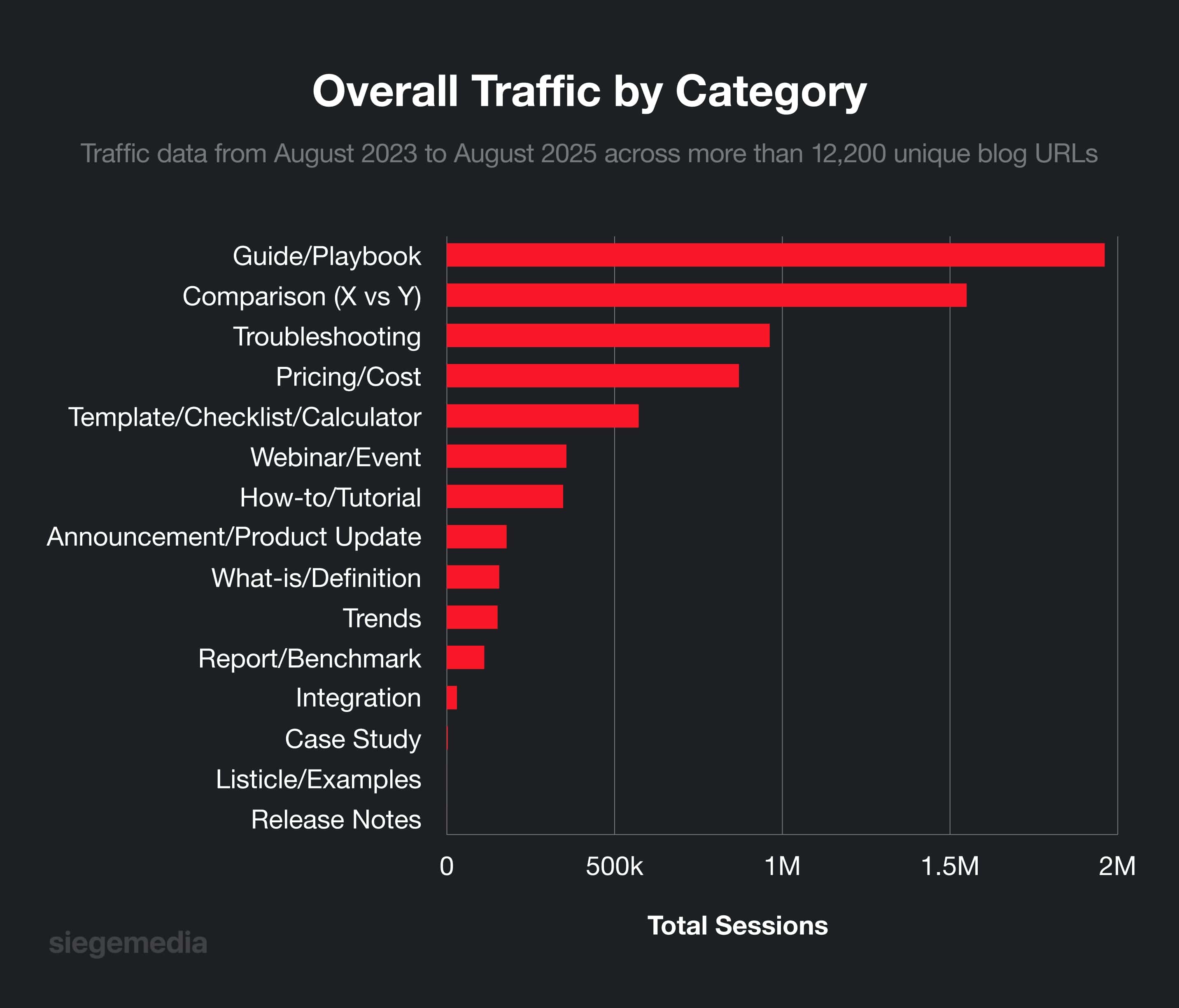
This growth comes at the expense of top-of-funnel guides and how-to-style articles, which are fading in influence. This is a major change in audience behavior that signals a new consideration for content strategy.
However, data showing that user engagement improved significantly across nearly every category indicates a unique new opportunity to capture a highly engaged audience.
Key Takeaways
- Pricing-Style Content is the New Growth Engine: It gained the most ground by a wide margin, increasing its share of total traffic by 12.1 percentage points.
- Comparison-Style Content Holds Strong: This high-volume category is maintaining its large audience while slightly growing its traffic share (+2.3 percentage points).
- Top-of-Funnel Content is Down: Guides and how-to-style articles lost the most traffic share, declining by -6.9 and -8.3 percentage points, respectively.
- Engagement Improvement is Universal: Nearly every content type saw a rise in engagement rate, with trend-style content showing the most improvement (over +35 percentage points).
New Share Leader: Pricing-Style Content
While some of the historically popular topics in the blogging world saw their traffic shrink, our data study shows that pricing-style content has become a reliable source of growth.
The category was the standout winner in gaining audience share, increasing its portion of total blog traffic by 12.1 percentage points over the two years.
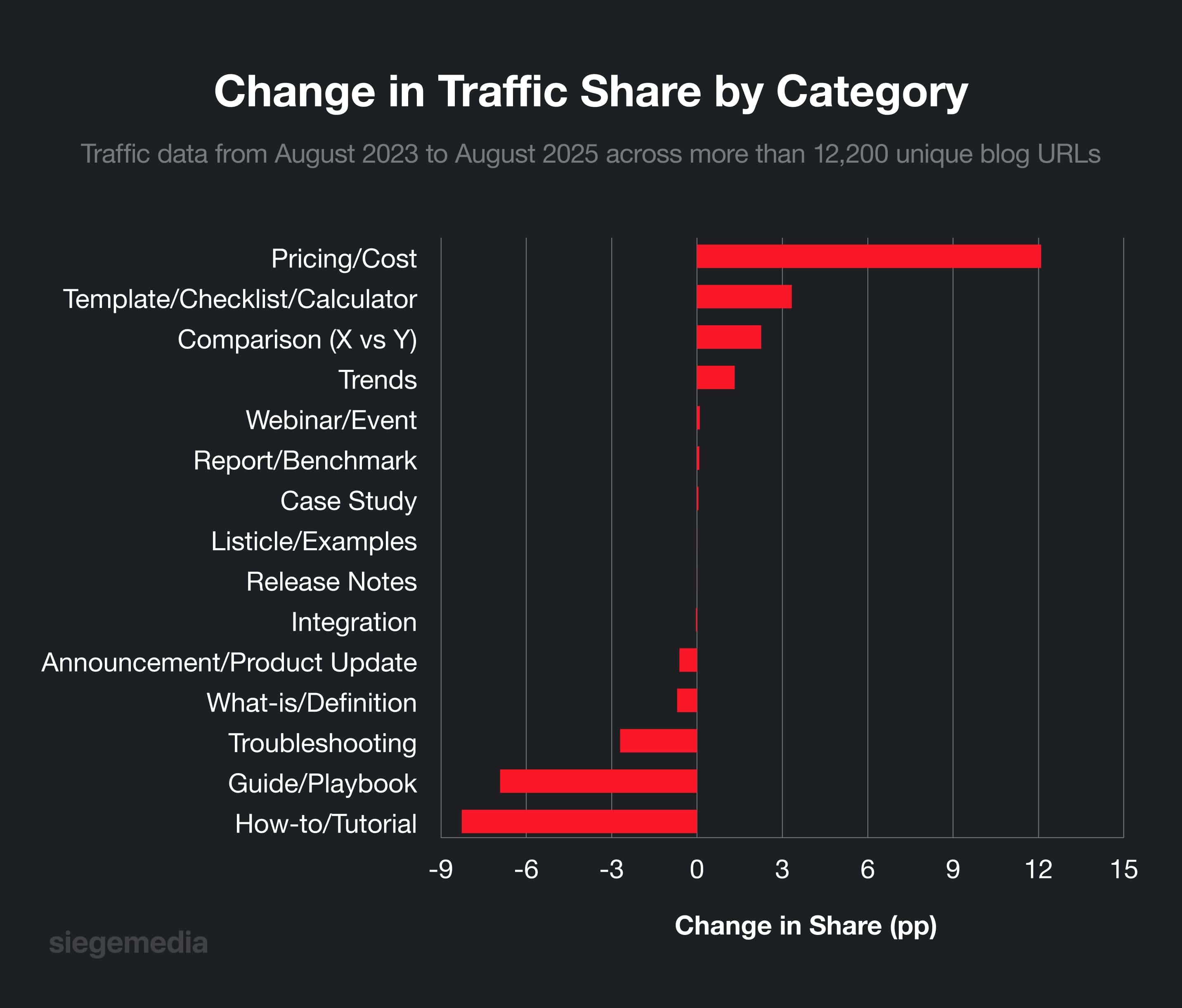
This trend highlights the importance of continuing to target high-intent users at the bottom of the sales funnel. A slowing economy may also amplify this focus on cost, as readers become more budget-conscious.
Readers have moved past general research and are actively considering solutions, making them a highly valuable audience.
The takeaway is to treat pricing pages as high-value content, not just straightforward landing pages. Ensure they are transparent, detailed, and easy to understand. It is crucial to include clear calls to action and keep the information consistently updated.
TOFU Content Decline & The Rise of AI
Our study data shows a clear decrease in the blogs’ largest and most established content categories. Guide-style traffic is declining at -34.7%, while how-to-style content saw an even steeper drop of -88.3%.
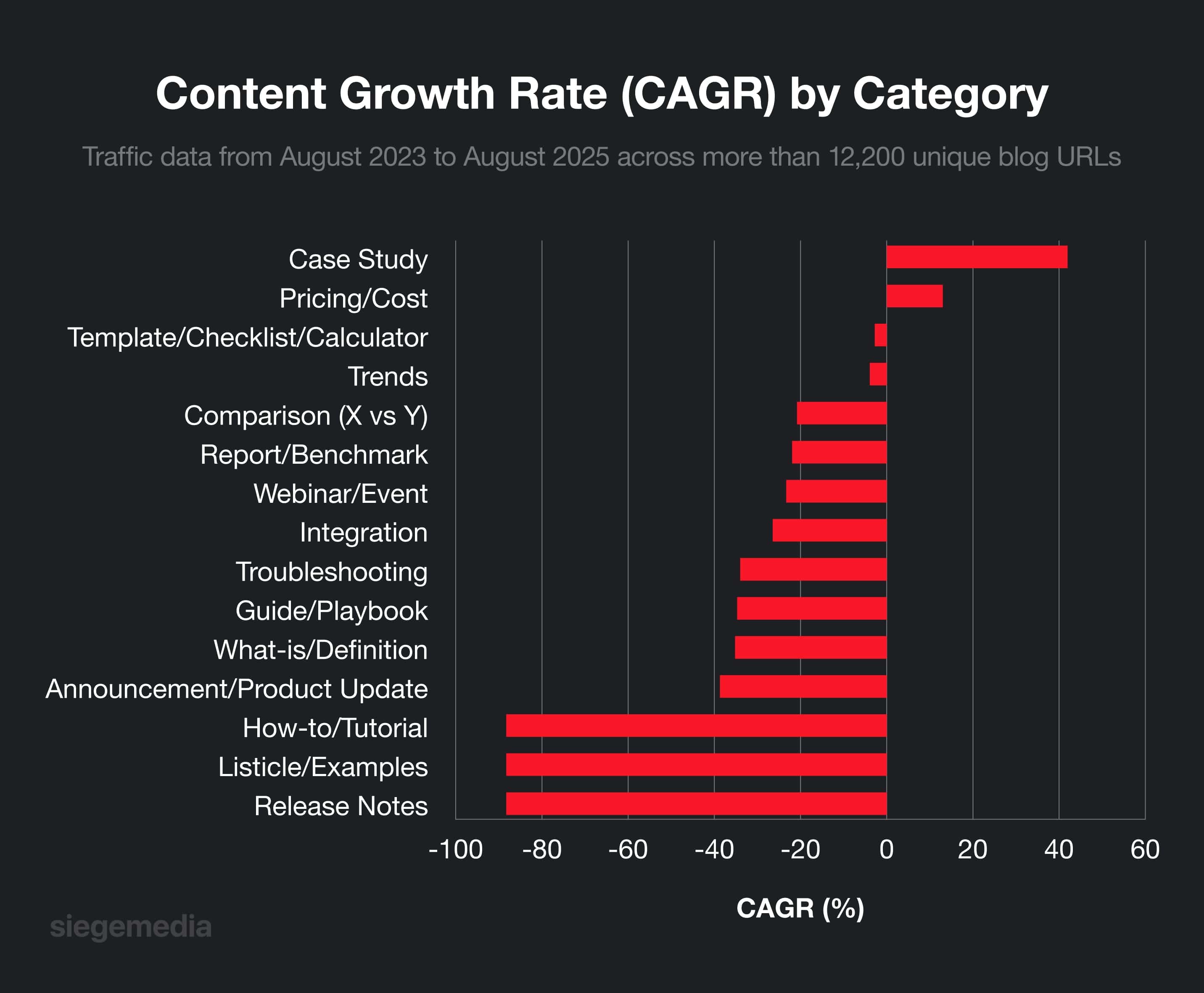
This is likely a direct result of the rise of AI search tools, which are changing user behavior. AI is increasingly answering the broad, top-of-funnel questions that this foundational content has traditionally served.
Users who click through to websites are more informed and have more specific, high-intent questions. They have already received a general overview from an AI and are now clicking a link for the crucial details, data, or context.
To succeed in this new landscape, content must provide a level of detail and expertise that a general AI summary cannot. Here are a few ways to improve these foundational styles of content:
- For Comparison-Style Content: Shift your blog outlines from broad, head-to-head comparisons to more specific use cases. Instead of a simple “Tool A vs. Tool B” piece, create content like “Tool A vs. Tool B for Enterprise E-commerce Teams.” These posts provide niche value that an AI overview is less likely to capture.
- For How-to and Guide-Style Content: Provide expert-level detail that goes beyond a simple summary. Your content should excel at explaining the “why” and the “how”. Try incorporating proprietary data, unique workflows, and insights from internal experts to create a definitive resource.
The Universal Win: Engagement Is Up
The most positive trend in the data is an across-the-board improvement in audience engagement. Nearly every content category saw its engagement rate increase significantly over the two years, signaling that the quality and relevance of the content are stronger than ever.
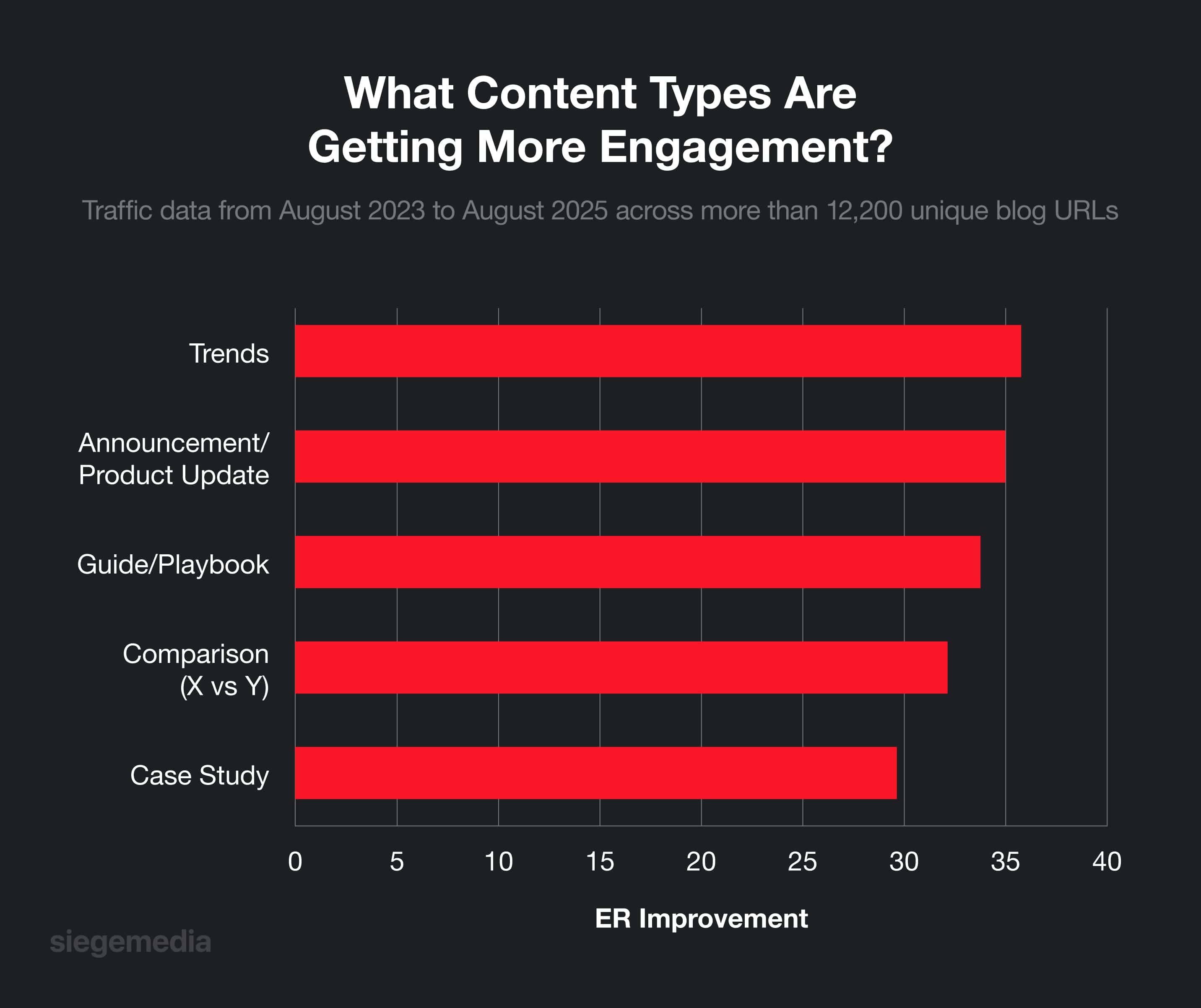
While what content is driving traffic is changing, the opportunity to capture and hold an audience’s attention is growing. High engagement is a leading indicator of blog content quality and audience satisfaction, helping establish your brand as an authority within its space.
The key: Use engagement as a guiding principle for future content development. Double down on formats that consistently prove to be the most engaging, like webinar, guides, and integration-style articles — not just for their traffic potential but also for their power to build authority.
Takeaways for a Hybrid Search World
Our data study reveals a clear path forward. Success in the current landscape requires a hybrid strategy that serves both traditional search and the high-intent nature of AI-driven traffic.
Here are a few ways to improve your content strategy moving forward:
- Prioritize High-Intent, Decision-Stage Content. The growth of pricing-style content and the high engagement of integration-style content show the value of targeting users who are trying to solve a problem. Content excels because it provides expert-level detail that a user seeks after getting a general overview from AI.
- Plan for B2B Seasonality. Seasonal B2B search trends likely heightened the shift in data during Q4 2024. Industry data shows that organic traffic for business blogs often dips in the summer and peaks in Q4 and Q1. Because AI referral traffic heavily skews toward B2B users, you should anticipate these cycles and use quieter periods for planning.
- Use Engagement as a North Star. The universal rise in engagement is a strong signal of well-written, high-quality content. The success of trends-style content and case studies shows that lower-traffic categories can be extremely valuable for building authority. Focus on formats that prove to be the most engaging, not just those with the highest volume.
Ready to Build a Data-Driven Strategy?
Understanding these trends is the first step.
Building a content strategy that acts on them is what drives results. Our team specializes in turning performance data into a clear, actionable plan focusing on what works now.
If you’re ready to move beyond assumptions and build a content program focused on measurable growth, reach out to our team today.
Reach out, and we’ll find the opportunities in your data.
Our Methodology
Siege Media conducted this study using analytics data obtained from over 7.2 million user sessions across more than 12,200 unique client blog URLs and 15 distinct content categories. Permission was provided from past and current clients to share their data. We collected traffic and engagement data between August 2023 and August 2025.
How We Defined Content Categories
To ensure consistency, we categorized each of the 12,200+ URLs into one of 15 distinct types based on the content’s primary goal and format.
Here are the definitions we used for our analysis:
- Announcement/Product Update: New feature launches, product updates, and company announcements.
- Case Study: Narratives detailing a specific team’s problem, solution, and results.
- Comparison (X vs Y): Head-to-head matchups comparing two products, concepts, or terms to help readers choose.
- Guide/Playbook: Deep, structured walkthroughs or strategy guides that teach a complete process.
- How-to/Tutorial: Step-by-step instructional content focused on accomplishing a specific task.
- Integration: Content specifically about connecting a product/service to another named product or platform.
- Listicle/Examples: Curated lists of tools, examples, or ideas formatted for quick scanning.
- Pricing/Cost: Posts that break down pricing models, cost comparisons, or budgeting for a product/service.
- Release Notes: Changelogs documenting incremental product changes and fixes.
- Report/Benchmark: Original research reports, indexes, surveys, or benchmark roundups that quantify a space.
- Template/Checklist/Calculator: Reusable assets that readers can apply directly.
- Trends: Observations or predictions about what’s rising or falling in an industry.
- Troubleshooting: Problem/solution posts that diagnose and fix specific issues or errors.
- Webinar/Event: Live or recorded sessions, event pages, or recaps.
- What-is/Definition: Concept explainers that define key terms and foundational ideas.