
If a CMO asked ChatGPT to describe their brand right now, the answer they’d get back would come from sources they’ve never reviewed.
The answer you get from ChatGPT is the consensus, not the reality. With ChatGPT driving 83% of of LLM activity across the sites we track, that consensus is the front door of your brand.
When a buyer asks ChatGPT about the best email platform for B2B SaaS, the answer comes from 5-10 listicles, review sites, Reddit threads, and similar sites.
They don’t always source your home page, and most of these third-party sites are those you’ve never optimized for. Still, all of them are casting votes on what your brand stands for.
The winning brands are those that drive you closer to your target customer. To do this, third-party sites need to build consensus around that target customer. Getting them to do this is the multi-vote strategy.
With over 50 content marketers and a track record of $148 million in annual revenue across SaaS, fintech, and e-commerce clients, we’ve watched this dynamic play out across hundreds of brands.
Our data shows that brands that push proprietary data earn 45% more AI citations than those relying on traditional “best overall” approaches. Volume isn’t the winner; specificity and originality are.
Let’s dig into how and why the multi-vote strategy works for your brand.
- Why LLMs Default to the Consensus
- The Three-Step Multi-Vote Audit
- Measuring the Vote Count
- Benchmarks for Controlling LLMs
- Improve Your LLM Brand Perception
- Frequently Asked Questions
Why LLMs Default to the Consensus, Not the Truth
LLMs are averaging what listicles and review pages are already saying about your brand. The training data behind it rewards repetition over accuracy. When multiple sources describe your business as the best for solo consultants, it outweighs any single-source claims, regardless of their authority.
This off-site influence makes some marketing leaders uncomfortable, as they need to admit that their brand positioning lives beyond their website. To LLMs, your homepage likely matters less than what third parties repeat about you.
Going further, third-party mentions that call you the “best overall” lose. They create no anchor for the LLM to attach to a buyer query. Buyer prompts are almost always specific, and targeting can help improve the ROI of your GEO campaigns.
“If your brand gets mentioned several different times on ‘best X’ lists but is described as the best in several different ways, that is not providing sufficient confidence to Google and LLMs that you are actually the best for any given thing.”
Ross Hudgens
Founder/CEO, Siege Media
Buyer prompts are almost always specific, and you can use tools to measure those results. For instance, Peec AI relies on prompt data from ChatGPT, Perplexity, and Gemini.
| Prompt | Visibility | Avg. Position |
|---|---|---|
| what is the best content marketing agency | 96% | 1.6 |
| who is the best content strategy agency | 93% | 1.4 |
| who is the best digital PR agency | 77% | 2.6 |
| who is the best fintech SEO agency | 73% | 3.7 |
| what is the best enterprise SEO agency | 70% | 2.9 |
From the data, we have some areas where we are clearly winning (content marketing, content strategy) and some where we could use improvement (best SEO agency, best enterprise SEO agency). Knowing this lets us take action to change the AI’s perception of our brand.
In other words, we can confirm that the multi-vote dynamic is real and observable.
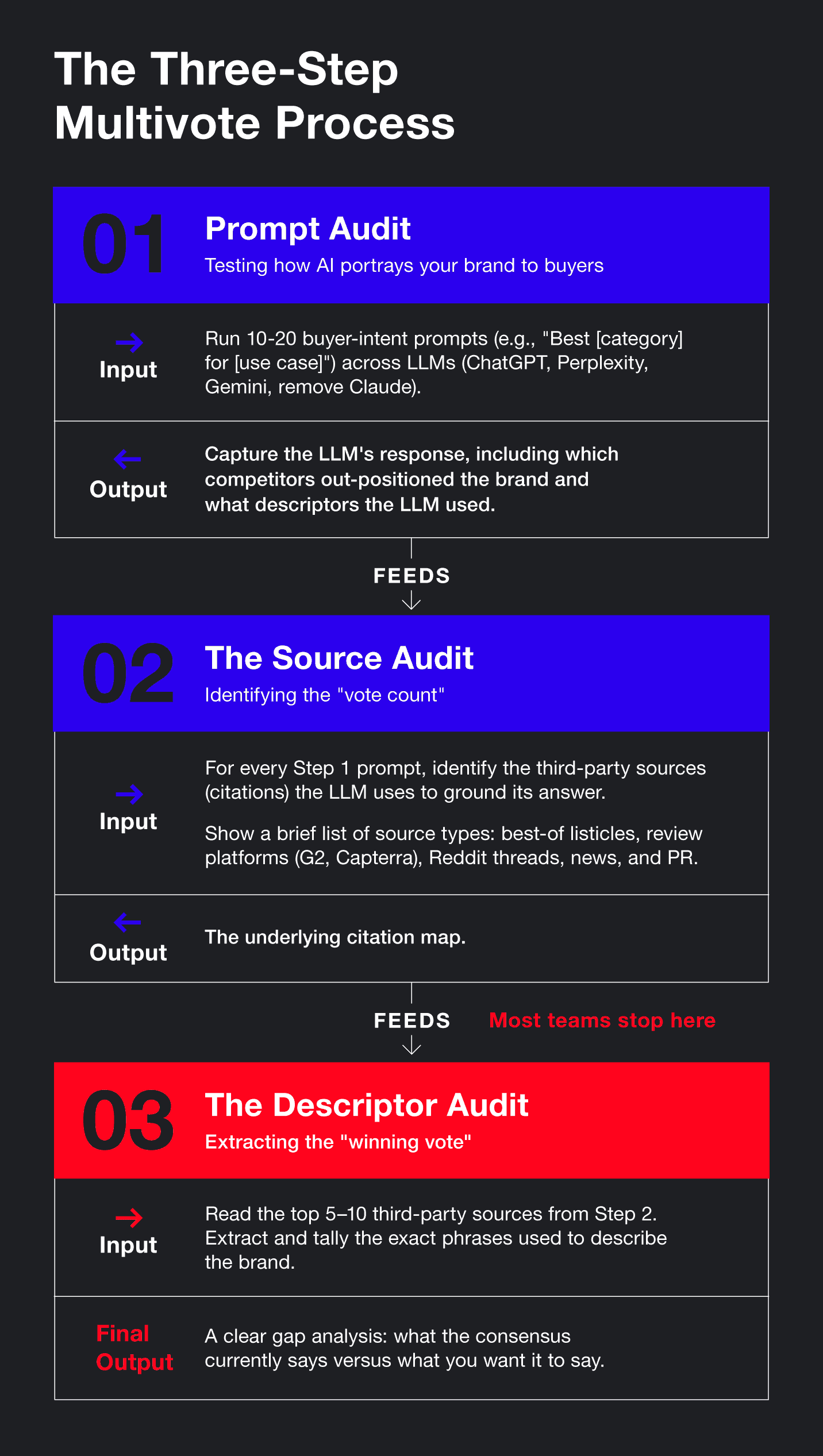
The Three-Step Multi-Vote Audit
Before you can change the consensus, you need to know what it is.
Don’t just stick to AI Overviews; look at the third-party citations that drive them and the descriptor language behind those sources. Each of these steps details an AI brand visibility audit:
1. The Prompt Audit
Run 10-20 buyer-intent prompts across ChatGPT, Perplexity, and Gemini to gather your brand mentions in each LLM. Capture each response verbatim. Here are some examples of what you can search:
- Best [category] for [use case]
- [competitor] vs [you]
- [you] alternatives
- [competitor] alternatives
- What is [you]
Adjust [category] based on the queries you’d like to win if you choose. For each response, capture these four things:
- Did you appear?
- How were you described?
- Which competitors positioned better than you?
- What descriptors did the LLM use?
In our case, we looked at three prompts focused on content marketing, generative engine optimization (GEO), and SaaS content marketing. These three cover where we currently work (content marketing and SaaS), and where we’re seeking more recognition (GEO).
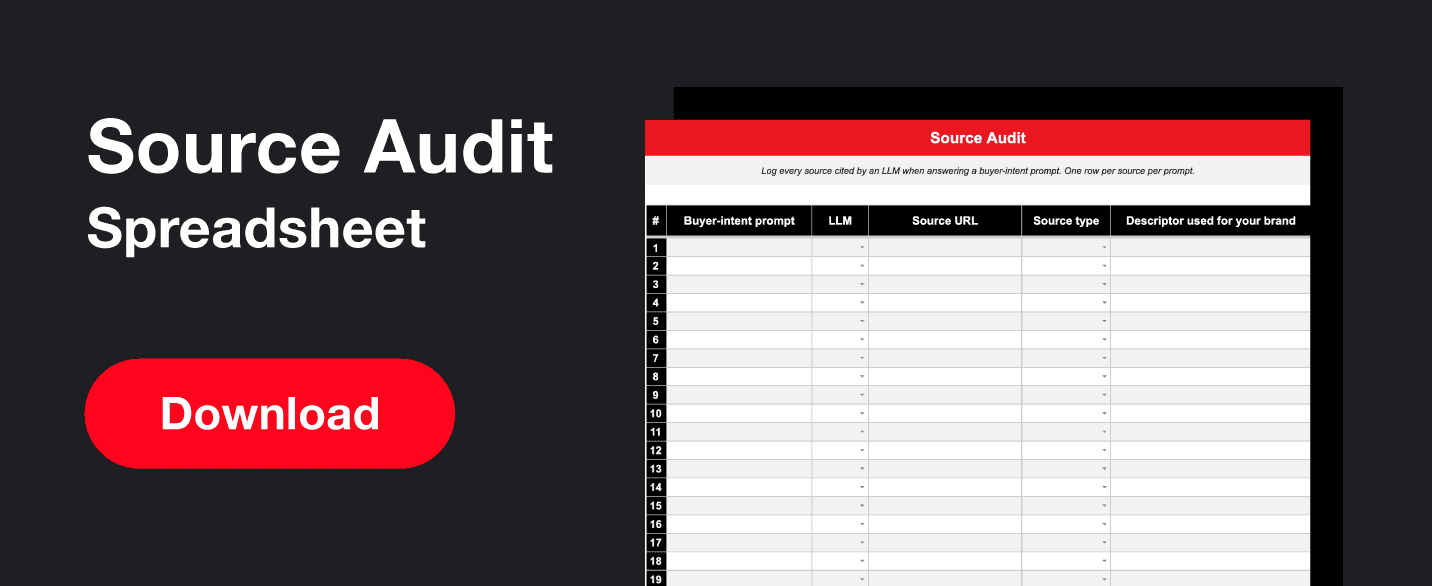
Here’s our Source Audit Tracker + how to use it:
- Run 10–20 buyer-intent prompts across the five LLMs above. Capture each response.
- For every source cited, add a row in the Source Audit tab. Log the prompt, the LLM that cited it, the source URL, and the source type (use the dropdown).
- Move to the Dashboard tab to see vote tallies by source type and by individual domain — those are the sources currently casting votes on your brand.
- The source types that dominate your tally are the channels worth prioritizing in the influence campaign that follows.
2. The Source Audit
Every third-party source found on the AI Overviews and through LLMs is your vote count. These votes may not always point in the direction you want, but they’re still votes placing you in some category.
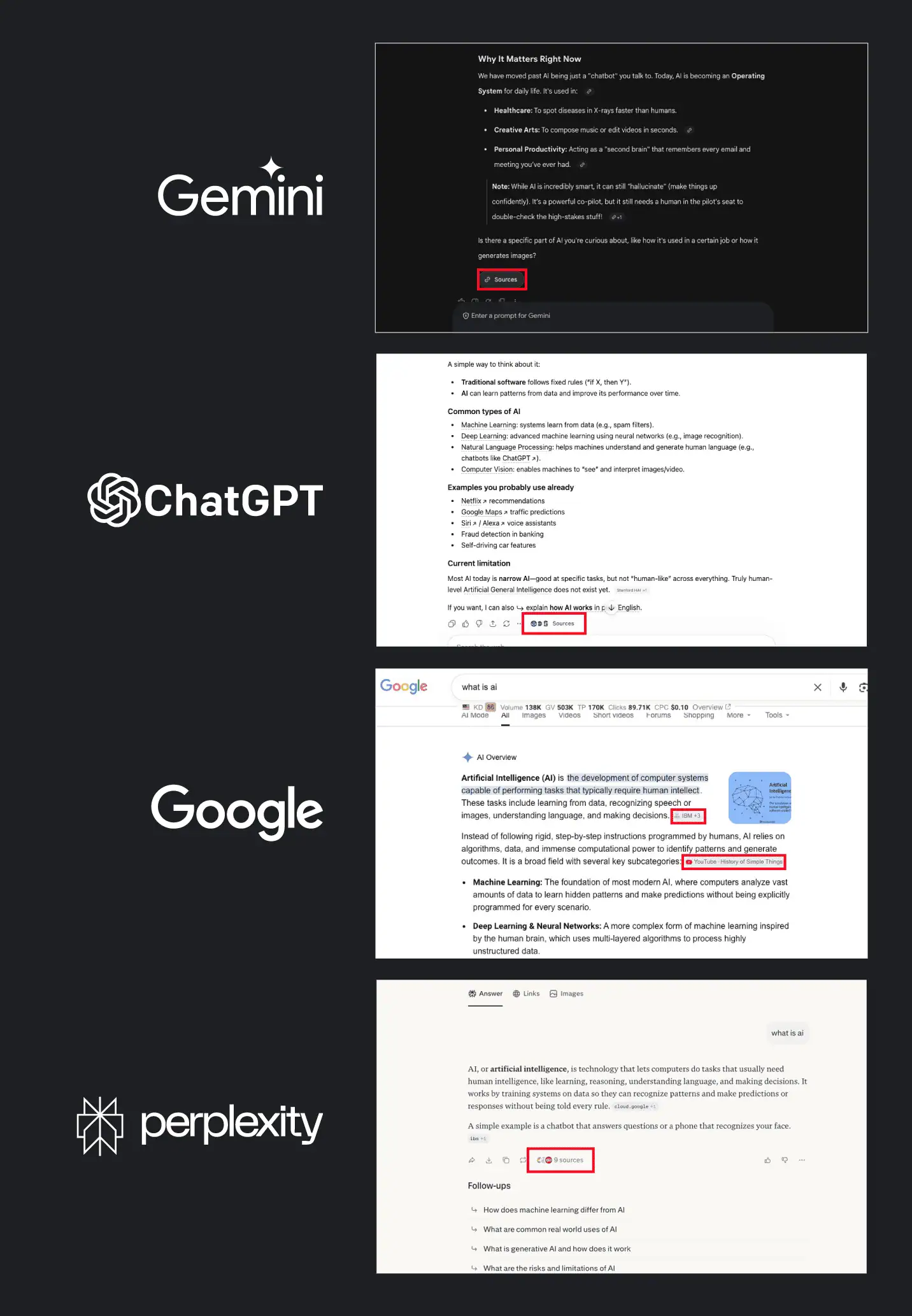
Each platform cites data in different ways:
- ChatGPT: Select “web search” from the plus menu and you’ll find it at the bottom of the generation
- Perplexity: At the bottom after clicking the “sources” button
- Google AI Overviews: To the right of the overview
- Gemini: Sometimes found through inline citations and other times found at the bottom through a “sources” button
But you’ll still need to sort through them to find the sites placing you in that category.
Categorize the sources into different groups: best-of listicles, review platforms, Reddit threads, news and PR, affiliate roundups, and category-defining publishers. We went through the process ourselves with this free spreadsheet to show you how it works.
The majority of our sources come from best-of listicles, with a few coming from our blog. For instance, our best SaaS content marketing agency article highlights how we deliver premium SaaS content for companies such as QuickBooks, Zapier, and Zoom.
Other blogs’ features highlight our work in content marketing and underscore the importance of BOFU content in shaping AI consensus.
3. The Descriptor Audit
Read the top 5-10 third-party sources for each prompt and extract the exact phrases used to describe you. Tally them. The phrase that repeats the most is your current winning vote, whether you want it to be or not.
The output should be a clear gap analysis that covers:
- What the consensus currently says
- What you want it to say
- Which sources need to change
This drives what you need to do next through your GEO and digital PR campaigns.
Measuring the Vote Count
Most organizations measure AI mentions when the right metric is descriptive consistency. Mentions is a vanity metric that’s no different from impression count. It tells you that you exist in the SERP, not that you’re winning the buyer’s journey.
If AI sources discuss your brand in the same way most of the time, you’ve won the prompt. If the LLMs mention you in several different ways across a few sources, you need to make a change by reaching out to request it, building a related service page, and creating BOFU articles ready for your desired position.
For instance, Zapier has anchored its editorial program around a narrow set of descriptors for years: automation, workflows, integrations, and operational efficiency. That sustained discipline produced a $7.2 million increase in traffic and 290% lift in monthly organic traffic.
Tight descriptor consensus compounds traffic value across every channel, not just LLMs.
“The action item here is to both be humble on controlled assets, and also to update your other ‘friendly’ listings in the preferred framing.
Almost certainly, this will ramp up how often you’re mentioned across AI Overviews, Gemini, ChatGPT, and everywhere else that matters to your company.”
Ross Hudgens
Founder/CEO, Siege Media
Benchmarks for Controlling LLMs
A good starting benchmark is a target share of voice of 55-80% across the top 10 sources for a given prompt. Here’s what our findings show:
| Visibility Assessment | Visibility | Sentiment | Position |
|---|---|---|---|
| Great | 75–80% | 70–75 | 1–2 |
| Good | 55–75% | 65–70 | 2–3 |
| Okay | 40–55% | 55–60 | 3–4 |
| Needs Improvement | 25–40% | 50–55 | 4–5 |
| New Business / Product Lines or Underperforming | 0–25% | <50 | >5 |
Tools like Profound, Peec AI, and Otterly give you some visibility into how AI behaves.
If you don’t want to invest in tools yet, you can get started by grabbing a descriptor, writing down the results in a spreadsheet, and tracking GEO changes each month until you see measurable results. Otherwise, you can outsource this work to a GEO agency like Siege Media.
Improve Your LLM Brand Perception With Siege Media
AI search has flipped brand positioning inside-out. As LLMs continue to consolidate buyer discovery, descriptor consensus becomes the new ranking—and the gap between brands that ignore this versus those who take it seriously will only widen further.
Siege’s GEO services help brands move from passive coverage to engineered consensus — across listicles, reviews, and earned media.
We run the three-step audit, define the descriptor worth owning, and execute campaigns that shift the conversation in your favor. With Siege Media, you can close the gap that shows you appearing without controlling how you’re described.
Reach out today to learn how we can help you shape your brand perception on LLMs.
Frequently Asked Questions
How Long Does It Take To Change How LLMs Describe My Brand?
It takes about 60 to 90 days to shift the descriptor’s share of voice across earned media and reviews. Listicles and affiliate roundups reindex more slowly, so those lag by another 30 to 60 days. If your descriptor is showing up in prompts within the first 30 days, the campaign is working even if the broader share-of-voice number hasn’t moved yet.
What’s the Difference Between AI Brand Visibility and Traditional SEO?
Search Engine Optimization (SEO) and AI brand visibility differ in where they focus: search engines versus AI. The two follow similar processes to gain exposure and spread your awareness. However, SEO involves technical on-site changes, while LLM brand visibility focuses more on what you do off your site.
How Can I Get LLMs To Mention Me at the Top of Their Lists?
You can get LLMs to mention you at the top of their lists by creating a clear brand consensus across multiple sources. That way, when someone searches “best X for Y,” they’ll be more likely to find your business. General superlatives, like “best overall,” are far less helpful in this context.