
SEO title tags are critical HTML elements that signal a web page’s title. Search engines like Google use this information to aid their algorithms, allowing them to understand a page’s topic and relevance.
Despite new AI-driven features in search results driving down click through rates, title tags remain the clickable headlines that draw users to your site. If nothing else, it may help drive brand awareness and eventual visits to your homepage.
By using the right keywords, marketers can optimize their pages, increasing their chance of ranking higher within the search engine results page (SERP).
But here’s a question: What are the most popular keywords on the web? In other words, what keywords used within title tags appear most often in the SERP?
We analyzed a thousand of the highest volume keywords, nearly 7,000 SERP titles, and over 30,000 individual words to determine what inclusions might give your SEO title an edge.
- 8 Top Words in High-Ranking Title Tags
- Uncovering Common Title Tag Words
- Tips for Writing SEO Title Tags
- Frequently Asked Questions
8 Top Words in High-Ranking Title Tags
We’ll discuss our research methodology shortly, but first, let’s examine the keywords that appear most frequently in high-ranking title tags. For each keyword we discovered, we’ll explain why the keyword may be performing well and provide some real optimized SEO SERP titles we found. Plus, we’ll explore how you can use the keywords within your titles.
We must note that we removed common English prepositions and other language features from our results, so you won’t see “the” or “a” appear in our list of most common words. Additionally, we have removed any erroneous words and adult-themed content from our list.
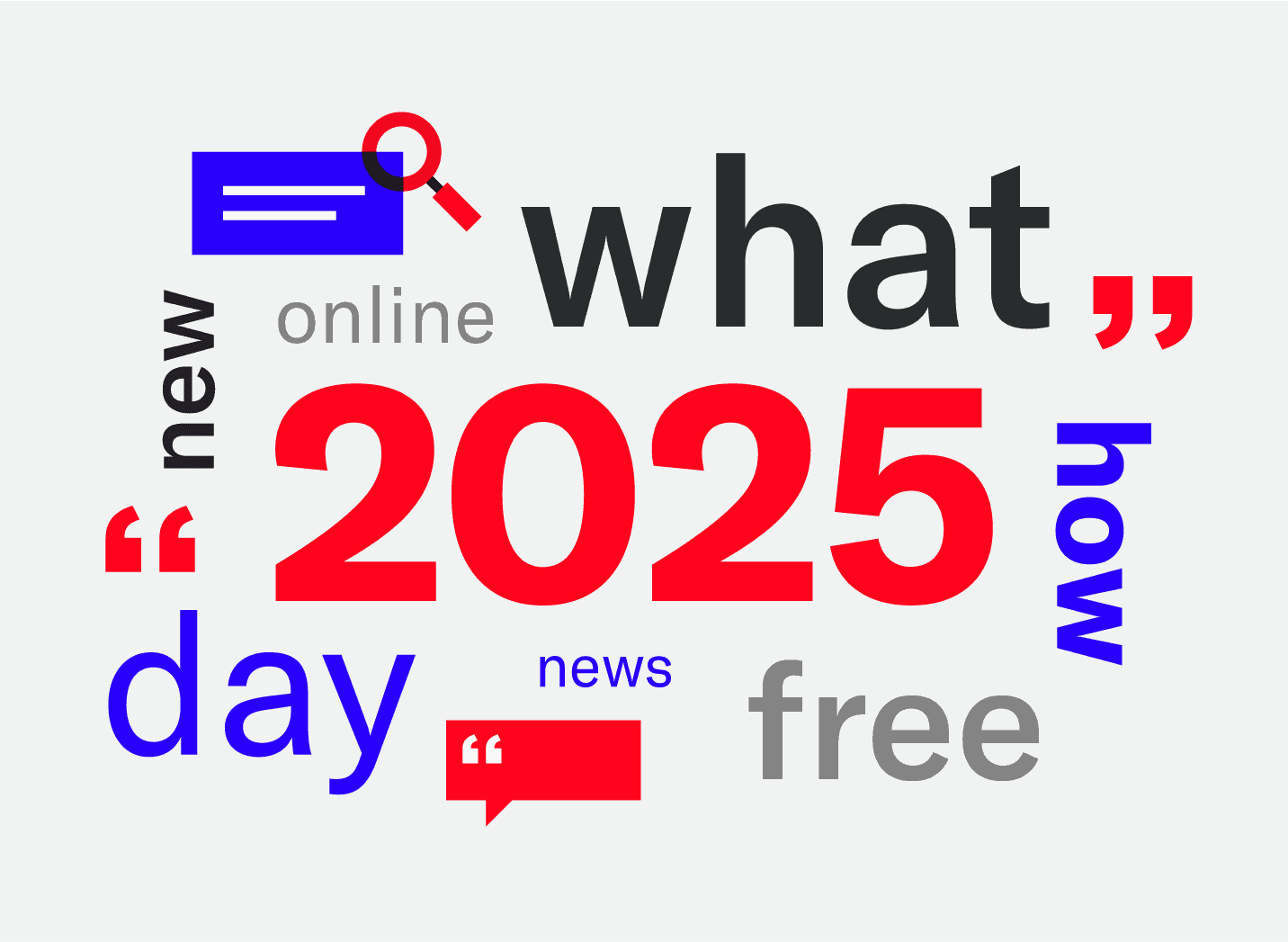
1. 2025
The most popular keyword found within ranking titles is the current year; that’s right, not a word, but a number. Using a year within your SEO title tag is a powerful way to signal to Google and users that your content is up-to-date and relevant.
In fact, page-one content is typically refreshed within the past two years on average, so demonstrating recency in your title can make a big difference.
While not all keywords result in pages of titles with years, they have a widespread presence in ranking content.
If your content is time-sensitive or regularly updated, consider including the current year when creating title tags. Including the year is a popular addition to listicle-type posts where users search for fresh information and rankings. Importantly, revisit existing content with previous years in the title, updating them as necessary.
Title tag examples:
- How To Apply For Indeed Jobs In Mobile (2025)
- NFL Scores And Schedule 2024-2025 – Where To Watch
- Best plagiarism checker of 2025
2. What
Out of context, the second highest ranking keyword, “what,” doesn’t give us much information. We uncover more when we understand that this word is generally paired with another word, making the phrase “what is?” Unsurprisingly, many users turn to search engines to answer questions, putting this phrase of curiosity at the top of the list.
When creating content that answers a question, including the phrase “what is” in your title can be helpful. For example, if your team is writing an article explaining a content marketing concept, such as “SERP,” the title tag “What is SERP?” might have a better chance at ranking than something without the phrase, like “Explaining the SERP.”
Additionally, consider adding a brief FAQ section (using FAQPage schema) on pages like these to address related questions – this can improve your chances of appearing in People Also Ask boxes and other rich results.
Title tag examples:
- What is the Chinese Lunar New Year? Everything to know
- What is the appeal of Taylor Swift?
- What is X? The new Twitter explained
3. Day
Another keyword highlighting the importance of relevancy, “day” is a common word found within high-ranking title tags. We found the word “day” occurring alone and within other words, such as “today.” Most SERP titles using the keyword were related to news, weather, or search query information about a holiday.
If you are an organization serving hyper-time-relevant news, “today” could be a powerful indicator of freshness for Google’s algorithm. Due to a high volume of searches focused on information about holidays, these can be compelling traffic topics to focus on during their appropriate times of year.
Title tag examples:
- Strong thunderstorms roll through Houston today
- When and why do we celebrate Mother’s Day?
- Best Meme Coins to Buy Today
4. Free
Who doesn’t want something free? Searching for the word “free” in this economy seems par for the course. Our research found that the keyword “free” is one of the top words used within title tags, adding it to everything from “free templates” to “free download.” If you’re offering a free item with your content, mentioning it in your title tag is worth noting.
This research shows that if your article isn’t offering a freebie, you should consider adding it for additional traffic. For example, if you’re writing an article about the top ways to run a work meeting, adding free downloadable templates or meeting workflows could be a powerful traffic driver.
“Free” offers are click magnets – just ensure your free resource is truly valuable to keep visitors engaged once they arrive.
Title tag examples:
- MLA Format | Complete Guidelines & Free Template
- Today’s best iOS app deals and freebies
- Pirate Ship: Free UPS and USPS shipping software
5. How
We found another keyword of curiosity: the word “how” frequently appeared in our research. It is likely no surprise that it was commonly paired with “is” and “to,” making the complete keywords “how is” and “how to.” People want answers, and just as it was with the phrase “what is,” including the entire question in your meta title can be a powerful tool for traffic generation.
If creating content that answers a question, include the phrase “how is” when applicable. Getting inside the head of the average user and delivering a SERP title that mirrors their search exactly will help generate higher-ranking content.
Better yet, if your content is a step-by-step tutorial, implement HowTo structured data along with a “How to” title – Google may reward you with rich, step-by-step snippets in the SERP.
Title tag examples:
- How to use Live Translate | Samsung Galaxy S25 Series
- What is a horoscope, and how is it used in astrology?
- What Does “Mah Jong” Mean? And How Is It Played?
6. New
When we saw the keyword “new” pop up in our research, we first assumed it was being pulled from the word “news,” but that’s not the case. Users want to find the latest information, so they use the word “new” to do so. We found the word within many news meta titles positioned to introduce new data or information, enticing readers to click.
If your content revolves around introducing new information or a new way of doing something, you might want to include “new” in the title. Again, ‘new’ is a firm way to indicate fresh ideas, suggesting that you have information users may have never seen before.
“New” also conveys novelty and triggers curiosity – users often click to find out what’s changed or recently discovered.
Title tag examples:
- New aerial footage reveals progress of Baltimore bridge
- 5 ways to use the new Find My Device on Android
- ‘Court of Gold’: See trailer for new Netflix docuseries
7. Online
The keyword “online” commonly appears within high-ranking meta titles. We found users performing searches related to resources, such as an online calculator, software, or service. This keyword highlights the importance of keyword research, where knowing that adding a simple word might help your content stand out.
If you provide an online tool or service, including the word ‘online’ within your meta title may give you an advantage with Google’s algorithm. For example, “Free translation tool” might have a better chance of being written as “Free online translation tool,” but ultimately, your research is the best decision.
Title tag examples:
- Online GIF Compressor – Compress GIFs
- Allara Health: Online PCOS and Women’s Hormonal Healthcare
- Scrabble Word Finder – Online Scrabble Solver and Cheat Site
8. News
We knew it was coming, and here it is — “news!” We want to make a careful callout here to separate it from our other top option, “new.” In this instance, “news” is used as a keyword when users search for the latest information. It may be an obvious callout, but including the word “news” in your title is a powerful indicator to the SERP that you are serving up news.
Many results indicated that the news organization’s name appeared within the meta title, such as “CBS News” or “ABC News.” However, it also highlighted users searching for a general topic such as “college football news.” If you’re a news organization, including your brand name with the word “news” or housing pages with general news topic sections could give you a leg up on the competition.
Even if your site isn’t a traditional news outlet, dedicating a section of your blog to “News” (and using that word in titles) can help capture searchers looking for current updates.
Title tag examples:
- Entertainment News for Pop Culture Fans
- NCAA Football – College Football News, Scores, Stats
- GameSpot: Video Games Reviews & News
Uncovering Common Title Tag Words
Discovering a method to uncover the most common title tag keywords was an adventure. Siege Media CEO and founder Ross Hudgens first performed this experiment ten years ago, and we’re excited to have retweaked it and performed it today. This time, we called on Ahrefs and the power of Python scripting to get the job done.
Here was our process to find the most common tile tag keywords:
Retrieving the Top Searched Keywords
First, we used the Ahrefs website to obtain a list of the top 1,000 most popular keywords in the United States. The last time we performed this experiment, we used the top keywords by cost per click (CPC), but we found that using volume this time gave us the most diverse list. We excluded any branded searches, such as users simply looking for “Facebook” or “Amazon.”
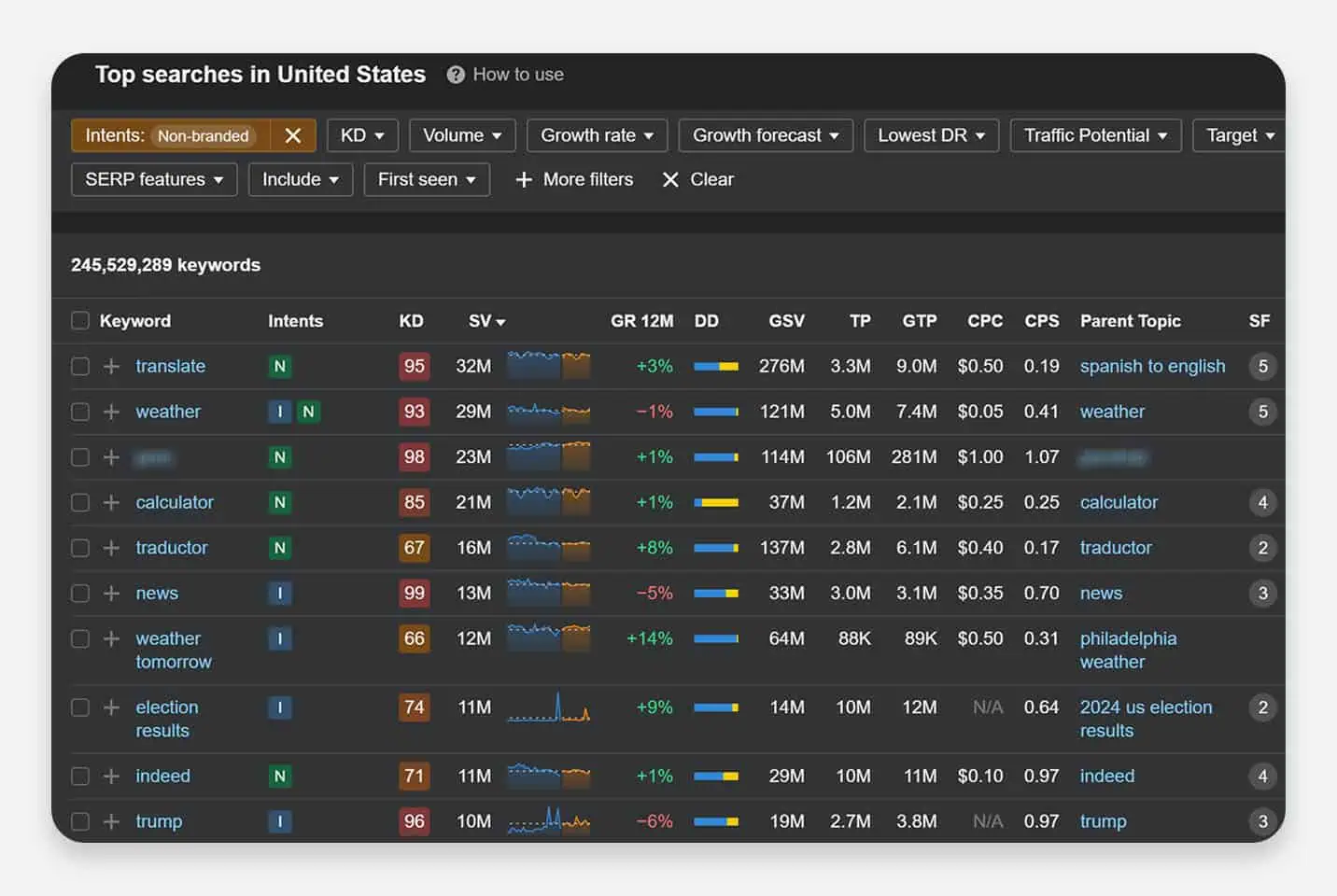
To obtain this information, we visited Ahref’s Keyword Explorer and performed a search with the query box blank. We sorted by search volume using the provided filters, using the intents option to show only “nonbranded listings.” We then exported this information to a CSV file for Microsoft Excel for further analysis.
Obtaining Title Tags for Top Keywords
Once we had obtained an Excel workbook of the top searched keywords from Ahrefs, it was time to grab the top title tags for each. Performing this research manually would have been a chore and taken too much time, so we used Ahref’s API and wrote a Python script to complete the job.
Our script read every keyword from the Excel file and fetched the top title tags for each. Once complete, the script wrote every discovered title tag back to the Excel workbook. The result was a list of over 6,600 of some of the top-performing title tags on the web. Next up, we analyzed the data for word frequency.
Sorting Through the Title Tags for Repetition
Our team argued between two options: laying out beans on a table to count each time a word appeared within a title tag or crafting another Python script. We opted for the latter. The script analyzed our list of meta titles, noting each word’s occurrence and frequency. The result was also a massive list of data, but we had more work to do.
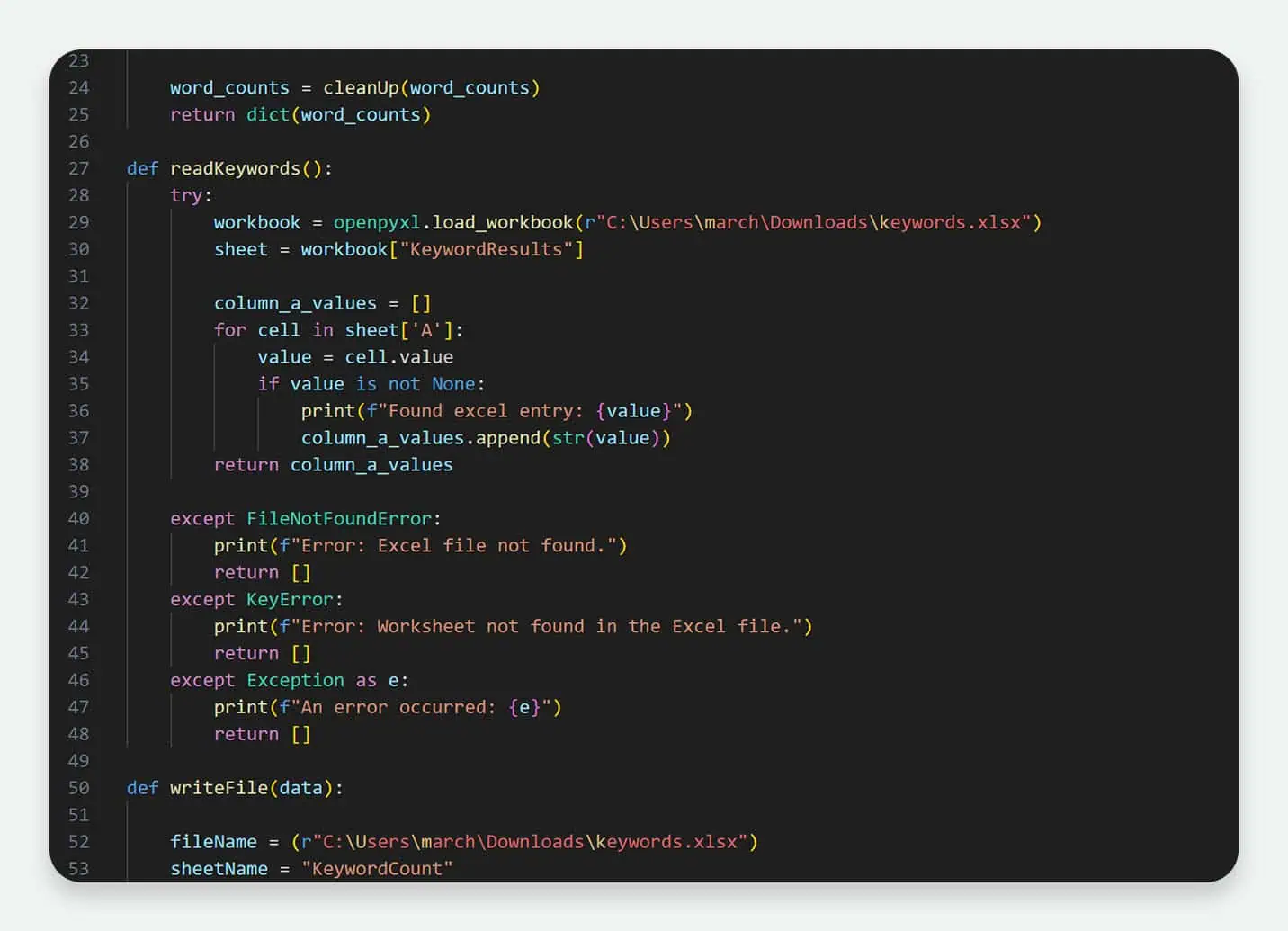
The English language has fancy grammatical elements, such as prepositions and connecting verbs, that we didn’t care to include. It’s not very interesting or informative to know the word “the” or “a” was used the most. So, our script removed these entries from our list, giving us a final count of over 30,000 words (that would have been a lot of bean counting).
Delivering the Results of Our Online Study
Once we had sorted entries, we could pull out the most commonly used words in title tags. While our list did include time-relevant results that may change throughout the year, such as the term “election,” none of these options made it into our top eight list.
And that’s it — we had a list of the most frequently used words. All that was left was to dive into the results and create this article with additional insights to help you create content that ranks.
Tips for Writing SEO Title Tags
Writing high-performing title tags can be challenging, but it is possible with a few tips and information from our research. We’ll walk through a few essential tips for creators crafting and hoping to appease the Google algorithm. Here are five tips to consider when writing SEO title tags:
| 5 Tips for Writing Title Tags |
|---|
| 1. Use high-ranking keywords from our study |
| 2. Limit the length of your title to 60 characters |
| 3. Make sure your title contains relevant words |
| 4. Ensure your title reflects the SERP intent |
| 5. Create human-friendly SEO title tags |
1. Utilize High-Ranking Words
We didn’t just perform our research for fun, even though we are all content marketing geeks who may have enjoyed it. We set out to discover the top SEO title tags to understand what Google and its users might want to see from web pages. By seeing what Google ranks higher, we can better understand what types of title tags rank the best.
And it’s worth aiming high – the top three search results capture about 54.4% of all clicks, so using proven high-ranking words could give you a competitive edge.
Our research identified eight keywords commonly used within high-ranking search results, sharing how you may be able to use them for your benefit.
Here’s a recap of what we learned:
- 2025: The current year is commonly used to express freshness and current relevancy within an article.
- What: Include the keyword in your title when addressing a “what is” question to help match a user’s thoughts.
- Day: If you’re talking about something hyper-time-relevant, including the phrase “today” could help.
- Free: Users want free things, such as templates; including and mentioning these could help boost your ranking.
- How: Similar to “what,” use “how” within a keyword when addressing a “how does” or “how is” type question.
- New: Have new information to share? Use “new” in your title to let your audience know they may have never seen it.
- Online: Sharing a web browser-based tool or service may be heightened by including the word “online.”
- News: If you have news to share, don’t be afraid to say it or include your news organization’s name in the title.
2. Keep Your Title Length to 60 Characters
Search engines like Google limit the number of characters displayed in the SERP. To avoid having your title truncated, keep it under 60 characters. However, don’t go too short; provide Google with as much information as possible about what your web page offers within its title tag.
Google also tends to rewrite title tags it deems too long or off-base, so staying concise (around 50–60 characters) helps preserve your intended title in the SERP.
Don’t Do This: “The 10 Top Software Development Solutions for Teams Who Need Management Help”(76 characters)
Do This: “10 Top Software Development Solutions for Better Management”(59 characters)
3. Include Relevant Keywords In Your Titles
How will Google, or users, know what your webpage is about if you don’t include relevant keywords in your title? When writing your title tags (and your descriptions), include keywords relevant to your topic, including those we highlighted in our research above.
Don’t Do This: “Latest Candy That Is Great if Sugar Is a No-Go”
Do This: “The Best New Sugar-Free Candy for Adults and Kids“
4. Ensure Your Title Matches The SERP Intent
Every SERP has a search intent; while some keywords may produce search results centered around informational answers, others will produce shopping links. Understanding what Google looks for will help you better align your titles with the SERP. For example, with a SERP that is information-focused, you may consider these options:
Don’t Do This: “Online Sale: The Latest Gaming Laptop for Kids” (Best for a transactional SERP)
Do This: “What Are the Best Gaming Laptops for Kids?” (Best for an informational SERP)
5. Write Your SEO Title Tags For Humans
We know that satisfying the Google algorithm is at the top of your list, but don’t forget your readers; especially in the age of AI-assisted writing.
When writing titles, leaning too deeply into the algorithm can quickly appear spam or unauthentic. Would you click on the link if it appeared in your SERP?
77.9% of content marketers trust ChatGPT as a writing tool, but any AI-generated title ideas should be vetted and edited to ensure they sound genuine and compelling to readers.
Don’t Do This: “100 Best Free Business Templates, Download Today!”
Do This: “100 Free Business Template Downloads To Increase Productivity”
Optimize Your Title Tags And Google SERP Rankings With Siege Media
Optimizing your title tags is essential to ranking and delivering expectations to Google’s algorithm and users. Our research has spotlighted a handful of words that you should consider when crafting content. We can’t guarantee that they will get your content ranking, but they make for a strong starting point.
If you’re struggling to get your content ranking, contact our team here at Siege Media. With a detailed approach, we offer everything from content strategy to content creation. With 66.5% of content marketers unsure where to allocate resources, partnering with experts can ensure your efforts drive results. Discover the possibilities your site holds and reach out today.
Frequently Asked Questions
At Siege Media, we have years of content marketing experience and account for over $12 million per month in client traffic value. If you have questions, our experts are ready to answer them.
Why Are Title Tags Important?
Title tags are essential as they signal your webpage’s intent to a search engine like Google. Optimizing your title tag helps search engines and their users better understand your offerings.
As a result, your page may be able to rank higher for its focus keyword. This idea is why our study focused on the top-performing keywords in SEO titles.
What Is The Ideal SEO Title Length?
The ideal length for an SEO title should be under 60 characters. Including a title tag longer than 60 characters can cause it to be truncated. Not only does this look visually inferior in SERP results, but it may also exclude critical keywords from results.
Where Should You Place Keywords in Title Tags?
We recommend placing your primary keywords at the beginning of your title tag to signify their importance; this will highlight their relevance to Google, help your rankings, and make it more likely for a user scanning through the SERP to locate them visually.