After auditing thousands of pages across Siege Media clients, one pattern is clear in 2026: the pages that worked last October aren’t the ones working now, and most teams still lack a system to decide what to fix, cut, or keep.
Content audits used to be straightforward. You’d pull traffic data, identify underperforming pages, and decide what to update or remove. But that approach needs to change.
AI-driven discovery is now shaping how users find and consume information, and not all traffic sources behave the same way. When we analyzed LLM engagement trends in more than 2.3 million LLM sessions, ChatGPT alone accounted for over 1.99 million sessions.
That shift matters because it reinforces a core issue most audits miss: visibility no longer guarantees meaningful traffic. A page can rank, be cited, or even appear in AI responses, and still lose actual engagement.
This guide walks through a modern content audit process — how to identify pages losing visibility, when to update vs. retire content, and how to rebuild pages for how search actually works today.
- Why Now Is the Right Time to Audit
- How To Audit Content in the AI Era
- What This Looks Like In Practice
Why Now Is the Right Time to Audit
Content performance isn’t what it used to be. AI Overviews, LLM-driven traffic shifts, and a steady run of Google updates have reshaped the search landscape in the last six months alone.
The content mix that drove traffic to your site in October isn’t the same one driving it today — which means the traffic you’re chasing this quarter doesn’t live where it used to.
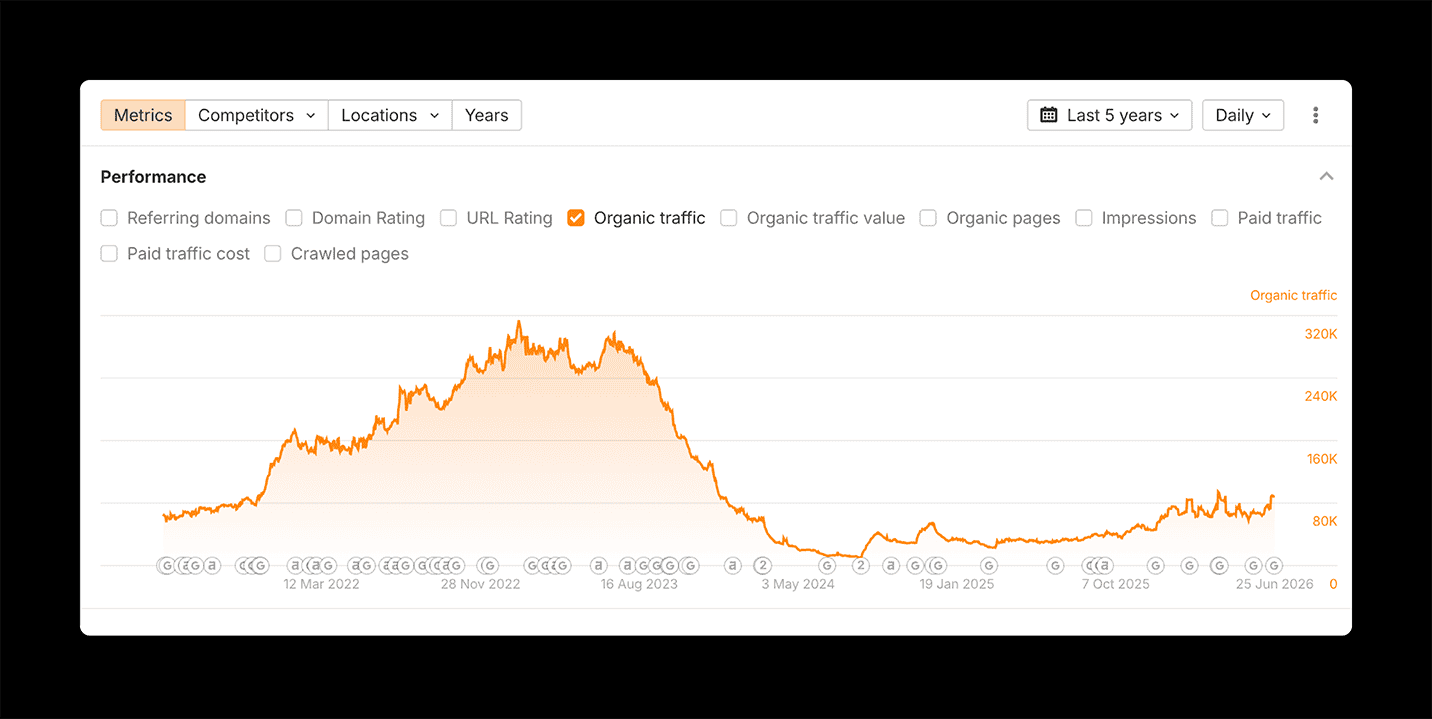
Take Retro Dodo, for example: a respected editorial site covering retro gaming. In January 2023, they were pulling roughly 474,000 monthly organic visits. By mid-2024, that number had collapsed to under 40,000 — a 92% drop in barely a year. They’ve partially recovered since, but they’re still about 75% off their peak.
Then CNET, one of the most established tech publishers on the internet. In November 2024, they were pulling roughly 13.5 million monthly U.S. organic visits. By June 2026, that had been cut to about 6 million — a 56% decline in 18 months.
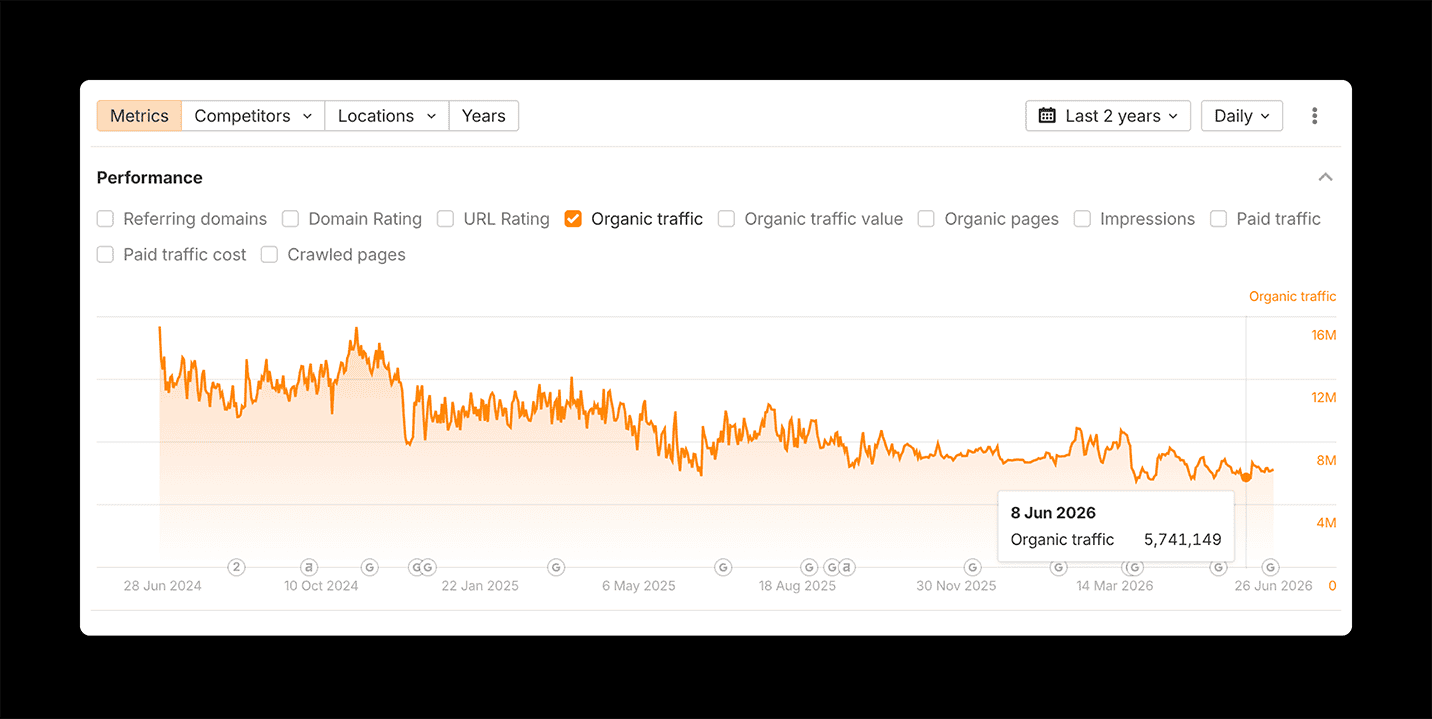
Neither decline was a content quality issue. Retro Dodo got caught by the September 2023 Helpful Content Update. CNET got caught by AI Overviews, which were replacing clicks with summaries. Different algorithms, same pattern: the rules shifted, and the existing archive didn’t survive the new criteria.
That’s the argument for a content audit. An editorial site and one of the largest tech publishers on the web both lost the majority of their organic traffic in under 18 months.
This wasn’t because their content got worse, but because the definition of “good” kept changing underneath them. Without a regular audit, the same shift will eventually catch your archive, too.
How To Audit Content in the AI Era
This audit process will show you how to spot underperforming pages, decide when to retire vs. update content, and identify when multiple pages are competing against each other or being diluted by AI-driven cannibalization.
1. Pull Your Inventory
The first step of any audit is honest accounting. You can’t decide what to rebuild or retire until you know exactly what’s in your archive, and almost every team underestimates how much they have.
For most audits, the cleanest place to start is Top Pages report in Ahrefs’ Site Explorer. It pulls every indexed page that ranks for at least one keyword, sorted by organic traffic.
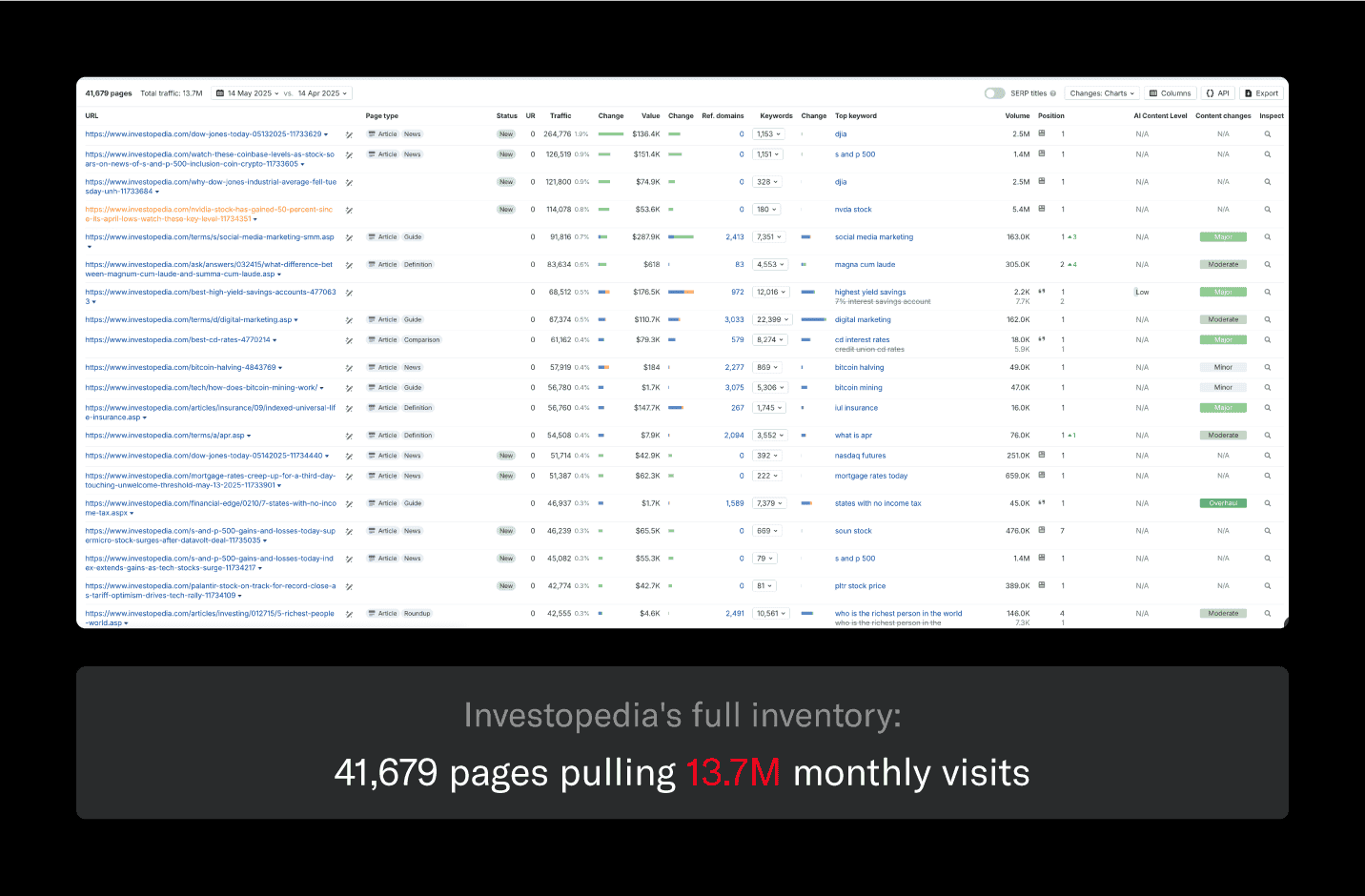
Set your timeframe to 12 months at minimum, or 24 months if you want to compare performance before and after AI Overviews rolled out broadly in May 2024.
Then go to:
- Top Pages
- Scroll toward the bottom
- Look for lower-performing content
That’s where the bloat lives.
Pro tip: Let AI handle the sorting. If you have the Ahrefs MCP connected to Claude, you can pull your Top Pages and categorize URLs by traffic trend, keyword count, and link profile in a single pass. Ask your preferred AI tool to flag:
- Bottom-tail bloat (pages with no traffic, no rankings)
- High-decay pages that are worth rebuilding
- High-link-equity candidates that shouldn’t be cut
2. Look for AI Overview Cannibalization
AI Overview cannibalization occurs when Google shows its AI-generated answer at the top of search results — and the user reads it instead of clicking through to your page. You still rank #1. You just don’t get the click anymore.
The pages most exposed to the above are those that explain a concept clearly and concisely. Common examples are pages focusing on definitions, “what is” articles, FAQs, and simple how-tos. The clearer your page is, the easier it is for AI to summarize you, and the less reason a user has to click.
Let’s look at an example from one of Investopedia’s low-performing pages.
Take Investopedia’s “What Is the Stock Market and How Does It Work?” page. On the surface, this page is winning across every traditional SEO measure:
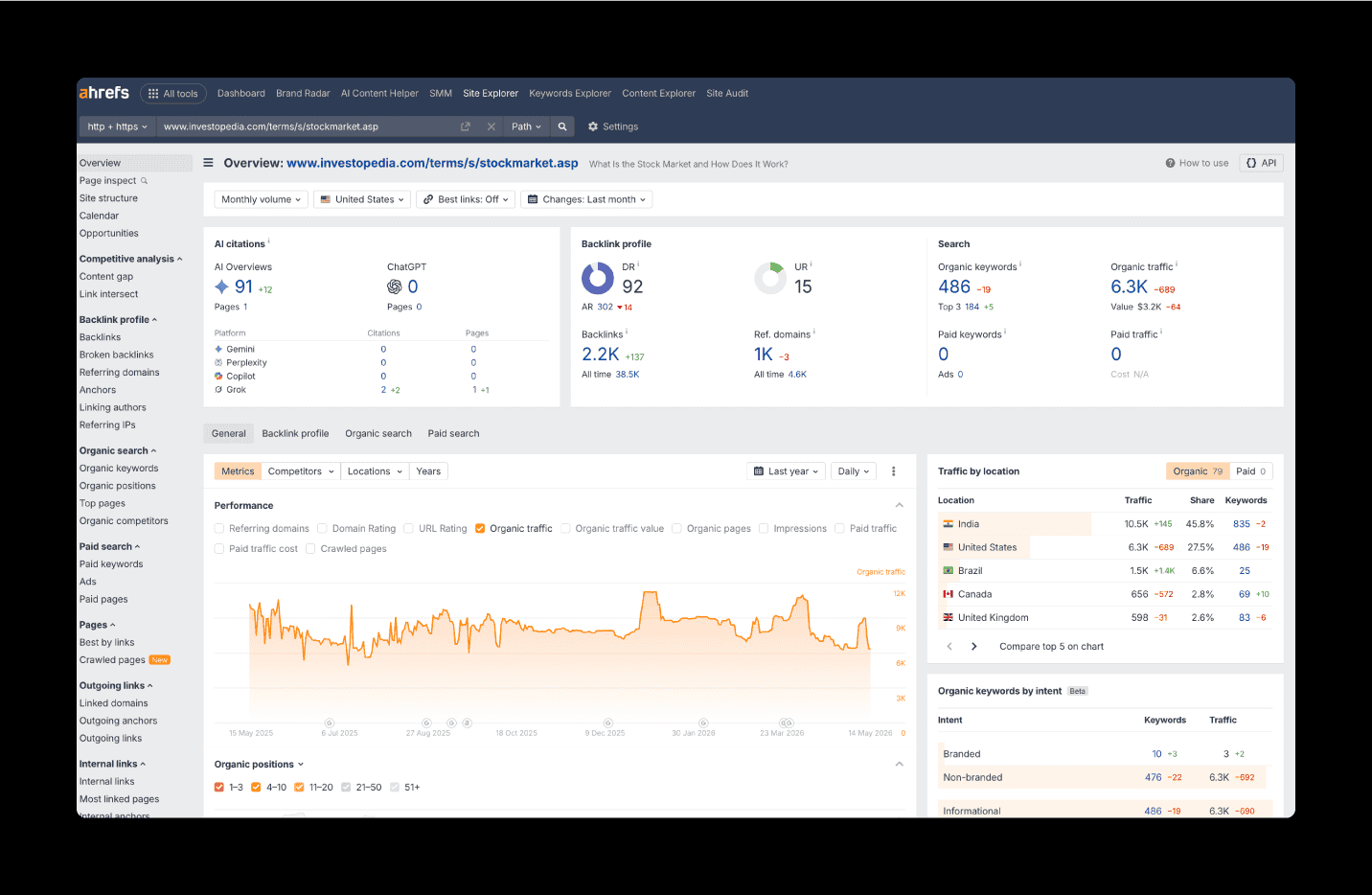
- AI Overview citations: 91 (+12 in the last month)
- Top 3 keyword rankings: 184 (+5)
- Backlinks: 2,200 (+137)
- Organic traffic: 6,300 (–689)
Rankings up. Citations up. Backlinks up. But organic traffic dropped by nearly 700 visits in a single month.
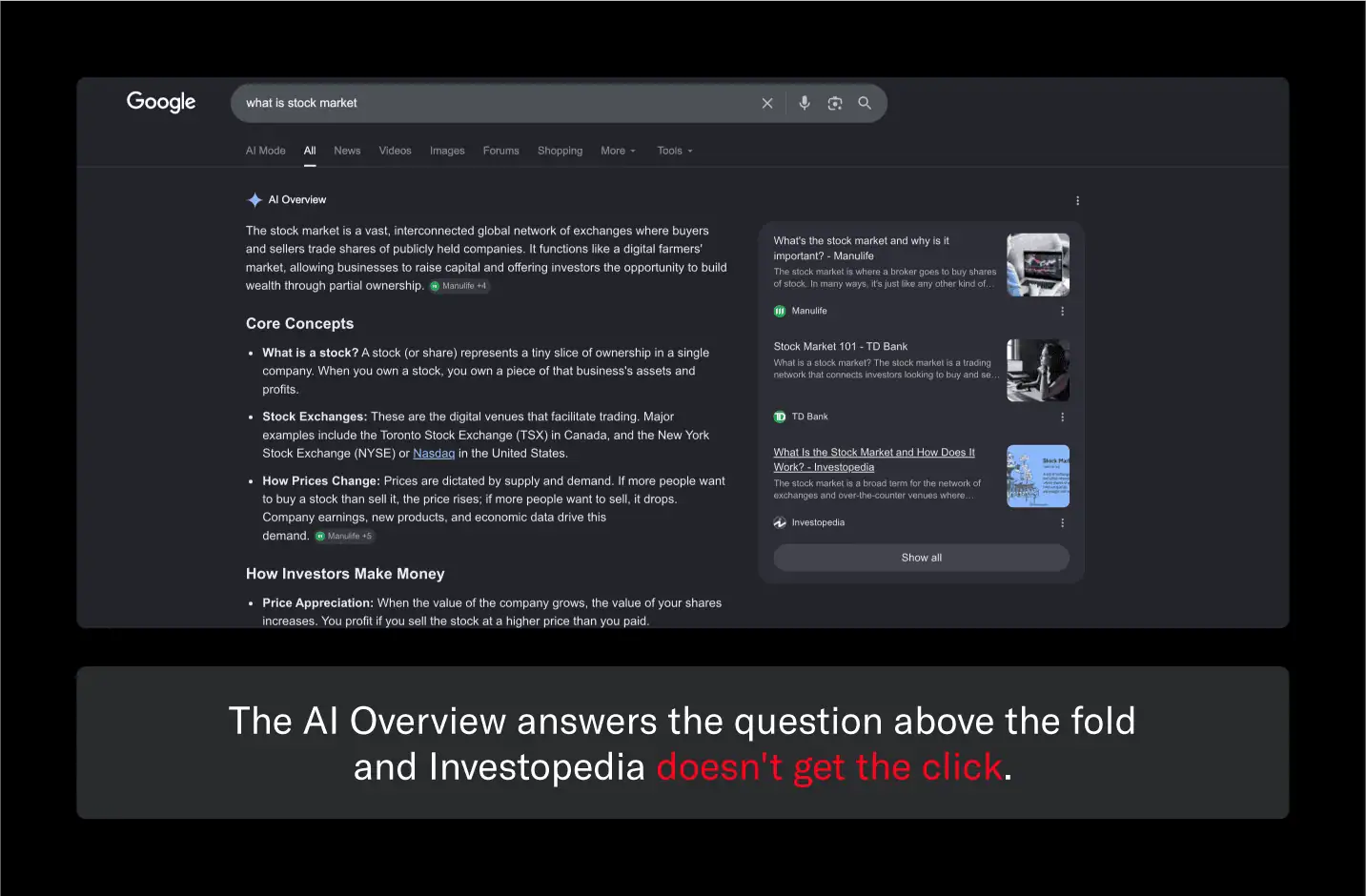
There’s only one explanation for that combination: the AI Overview is doing the work of the click. Google has decided that Investopedia is a trustworthy source on “what is the stock market” — trustworthy enough to cite this page in 91 AI Overviews.
But when Google pulls a few sentences from the page into the AI Overview, the user reads them, gets the answer, and never reaches Investopedia.com.
The citation looks like a win in the abstract. It isn’t. Citations don’t drive traffic. They don’t push users to related content. They don’t create the on-site engagement that turns visitors into subscribers, signups, or repeat readers. In a clicks economy, being cited is no longer the same as being read.
How to spot the same pattern on your own site:
Run your top pages report and flag any URL that hits all four of these:
- Ranks in the top 3 for at least one high-volume informational keyword
- Traffic is declining while position is holding steady or improving
- AI Overview citations are present and growing
- The query intent is “what is,” “how does,” “definition of,” or a simple comparison
AIO cannibalization is the most urgent pattern to spot in 2026, but it’s not the only one. To finish the audit, sort every URL in your inventory into one of three buckets:
- Performing: Earning traffic, links, and rankings consistent with its purpose. Optimize incrementally and leave the foundation alone.
- Rebuild: Has authority signals — links, rankings, historical traffic — but is decaying. Cannibalized pages live here. The next step walks through how to fix them.
- Retire: No traffic, no links, no rankings, no realistic path to recovery. Step 4 covers when and how to cut.
Pro tip: Let AI find the cannibalized pages for you. If you have the Google Search Console MCP connected to your preferred AI tool, ask it to flag every URL where impressions are flat or growing while clicks are declining and position is holding steady.
That combination is the signature of AIO cannibalization — the page is still being shown, still ranking, just losing the click. No manual SERP checks required.
3. Rebuild for the AIO Era
We flagged Investopedia’s stock market page in the previous step as a textbook example of AIO cannibalization. So what does rebuilding it actually look like?
The instinct is to “refresh” — tweak the intro, swap in new stats, update the publish date. That’s the trap. Incremental edits don’t change the underlying problem: the content is still summarizable, so the AI Overview keeps eating the click.
A real rebuild changes what the page is, not just what it says.
Pro tip: Let AI tell you which pages are worth saving. If you have the GA4 MCP connected to your AI tool, pull engagement signals for every URL flagged in Step 2:
- Scroll depth
- Average time on page
- Return visit rate
That data separates pages with an audience worth rebuilding from pages where users were already bouncing before the AI Overview ever showed up.
Here’s what we’d do with this URL:
- Add proprietary data Investopedia owns. They run a stock market simulator with millions of users — a goldmine of audience data AI can’t synthesize from public sources. Embedding original benchmarks and charts gives users a reason to scroll past whatever the AI Overview showed them.
- Add named expert quotes. Two or three credentialed experts (a CFP, a portfolio manager, an academic economist) with “reviewed by” markers raise E-E-A-T signals that Wikipedia-style explainers can’t match.
- Add interactive elements. A compound interest calculator. A risk tolerance quiz. A “what if you’d invested $1,000 in 2010” tool. AIOs can’t replicate these, and they create the on-page engagement this page is currently missing.
All your definitional content must be transformed into experiential content. Pages that simply explain a concept will keep losing CTR. Pages that demonstrate, calculate, and quote experts will hold their ground.
4. Identify When to Retire a Page
Not every page is a candidate for a rebuild. Some pages are simply done — tied to an event that’s over, targeting an audience that no longer exists, or written for a moment that’s passed.
Retirement is the most underused move in any audit, mostly because cutting content feels like undoing work. But the reality points the other way: a page that no longer earns traffic, links, or rankings is actively dragging on the pages that do.
Let’s look at one.
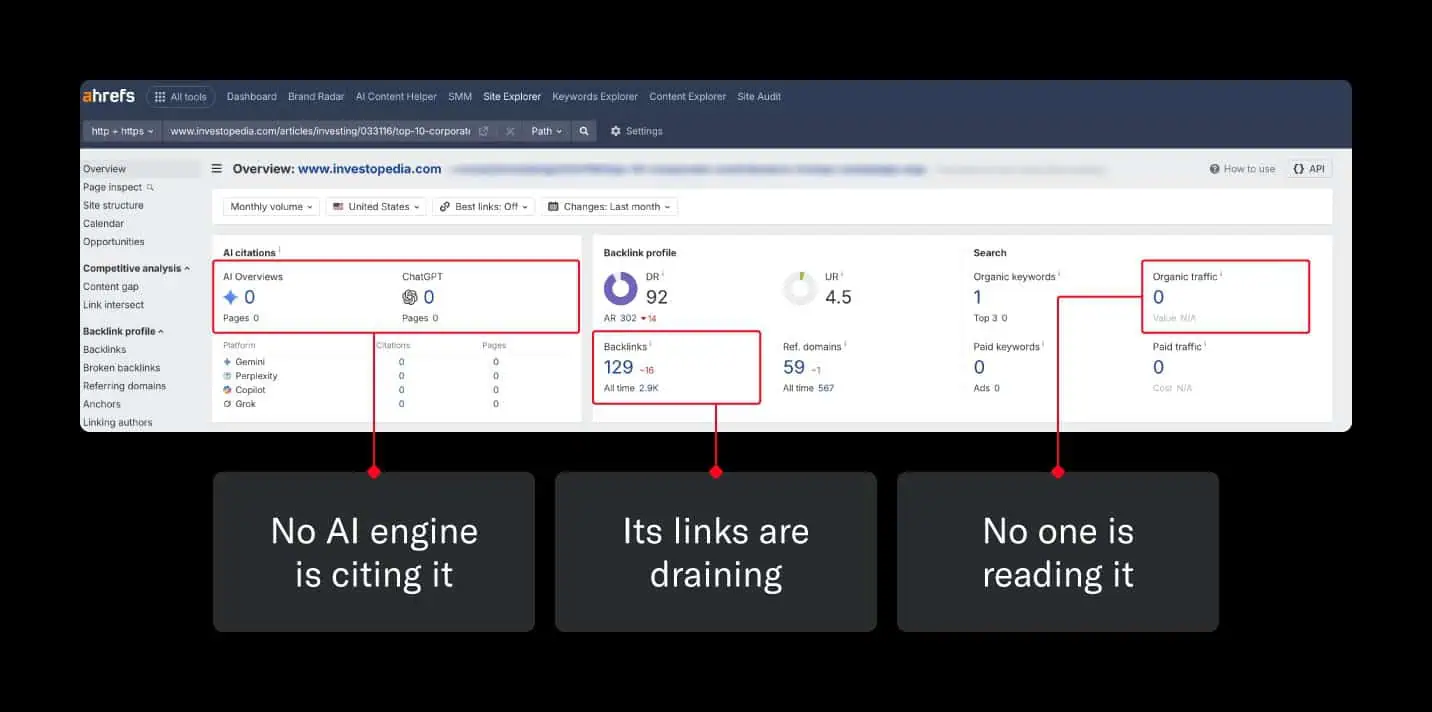
Here’s what the data is telling us, in plain terms.
- No one is reading it. Organic traffic is at 0 and has been for most of the past year. The page had a few small spikes through summer 2025, then dropped off and never came back.
- No AI engine is citing it. Zero citations across AI Overviews, ChatGPT, Perplexity, Gemini, Copilot, and Grok. That’s a clean sweep across every generative source. If even one of those engines saw this page as a credible source on its topic, it would show up. None of them do.
- Its links are draining. The page once accumulated 2,900 backlinks from 567 referring domains over its lifetime — solid numbers for any article. Today, it’s down to 129 backlinks from 59 domains, and it lost 16 backlinks in the last month alone.
When a page is losing links faster than it’s earning them, the rest of the web has already decided it isn’t worth pointing to anymore.
It ranks for exactly one keyword. Just one. And not in the top three.
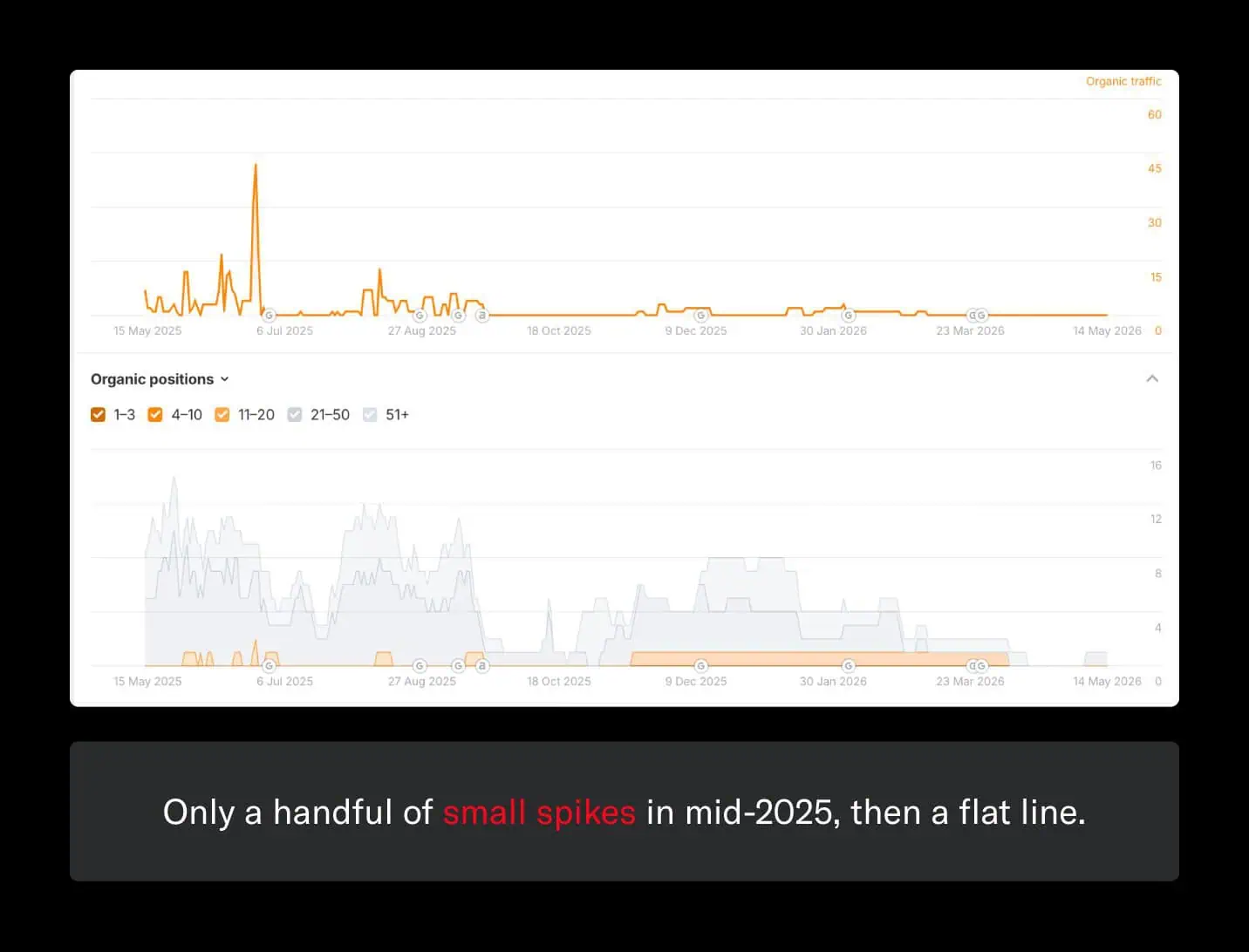
The traffic chart tells the story in one line. The position chart shows the same erosion: every ranking bucket emptied out by late 2025.
So why did this happen?
The article is about the top corporate donors to the Trump 2020 presidential campaign. It was originally published in 2016, kept alive through occasional updates, and tied to a moment that’s now five years behind us.
The 2020 election is over. The 2024 election is over. The audience for this specific list — at this specific level of analytical depth — evaporated the moment the news cycle moved on.
Pro tip: Automate the retirement queue. Build an AI workflow that connects Ahrefs, GSC, and GA4, and automatically resurfaces URLs that cross your retirement thresholds:
- Zero organic traffic for 180 days
- No AI citations across any generative engine
- Backlinks declining month over month for three or more consecutive months
- Engagement metrics below the site average
Run the same workflow monthly, and you’ll catch bloat the moment it crosses the line.
What This Looks Like in Practice
Rather than focusing solely on publishing net-new content, the strategy focused on auditing and refreshing what Purple already had.
We identified that Purple’s existing library held massive untapped potential. By focusing on Generative Engine Optimization (GEO), the strategy included:
- Content inventory and pruning: Identified content gaps and low-performing pages that were dragging down sitewide authority.
- High-impact revamps: Revitalized middle-funnel assets. For example, a “Full vs. Queen Mattress” post saw a 1,554% increase in traffic after being audited and updated to better align with current intent.
- UX for GEO: Implemented design recommendations to make the blog more digestible for both humans and Large Language Models (LLMs), ensuring the brand’s proprietary GelFlex Grid® technology was clearly cited.
- Full-funnel targeting: Balanced educational sleep health content with high-intent product comparisons to drive both awareness and conversions.
The audit-led approach proved that refining what you already have is the fastest path to growth. The partnership resulted in:
- 224% increase in monthly organic blog traffic.
- $557,000 increase in monthly traffic value.
- 11,700 citations in LLMs and AI Overviews, future-proofing the brand for 2026 search.
What To Do After the Audit
A content audit is useful, but it’s not the end goal. The real value comes from what it unlocks next. Once you understand what’s broken, underperforming, or missing, the harder question becomes how to turn that into a content system that actually drives growth in a search landscape that’s constantly shifting.
That challenge is only getting bigger in the era of GEO, where visibility isn’t just about ranking anymore but about becoming a trusted source that AI systems pull from and cite.
This is how Siege Media’s strategists run audits on client engagements in 2026. AI tools don’t replace human judgment. Every recommendation still passes through a GEO strategist who knows the brand, the audience, and the long-term plan. The AI tools just remove the need for manual data wrangling.
Siege Media brings this full system together, from content strategy to GEO that keeps brands competitive as the landscape evolves. Let’s talk!