More than 9 out of 10 marketers cite video marketing as a key part of their overall strategy. Leverage these video marketing statistics to boost your strategy — or you might get left behind.
Whether it’s an expert interview or a product explainer, video content is a versatile type of content marketing that can engage your audience and boost your ranking potential.
This roundup of video marketing statistics covers everything from the latest usage patterns and ROI metrics to platform-specific strategies, the rise of AI in video creation, and effective approaches for B2B.
Get ready to unlock the data that will shape your video marketing strategy for the year ahead.
- Top Statistics
- Trends Statistics
- AI Statistics
- Video Type Statistics
- Usage Statistics
- Engagement Statistics
- Social Media Statistics
- YouTube Statistics
- B2B Statistics
- Cost Statistics
- ROI Statistics
Top 8 Video Marketing Statistics
While viral videos and miscellaneous funny cats come and go, videos for marketing are here to stay for the long haul — and so is the audience consuming them.
Use these top video marketing statistics to make a case for prioritizing the content medium in your marketing plans this year and beyond.
- Between 2007 and 2024, worldwide digital video ad spend reached $176.63 billion USD. (Statista, 2024)
- Including visual content is a major trend in blogging, so 1 in 4 bloggers incorporate video into their content. (Orbit Media, 2024)
- 52% of content marketers and SEO professionals plan to spend more on video or multimedia content in 2026. (Siege Media, 2026)
- 42% of content marketers and SEO professionals plan to spend more on short-form content specifically, much of which may be short-form videos. (Siege Media, 2026)
- As of 2026, around 91% of businesses are engaged in video marketing — a significant increase from the 61% of businesses who reported using video marketing strategies in 2016. (Wyzowl, 2026)
- As of 2026, 93% of marketers identified video as a key part of their overall strategy. (Wyzowl, 2026)
- After paid social advertising, video production is the most common service outsourced by social media marketers. (Meltwater, 2025)
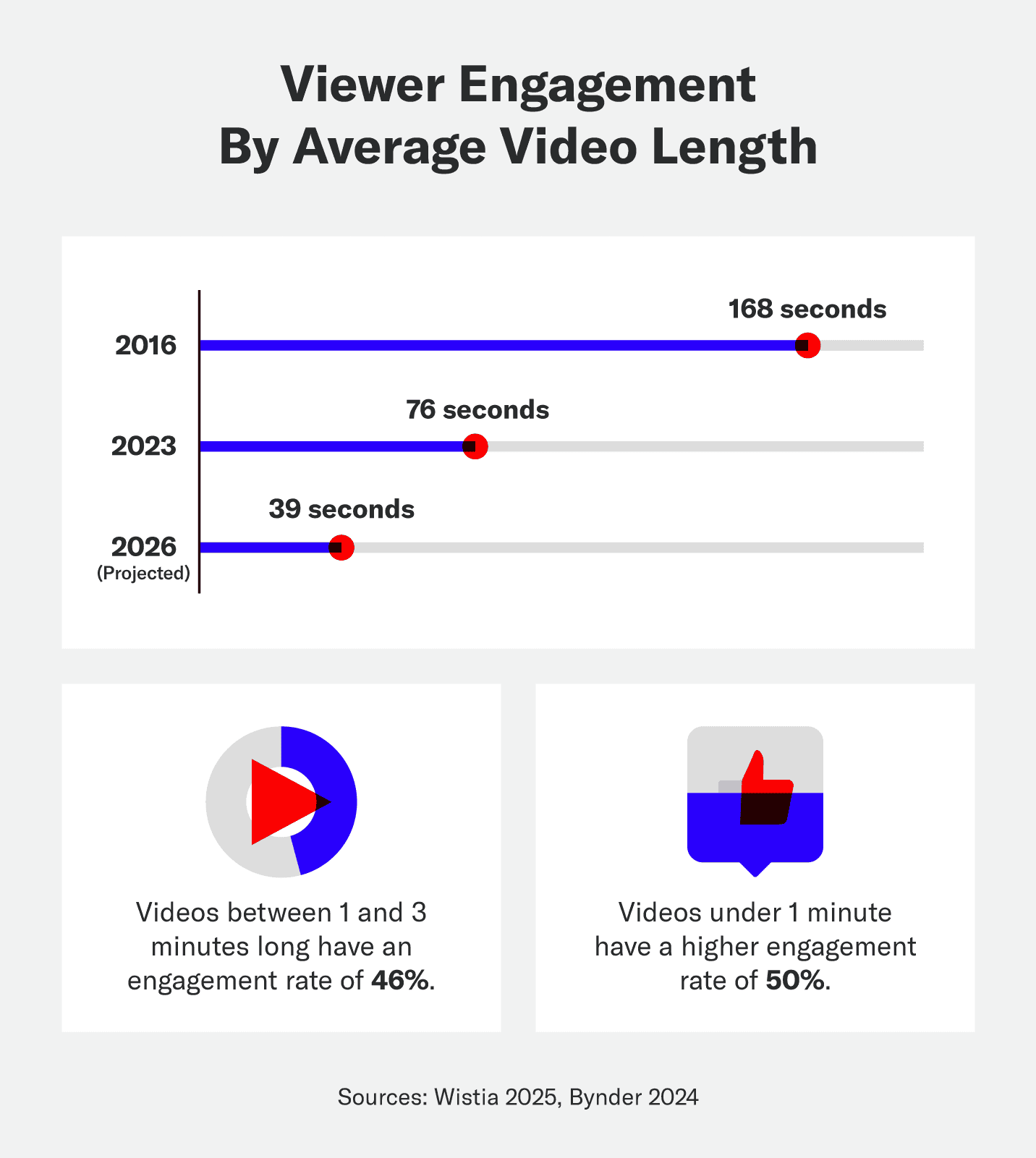
- Shorter videos tend to get more engagement, with videos under one minute long earning 50% engagement compared to videos over 60 minutes, with 17%. (Wistia, 2025)
Video marketing has proven to be a worthwhile strategy for engaging, educating, and converting viewers. The latest trends in video marketing can guide your strategy and give you a better understanding of how to create videos that meet your audience’s needs and help you achieve your goals.
Video Marketing Trends Statistics
We’re seeing video length decreasing, and B2B marketers plan to spend even more money on video this year. Video is becoming even more important for businesses to connect with their audiences and explain what they offer.
- The average video length has decreased 75% from 168 seconds in 2016 to 76 seconds in 2023, aligning with the growing popularity of short-form videos. (Bynder, 2024)
- The projected average length of videos this year is just 39 seconds. (Bynder, 2024)
- Of marketers who use video marketing, 93% claim that this strategy has improved how well their users understand what the business has to offer. (Wyzowl, 2026)
- 77% of all consumers would like to see interactive video content, and a higher percentage of Gen Z consumers (93%) and high earners (86%) agree. (Idomoo, 2025)
- 74% of consumers want more personalized videos, including 80% of Gen Zers and 77% of high earners. (Idomoo, 2025)
AI is one of the most notable digital marketing trends in 2025, including video. While integrating AI tools into your content production process is a fairly new approach, we already see plenty of excitement and possibility with AI in video marketing.
AI in Video Marketing Statistics
Artificial intelligence has rapidly become integrated into virtually every industry, and video content production is no different. Whether you’re already using AI prompts or just getting started, these statistics illustrate AI’s growing adoption and anticipated importance in shaping the future of video marketing strategies.
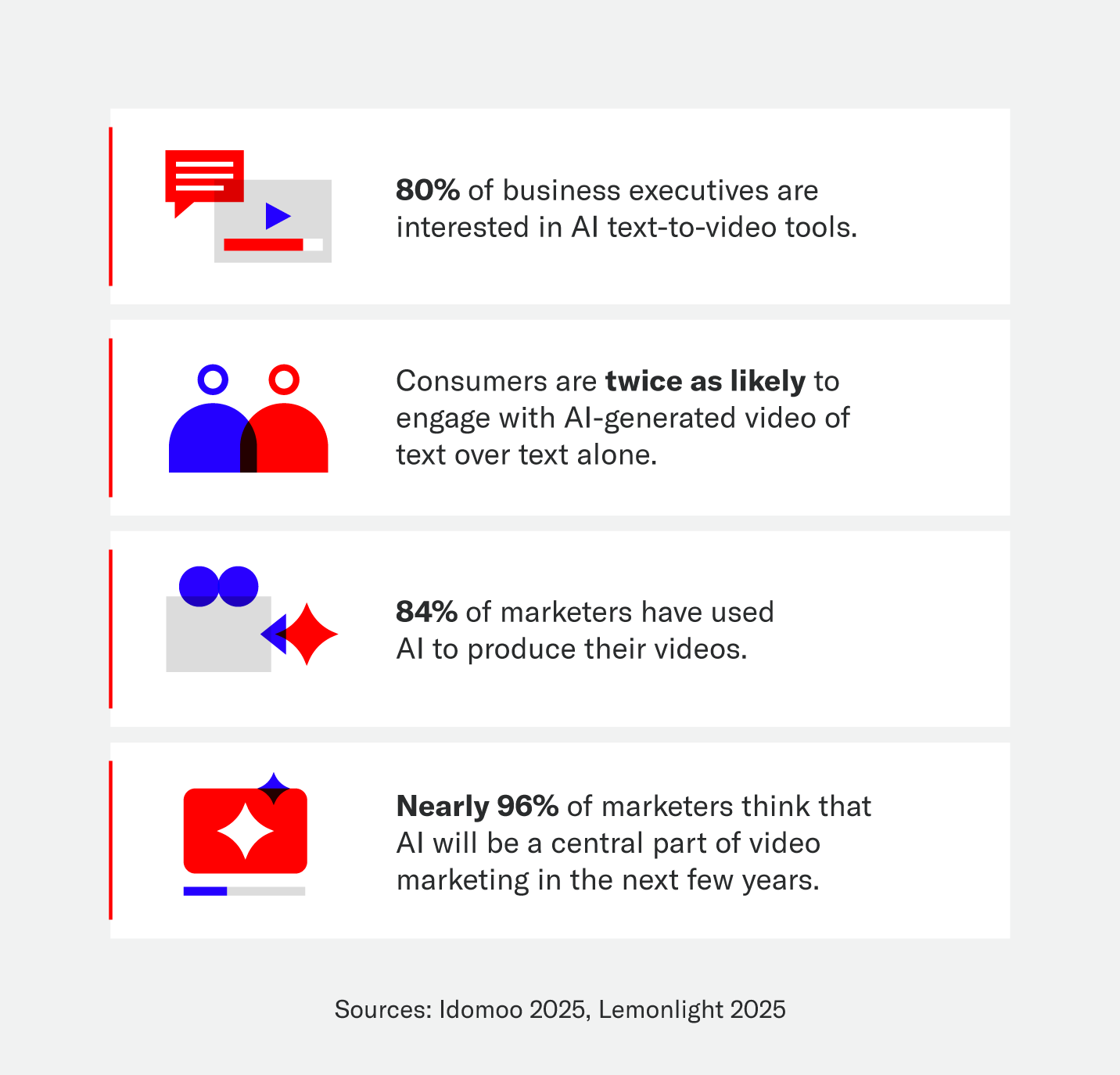
- Nearly all (96%) marketers think that AI will be a central part of video marketing in the next few years. (Lemonlight, 2025)
- One report found that the percentage of marketers who use AI in video production has increased from 18% in 2023 to 41% in 2024. 19% said that they will start using it soon. (Wistia, 2025).
- Another report found that 84% of marketers have used AI to produce their videos. (Lemonlight, 2025)
- Over 60% of marketers use or intend to use AI to generate captions for their videos, and 30% have used it or plan to use it to translate their content using AI. (Wistia, 2025).
- Over 80% of marketers and business executives want to utilize an AI-powered text-to-video tool, and consumers are twice as likely to prefer an AI-generated video of text over the text alone. (Idomoo, 2025)
- By 2032, the machine translation market may grow to $7.5 billion, but AI in writing and video creation encompasses a broad range of applications. (Global Market Insights, 2023)
- Visual AI generators (including video, image, and design tools) are in use by 49% of social media marketers, and most say that generative AI is primarily helpful for creating short-form videos. (HubSpot, 2025)
The use of AI in video marketing will likely continue to increase across applications, from script writing, video editing, and captioning. Depending on the type of videos you’re creating, AI may be more useful in producing content that engages and informs your viewers.
Next, we’ll break down the most effective video types to inform you of your strategy.
Video Marketing Statistics by Video Type
From the entertainment-driven popularity of music and comedy to the practical value of how-to content, video content has only become more prominent in everyday life.
This section breaks down the most popular video formats, offering insights into current trends that marketers can use to focus their creative energy.
- Between July and September of 2024, 45.3% of U.S. internet users reported watching music videos, making this the most popular type of video content consumed each week. (Statista, 2025)
- Comparatively, 37% of internet users watched comedy/viral videos, and 30% reported watching how-to videos. (Statista, 2025)
- One report found that educational videos, product spotlights, and social media videos were the most common types of videos companies produced in 2024, followed closely by webinars and live streams. (Wistia, 2025)
- Another study found that social media videos, explainer videos, and testimonial videos explainer videos were the most widely used type of video marketing content by marketers in 2026. (Wyzowl, 2026)
The power of video marketing is hard to ignore. But how many businesses are actually using and investing in this strategy? As you’ll learn in the next section, it seems like most businesses recognize the value of video marketing — and they plan to continue using it in 2025 and beyond.
Video Marketing Usage Statistics
Not only is online video popular with consumers, but companies large and small are turning to video to boost their marketing content. Check out these statistics on video marketing to learn more about how brands utilize video in their content strategies.
- 81% of businesses have a dedicated video marketing budget, with 45% spending between $20,000 to over $100,000 per quarter. (HubSpot, 2024)
- The biggest reasons businesses don’t implement video marketing are that they feel it’s unneeded (24%), that it’s too expensive (24%), or that they don’t have the time to do it (19%). (Wyzowl, 2026)
- Despite the challenges, 67% of marketers who didn’t engage in video marketing stated that they plan to start in 2026. (Wyzowl, 2026)
- As of 2026, 69% of marketers created social media videos, making this the top use case of video marketing. (Wyzowl, 2026)
- Comparatively, 68% created social media videos, 57% made video testimonials, and 48% made video presentations. (Wyzowl, 2026)
- Over a quarter (28%) of professionals in marketing stated that they increased their investment in TikTok-based video content in 2025. (HubSpot, 2026)
While creating video content is one thing, successfully engaging your audience is another. Next, let’s examine video marketing engagement statistics.
Video Marketing Engagement Statistics
From podcast clips to highlights of last night’s game, we all encounter videos as we scroll. According to engagement statistics, these videos do more than entertain and often help to build a relationship with consumers.
When creating your content, keep your audience in mind. From prioritizing short content to formatting your video for mobile devices, there are steps you can take to ensure your video content is accessible and digestible for your audience.
Read these engagement statistics to learn more about how incorporating video into your content can help you connect with your audience.
- 93% of marketers believe that video content has increased brand awareness. (Wyzowl, 2026)
- Nearly three-quarters of marketers believe the most effective video length is between 30 seconds and two minutes. (Wyzowl, 2026)
- Videos under 15 seconds long perform best on X (formerly Twitter) and Instagram, 15-to-60-second videos do well on TikTok, and users tend to prefer videos longer than 60 seconds on YouTube. (Sprout Social, 2025)
- 84% of consumers would like to see more branded video content in 2026. (Wyzowl, 2026)
- Lead generation forms generate more conversions than standard calls-to-action or annotation links when included in videos. (Wistia, 2025)
- How-to videos have the highest engagement rates across all video types and lengths. (Wistia, 2025)
- Long form videos have the highest average conversion rate, clocking in at 17% for 30-60 minute videos and 10% for 5-30 minute videos. (Wistia, 2025)
Now that you know how video marketing can help you perform online, let’s take a closer look at the home of a staggering amount of video content: social media.

Social Media Video Marketing Statistics
While you may use social media to share pictures of your latest vacation or keep up with your college friends, content marketers and content creators are using platforms like Facebook, YouTube, Instagram, and TikTok to share their video content with the world.
Use the following social media video statistics to help you effectively leverage social media in your content marketing strategy.
- With an estimated 211 million viewers in 2024, YouTube was the top social video platform in the U.S. (Statista, 2024)
- Videos between 2 and 5 minutes have the strongest performance metrics on Facebook. (LemonLight, 2025)
- Videos less than 60 seconds are the most likely to garner engagement on Instagram. (Sprout Social, 2025)
- Over 50% of TikTok users made a purchase after watching a TikTok LIVE. (Sprout Social, 2025)
- Tweets with videos generate 10x more engagement than those without video, and save over 50% on cost-per-engagement. (LemonLight, 2025)
- More than one-half of marketers spend more time creating video content than promoting it. (Wistia, 2025)
- 69% of marketers post their videos on YouTube, and over half share them on LinkedIn and Instagram. (Wistia, 2025)
- Another study found that 89% of B2B marketers shared their video content on social media, more than any other distribution channel. (Content Marketing Institute, 2025)
- Only 23% of marketers shared their videos on TikTok in 2024. (Wistia, 2025)
- 71% of marketers resize their videos for social media, and more than half do so for Instagram. (Wistia, 2025)
With an understanding of the strong presence of video content on popular social media platforms, you can likely expect your audience to like, comment, and subscribe.
YouTube Marketing Statistics
With billions of active users, YouTube is more than a platform — it’s a daily habit for many. For businesses diving into YouTube video marketing, understanding this massive audience and what keeps them clicking is crucial.
These stats give us a peek into the world of YouTube users and how they interact with content.
- After Facebook, YouTube is the most popular social network with over 2.5 billion monthly users. (Statista, 2025)
- More than 60% of internet users in the U.S. use YouTube every day. (Vidico, 2024)
- More YouTube users seek out entertaining and educational content over other types. (HubSpot, 2024)
- Nearly 50% of YouTube users actively engage with branded content on a weekly basis, particularly brands that produce long-form videos. (Sprout Social, 2025)
- When people find a product or service they like on YouTube, they are 87% more likely to take a further action (potentially leading to a conversion). (Sprout Social, 2025)
- Over half (52%) of YouTube users have a higher likelihood to interact with short-form branded content over long-form branded content. (Sprout Social, 2025)
- Reaching 100K viewers through YouTube Ads generally requires an average spend of $2,000. (Sprout Social, 2025)
- 80% of YouTube users look for new content on the platform, reinforcing the need for ongoing video creation for brands. (Vidico, 2024)
- Two-thirds of marketers intend to produce or post more video content on YouTube. (Vidico, 2024)
Marketing to consumers with video content on YouTube and other platforms can be more straightforward than B2B marketing. Additionally, many B2B businesses find that video marketing is an effective way to attract, engage, and convert potential buyers.
B2B Video Marketing Statistics
Building trust and providing valuable information are paramount for B2B marketers. These statistics underscore the significant role video plays in B2B marketing strategies and the buying journey.
- About 70% of B2B buyers engage with videos as part of their decision-making process for purchases. (Vidico, 2025)
- 73% of B2B marketers said that producing video had a positive impact on their overall marketing results. (Vidico, 2025)
- 65% of B2B companies have gained customers as a direct result of video marketing campaigns on LinkedIn. (Vidico, 2025)
- YouTube is the second-most effective platform for B2B marketers. (Vidico, 2024)
- At least half of all B2B buyers make buying decisions informed by video content. (Vidico, 2025)
- More B2B companies created testimonial videos than any other type of marketing video content in 2023. (Statista, 2024)
Across industries and applications, video marketing appears to be one of the most valuable strategies — but how much does it cost to produce quality videos that convert?
Video Marketing Cost Statistics
Like most things, effective video marketing often comes with a cost.
Fortunately, video’s strong performance and ROI led many marketers to expect their content marketing costs to increase in 2025, suggesting that video is here to stay.
How much should you expect to spend on your video content? We’ve gathered some video marketing cost statistics to answer this question.
- Filming a live-action video can cost businesses anywhere from $2,000 to over $50,000 per finished minute, depending on video length, complexity, technique, editing, and equipment. (Synthesia, 2025)
- Creating an animated video may cost between $1,000 and $45,000+, depending on who you hire, the complexity of your designs, and editing requirements. (QuickFrame, 2025)
- A branded video designed to increase brand awareness can cost upwards of $1,500 per finished minute if you hire professional services. (Business.com, 2025)
- Video production companies may charge $100 or more per hour for setup, filming, editing, and post-production work. (Vidico, 2025)
- Video marketing makes up a third or less of most marketer’s budgets, but 92% of marketers are planning on allocating the same amount or more in 2026. (Wyzowl, 2026)
- Perceptions of video marketing costs vary among marketers – 38% believe costs are rising, 32% said they remained the same, and 30% believe costs are decreasing. (Wyzowl, 2026)
But does video content actually convert? To help answer this question, let’s look at some ROI statistics.
Video Marketing ROI Statistics
Not only does video marketing thrive on social media, but it can help you gain customers and influence purchase decisions. In some cases, video content even outperforms paid advertisements.
Measuring video and content marketing ROI can be challenging without establishing your metrics upfront. Consider these ROI statistics to better understand the benefits of video marketing so you can drive more engagement and conversions.
- With revenue increasing 19.2% between 2023 and 2024 to $62.1 billion, digital video is the fastest-growing ad format, amounting to 24% of ad revenue overall. (Interactive Advertising Bureau, 2025)
- Google and YouTube are projected to earn over $200 billion in digital ad revenue in 2025 for parent company Alphabet. (eMarketer, 2025)
- Video marketing helps nearly 50% of businesses achieve faster growth. (Wordstream, 2024)
- 82% of marketers say that they’ve achieved a good ROI from video marketing. (Wyzowl, 2026)
- 52% of B2B marketers state that video is the highest ROI type of content for their niche. (Vidico, 2025)
- Compared to generalized videos, personalized videos are 4 times as likely to cause customers to feel individually valued, 3.5x more likely to become or remain a customer, and 3x more likely to trust and recommend it. (Idomoo, 2025)
- Most marketers quantify ROI for video marketing through view count, followed by engagements and leads. (Wyzowl, 2026)
- Over 4 in 5 marketers state that video marketing has led to increased sales and website dwell times, while over 1 in 2 say that it has reduced their total number of customer support queries. (Wyzowl, 2026)
Not every video will bring in a record number of sales, but if you want to increase your chances of a successful video marketing campaign, follow these tips to produce effective, engaging videos.
Video Marketing Tips for Success
Excelling in video marketing isn’t just about creating a lot of videos; it’s about creating the right videos with the best strategies. These actionable insights, backed by recent data, can help you optimize your video content and maximize your success in connecting with your target audience.
- Keep it brief: 77% of marketers believe that short-form videos have the highest ROI, compared to just 22% who said long-form videos perform better. (Statista, 2024)
- Know your audience: 42% of marketers use video to improve customer relationships and retention with personalized, value-additive content. (Vidico, 2025)
- Prioritize quality: Nearly 90% of consumers agree that the quality of a brand’s video content affects how much they trust that brand. (Wyzowl, 2026)
- Post at the best time: The best times to post on YouTube include Wednesdays, Thursdays, and Mondays at 4 p.m. (Buffer, 2025)
You should also consider using storytelling in your videos to improve engagement and make a point to create an effective hook within the first few seconds to grab and keep your viewers’ attention.
Maximize Traffic and Engagement With Expert Content Creation Services
Understanding the latest video marketing statistics is just the first step in crafting a successful strategy. Partnering with an expert content marketing agency like Siege Media can drive meaningful engagement and traffic with strategic insight.
If you’re looking to improve your marketing strategies, Siege Media offers expert content marketing services, video production services, and generative engine optimization to help drive conversions and organic traffic. Our team is here to help you every step of the way.