
Your marketing dollars are powerful, but are you spending them wisely?
For many businesses, allocating a marketing budget means facing a familiar dilemma: how to best get noticed online. It’s a challenge almost every company faces, and it usually boils down to a fundamental choice between two key pillars of search engine marketing: SEO vs. PPC.
Both search engine optimization (SEO) and pay per click (PPC) advertising still power profitable growth — but 2026 continues a major shift: AI‑driven results are changing where (and why) people click, and which content types win.
This guide breaks down SEO vs. PPC through that new lens, so you can pick the right mix for immediate impact and long‑term compounding returns.
What’s new in 2026?
- AI Overviews & LLMs reduce clicks on many informational SERPs; brands cited in AI summaries tend to capture more total clicks than those not cited.
- Informational and how-to content is losing share; bottom‑of-funnel (BOFU) topics, like price guides and comparisons, are gaining.
- Engagement is up — especially on industry trend reports, proprietary research, and product updates — making engagement a leading indicator to watch.
- SEO vs. PPC: A Comparison
- How AI Is Changing SEO vs. PPC in 2026
- What Is SEO?
- What Is PPC?
- When To Prioritize SEO vs. PPC
- How Your Company Benefits From Both
- Strategies for SEO and PPC Integration
- Frequently Asked Questions
SEO vs. PPC: A Comparison
To truly grasp the core difference between PPC and SEO and figure out what’s best for your business, we’ve compiled a quick-hitting comparison highlighting their main features, how they work, and what kinds of results you can expect:
| Feature | SEO (organic search) | PPC (paid search) |
|---|---|---|
| Cost model | No direct cost per click; investment in time/resources | Pay per click (CPC), cost per impression (CPM) |
| Time to results | Long term (months to years) | Short term (a few days) |
| Visibility | Earned; appears in organic results | Bought; appears as “Ad” at top/bottom of SERPs, display networks |
| Control | Less direct control over rankings, more over content | High control over ad placement, budget, and targeting |
| Trust factor | Higher perceived credibility and trust | Can be seen as less trustworthy by some users |
| Longevity | Sustainable once established | Stops when budget runs out |
| Targeting | Keyword intent, content relevance | Granular (demographics, interests, location, behavior) |
| ROI measurement | Harder to directly attribute, high long-term ROI | Highly measurable, direct ROI calculation |
| Effort type | Content creation, technical optimization, link building | Ad copy, bid management, landing page optimization |
| AI exposure & CTR impact | High on long-tail queries, CTR down on AIO queries | Variable; less AIO presence on local queries, more on info queries |
How AI Is Changing SEO vs. PPC in 2026
AI Overviews and LLM‑powered results compress “top‑of‑SERP” attention, lowering CTR on many informational queries for both organic and paid listings. Being cited within AI summaries can offset those losses.
At the same time, content demand is shifting bottom funnel: Pricing- and cost-focused content gained a 12 percentage-point share, and comparison or versus content gained 2 points. Meanwhile, informational and how-to content saw steep declines.
AI surfaces fewer summaries for transactional and local queries, so brand, product, and local conversion pages retain more traditional click patterns than broad informational topics.
Treat BOFU pages as growth assets and optimize them for both classic SEO and AI citation — using structured data, crisp Q&As, and scannable, authoritative copy.
What Is SEO?
Search engine optimization (SEO) is the process of optimizing your website to rank higher in unpaid search engine results, essentially “earning” visibility.
In its simplest form, search engine optimization is about making your website appealing to search engines like Google, so it shows up higher in the “organic” (i.e., unpaid) results. You essentially “earn” your spot on the first page by optimizing your content and site structure so Google sees you as the most relevant and trustworthy answer to a user’s query.
Now, if you’ve heard whispers about SEO’s wilder days, you might recall when it was a bit like a game of keyword stuffing whack-a-mole. Those days are (thankfully) long gone. Modern SEO content isn’t about gaming the algorithm. It’s about creating genuinely valuable experiences for your audience.
This means focusing heavily on user experience (UX) — how easy and pleasant your site is to navigate — and demonstrating what Google calls E-E-A-T: your experience, expertise, authoritativeness, and trustworthiness on a given topic.
Key Components of a Strong SEO Strategy
So, what does it actually take to earn that top spot on Google? Building a strong SEO strategy requires a blend of several key components that work together to signal your site’s value to search engines and users alike:
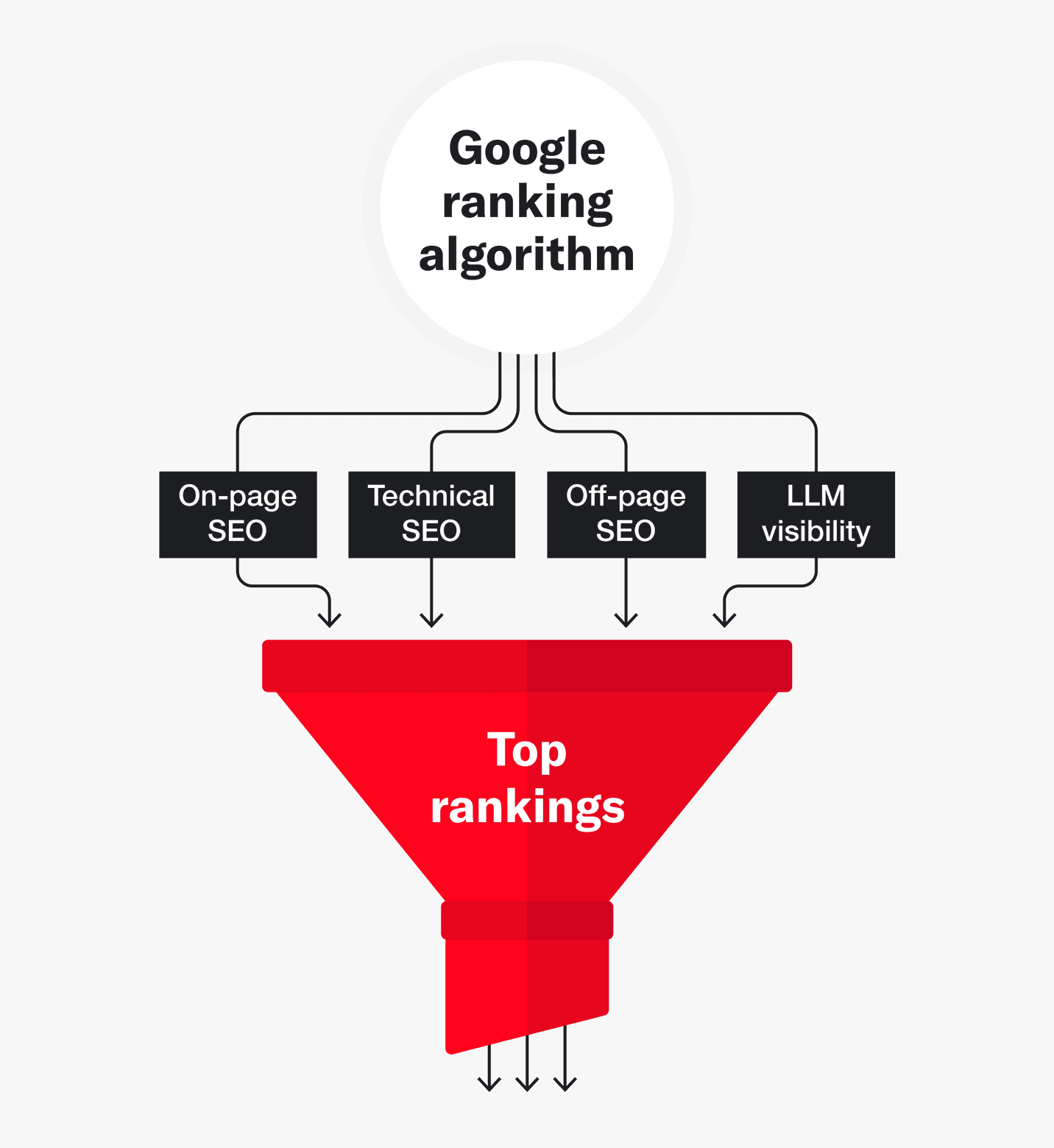
- On-page SEO: This covers the content and elements on your actual web pages, like high-quality, relevant content that naturally includes your keywords (no forced stuffing!), compelling meta titles and descriptions that entice clicks, properly structured headers (H1, H2, etc.), descriptive image alt text, and smart internal linking to guide users and search engines through your site.
- Technical SEO: This is the behind-the-scenes work that ensures search engines can easily find, crawl, and understand your site. Key elements of technical SEO include site speed, mobile-friendly design, site crawlability and indexability, a well-organized XML sitemap, structured data (schema markup), and site security using SSL.
- Off-page SEO: Off-page SEO focuses on signals from elsewhere on the internet that boost your authority. The big one here is link building, where other reputable sites link to yours (think quality over sheer quantity). This also includes brand mentions across the web and strong local SEO signals, especially through a well-optimized Google Business Profile (formerly Google My Business).
- LLM visibility: AI Overviews and generative AI tools answer queries directly, so optimizing for large language models (LLMs) is becoming another factor of organic visibility. This means structuring content for direct answers, ensuring factual accuracy, and demonstrating extreme E-E-A-T so your content is cited or summarized by these AI systems, even if users don’t click through to your site immediately.
Don’t let AI systems skip your content! To make sure your insights get cited in AI Overviews and LLM responses, dig into our article: How To Rank in AI Search Engines and Results
- User experience: Google wants to send users to sites they’ll love. Factors like Core Web Vitals, easy navigation, and overall site usability directly impact your rankings. At the end of the day, modern SEO is about delivering a fantastic experience for the user.
Pros of SEO
So, you’re investing time and effort into SEO. What’s the payoff? The benefits of a strong organic presence are substantial and tend to grow over time, making it a powerful long-term play for any business. Here are some of the key advantages that make SEO such a valuable strategy:
- Long-term, sustainable results: Unlike paid ads that disappear when your budget runs out, once you rank well organically, that visibility can be a consistent, “free” source of traffic and leads. It’s like building a valuable asset that continues to pay dividends.
- Higher trust and credibility: Users often perceive organic search results as more authoritative and trustworthy than paid advertisements. Achieving a top organic ranking signals to users that your content is genuinely valuable and relevant.
- Cost-effectiveness (over time): While SEO requires an initial investment in content, technical work, and link building, you’re not paying per click. This means that over the long run, the return on investment can be significantly higher, as your traffic comes without a recurring click cost.
- Broader funnel reach: SEO isn’t just for immediate sales. It allows you to attract users at every stage of the buyer’s journey, from those doing initial research (top-funnel) to those ready to buy (bottom-funnel), helping you engage potential customers early on.
- Increased brand authority and awareness: Consistently ranking high for relevant keywords builds your brand’s reputation as an industry leader. This increased visibility and perceived expertise naturally lead to greater brand recognition and recall.
- Compounding traffic & brand authority — now with an AI citation upside: If your page is cited in AI Overviews, brand familiarity and total clicks can increase relative to non‑cited competitors.
- Ownership over BOFU demand for durable ROI: Prioritize pricing, comparisons, and product‑led pages, which gained share while TOFU “how‑to/guides” declined.
SEO in action: Organic traffic builds serious momentum. For Zip, our work translated to a remarkable 213% increase in blog traffic value, proving the incredible power of earned visibility.
Cons of SEO
While the long-term benefits of SEO are undeniable, it’s also important to be realistic about its challenges. SEO isn’t a quick fix, and it comes with its own set of hurdles that businesses need to prepare for:
- Time to see results: SEO is definitely a long game. Don’t expect to rank number one overnight — it often takes several months, and sometimes even a year or more, to see significant organic traffic gains and top rankings. Patience is key here.
- Algorithm volatility: Google’s algorithms are constantly being updated and refined. This means your rankings can fluctuate unexpectedly — sometimes dramatically — after a major algorithm change, requiring you to adapt your strategy.
- No guaranteed placement: You can do everything right with your SEO, but ultimately, Google’s algorithm decides who ranks where. There’s no paying for a guaranteed top spot, unlike with paid advertising.
- Intensive and ongoing effort: SEO isn’t a “set it and forget it” strategy. It demands continuous effort in content creation, regular technical maintenance, and ongoing link building strategies to maintain and improve your rankings. It’s a marathon, not a sprint.
- Zero‑ or low‑click realities on informational queries: AI Overviews depress organic CTR on many info terms; plan for visibility and assisted conversions, not just clicks.
| Pros | Cons |
|---|---|
|
|
What Is PPC?
Pay-per-click (PPC) is an advertising model where businesses pay a fee each time their ad is clicked, essentially “buying” immediate visibility on search engines and other platforms
So, if SEO is about earning visibility, then PPC is about buying it
PPC is an advertising model where businesses pay a fee each time someone clicks on their ad. These ads are strategically placed, often at the very top or bottom of search engine results pages (SERPs), on social media feeds, or across various websites.
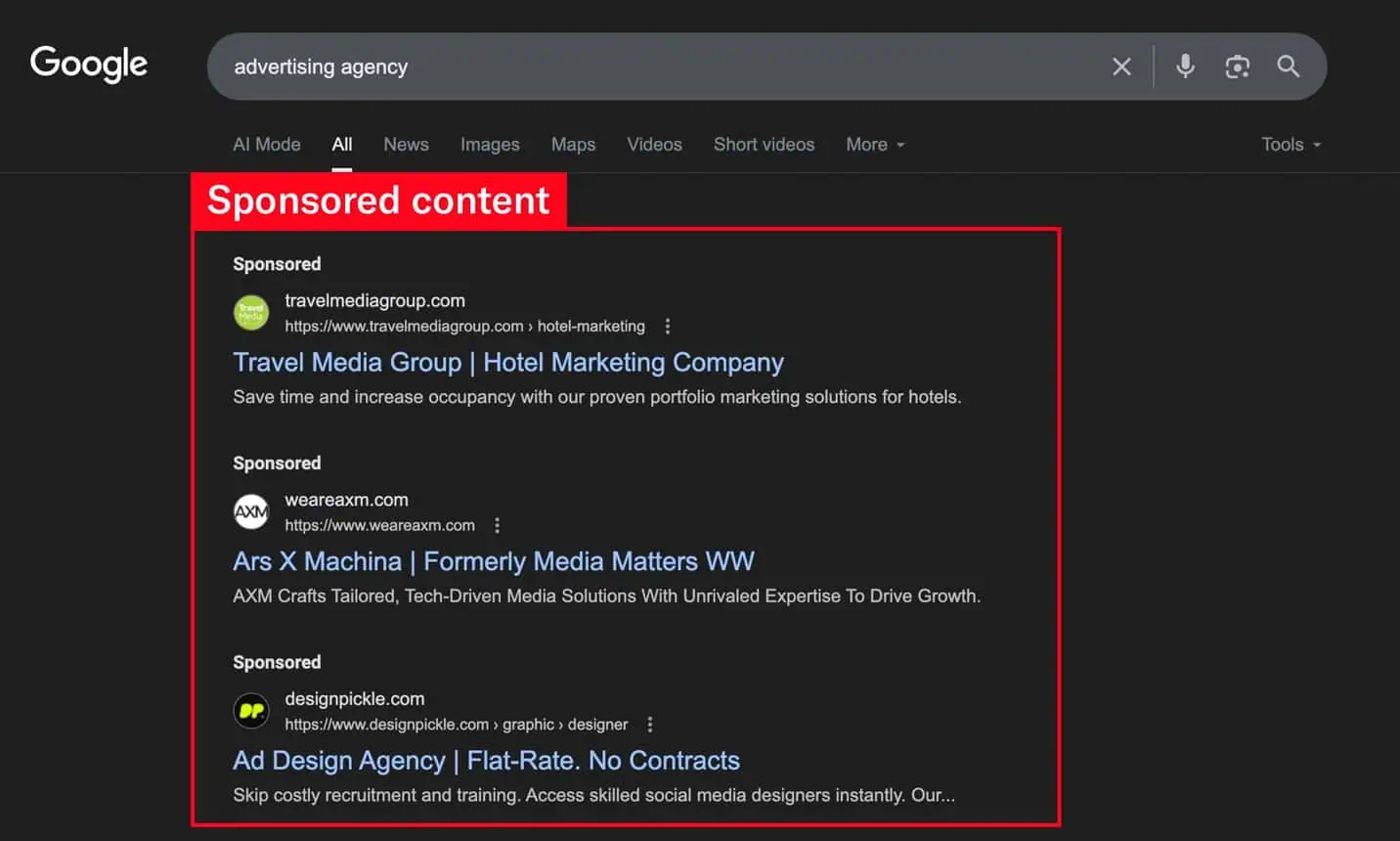
The most common platform you’ll encounter is Google Ads, but platforms like Microsoft Ads (formerly Bing Ads), Facebook Ads, and others also operate on a PPC model.
The beauty of PPC is its immediacy: Once your campaign is live, your ads can appear almost instantly on the SERP. But how do your ads get there, and what determines the cost?
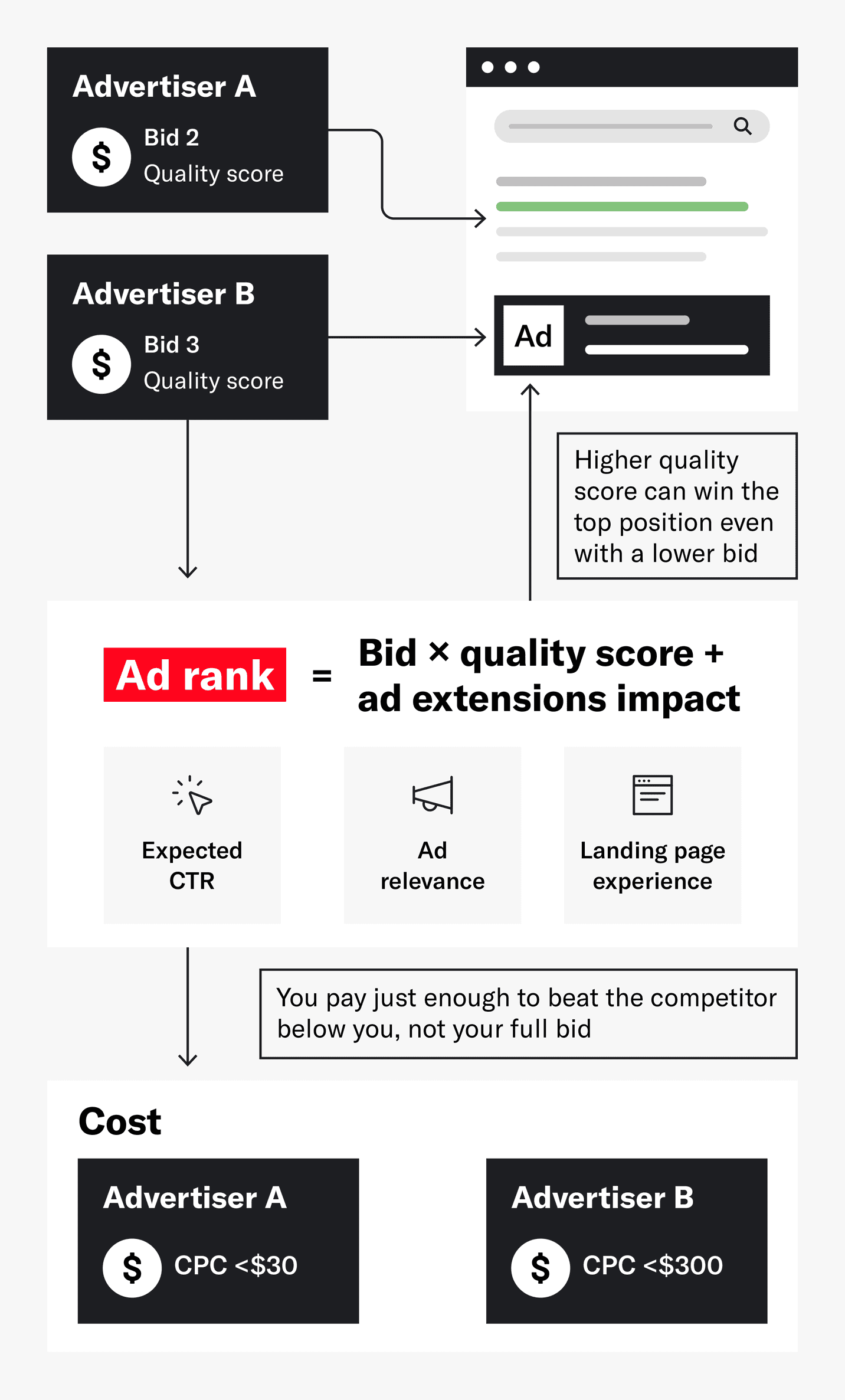
PPC ads run on an auction system, though it’s not quite like eBay. Here’s a simplified look at how it works:
- The bid: Advertisers set a maximum bid they’re willing to pay per click for a given keyword.
- Quality Score: Google evaluates the relevance and quality of your ad, keywords, and landing page. A higher Quality Score means your ad is a better match for what the user is searching for.
- Ad rank: Google then calculates your ad rank, which determines your ad’s position. This isn’t just about your bid; it’s a combination of your bid, your Quality Score, and the expected impact of things like ad extensions (extra bits of information on your ad).
- Cost determination: Surprisingly, the highest bid doesn’t always win the top spot or pay the most. Because Quality Score is so important, you might pay less than a competitor even if they bid higher, simply because your ad is more relevant. It’s a system designed to reward relevance and a good user experience.
Key Components of a PPC Campaign
Running a PPC campaign isn’t just about setting a budget and hoping for the best. To truly succeed at capturing search intent and get the most bang for your buck, you need to strategically assemble several key components:
- Keyword research (paid intent): Focus on commercial and transactional keywords — what people search for when they’re ready to buy or take action. Don’t forget long-tail variations for more specific, less competitive traffic, and negative keywords to prevent your ads from showing up for irrelevant searches.
- Ad copy and creative: Craft compelling headlines and descriptions that grab attention and clearly communicate your value. For display or social campaigns, eye-catching visual ads will make or break your success.
- Landing page optimization: Your landing page needs to be hyper-relevant to the ad a user clicked. A strong connection between the ad message and the landing page content is vital for a good Quality Score and, more importantly, for turning clicks into actual conversions.
- Bid management and budgeting: Optimize your bids — whether manual or automated — to get the best ad positions without overpaying. Careful budgeting ensures your campaigns stretch every dollar.
- Targeting options: Define exactly who sees your ads based on demographics (age, gender), locations, specific devices, and even detailed audience lists like remarketing audiences.
Pros of PPC
When you need to make a splash now, PPC is your go-to content distribution strategy. It offers a distinct set of benefits, particularly around speed, control, and precise audience reach, that can jump-start your digital marketing efforts:
- Immediate visibility and results: Unlike SEO, which takes time to mature, PPC ads appear almost instantly once your campaign launches. This means you can drive targeted traffic to your site and start generating leads or sales almost immediately.
- Precise targeting: PPC gives you incredibly granular control over who sees your ads. You can define your audience based on factors like demographics, interests, specific locations, and even the time of day, ensuring your message reaches the most relevant potential customers.
- Measurable ROI and data: One of PPC’s biggest strengths is its transparency. You get highly trackable metrics like impressions, clicks, conversions, and cost per conversion, making it incredibly straightforward to calculate your return on investment (ROI) and optimize campaigns based on solid data.
- Flexibility and control: PPC platforms offer unparalleled control. You can easily adjust budgets, pause or start campaigns with a click, and rapidly test different ad copies to see what resonates best with your audience.
- Top-of-SERP placement: Paid advertisements frequently occupy the most prominent positions on search engine results pages, often appearing directly above organic listings. This prime real estate provides maximum visibility for your brand when users search.
- Resilience on transactional intent: AI Overviews appear far less on transactional/local queries (and Shopping), keeping PPC a reliable lever when the goal is immediate conversions.
- Rapid testing for SEO: Use PPC to validate headlines/offers and feed high‑intent keyword learnings into organic content.
Cons of PPC
PPC offers undeniable advantages in speed and control, but it’s not without its drawbacks. Understanding these potential challenges will help you set realistic expectations and manage your advertising budget effectively:
- Cost per click (CPC): The most apparent drawback is the direct cost associated with every click. In highly competitive industries, CPC can quickly add up, and the traffic stops flowing the moment you stop paying.
- Lower ad click-through rate (CTR) on info queries: Ad CTR has fallen on AI Overview‑heavy informational terms; judge efficiency by qualified conversions and blended SOV vs. raw CTR.
- Requires ongoing budget: To maintain visibility and keep driving traffic, you need a constant advertising budget. Unlike SEO, where established rankings can bring “free” traffic over time, PPC visibility immediately disappears when your funding runs out.
- Ad fatigue and banner blindness: Over time, users can become desensitized to ads, a phenomenon known as ad fatigue or banner blindness. This means your ads might become less effective if you don’t regularly refresh them with new creatives and messaging.
- Requires expertise: It’s easy enough to start a PPC campaign, but getting it to be profitable and avoiding wasted money takes serious know-how. You need a skilled hand to navigate those complex platforms, figure out bidding strategies, and constantly analyze the data to make sure you’re actually seeing a positive return.
- Lack of set‑and‑forget with more automation: Broad match plus Smart Bidding and AI Max demand negative lists, brand guardrails, and landing page CRO to avoid waste.
| Pros | Cons |
|---|---|
|
|
Pro Tip: Don’t just chase clicks — optimize for conversions.
While PPC can get a bit pricey, you can mitigate this drawback by focusing your efforts beyond mere clicks.
Instead of just trying to get the lowest CPC, prioritize improving your conversion rate. A higher conversion rate means you’re getting more leads or sales from the same number of clicks, effectively lowering your true cost per acquisition even if your CPC seems high.
This requires dedicated landing page optimization and continuous A/B testing of your ad copy and offers. By shifting your focus to what happens after the click, you make every ad dollar work harder, transforming a potential money pit into a powerful revenue engine.
When To Prioritize SEO vs. PPC
Deciding between SEO vs. paid search isn’t a one-size-fits-all answer. The best strategy for your business hinges on your specific goals, available budget, desired timeline, and the competitive landscape of your industry. Here’s a breakdown of the strategic considerations to guide your choice:
If your goal is…
- Generating immediate sales/leads: If you need to drive conversions right now, PPC offers that rapid response.
- Building long-term brand authority/trust: For building enduring credibility and a trusted online presence, SEO is key.
- Testing new products/offers: PPC allows for quick market validation by sending targeted traffic to new offerings.
If your budget is…
- Limited: SEO can be built over time without the need for continuous ad spend.
- Larger/flexible: PPC allows for rapid scaling and significant investment for fast growth.
If you need results…
- ASAP: If urgency is your priority, PPC delivers immediate visibility.
- For the long haul: For an asset that delivers consistent returns over time, SEO is the answer.
If your industry is…
- Highly competitive: PPC can secure immediate visibility in crowded spaces, while SEO builds long-term dominance.
- Niche: For specific, lower-volume, high-intent topics, SEO might be more effective and cost-efficient.
Ultimately, if you’re looking for immediate visibility, PPC is likely your starting point. But if building a sustainable, trustworthy, and cost-efficient online presence is your long-term goal, then lean into SEO.
| When To Use SEO | When To Use PPC |
|---|---|
|
|
How Your Company Benefits From Both
While SEO and PPC have their individual strengths, the real magic happens when you bring them together. The smartest digital marketing strategies don’t see SEO and PPC as rivals but as a team, each boosting the other.
Let’s break down some of the key ways this synergy can benefit your business.
Increased Search Real Estate
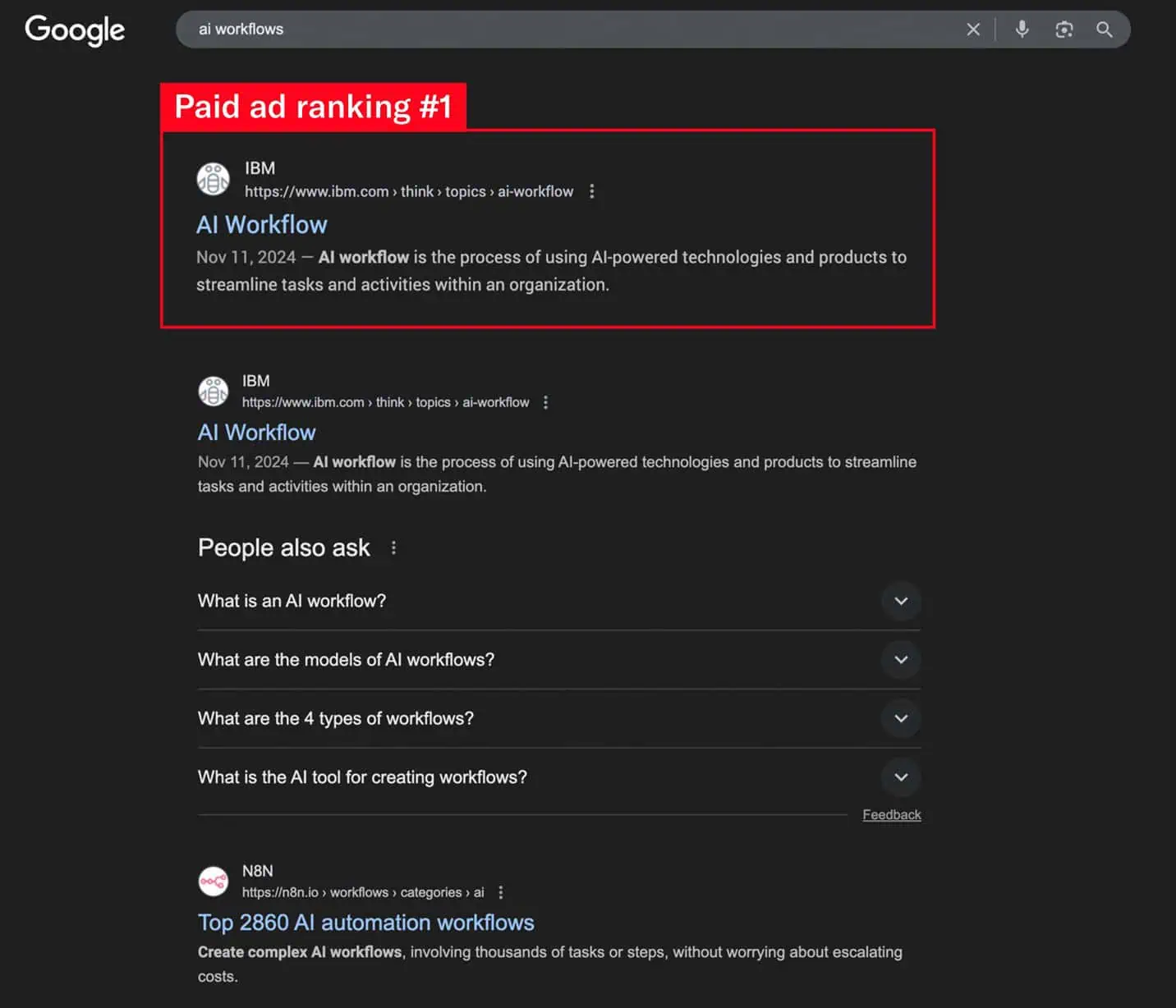
When you strategically combine SEO and PPC marketing, your brand can appear in multiple spots on the SERP: at the very top as a paid ad, within the organic listings, and as a source cited by AI Overviews or LLMs answering queries directly.
Having your brand show up in several places increases the chance of a user seeing and clicking on your listing. It builds immediate familiarity and trust, making your brand seem more established and authoritative. Whether a user prefers to click on an ad or an organic result or simply relies on an AI summary, your brand is consistently present and recognized.
Data Sharing and Keyword Insights
One of the coolest things about running both SEO and PPC is how they can feed each other with invaluable data.
Your paid campaigns can serve as a super-fast testing lab for keywords. You can quickly see which terms are driving not just clicks but actual conversions and sales.
You can then take those high-converting PPC keywords and use them to inform your long-term SEO content strategy, meaning you’re putting effort into organic content around terms you already know are profitable.
But the insights don’t just flow one way. Your organic search data also provides a wealth of information that can turbocharge your PPC. By digging into your SEO analytics, you can uncover trending topics, long-tail keywords, and specific user questions your audience is searching for naturally.
These organic insights can then inspire new, highly relevant PPC campaigns, making sure your paid ad spend is always directed toward opportunities with proven user interest.
Reinforced Brand Messaging and Credibility
When a potential customer sees your brand in a paid ad and consistently ranking in the organic results, it sends a powerful message. This repeated exposure across different parts of the SERP strengthens your brand’s presence and legitimacy.
This builds a stronger sense of trust and recall than either SEO or PPC could achieve on their own. Users are more likely to remember and trust a brand that appears to be a consistent, credible presence, whether they’re clicking a sponsored link or an organic one.
Filling Gaps and Hedging Bets
An integrated SEO and PPC strategy acts like a smart insurance policy for your online visibility. Paid campaigns can immediately jump in and cover keywords where your organic rankings aren’t quite strong yet. This means you won’t miss out on valuable traffic for those competitive terms while your SEO efforts are still building momentum.
For instance, if you’re targeting a highly sought-after keyword that might take months to rank for organically, PPC can capture that immediate demand right away.
On the flip side, your strong organic presence from SEO provides a stable, consistent baseline of traffic that doesn’t depend on your daily ad spend. So, if PPC budgets get tight or you need to pause campaigns for any reason, your business still maintains a steady level of visibility and traffic through its earned SEO rankings.
Optimized User Journey
Think about the journey a potential customer takes, from first hearing about your brand to finally making a purchase. An SEO and PPC management strategy allows you to smoothly guide users through every step of this funnel.
You can leverage your organic content, which is fantastic for building trust and providing valuable information, to attract users in the early stages of their research and awareness. This gets your brand on their radar without an immediate cost per click.
Once these users have visited your site and shown some initial interest, PPC can then step in to re-engage them with highly targeted ads, like remarketing campaigns. This means you’re not just hoping they come back — you’re actively nudging them toward a conversion with tailored messages.
Cost Efficiency in the Long Run
While PPC has an immediate cost per click, weaving it together with SEO can actually lead to significant cost efficiency over the long haul.
As your SEO efforts mature and you start climbing those organic rankings for key terms, you’ll find that you can gradually reduce your PPC spend on those specific keywords. This frees up money that you can then wisely reallocate.
For example, you might pay for “best project management software” through PPC, gaining immediate leads. As your SEO content for that term begins to rank on Page One, you can dial back your ad spend, letting the “free” organic traffic take over. This saves budget, which you can then reinvest into new campaigns or other marketing efforts.
Strategies for SEO and PPC Integration
Here are some expert tips to help you blend your organic and paid efforts for maximum impact:
- Testing and validation: Use paid campaigns to test out new keywords and different ad copy variations. You’ll get immediate data on what resonates and converts, allowing you to confidently invest in SEO content around those proven terms instead of guessing.
- Remarketing to organic visitors: Your SEO efforts bring valuable organic traffic to your site — don’t let those visitors leave and forget about you! Set up PPC remarketing campaigns to specifically target users who landed on certain pages organically. It’s a highly effective way to re-engage interested prospects and guide them further down the funnel.
- Competitive defense: Even if you rank #1 organically for your own brand name, consider running PPC ads for your branded terms. Why? Because competitors often bid on your brand name to steal clicks. Your branded PPC ad serves as a defensive shield, dominating the top of the SERP and making it harder for rivals to siphon off your direct traffic.
- Content promotion: Use PPC channels like social media ads, display ads, or native advertising to amplify the reach of your organic content. This drives more eyeballs to your high-quality pieces, potentially earning more links and improving organic authority.
- Local SEO + local PPC: For businesses with a physical location, optimize your Google Business Profile and local citations for local SEO to show up in “near me” searches and map packs. Simultaneously, run local PPC campaigns with geo-targeting to ensure you appear prominently for immediate, localized searches, driving more foot traffic or local leads.
SEO and PPC Go Hand in Hand
Instead of picking a side, smart digital marketing integrates both SEO and PPC for a robust, multi-faceted online presence that delivers both quick wins and long-term dominance. You’ll own more search real estate, gain invaluable data insights, and guide users from awareness to conversion.
Ready to unlock the combined power of SEO and PPC for your business? Building a cohesive digital marketing strategy that seamlessly integrates SEO and PPC requires a specialized approach.
Siege Media specializes in crafting tailored content strategies that drive organic growth and harmonize seamlessly with your PPC campaigns. Trust us to help you navigate the nuances, make sure your content resonates, and elevate your online presence to hit your most ambitious goals. Contact us to learn more about how our team can help build a unified digital strategy for your brand.
Frequently Asked Questions
Is SEO or PPC Better in 2026?
Both — if used for their strengths. PPC excels on transactional and local queries with immediate conversion goals; SEO compounds on BOFU topics and earns AI citations for durable visibility.
How Does AI Change SEO vs. PPC?
AI Overviews lower CTR on many informational queries for both channels; brands cited in summaries tend to capture more clicks than non‑cited competitors.
When Should I Invest in BOFU Content?
Now — pricing and comparison pages are gaining share and driving conversions, while how-to guides have declined.
What PPC Setups Work Best Right Now?
Run keyword search with brand guardrails for precise targeting and incremental reach. And leverage reporting and granular controls to direct your ad spend toward the most promising leads and optimize your ROI.