Think of your homepage as the front door to your site — if it doesn’t invite people in, they’ll keep walking.
Too often, though, businesses treat it like a static landing page instead of a powerful driver of visibility and growth. Optimized the right way, your homepage can attract more qualified visitors and encourage them to take the next step.
That opportunity is only growing. Recent data shows homepage traffic is up 11% thanks to AI Overviews and LLMs—proof that search engines are sending more users straight to homepages.
The challenge? Striking a balance that works for both your audience and search engines.
Keep reading to learn six homepage SEO steps that will make your homepage work harder for both traffic and conversions.
- Identify Keywords
- Optimize Homepage Content
- Strengthen Internal Linking Strategy
- Earn Homepage Links
- Fix Technical SEO Issues
- Monitor Homepage Performance
1. Identify Your Primary and Secondary Keywords
Your homepage should clearly signal to both search engines and visitors what your business is about. The best way to do that is by selecting one primary keyword and a set of supporting secondary keywords.
Start by building a list of terms that describe your core product or service. Three reliable ways to do this include:
- Brainstorming potential terms
- Reviewing competitor sites
- Using keyword research tools
Platforms like Ahrefs’ Keywords Explorer and Semrush’s Keyword Magic Tool provide traffic potential, keyword difficulty, and search volume.
For example, if your business is a content marketing, SEO, and PR agency like Siege Media, primary keywords could include “content marketing agency,” “SEO content services,” or “digital PR agency.” Supporting terms might be “content strategy,” “SEO copywriting,” or “digital PR.”
Once you’ve gathered potential keywords, evaluate search intent. Look at the top results for each term to see what types of pages are ranking. If you find mostly homepages or product pages, that’s a good sign that your keyword aligns with the purpose of your homepage.
After choosing your primary keyword, weave secondary terms naturally into your homepage copy. Save other relevant keywords for blog posts or landing pages to help build topical authority over time.
Pro tip: Relevance beats volume. A keyword aligned with your audience’s intent will drive more qualified traffic than a broader term with higher numbers.
2. Optimize Your Homepage Content
After selecting your primary and secondary keywords, focus on weaving them into your SEO homepage content. Doing so makes it easier for search engines to classify your site and for visitors to see why they should stick around.
Title Tag
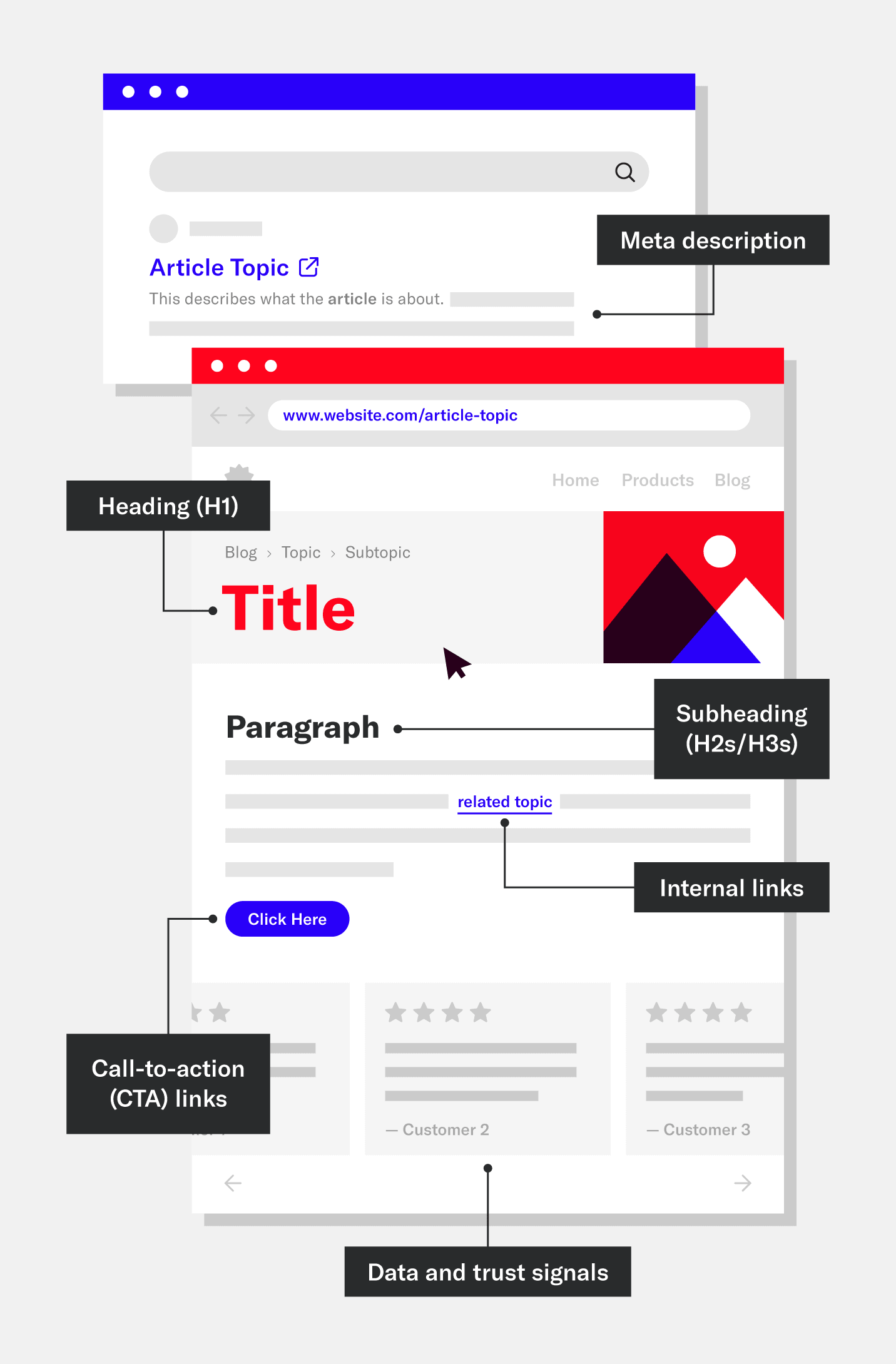
Your homepage title tag plays a major role in both visibility and click‑throughs. It’s the clickable headline that appears in search results, and one of the first signals search engines use to understand your page.
Keep it clear, keyword‑focused, and compelling. Include your primary keyword near the beginning, stay under 60 characters, and set accurate expectations for what visitors will find once they click.
A strong title tag can set the stage for better rankings and higher click‑through rates.
Meta Description
Your homepage meta description is the short snippet that shows up below your title tag in search results. It won’t move the needle on rankings directly, but it can make the difference between someone clicking your result or scrolling past.
Think of it as ad copy for your search listing. Keep it concise and focused on your unique value. Incorporate your primary keyword naturally, and use a call to action that nudges users to click.
Aim for 150–160 characters so your description displays in full and captures attention where it matters most, the SERP.
Headings and Main Content
The structure of your homepage matters as much as the content itself. Clear, well‑organized headings make your page easier to scan for visitors and help search engines understand what it’s about. The goal is to use keywords naturally without sacrificing readability.
Most homepages follow this basic hierarchy:
- H1 (mainheading)
- Subheadings (H2s, H3s, H4s)
- Body copy (“<p>”)
A strong heading structure makes your homepage feel intuitive for readers and gives search engines clear signals about your content’s organization and relevance.
Showcase Data and Trust Signals
Your homepage should build trust the moment someone lands on it. Visitors want proof that you can deliver, and search engines reward pages that demonstrate authority. Showcasing real results and credible proof points can make the difference between a bounce and a conversion.
Some effective ways to do this include:
- Testimonials: Quotes from satisfied clients that highlight your results.
- Case studies or customer stories: Success stories with measurable outcomes that demonstrate your impact.
- Performance stats: Numbers like ROI, traffic growth, or customer counts that provide tangible proof of value.
- Schema markup: Structured data for reviews and ratings to improve visibility and qualify for rich snippets.
Together, these signals help your homepage earn trust at a glance and give both users and search engines more reasons to stay on the page.
3. Strengthen Your Internal Linking Strategy
Internal links are one of the simplest ways to improve homepage SEO. They guide visitors to the content they need and help search engines understand how your site fits together. A clear internal linking structure makes sure both users and crawlers can navigate your site without hitting dead ends.
From an SEO perspective, internal linking helps your site in three key ways:
- Helps new pages get discovered: Internal links create a crawl path so search engines can find and index fresh content.
- Passes authority between pages: Because your homepage usually earns the most links, it can distribute that authority to other priority pages.
- Clarifies context: Descriptive anchor text signals what a page is about, improving its chances of ranking for relevant terms.
Your homepage is a strong place to start. Since it often carries the most authority, linking from it to top service pages, blog content, or product overviews gives those areas a better chance to rank.
Links pointing back to your homepage matter too. While menus and logos already handle some of this, in‑content links can be even more powerful. For example, when a blog post mentions your services, linking that mention to your homepage reinforces its importance and helps search engines connect it to relevant queries.
To keep this strategy effective, make sure your navigation is clear and uncluttered. A straightforward link hierarchy improves user experience and signals to search engines which pages deserve the most attention.
Pro tip: A few well‑placed, contextual links are far more effective than cramming dozens into your homepage footer.
4. Earn Links to Your Homepage
Authoritative links remain one of the strongest signals for search engine rankings, and earning them is a core part of homepage SEO best practices. To compete for competitive, non‑branded keywords, you’ll need links from credible, relevant sites.
But here’s the catch: the value of a link depends on more than just having it. Search engines put the most weight on links from authoritative sites in your industry.
Descriptive anchor text gives Google context for your homepage, and while both followed and nofollowed links can drive traffic, followed links usually carry the most ranking power.
Earning high‑quality homepage links takes effort, but the payoff is worth it. A few proven tactics include:
- Digital PR campaigns: Share original research, expert commentary, or unique insights that journalists and industry outlets will want to cite.
- Reviews and roundups: Pitch your business to review sites or comparison articles covering your niche.
- Leverage partnerships: Ask clients, partners, or vendors to link to your homepage in relevant spots on their sites.
- Guest contributions: Publish articles on reputable blogs or industry publications to build authority and earn homepage links.
- Reclaim lost or broken links: Use content marketing tools like Ahrefs or Semrush to identify links pointing to outdated URLs and request updates.
Pro tip: Quality outweighs quantity. One homepage link from a relevant, high‑authority site can deliver more value than dozens from low‑quality sources, leading to increased web traffic and stronger rankings.
5. Fix Technical SEO Issues
Even the best homepage content won’t rank if search engines can’t crawl or understand it. Think of technical SEO as your site’s plumbing; invisible when it’s working, but a major problem when it’s not. Removing these roadblocks keeps your homepage visible in search results and user‑friendly.
Tools like Ahrefs’ Site Audit or Semrush’s Audit Tool make it easy to spot and fix issues. They scan your site, highlight errors, and provide recommendations to improve your homepage’s technical health.
Some of the most common problems to watch for include:
- Crawlability issues: Misconfigured robots.txt files, redirect loops, or incorrect canonical tags can block search engines from indexing your homepage.
- Error responses: Pages that return 404 or 5xx errors create a poor user experience and limit visibility.
- Mobile usability problems: Mobile optimization makes sure your homepage is responsive and easy to navigate, which is critical under Google’s mobile‑first indexing.
- HTTPS setup errors: An unsecured homepage or duplicate versions caused by a faulty HTTPS setup can reduce trust and confuse search engines.
- Core Web Vitals concerns: Slow loading speeds or poor responsiveness frustrate visitors.
Running regular technical site audits helps catch these problems early. For most sites, conducting a site audit each quarter is enough to keep things running smoothly, while sites that change frequently benefit from monthly reviews to prevent small issues from turning into big ranking losses.
Pro tip: Start with errors that impact crawlability, page speed, and mobile usability since those tend to have the biggest effect on homepage SEO.

6. Monitor and Refine Homepage Performance
SEO isn’t a set‑and‑forget game. If you’re not checking in on your homepage, your competitors are—and they’ll be happy to take your spot.
Our 5-site study on homepage traffic found clicks are up nearly 30%, with impressions climbing 17% on Google. Yet while impressions sometimes rise as much as 50%, clicks may only grow around 8%. That widening gap shows how important it is to optimize for homepage CTR.
Search algorithms, competitor strategies, and user behavior shift constantly, so monitoring performance is important to effective SEO management.
Start by tracking a few key metrics:
- Keyword rankings: See how your homepage performs for target keywords to catch early signs of stagnation or decline.
- Organic traffic: Measure the search traffic your homepage attracts as a leading indicator of visibility.
- Referring domains: Monitor the number and quality of sites linking to your homepage; changes here often explain shifts in authority.
- Engagement metrics: Review bounce rate, time on page, and click‑throughs to gauge how effectively your homepage engages visitors.
Regular site audits with tools like Ahrefs can surface new technical issues and help benchmark your homepage’s health against competitors. When you pair audit findings with traffic and ranking data, you’ll have a clear picture of what’s working and where adjustments are needed.
Pro tip: Review your homepage performance at least quarterly and more often if you’re in a competitive space. Continuous monitoring makes it easier to refine your strategy before small issues turn into ranking setbacks.
Make Your Homepage a Powerful SEO Asset
Your homepage is one of the most powerful tools you have for driving visibility and conversions. With the right homepage SEO strategy, you can attract more qualified visitors and guide them toward taking action.
At Siege Media, we don’t just check boxes. Our SEO services are built to increase traffic, strengthen authority, and turn clicks into customers. From content strategy to technical audits and link building, we create homepage strategies that actually move the needle.
Talk to our team and let’s make your homepage your hardest‑working SEO asset.
Frequently Asked Questions
How Important Is the Homepage for SEO?
Your homepage is critical for SEO. It usually earns the most links, holds the most authority, and helps search engines understand your brand. A well‑optimized homepage can drive visibility and conversions.
How Much Text Should Be Included on a Homepage?
Include enough content to explain your value, highlight core services, and use your primary and secondary keywords naturally. Quality matters more than word count, so aim for clear, helpful copy instead of a specific number.
How Often Should a Homepage Be Updated for SEO?
Check your homepage a few times a year to keep content accurate and aligned with your keywords. If your industry changes quickly, update more often to maintain relevance and rankings.