Most companies already have the people they need to win at GEO, they just don’t have them working together.
For years, organic search followed a predictable playbook. You create strong content, earn authoritative links, and then rank on Google. The roles built around that system (SEO managers, content leads, link builders) were structured for a world where visibility only meant ranking a page.
That system has changed.
Today, discovery happens across ChatGPT, Perplexity, and Google’s AI Overviews. Now, success is more than just about ranking links, but about getting cited inside AI-generated answers. That shift changes what “organic growth” actually means, and it reshapes the teams behind it.
In this post, drawn from Ross Hudgens’ forthcoming book on generative engine optimization (GEO), we break down how titles, roles, and org charts are evolving to match how search now works — and why traditional structures are starting to fall behind.
- The Argument for an SEO/GEO Title
- GEO Analyst vs. SEO Analyst
- The New Roles Emerging From GEO
- Where Does GEO Fit in Your Budget?
The Argument for an SEO/GEO Title
In most organizations, your title sets your level of influence. It shapes what recommendations you can make, who takes your input seriously, and how much cross-functional authority you have before you even speak.
For SEO practitioners moving into GEO, that matters more than ever because the scope of the work has expanded beyond traditional search.
An SEO title now often covers conversations like:
- ChatGPT and AI Overview visibility
- Perplexity and LLM source selection
- Cross-channel authority signals from PR, content, and affiliate
But the “SEO” label doesn’t always clearly convey that scope. That can create unnecessary friction when you’re trying to lead GEO-related recommendations, since stakeholders may not immediately connect the title with the responsibility.
That shift is already showing up in hiring at the highest levels. Caterpillar and Capital One — both Fortune 500 companies — have posted dedicated GEO specialist roles, according to a February 2026 report by ITPro.
💡 Pro tip: How to make the case internally
If you need to make the argument to your VP or CMO, Ross’s book offers this ready-to-use language:
“We should consider adding GEO — Generative Engine Optimization — to our SEO-related titles, since our scope is already expanding beyond traditional search engines. More and more discovery is happening through AI-driven experiences like ChatGPT, Perplexity, and Google’s AI Overviews, where the goal isn’t just ranking links but influencing what sources get cited and summarized in generative responses.
Many of the fundamentals overlap with SEO, but emerging tactics include entity clarity, citation eligibility, and content structures that AI systems can reliably interpret. Including GEO in the title helps reflect the industry’s direction and signals internally that our role is evolving to encompass visibility across both traditional search and generative discovery.”
GEO Analyst vs. SEO Analyst: What’s Actually Different
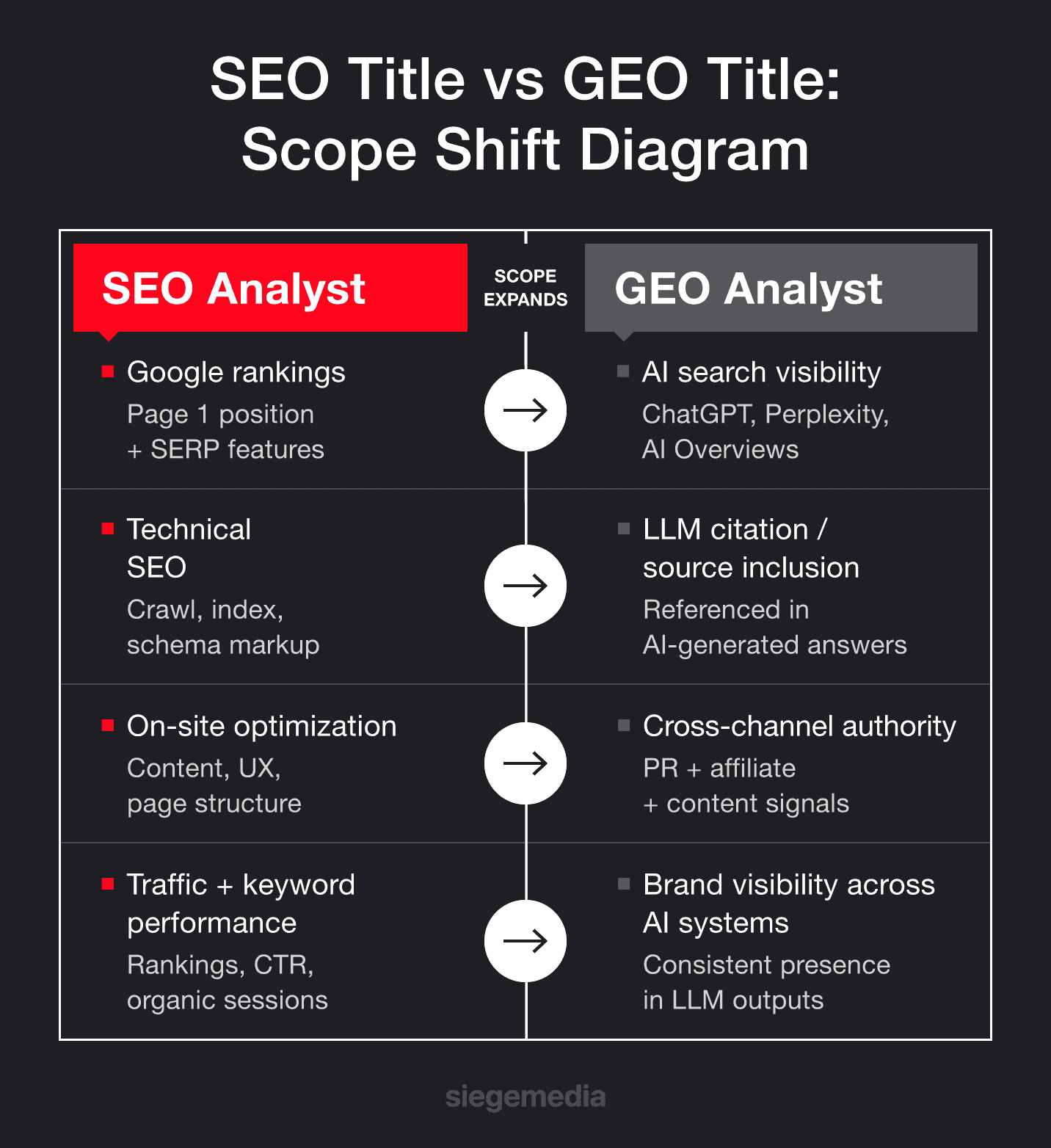
The main difference between a GEO analyst and a traditional SEO analyst is less about technical SEO and more about cross-functional execution.
Traditional SEO roles focused heavily on technical work, such as crawl audits, schema, indexing, and site performance. Those skills still matter, but many technical issues are easier to manage with modern CMSs and SEO tools.
GEO analysts spend more time aligning teams across content, PR, affiliate, and product because AI visibility depends on signals from all of those channels together.
Say a SaaS company wants visibility for “best project management software for remote teams.”
A traditional SEO analyst optimizes the page itself: title tags, internal links, schema, site speed, and content gaps against page-one competitors.
A GEO analyst spends most of their time off-page, coordinating signals. They’d push PR to land mentions in roundups (Zapier, G2), align affiliate teams on consistent product descriptions across review sites, and brief content on comparison tables LLMs can easily cite.
The SEO analyst asks, “Is our page optimized?” The GEO analyst asks, “Is our brand showing up everywhere AI pulls from?”
The T-Shaped Marketer
As CMS platforms and SEO tools improve, GEO is becoming less about fixing technical issues and more about having a broad understanding of multiple disciplines.
That’s why GEO favors “T-shaped marketers” — people with working knowledge across areas like content strategy, digital PR, affiliate marketing, and technical SEO, plus deeper expertise in one specific area.
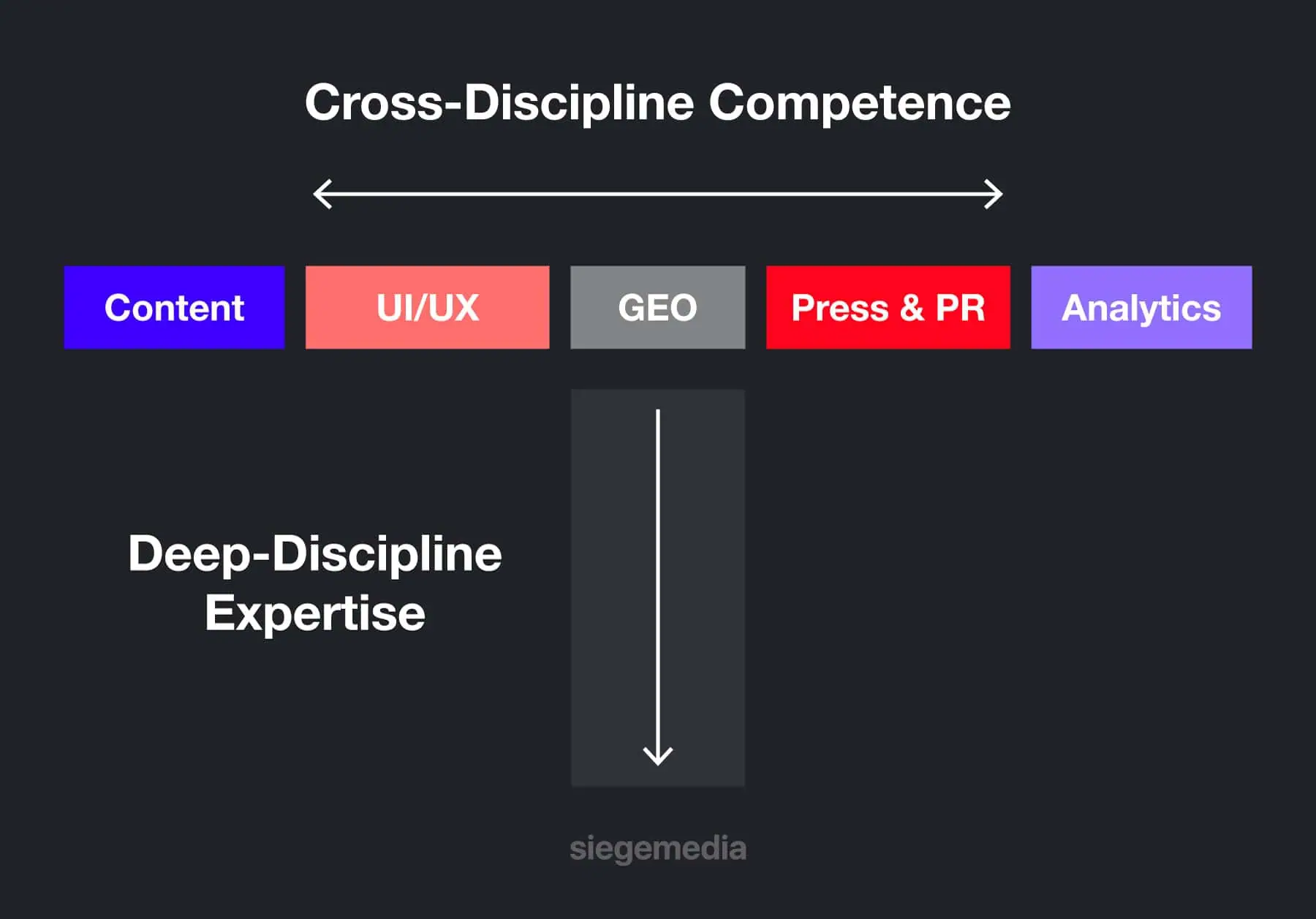
Where that deeper expertise matters most depends on the business:
- Large e-commerce brands: Technical SEO is often most important due to site scale, product pages, and structured data requirements.
- SaaS companies: Content strategy matters most because topical authority and citations drive visibility.
- B2B companies: Communication and stakeholder management are often the biggest differentiators since GEO requires alignment across teams.
AI tools are also making this easier because marketers can now use AI workflows to strengthen weaker skill areas without needing to become experts in everything.
The New Roles Emerging From GEO
The traditional SEO role was never built with generative AI in mind — but the overlap between the two disciplines is now impossible to ignore. As more content discovery shifts to LLMs, AI citations, and generative search surfaces, the skills required to drive organic visibility have expanded well beyond what a conventional SEO title covers.
That’s creating a new category of roles — some evolved from existing functions, some entirely new — that reflect how the job has actually changed. Three are worth understanding in depth.
Content Engineer
One new role GEO is creating is the Content Engineer, a term popularized by AirOps.
A content engineer builds the systems and workflows behind AI-powered content production. Instead of creating every asset manually, they help teams scale content creation while maintaining accuracy, consistency, and on-brand integrity.
The role usually sits somewhere between content marketing and technical operations. In many cases, it’s a content marketer who is comfortable experimenting with AI tools, automations, and lightweight coding workflows.
As AI tools become more advanced, more marketers are building workflows for research, content briefs, updates, optimization, and distribution, without a traditional engineering background.
Director of Automation
The Director of Automation is Siege’s preferred evolution of the Content Engineer concept and the distinction matters.
Where the Content Engineer focuses is focused on content systems specifically, the Director of Automation asks a bigger question across the entire organic growth workflow:
- What can’t be automated that we should protect?
- What can be automated that we should systematize?
That reframe opens the role well beyond content production into every repeatable process that touches SEO, GEO, digital PR, and affiliate. Siege has this role internally — a reflection of the belief that automation strategy deserves dedicated ownership at the right scale, not as a content function but as an organic infrastructure function.
“Modern teams need four things: concise documentation of their processes, a single source of truth for every task, a way to update docs with new information, and a structure that lets agents discover and execute work as a genuine extension of the team. This isn’t just operational hygiene — the content your team produces today will train the next generation of frontier models.”
Drew Page
Director, Automation at Siege Media
Director of Organic Acquisition
This will likely become one of the most important roles on modern organic marketing teams.
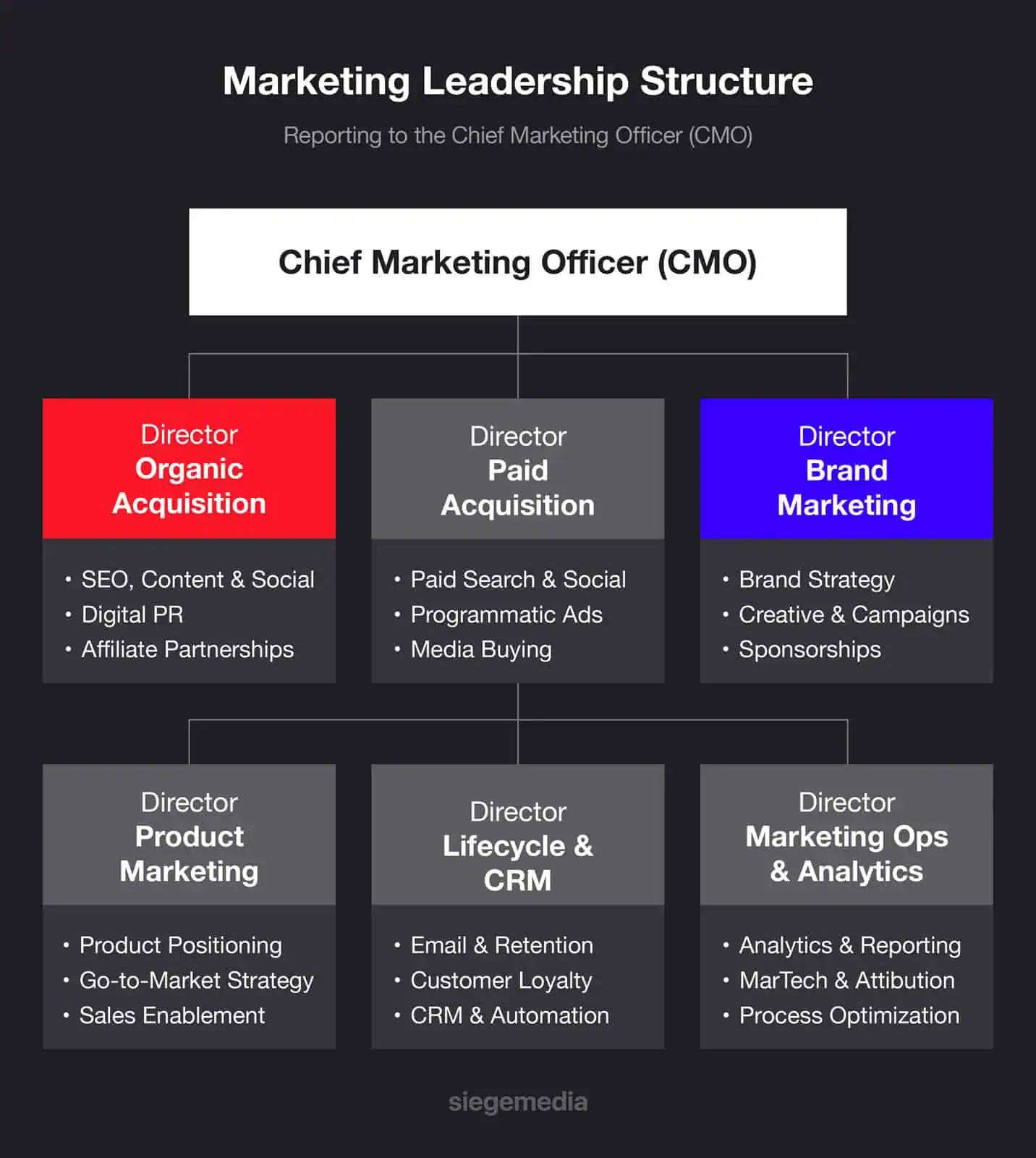
The main idea is simple: SEO, GEO, content marketing, digital PR, and affiliate marketing can no longer operate separately. AI search systems pull signals from all of them at once, so siloed teams are far less effective.
The Director of Organic Acquisition oversees all these functions under a single strategy and leader. Their job is to ensure every channel aligns with the same visibility and growth goals.
This person is responsible for:
- Understanding how GEO impacts the business overall
- Identifying opportunities across channels
- Allocating budget and resources across SEO, content, PR, and affiliate efforts
- Making sure all teams support the same organic growth strategy
Affiliate marketing is becoming especially important in GEO because AI-generated answers frequently cite high-authority review and comparison sites. That means strong affiliate partnerships can directly improve brand visibility in AI search experiences.
“The skillset of an organic acquisition director will be hard, if not impossible, to find in the first years of GEO. But as this new industry matures, talented SEOs who have touched affiliate or talented affiliates who have touched SEO or content will become more prolific.
Within organizations where SEO and now GEO have driven a significant portion of company sales, an organizational design with this structure likely makes sense. Where paid is a stronger emphasis point, it may make sense to keep affiliate partnerships under a Director, Paid Acquisition.”
Ross Hudgens
Founder, Siege Media
Where Does GEO Fit in Your Annual Budget?
Here’s a question most marketing leaders haven’t asked yet: Does GEO get its own budget line?
The short answer is no. And that’s actually the right call.
Given the significant overlap with SEO, carving out a standalone GEO budget creates more confusion than clarity. But that doesn’t mean GEO gets ignored at budget time.
GEO should have representation within every department it touches:
- Content marketing: Investing in content structures and formats that AI systems can reliably extract and cite.
- Product marketing: Optimizing product pages and entity definitions for generative visibility.
- Digital and performance PR: Earning placements on the high-authority sources AI systems reference most.
- Affiliate and partnerships: Prioritizing listings on comparison and review sites that consistently appear in AI-generated responses.
Your Org Chart Is Your GEO Strategy
GEO rewards the teams that organize around it, and it’s indifferent to the ones that don’t. The title you carry, the role you create, and the reporting structure you build aren’t mere administrative details.
They determine whether your brand has the cross-functional alignment to show up in AI-generated answers or whether it keeps optimizing in silos while competitors earn the citations.
The proof is already there. Siege Media partnered with Mentimeter on a cross-functional GEO strategy. We paired bottom-funnel content with LLM optimization and the results were 124,000 ChatGPT sessions and 3,400 conversions in a single month. That’s what alignment looks like in practice.
The framework is here. If you’re ready to put it into practice, explore Siege Media’s GEO services and start building it into your organic strategy.