Increasing website traffic by 250,000+ monthly visits — even 2,500 monthly visits at the start — can feel impossible, especially in a world where AI overviews and LLMs are transforming how people discover content and how businesses need to show up.
It’s not.
Website traffic growth is at the top of any business’s KPIs because we know that traffic growth leads to:
- Brand recognition
- Revenue growth
- Repeat customers… and more.
With this in mind, we developed tried-and-true methods for long-term, sustainable growth in the thousands (and hundred-thousands).
Web traffic strategies have evolved, largely thanks to recent Google algorithm updates emphasizing quality, expertise, and user engagement. Now, websites optimized for exceptional user experience — especially fast, mobile-friendly pages with content optimized for AI search will dominate rankings.
Winning in 2026 means ranking in traditional search AND getting cited by AI engines like ChatGPT, Perplexity, Gemini, and Google AI Overviews. At Siege Media, we’ve built our strategy to do both.
Even as behavior evolves and traffic growth becomes more difficult to achieve, 62.8% of content marketers report year-over-year increases — clear evidence that sustainable growth is achievable with the right approach.
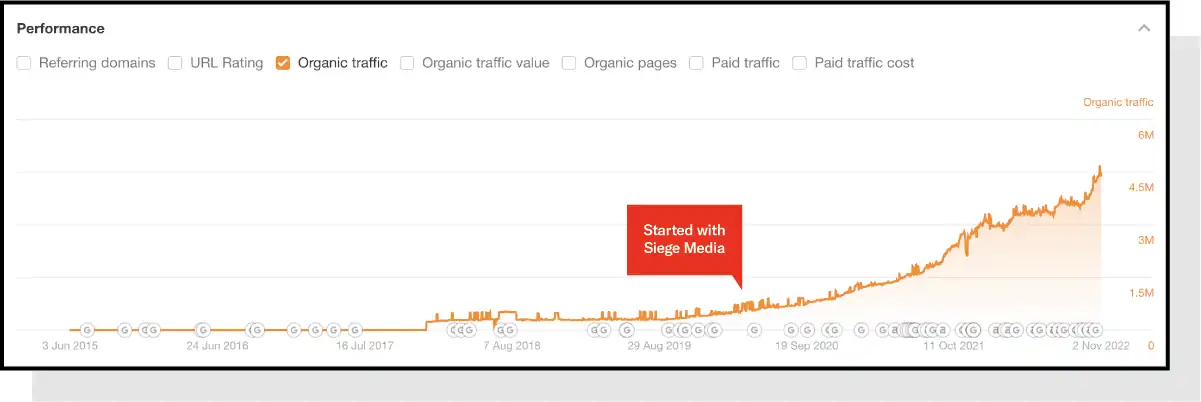
At Siege Media, we’ve even helped our clients grow their website traffic by 500,000 visitors a month. We’ve accomplished this not once, not twice, but five times in the past five years — and even more during 13+ years in business.
Sustainable website traffic in the millions is possible with a repeatable, achievable strategy.
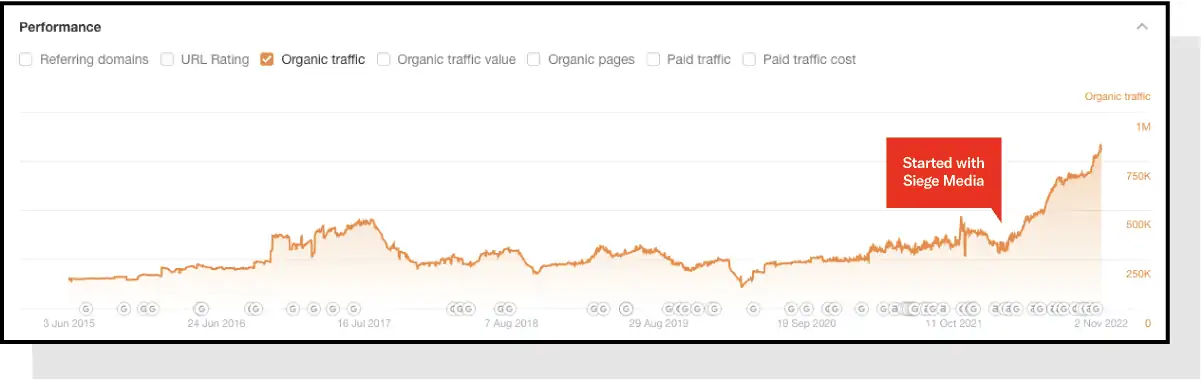
This post will discuss Siege’s reliable traffic-building methods to help you gain more visits to your websites.
How To Increase Website Traffic
The short answer: create expert content people want to link to, optimize it for both Google and AI search engines, and repeat the process consistently.
By repeatedly creating unique, well-researched top or middle-funnel content, promoting your work, and using SEO best practices, you can expect to see growth.
Similar to the Skyscraper Technique, we believe it’s important to find link-worthy content to write about, but our strategy doesn’t stop there — we know it takes a mix of content-worthy topics, Domain Authority, linking, and repetition to create truly irreplaceable content.
- Establish Product-Market Fit
- Perform and Use KOB Analysis
- Prepare a Project Plan
- Prioritize Organic Link Topics
- Create Great Content
- Optimize Internal Linking
- Keep Your Website Looking Fresh
- Optimize for AI Search and GEO
- Update Content Regularly
- Amplify Your Content
- Repeat, Repeat, Repeat
1. Establish Product-Market Fit
Before you even consider implementing a new website traffic strategy, you need to establish product-market fit.
Product-market fit refers to the idea that your business’s products or services are bought, used, and praised by your target audience.
If you can create a product that satisfies your audience’s wants and needs, you have already taken a giant step toward growing your traffic and business.
Once you’re seeing traction and building industry authority, your traffic will follow. Until you’ve created a product or service that satisfies product-market fit, you shouldn’t focus your efforts anywhere else.
2. Perform and Use KOB Analysis
Your KOB analysis (Keyword Opposition to Benefit Analysis) is a prioritization framework that helps you identify which content topics will deliver the highest return for the least competitive effort — so you’re not wasting time on keywords you can’t rank for yet.
In plain terms: KOB tells you which content to write first. It considers your revenue potential and ROI alongside your competitors’, so you can prioritize your most beneficial, rankable content first and work toward more difficult topics over time.
After enough time, effort, and subsequent rankings, your website traffic should grow, allowing you to focus on other aspects of your business.
How KOB Works
The math is straightforward:
KOB Score = Traffic Value ÷ Keyword Difficulty
- Traffic Value: The estimated revenue a page earns, based on CTR across all ranking positions multiplied by Google AdWords CPC. Think of it as what that traffic would cost to buy.
- Keyword Difficulty: A score from your SEO tool (Ahrefs, Semrush, or Moz all work) reflecting how competitive a topic is based on competitor backlink strength and content authority.
Once you have a raw KOB score, multiply it by a relevancy factor of 1 to 3, depending on how closely the topic relates to your product or service.
Topics tangentially related to your business score a 1, moderately relevant topics score a 2, and topics directly tied to what you sell score a 3. When you do this across 150+ topics, the highest scores rise to the top and tell you exactly where to start.
Before creating a project plan, check out our KOB analysis spreadsheet for our ready-to-use document.
3. Prepare a Project Plan
With your research in hand, it’s time to start thinking about your project plan.
While your KOB analysis is great for finding low-competition, high-benefit keywords, you still need to prioritize target topics and keywords to make sure you’re capitalizing on the content you can rank for.
Ask yourself these three things when preparing your strategy:
- What is your Domain Authority (DA)?
- What internal resources do you have?
- Are you creating top-, middle-, or bottom-funnel content?
For example, if your DA is below 70, your best bet for strong content creation is to prioritize topics or keywords with a difficulty rating below 60 or 70.
On the flip side, if your domain authority is 70+, your prioritization should consider what you can rank for without promotion.

Understanding the strengths and weaknesses of your domain will help you determine the content that best suits your business.

All in all, investing in your SEO content strategy and a team of content creators will allow you to grow and prioritize more projects, invest time and energy into revamping older posts, and create new content that is great the first time around.
4. Prioritize Organic Link Topics
Siege Media has sent over 1 million outreach emails. We started as a link-generation company, but we’ve gradually stopped manual outreach for most of our clients.
Why? Focusing on search-driven topics that emphasize a brand’s services, products, and expertise has led to a substantial increase in content performance through organic link building.
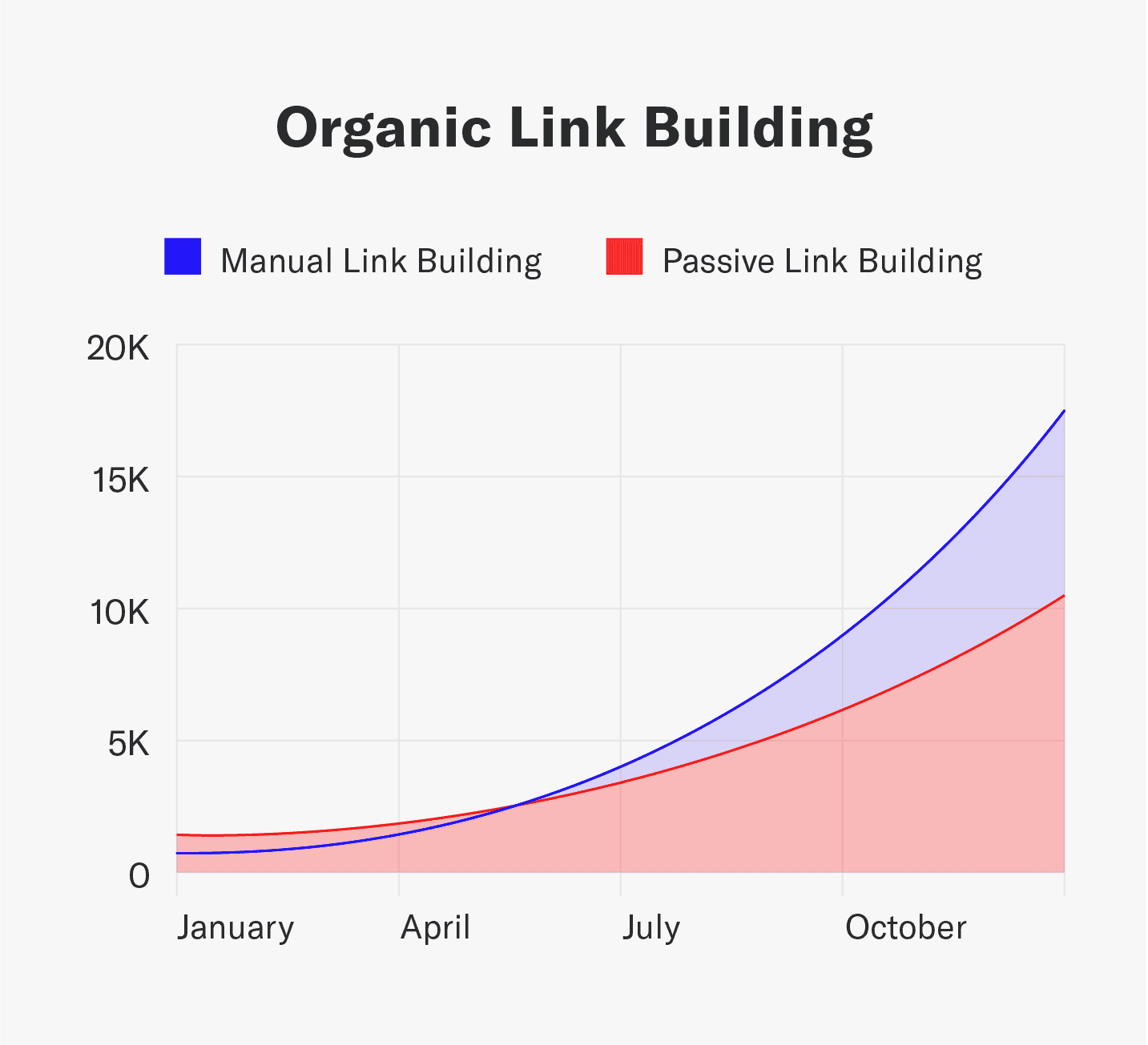
Instead of allocating double the time and resources to a post that will need manual outreach to rank, we have learned that focusing our talents on creating search-friendly content from the start can bring in hundreds of links to a single post.
Plus, Google prioritizes branded content, so our focus on shareable, promotable aspects just wasn’t cutting it on its own.
While it’s not worth completely throwing manual outreach — what we call digital PR at Siege Media — out the window, you may want to consider reevaluating how your content is gaining links.
One effective approach is doubling down on product-led content that leverages unique first-party data. Our analysis shows keyword-driven posts that incorporate proprietary data get 51% more organic traffic and 34% more referring domains than their data-absent counterparts.
Incorporating exclusive insights from your product not only differentiates your content but also naturally attracts high-quality backlinks (a true product-led digital PR win).
The content types that earn the most organic backlinks — statistics posts, original research, calculators, and trend reports — are also the content types AI engines are most likely to cite. If you want to show up in both traditional search and AI-generated answers, proprietary data content is your highest-leverage investment.
5. Create Great Content
Now comes the hard part — actually creating the content.
Great content doesn’t happen by accident. Every element — structure, depth, design, and relevance — has to earn its place on the page. The tactics below are what separate content that ranks from content that gets ignored.
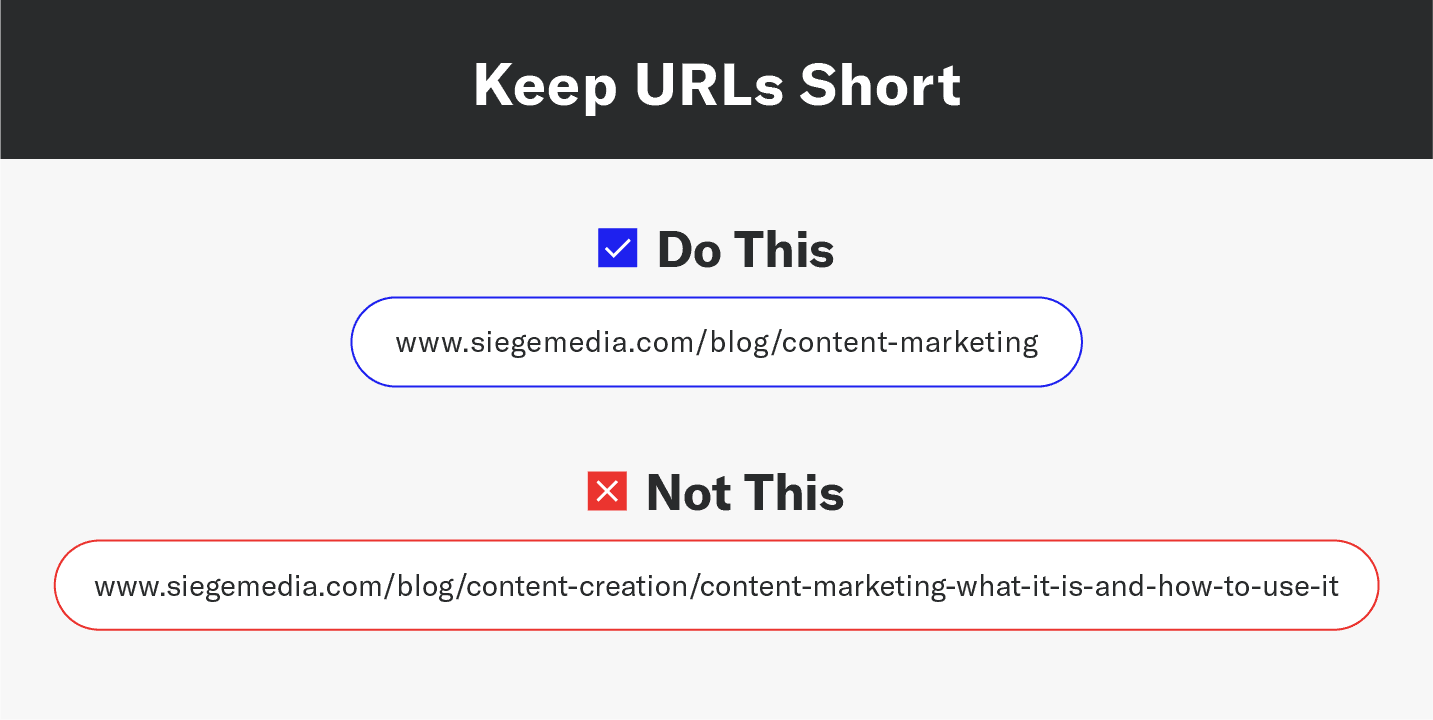
- Short URLs: Your URLs should be simple and easy to identify. Use single-word tags where possible, and keep the keyword as the URL topic.
- Intriguing titles: Make title tags short, punchy, and clickable. We aren’t looking for clickbait, but they need to be interesting.
- PPB Introductions: The best strategy for introducing your post is to use the PPB — or Proof, Preview, Benefit — structure to draw the reader into your content.
- Scannable content: Using bullet points, short sentences, and paragraphs and breaking up content with visuals can help your readers scan and understand your content.
- Larger font and smaller margins: It’s difficult for the eye to track really small fonts or really large margins. We recommend using a font size of at least 16pt and keeping your margins at 1 inch.
- Differentiated copy: Don’t be afraid to shake up your content using our V.I.N.E.S. method — or one of our other actionable SEO writing tips — include videos, images, illustrated graphics, news stories, experts, and social media research to make your content stand out from the crowd.
- Video: To identify any holes in the search intent, enter your phrase into YouTube. What topics are people discussing on YouTube that aren’t covered by articles? Can you find any new inquiries in the comments?
- Images: Examine Google’s “images” tab. Are the pictures ornamental or illustrative? Do they aid with conceptual visualization?
- News: Check out Google’s “news” tab. Are there any data studies or surveys that you might use? Is this a hot issue right now?
- Experts: Read trade blogs, subscribe to newsletters, and follow industry professionals on social media to obtain thought leadership ideas. This is most useful in the commercial or B2B sectors.
- Social: Search for your term on X (formerly Twitter) or Reddit to see what results match the user’s intent. Remember that the lifestyle or B2C sectors benefit the most from this.
- Schema Markup: Implement relevant Schema.org structured data in your posts to help them stand out with rich results. Pages enhanced with schema markup often enjoy higher click-through rates — for example, Rotten Tomatoes saw a 25% higher CTR on pages with schema vs. those without.
- Question-Based Headers: Structuring your H2s and H3s as questions improves both featured snippet capture and AI Overview extraction — because it directly mirrors how people search. For example, a header like “Content Marketing Tips” becomes “What Are the Best Content Marketing Tips for 2026?” or “Link Building Strategies” becomes “What Link Building Strategies Actually Work Today?” The more your headers match real search queries, the more surface area you create for AI engines to pull from.
- AI Assistance: Today, 90% of content marketing programs utilize AI in their workflows. If you aren’t already, it’s time to start. Use it to streamline research and content production, but keep human expertise at the center. Original data and real subject matter depth are what Google and LLMs reward most, and those aren’t things AI can replicate on its own.
While these may seem like small adjustments, consistently implementing them can improve your content and drive traffic growth.
Our infographic summarizes the best practices that can help you create content 10x better than your competitors’.
If you can create strong content and execute your strategy well, it’s possible you could outrank all your competitors.
6. Optimize Internal Linking
Optimized internal linking is important to any content strategy because it helps your visitors — and search engine crawlers — navigate your content and site.
Internal links refer to links within the body of your content that link your post to other pages on your website. There are two types of internal links:
- Inbound internal links: Links that guide readers back to your post from a different website page.
- Outbound internal links: Links that guide readers away from your post to a different website page.
Giving readers (and Google) internal resources to research a topic further helps boost organic linking assets, keeps readers on your site longer, and determines website hierarchy.
Plus, internal links are great for spreading link equity.
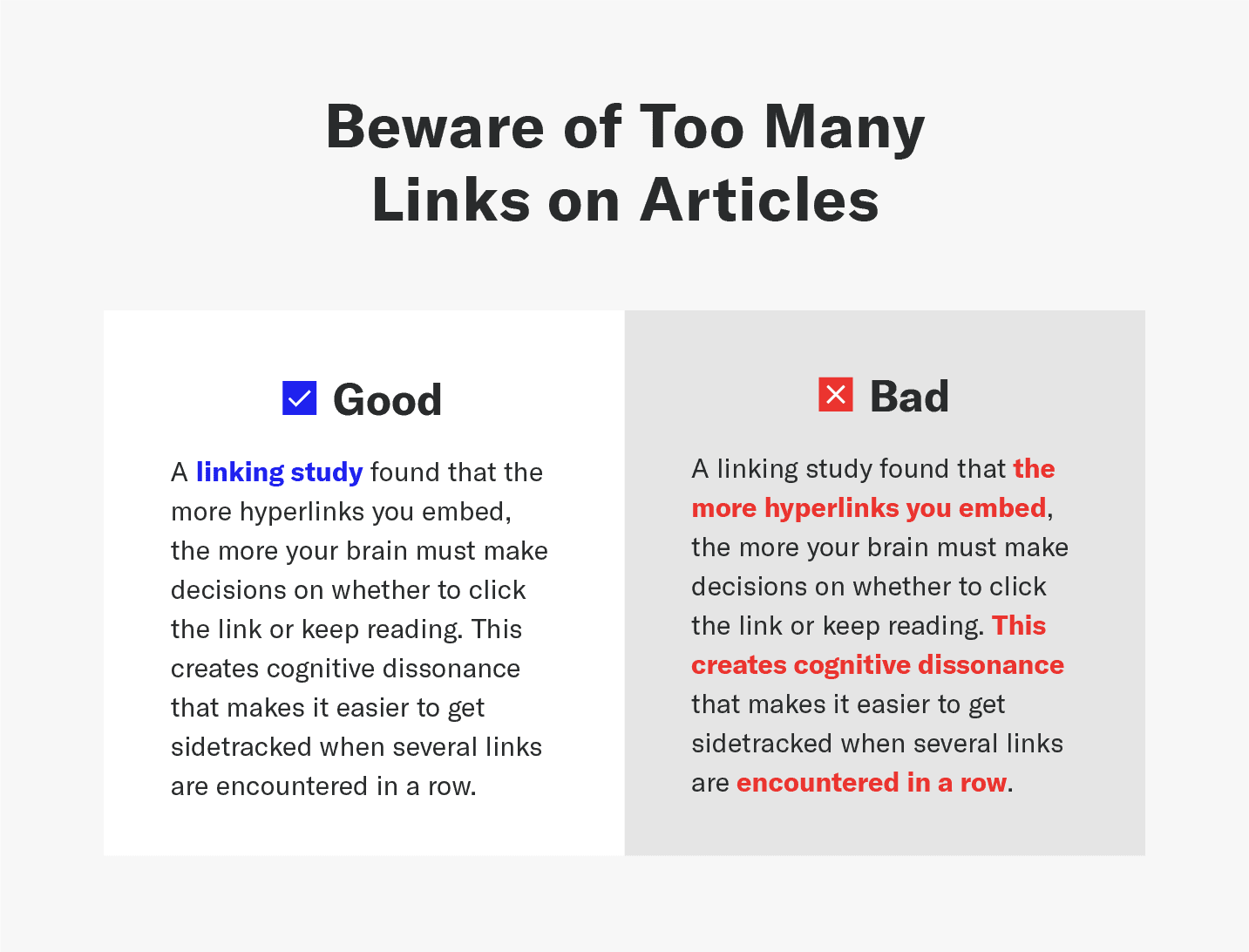
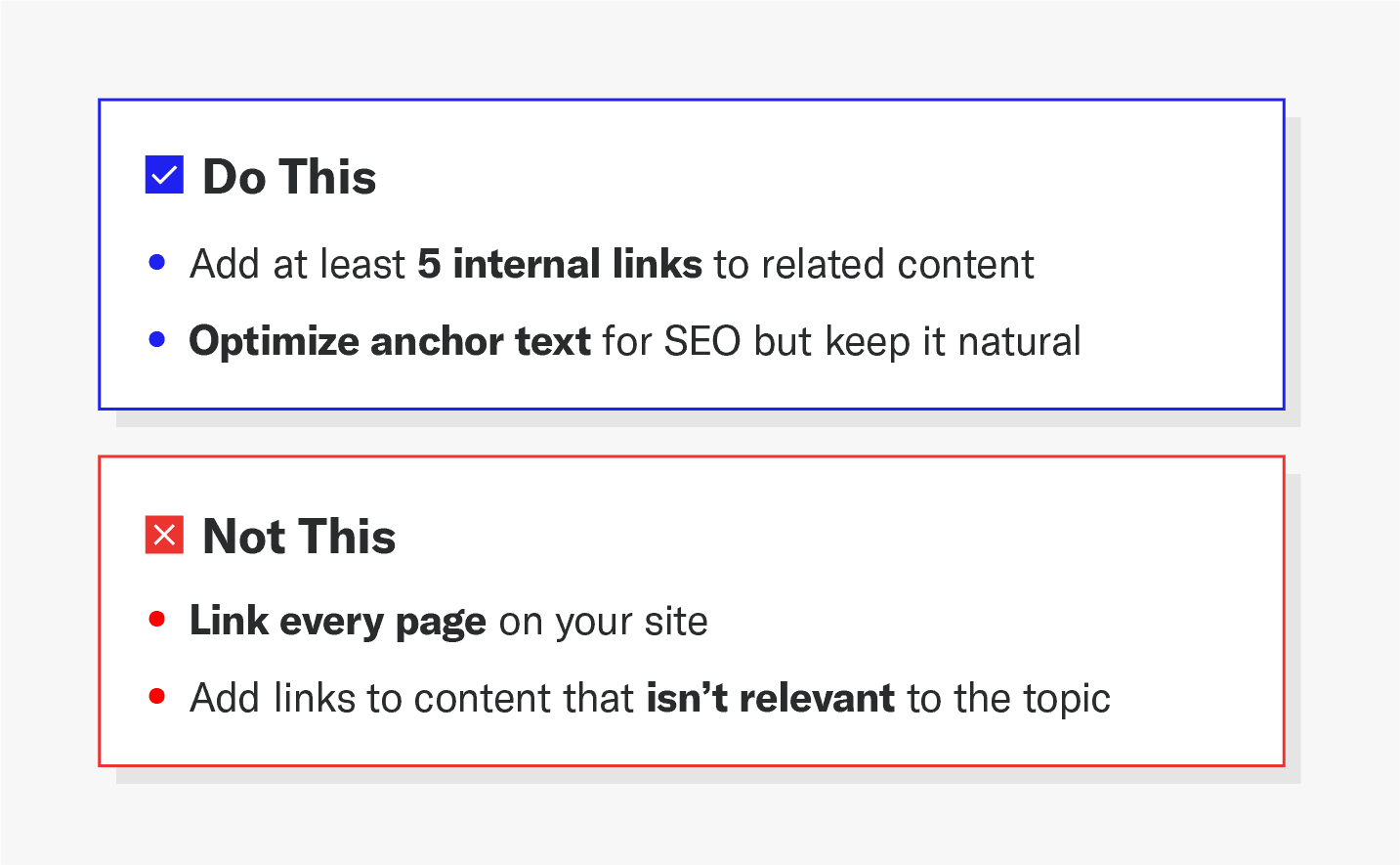
Knowing what to link and what not to link can be difficult, especially if you have plenty of content on your website. As a rule of thumb, including between five and ten links per post is a safe bet for optimized internal linking.
To further enhance internal linking, consider leveraging AI-driven tools to suggest high-value internal links based on topical relevance and user intent, significantly streamlining your optimization process. With AI-assisted linking, your site’s structure remains SEO-friendly and user-centric, ultimately driving more traffic over time.
Our best tips to optimize internal linking include:
- Keeping all content within two clicks of the homepage
- Ensuring your blog or learning center is in the navigation bar of your website
- Displaying 15+ posts on your blog homepage
- Linking sparingly and strategically
- Using clear anchor text
Internal linking can be daunting, so SEOs turn to automated solutions for assistance. At Siege Media, we’ve developed Rise, an internal linking solution that plugs directly into your WordPress installation. Forget auditing your links once a year; Rise has your back in real-time.
7. Keep Your Website Looking Fresh
Your website’s structure and overall design are key parts of your content; no matter how amazing your content is, it will need to rely on your website to stand out. No one wants to wait for a website to load or get lost among mounds of text and an endless stream of blog posts.
Google has made clear that mobile-first optimization and Core Web Vitals—metrics measuring loading, interactivity, and visual stability—are major ranking factors.
To meet these demands, keep page load time under 2.5 seconds, minimize cumulative layout shifts, and maintain interactivity and responsiveness across all devices. Tools like Google’s PageSpeed Insights and GTmetrix can help diagnose issues and prioritize fixes to significantly boost your organic traffic.
Think about it—how long do you spend on a website when you can’t find what you want? Next website, please!
Great websites are also interactive. Visitors can sign up for a newsletter, utilize an on-page calculator, or interact with graphics that adjust their mouse movements. This keeps them entertained while providing them with the resources they need.
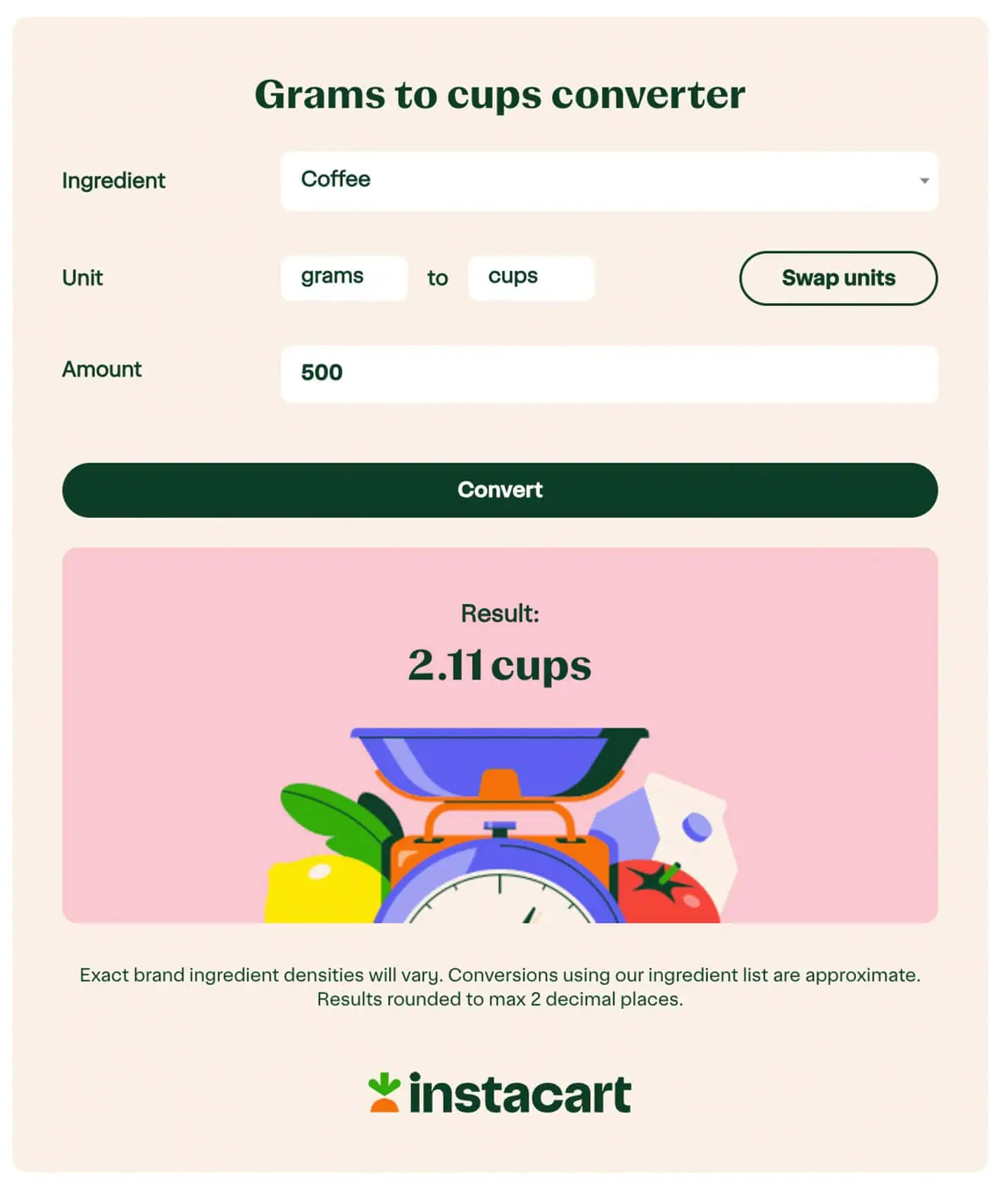
This interactive conversion calculator on Instacart’s Grams to Cups Converter page helps visitors convert ingredient units; it’s as useful as it is beautiful.
The team at Siege Media offers blog and website design services for those who need help taking their content to the next level. Whether it’s your content hub, a specific landing page, or an entire CMS refresh, we’re here to help.
8. Optimize for AI Search and GEO
Search behavior has fundamentally changed. People aren’t just Googling anymore. They’re asking ChatGPT, Perplexity, Gemini, and Claude for answers, and those AI engines are responding without ever sending users to your site. Generative Engine Optimization, or GEO, is the practice of structuring your content so it gets found, quoted, and cited inside those AI-generated answers.
AI assistants prioritize content that gets to the point. Open every major section of your post with a direct answer to the implied question before expanding into detail, ideally in the first few sentences under each subheading.
When relevant, structure your H2s and H3s as actual questions your audience is asking, since AI systems often segment content by subheadings when selecting what to cite.
GEO isn’t purely an on-page strategy. The authority signals AI systems use to decide whose content is worth citing are also built off the page — through expert coverage, reputable mentions, and a consistent presence across multiple platforms. It’s another reason the organic link building and digital PR work from Step 4 pays off well beyond traditional search.
9. Update Content Regularly
There’s no guarantee your rankings will hold, even if you’ve gained the number one spot. Fluctuations are normal, and content becomes outdated. But you can protect your progress with one simple method: regular content updates.
Maintenance and refreshes should be strategized concepts in your content marketing mix, not afterthoughts. If your posts aren’t delivering updated facts and statistics, readers will leave. A recent Siege Media study found that page-one content for popular keywords is refreshed within the last two years on average. In a competitive SERP, fresh content wins.
Who’s going to click on “Content Marketing Statistics for 2023” when your competition has “Content Marketing Statistics for 2026?”
Watch the SERPs for what we call the freshness distance or the gap between the oldest and newest timestamps on page one. Aim to stay in the top 25%.
That same principle applies to AI search. AI Overviews prioritize recently updated content, and pages untouched for 18 months or more get passed over by LLMs even when they still rank in traditional search. Siege’s freshness distance framework gives you a concrete way to keep high-priority pages active and competitive across both channels.
Use a project tracker to stay on top of updates and keep your team organized. Build a refresh cadence that works for your business and the results will compound over time.
10. Amplify Your Content
Content amplification is how you accelerate everything the organic strategy is already working toward. Once a post is live, having a content distribution plan that includes email, social, and digital PR drives better results.
More early traffic signals. More links. More citations.
Email Distribution
Send every new and freshly updated post to your email list. Early engagement signals — time on page, low bounce rate — reinforce your content’s credibility in Google’s eyes. You don’t need a massive list to make this work. A modest audience of engaged subscribers can meaningfully move the needle on how quickly a post gains traction.
Social Seeding
Share data-driven posts and original research on LinkedIn, X, and relevant Reddit communities. The goal is to get your best link-worthy content in front of the people most likely to cite it. That link velocity compounds over time, strengthening both your SERP rankings and your GEO visibility.
Digital PR and Third-Party Mentions
Positive mentions across independent, authoritative domains do more than build backlinks. It creates the multi-source corroboration that LLMs rely on when deciding which brands to cite in AI-generated answers. This is why Siege’s digital PR work connects directly to GEO — the same coverage that earns a link today shapes how AI engines perceive your authority tomorrow.
11. Repeat, Repeat, Repeat
The title of this post is ambitious and achievable. It has taken the Siege Media team 13+ years to develop and refine this process, but the strategy itself isn’t complicated. It’s the execution and the consistency of that execution that separates brands that grow from brands that plateau.
Your best bet for sustainable traffic growth is this proven sequence:
- Keyword analysis
- Content execution
- Strategized linking
- AI and GEO optimization
- Content amplification
- Content updates
- Repetition
After implementing these techniques, compare your pre-strategy ROI with your post-strategy ROI, or estimate the potential impact with our marketing ROI calculator.
Upgrading Your Process
If you find this method complex and its implementation difficult, check out our content marketing services. With more than 13 years of experience and 100 team members, we can help you through the process.
Looking for an in-depth look into our method? Consider taking our SiegeLearn course, which includes access to more than 25 content marketing videos with tips about content creation, SEO, and outreach.
Soon, you can enjoy the benefits of receiving 250,000+ website visits with our strategy and experience.