Every strong content strategy has strong keyword research behind it — at least that’s what has helped us generate over $148 million in traffic value per year for our clients.
Keyword research is the process of uncovering keywords you can target to create relevant and high-converting content for your customers, ideally for the highest value and lowest effort. Without keyword research, you risk wasting time creating irrelevant or low-performing content that drags down the entire health of your blog.
So, are you eager to start creating content but unsure where to begin?
In this how-to guide for 2025, we’ll go over exactly how to do keyword research for SEO, how to prioritize topics, and which tools you can use to help along the way.
- Define Your Keyword Research Goals
- Get To Know Your Audience
- Build a List of Keywords
- Use Keyword Frameworks
- Analyze Your Competitors
- Use Keyword Research Tools
- Use AI for Keyword Inspiration
- Prioritize Your Keywords
- Confirm Target Keywords
- Scope and Order Projects With ROI in Mind
Step 1. Define Your Keyword Research Goals
A great content strategy can help you achieve various goals, whether you’re looking to discover new customers or convert your current audience. But no single piece of content can do it all.
Every business wants to increase conversions, but if there’s no traffic to your site, good content can only do so much. Assess your goals and set realistic expectations to guide your SEO research.
Step 2. Get To Know Your Audience

While you might want to jump into a popular keyword suggestion tool immediately, this skips one of the most critical aspects of creating SEO-friendly content: audience research.
Whether you’re new to a company or an industry veteran, it’s imperative to start the keyword research process by thoroughly researching the industry you’re writing about.
Here are our go-to places to gain a deeper understanding of a new target audience:
- Reviews: Analyzing product and competitor reviews helps identify common pain points and topic clusters for your target audience. Content marketing can then position your business as the solution.
- Social media: Find where your audience lives and browse posts from thought leaders, competitors, content creators, and potential customers for news and timely content inspiration.
- Newsletters: Like social media, thought leadership newsletters within your industry can be a fruitful resource for staying informed and sparking keyword research ideas.
- Conversations with customers: No resource will ever provide personal insight like information from your existing customer base. Use surveys to open a dialogue between you and your target audience to figure out the types of information and content they’re looking for.
- Internal resources: Talk with your coworkers and team members to see what topics come up for them daily. Maybe the sales team always hears the same questions, or the customer success team gets the same tutorial request.
If your audience includes regional or multilingual markets, you can also stand out by addressing localized keyword research. You can do this by adjusting search intent and volume by region. Keep in mind that direct translations of keywords don’t always result in the same search behaviors. Cultural or linguistic differences may require optimizing metadata for each target language.
Now that you’ve stepped into your audience’s shoes, you can start brainstorming content and be well on your way to creating more effective and engaging content.
Step 3. Build a List of Keywords
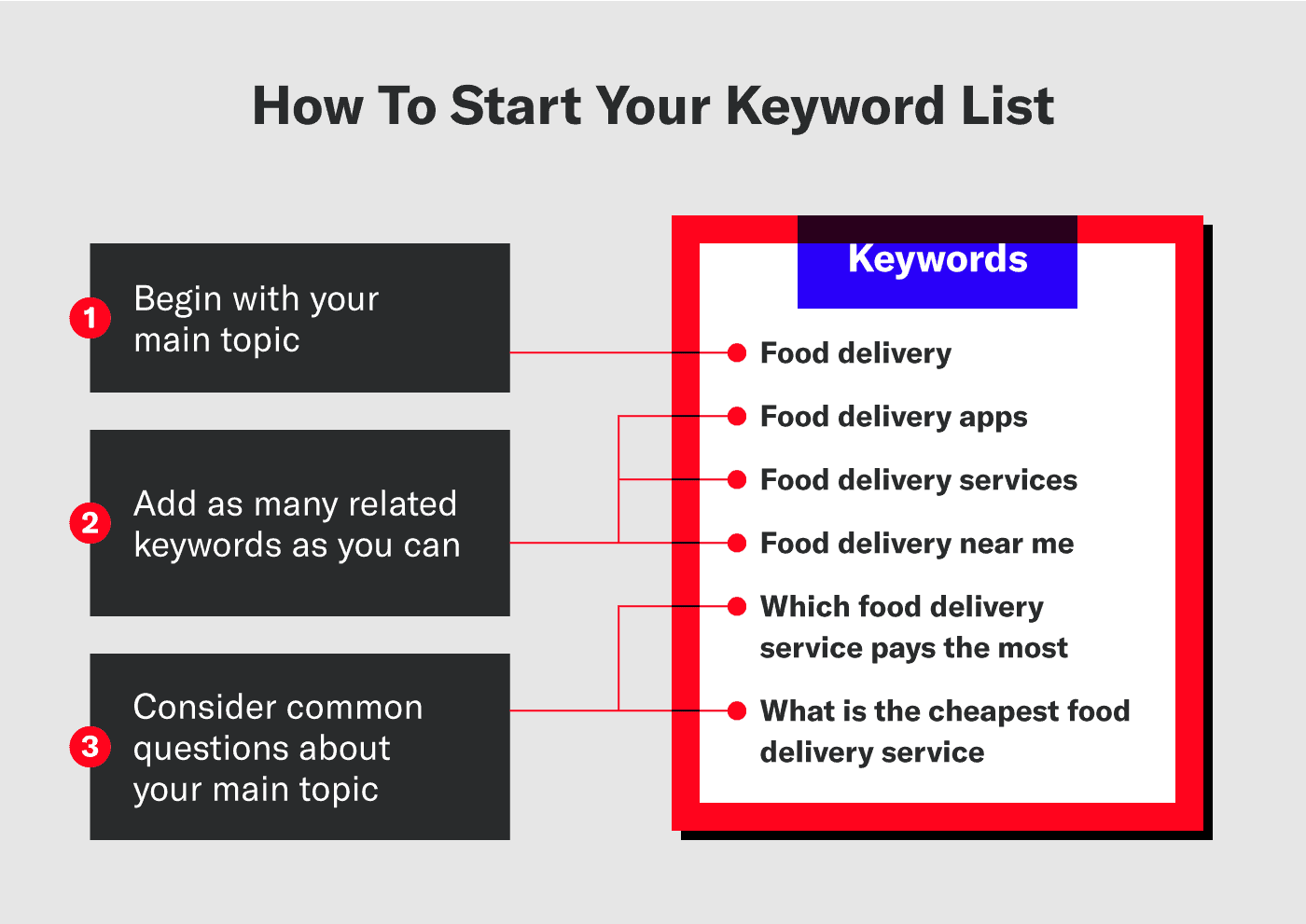
Next, open up a blank spreadsheet and build a list of keyword ideas based on your audience research. Put yourself in the minds of your buyers and write down the queries you would have.
While making your keyword list, don’t worry about adding data to back up their value. Right now, the most important thing is getting all of your ideas onto the page.
After you’ve exhausted all the keyword ideas from your audience research, take stock of your list and organize them by goal. Perhaps all your ideas are top-funnel queries, but you already have solid traffic, so you’re looking for ways to convert. You can then pivot the rest of your research to focus on what you’re missing.
This is a good time to start exploring other methods for keyword research in SEO, including the use of keyword frameworks.
Step 4. Use Keyword Frameworks
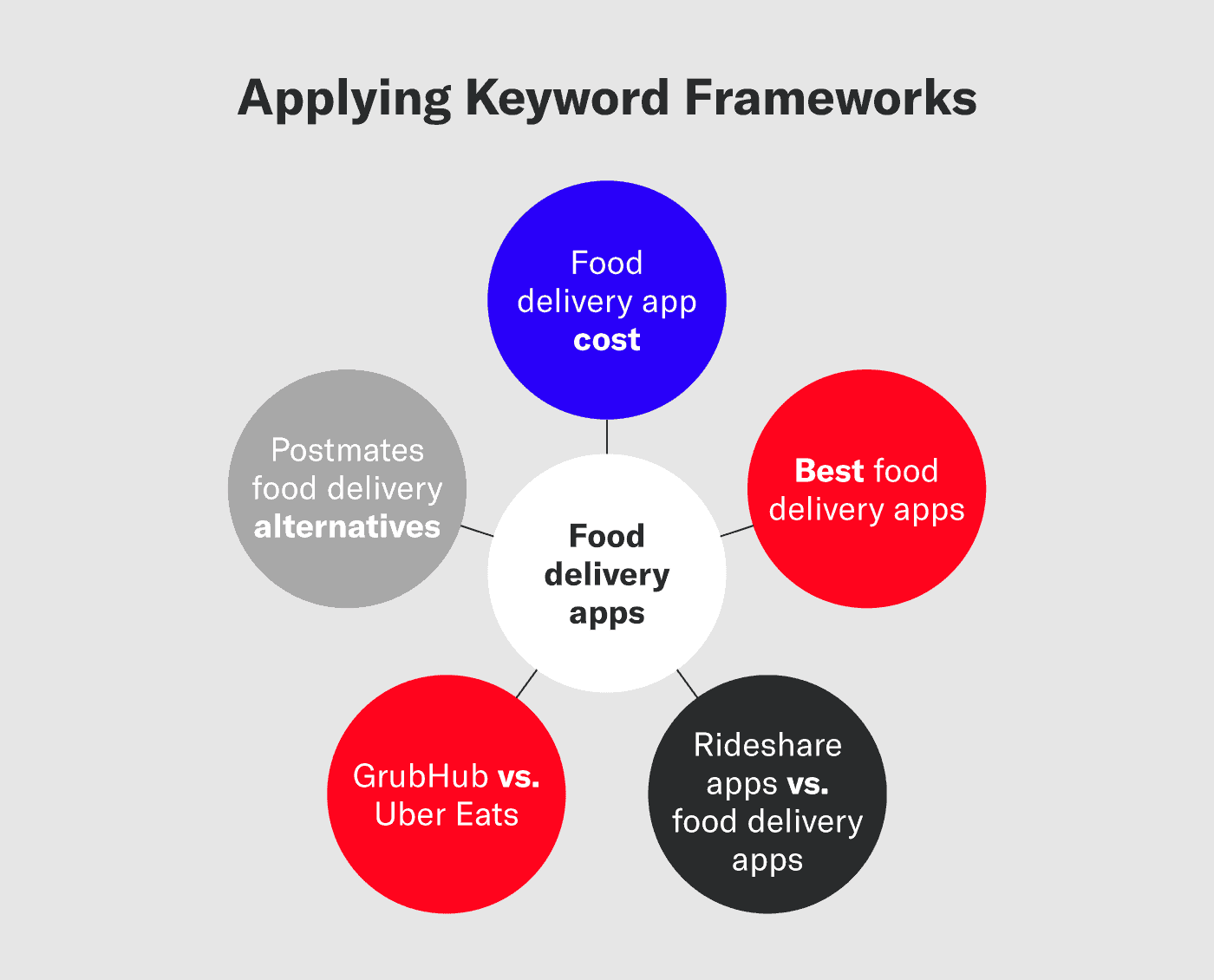
Keyword frameworks are common content types that are proven to drive conversions. Examples of keyword frameworks include:
- [PRODUCT] cost
- [PRODUCT] vs. [PRODUCT]
- [KEYWORD] template
- [INDUSTRY JARGON]
- [COMPETITOR] vs. you
- [COMPETITOR] alternatives
- What is [INDUSTRY JARGON]?
- Best [PRODUCT]
Let’s say you are brainstorming keyword ideas for a running shoe company called Flyrunner. By expanding your research with keyword frameworks, you can add new keywords to your list that target high-converting content types, including:
- Running shoes cost
- Flyrunner vs. Nike
- Adidas running shoe alternatives
- What is drop in a running shoe?
- Best running shoes
In some cases, these keyword frameworks may provide you with keywords that have little to no search volume. But they’re still worth adding to your list, as they often unveil valuable bottom-funnel content that some content marketers might struggle to find. Bottom-funnel keywords like “Flyrunner vs. Nike” can drive conversions despite a lower keyword search volume.
Now that you’ve prioritized audience research and keyword frameworks, you’ve likely already found SEO keywords that are sure to stand out from other pieces of content marketing in your industry. Let’s continue the momentum.
Creating Topic Clusters
Your posts and pages should never exist on their own islands. Google and other search engines increasingly reward topical depth and internal linking, so strategically building out topic clusters can demonstrate subject expertise and boost rankings for dozens of related keywords at once.
Start by identifying a broad pillar topic (for example, “dog grooming”) and create supporting cluster pages that cover narrower aspects (“dog dental cleaning,” “dog nail trimming,” “flea and tick treatments,” breed-specific pages like “poodle grooming,” etc.). Next, use keyword research tools to find close variants and subtopics for each cluster.
Effective topic clusters capture users at every stage of the customer journey, from initial research to decision-making. Internally link cluster content to your pillar page and between subtopics to guide readers and reinforce your authority to search engines.
Step 5. Analyze Your Competitors
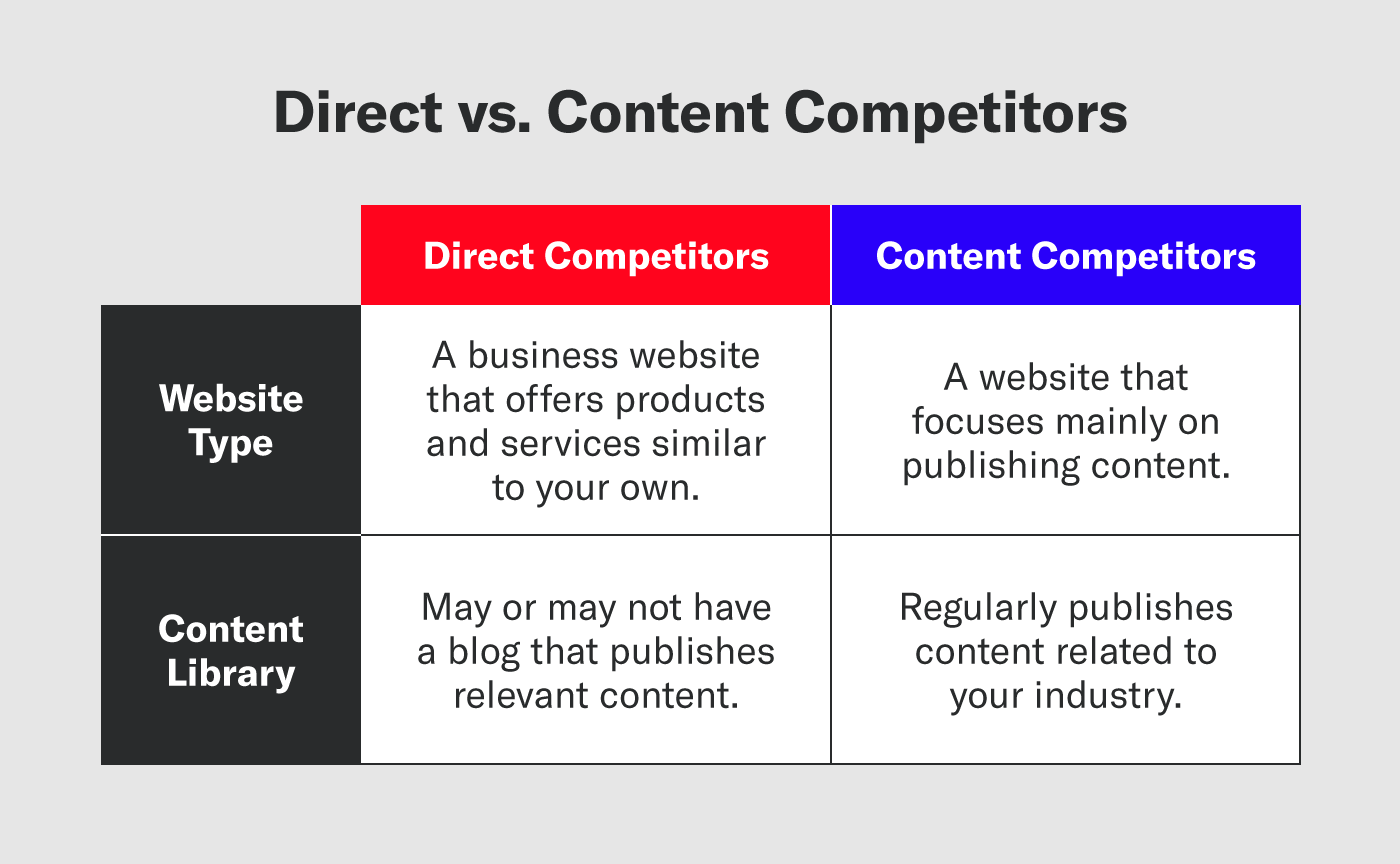
Next, take a deep dive into your competitors for keyword research analysis. Make a list of successful direct and content competitors to get started with.
Direct competitors are other companies in your industry, whereas content competitors are other sites that publish content similar to yours. For example, if you were doing SEO for a fintech company that offered online banking, SoFi would be a direct competitor, and NerdWallet would be a content competitor.
After establishing your direct and content competitors, punch their websites into a keyword research tool (we’ll dive deeper in the next step) to uncover the topics of their top-performing pages. Once you’ve figured out what topics your competitors are covering, add around 50-200 of these topics to your existing keyword list.
Step 6. Use Keyword Research Tools
While it’s important to prioritize audience research and imagine yourself in your customers’ shoes, it’s also OK to use content marketing tools to gather crucial data and spark new topic ideas. With an emphasis on AI-powered analysis, semantic suggestions, and customizable dashboards, here are our recommendations for the best keyword research tools for SEO in 2025 and beyond.
| Tools | Cost | Top Features |
|---|---|---|
| Ahrefs |
|
|
| Moz |
|
|
| Semrush |
|
|
| AnswerThePublic |
|
|
| Exploding Topics |
|
|
| Google Trends |
|
|
| Rise |
|
|
| Surfer SEO |
|
|
| Clearscope |
|
|
| Frase |
|
|
To get the most out of whichever platform you choose, focus on advanced filters, semantic keyword suggestions, and competitor benchmarking. These will help you gain a complete view of your keyword landscape.
Step 7. Use AI for Keyword Inspiration
Although AI tools like Gemini and ChatGPT can’t completely replace more comprehensive keyword research tools like the ones we featured above, they can certainly help you find keyword ideas.
Keep in mind that neither Gemini nor ChatGPT will give you specific metrics like search volume or other traffic data for keywords.
That said, they can help streamline the ideation process — you might just have to sift through some lackluster ideas and back them up using an actual keyword research tool.
Through our tested AI prompt library, we’ve found the key is to provide as much context as possible to get the most out of AI tools. Instead of saying, “Give me a list of terms related to [KEYWORD],” provide more context like:
“I’m writing blog posts about [TOPIC] for [WEBSITE], targeting [SPECIFIC TARGET AUDIENCE]. I want to find relevant long-tail keywords related to the term [KEYWORD]. Please suggest 20 long-tail keyword ideas that address specific topics related to this term that are relevant to [AUDIENCE].”
Here’s a look at this prompt in action using Gemini:

And here’s the same prompt using ChatGPT:

If you’re not getting the ideas you want, there’s a good chance your prompt isn’t specific enough. Add some clarifying factors until you have a usable output.
Step 8. Prioritize Your Keywords

With a solid list of keywords, you can begin using search data to help prioritize which keywords are best for your business.
A great place to start is with a KOB (Keyword Opposition to Benefit) Analysis. Below, see how we’ve evolved this process for 2025.
A KOB analysis considers your revenue potential and ROI in combination with your competition’s. This can help you prioritize your most beneficial and rankable content first, which can help propel you toward more difficult topics in the future.

To calculate a KOB score, follow this equation:
- (Total Traffic Value of the Top-Ranking URL / Keyword Difficulty) x Relevancy Score
Let’s say you target the keyword “best food delivery apps.” The process would look like:
- Grab keyword data: Use your favorite SEO tool to find the keyword difficulty, search volume, and traffic value for the keyword. Also, note the top-ranking URL. For this example, our metrics are:
- Keyword difficulty: 62
- Search volume: 1,000
- Total traffic value: $43,200
- Determine keyword relevancy: Rate the relevance of this content to your site on a scale of 1 to 3, where 1 is low and 3 is high.
- Calculate the KOB Score: Here’s how you’d calculate this example keyword with a relevancy of 3 to get 2,090 as its KOB score.
- ($43,200 / 62) x 3 = 2,090
Out of context, this score means nothing. However, in combination with additional research and a substantial list of keywords, a KOB score can help you prioritize which keywords to target first.

To help you hit the ground running on your keyword research journey, download our ready-to-use KOB analysis spreadsheet.

Step 9. Confirm Target Keywords
With your basic keyword research in hand, you may now start thinking about the specifics of your project plan.
A KOB analysis is great for finding low-competition, high-benefit keywords, but you should still quickly look at the context for each keyword to ensure you’ve found the right opportunity.
Ask yourself these three things when preparing your strategy:
- What is your domain rating (DR)?
- What internal resources do you have?
- Are you creating top-, middle-, or bottom-funnel content?
- Does the search intent behind the keyword match your content goals?
- Do you have authority on this topic?
For example, if your website has a DA score of 50, you may want to prioritize keywords with a difficulty rating lower than 60 or 70. Brand-new businesses may want to push this even lower — instead, look at topics with a difficulty rating of 40 or 30 — to improve their chances of ranking.
You’re more likely to see success using topics with lower keyword difficulty to build authority rather than investing all your resources into targeting high-difficulty terms. By understanding your domain’s strengths and weaknesses, you can better determine the best content for your business.
Step 10. Scope and Order Projects With ROI in Mind
After solidifying your project plan, refer back to your KOB analysis to adjust the scope — the time you’ll need to create each piece of content effectively. For example, interactive content such as a calculator will likely take longer than a simple SEO post.
Keyword Research for Voice Search and Semantic Search
According to recent projections, voice is expected to be a $45 billion channel by 2028. 65% of 25-49-year-olds speak out loud to their voice-enabled devices at least once a day, and 56% of smartphone users turn to voice search to find out more about businesses and brands.
This means voice search could soon make up a large percentage of all searches. This shift could fundamentally transform how users discover and engage with online content.
Voice queries are longer, more conversational, and usually framed as questions (like “what are the best running shoes for flat feet?” or “how long do pigeons live?”).
To adapt accordingly, incorporate natural question-style keywords throughout your copy and headings. Leverage schema markup so voice assistants can easily find and showcase your answers.
Semantic search also plays a huge role. Google and other engines now analyze the context and relationships between words rather than just matching isolated keywords.
This means your keyword research should focus on clusters of meaning by covering core concepts, supporting details, and related questions in every post and linking them together.
Remember: Keyword Research Is an Ongoing Process
Keyword research isn’t a one-and-done endeavor. It’s an ongoing process that requires regular attention and adjustment as search trends, algorithms, and competitors evolve.
Rankings will fluctuate, and new topics will emerge. That’s why successful companies consistently monitor their keyword lists and content performance, explore fresh opportunities, and revise their content strategies.
Making a habit of conducting quality keyword research helps you spot new areas for improvement, so don’t be afraid to go back to the drawing board.
Plus, AI Overviews now appear in the majority of search results for problem-solving queries, and these searches sometimes result in a “zero-click” event. This highlights the importance of optimizing your content for featured snippets and AI-generated answers.
Similarly, clicks matter more than impressions, especially with those AI Overviews trying to beat you to the punch. Track click-through rate (CTR), not just search volume, from search traffic to gauge actual performance.
Monitor AI Overviews and how your content is referenced, especially for informational queries.
Keyword Research Glossary
A more in-depth understanding of keyword terms and their purposes will help you maximize your content opportunities. Below are some must-know definitions.
Top Keyword
The top keyword is the most relevant keyword with the highest search volume. By targeting the top keyword, you can maximize your overall topic opportunity.
Search Volume
Search volume is the average number of times a keyword is searched per month. (Note: Don’t automatically dismiss zero-volume keywords, as they can still convert well if and when they match user needs.)
Keyword Difficulty
Keyword difficulty is a metric used by SEO tools to gauge the difficulty of ranking for a keyword. Since the number can vary across different keyword research tools, it’s best to use just one tool for consistency.
Long-Tail Keywords
Long-tail keywords are lengthier keyword phrases related to your top keyword. For example, a long-tail keyword related to “SEO tools” would be “what are SEO tools.” According to a study by Backlinko a whopping 91.8% of all search queries are long-tail keywords.
Search Intent
Search intent is the reason for an online search. Depending on the keyword, the SERP may show results for different types of search intent, including:
- Informational intent: The user is searching to discover information.
- Navigational intent: The user is looking for a specific search result.
- Transactional intent: The user is looking to buy something.
- Commercial investigation: The user is in the market for something specific but wants to compare options.
The type of search intent can help you determine whether or not the keyword you’ve selected is a good fit for your business.
Top-Ranking URL Visual
The top-ranking URL is the post at the top of the SERP most similar to your site. For some topics, the first URL may be a sales page or a site like Wikipedia that is far different from your own. Because of this, you’ll want to disregard those sites and focus on the highest-ranking page similar to your website.
Total Organic Traffic
Once you’ve determined the top-ranking URL for your keyword, you can use an SEO keyword research tool to find the total organic traffic, which is the page’s estimated monthly organic search traffic.
Organic Link Score
This is a keyword difficulty metric that’s only used by Ahrefs. It’s based on the number of links to the top 10 ranking posts for a keyword. The higher the score, the more linking potential there is. You can use this metric to prioritize topics that are likely to generate a high volume of links.
Total Traffic Value
Also pulled from the top-ranking URL, total traffic value is the estimated dollar value of a URL’s monthly organic search traffic.
Links To Top Result
The links to the top result are the number of unique domains linking to the top-ranking URL and can help indicate a topic’s passive link building potential — and, in turn, your passive link building potential. Because this metric only counts the number of referring domains, it will not count multiple links from the same site.
Relevancy Score
A relevancy score is a 1-3 ranking scale used to indicate how relevant the keyword is to your business. You’ll be the one to decide what it is based on this guide:
- You can only mention your product or service sparingly.
- You can talk about your product or service some of the time.
- You can talk about your product or service throughout the entire blog post.
KOB Score
The Keyword Opposition to Benefit (KOB) score is determined by the KOB analysis. By calculating the KOB score of each keyword, you can quickly determine which topics you should prioritize first when building out your content strategy.
Scope
The final metric you’ll want to record is the scope per asset for each keyword. This is the number of hours that you’ll have to dedicate to create a piece of content for the selected keyword. Include everything from the outlining phase to uploading time to ensure you can properly plan your content.
Expert Content Strategy Yields Expert Results
In the SEO world, you can always learn new tricks. If your keyword research skills could use some help, our team of industry experts is in your corner. Our content marketing services can help you create content that drives conversions and reaches your audience organically.
Frequently Asked Questions
Have more questions about how to do keyword research? We’ve got the answers.
What Is Keyword Research?
Keyword research is the process of discovering content opportunities based on the keywords people use on search engines.
What Is the Purpose of Keyword Research?
Keyword research helps determine the words and phrases people use in search engines. With this information, you can create valuable content that appears in relevant search results, attracts the right audience, and increases your website’s overall visibility.
These days, visibility extends beyond traditional search engines to AI-powered search tools and large language models (LLMs) like ChatGPT, Google’s AI Overviews, and other conversational platforms.
Effective keyword research enables your content to align with natural language queries and question-based prompts that AI systems will prioritize when generating instant, zero-click answers. Optimizing for these AI-driven search channels helps your site appear as a trusted source within AI responses, which can significantly increase brand exposure and drive qualified organic traffic.
Are There Free Keyword Research Tools?
Yes, there are free keyword search tools. Often limited in features compared to their paid alternatives, keyword suggestion tools like Google Keyword Planner, Moz Keyword Explorer, and Keyword Surfer are free to use.
Are SEO and Keyword Research the Same?
While SEO research and keyword research are different, keyword research is a crucial part of SEO and is used to create content that will rank on search engines.
Should You Conduct Keyword Research for Paid Campaigns?
Yes. Whether for organic search or paid campaigns, keyword research is an essential method you can use to create engaging and relevant content for your audience.
How Do You Come Up With Research Keywords?
There are a variety of ways you can brainstorm research keywords, such as through audience research, using keyword tools, and using AI for inspiration.